Written by: Matthew Timmins, Founder and Managing Director, Leva Sleep
Key Takeaways on Adjustable Beds and Snoring
- Snoring disrupts both partners’ sleep and can strain relationships, which often pushes couples toward separate bedrooms.
- Clinical studies show that elevating the upper body at 12–20 degrees can reduce snoring and mild sleep apnea symptoms by keeping airways open, though results vary by sleep position and severity.
- Adjustable beds work best for back sleepers with positional snoring, while side sleepers gain less snoring relief but still benefit from pressure reduction and partner independence.
- Common complaints like motor noise, discomfort, and weak elevation usually come from basic models, not from premium split systems with quiet motors and mattresses built for articulation.
- Transform your sleep with Leva Sleep by exploring adjustable base options designed for couples.
How Reddit Experiences Compare to Clinical Evidence
Reddit threads on adjustable beds and snoring usually split into two groups. Some users describe dramatic improvement, while others say the bed changed nothing or created new problems like discomfort and motor noise. Both groups share useful experiences, but anecdotal posts cannot control for snoring severity, sleep position, or elevation angle. Clinical research shows that these variables strongly influence results.
The clinical picture is more precise. Studies on regular snorers have found that upper-body tilt can reduce or stop snoring at specific inclines. Separate in-home studies on self-reported snorers show that sleeping at an incline can reduce snoring, decrease nighttime awakenings, and increase time spent in deep sleep. Further research reports that head and upper-body elevation can reduce upper airway collapse and improve sleep apnea symptoms.
These consistent findings across multiple studies point to a single underlying cause. The physiological mechanism is straightforward. Raising the upper body counteracts gravity pulling the tongue and soft palate backward, keeping the airway open and reducing snoring and mild sleep apnea symptoms. Reddit users who see no improvement often use too little elevation, sleep mainly on their side, or have moderate-to-severe obstructive sleep apnea that needs clinical treatment rather than positional changes alone.
Side Sleepers, Back Sleepers, and Snoring Relief
Side sleeping is the most effective natural position for keeping airways open, because gravity pulls the tongue and soft palate toward the cheek instead of the throat. This position maintains a wider airway and reduces tissue vibration compared to sleeping on the back. For consistent side sleepers, head elevation on an adjustable base adds only a modest extra benefit, because lateral positioning already supports airway openness.
Research suggests that upper-body incline can reduce snoring for back sleepers, although the improvement is smaller than the benefit of switching to side sleeping. Adjustable bed elevation therefore helps most when people sleep on their back or have positional obstructive sleep apnea. Many snorers fall into this positional category, with breathing events that worsen on the back compared to other positions. For them, elevation becomes a meaningful intervention. For dedicated side sleepers, the base’s main value comes from pressure relief, comfort customization, and partner independence rather than snoring reduction alone.
How Doctors View Elevation for Mild Sleep Apnea
Physicians tend to view head-of-bed elevation as a cautiously positive option for mild cases. Studies show that elevation can reduce the apnea-hypopnea index in patients with mild to moderate obstructive sleep apnea while increasing minimum oxygen saturation and preserving sleep quality. Follow-up research supports these findings and notes that benefits often appear strongest for positional obstructive sleep apnea and back sleepers.
Clinicians also draw clear boundaries. Elevation does not replace CPAP for moderate-to-severe apnea. Position changes alone will not fix obstructive sleep apnea, and people who experience gasping, witnessed apneas, or severe daytime sleepiness should seek clinical evaluation. For mild snoring and mild positional apnea, elevation offers a low-risk, non-invasive first step that many physicians now recommend alongside lifestyle changes.
Downsides of Adjustable Beds for Snoring
Reddit users who feel disappointed with adjustable beds for snoring usually describe a familiar set of issues. Understanding these limitations helps couples set realistic expectations before they invest. The most common complaints highlight where entry-level systems fall short.
- Insufficient or inconsistent angle: Many users set the head elevation too low or forget to activate it nightly, which removes the clinical benefit that depends on a specific incline maintained throughout the night.
- Motor noise: Basic adjustable bases use motors that create noticeable grinding or whirring sounds during movement, which can wake a light-sleeping partner and undermine the goal of quieter nights.
- Discomfort after extended use: Some users develop discomfort after several weeks at elevation, especially in the lower back, when the base lacks lumbar support or the mattress is not designed to flex.
- Incompatible bedding: Standard fitted sheets often pull loose when the head section rises, which creates bunching and an uneven surface that disrupts sleep on its own.
- Cost without clear return: Entry-level bases without anti-snore presets, app control, or split configurations may not solve enough problems to justify the price for couples with complex or differing needs.
Wedge Pillow vs. Adjustable Base: Where to Start
HelpGuide.org recommends elevating the head about four inches with an anti-snore pillow to ease breathing and encourage the tongue and jaw to move forward. A firm wedge pillow can reach a similar angle to a 12° base incline at a much lower cost. This makes it a practical first test for back sleepers who want to see whether elevation helps their snoring before buying a full adjustable system.
The wedge pillow comes with real tradeoffs. It cannot be adjusted incrementally to find the ideal angle for a specific person, and its fixed foam shape tends to shift as you move during the night. More importantly for couples, it does nothing for the non-snoring partner and does not address firmness differences, pressure relief, or temperature control. Adjustable bed bases provide precise control for achieving the clinically supported incline mentioned earlier, while firm wedge pillows reach a similar angle at lower cost but without fine-tuning options. Couples should decide whether snoring is the only problem they want to solve. If they also face pressure pain, different comfort needs, or frequent partner disruption, an adjustable base can address several issues at once, while a wedge pillow targets only snoring.
2026 Tech Update: Automatic Anti-Snore Modes
Automatic, sensor-driven anti-snore systems now represent the biggest shift in adjustable base technology. These systems detect snoring in real time and change head elevation in small steps without waking the sleeper. Sensor-driven anti-snore systems detect snoring in real time and make micro-adjustments to head elevation without waking the sleeper.
Adherence plays a major role in any positional therapy. Roughly half of CPAP users wear their machine under four hours a night, and long-term compliance often drops further. Automatic elevation removes this compliance problem, because the system responds to snoring events without any action from the sleeper. Objective metrics such as HRV, deep sleep percentage, and wake-ups have been observed to improve with automatic elevation, which supports ongoing benefits from the feature.
How Split Adjustable Systems Help Couples Sleep Together
The Reddit complaints that most often damage adjustable bed satisfaction for couples involve motor noise, the non-snoring partner waking when the bed moves, and the lack of separate positions for each side. Split adjustable systems with independent controls directly address all three complaints.
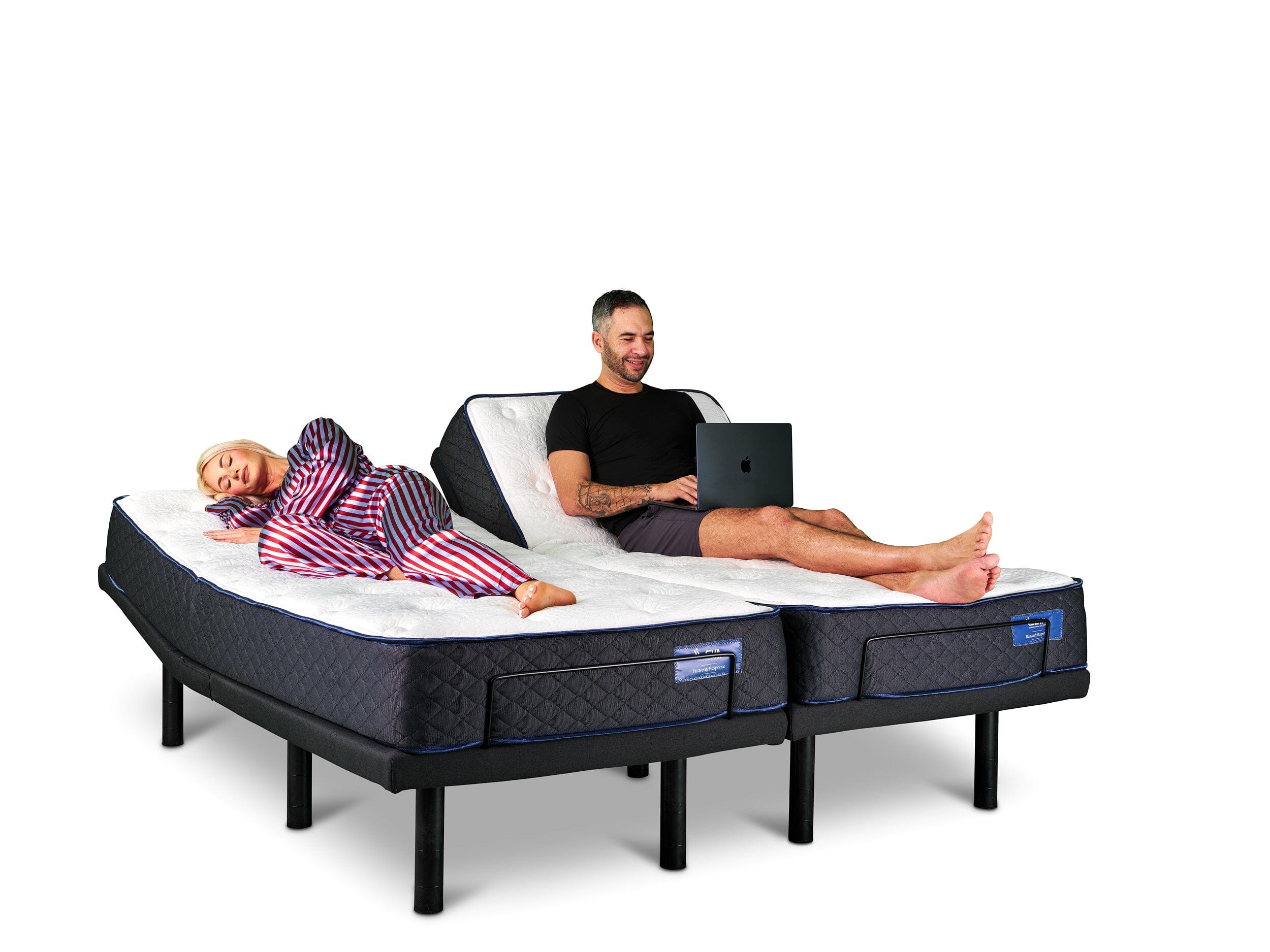
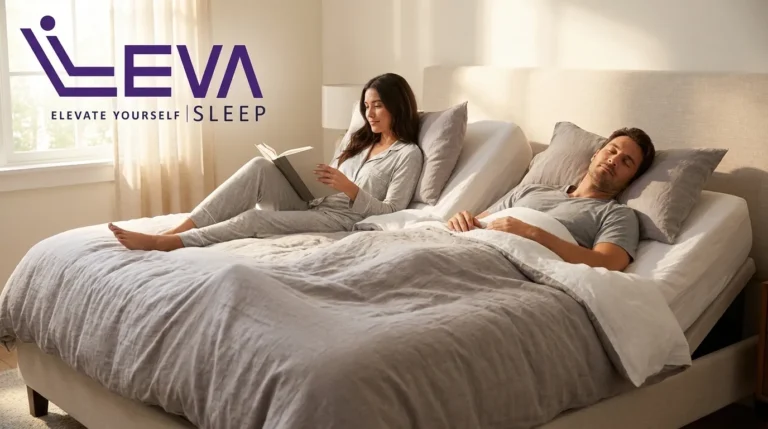
When each side of the bed operates independently, the snoring partner can sleep at the elevated angle while the non-snoring partner stays flat or chooses a different position. This independence removes the forced-position compromise that many Reddit users describe. Whisper-quiet motors then allow mid-night adjustments, whether manual or automatic, without the loud mechanical sounds that wake light sleepers. Mattresses engineered for articulating bases flex at the hinge zones without creating pressure points, which reduces the long-term discomfort that often appears in user reviews after the first few weeks. Bedding with deep-pocket elastic and adjustment-friendly construction keeps fitted sheets in place, preventing the slippage that can add to discomfort at elevation.
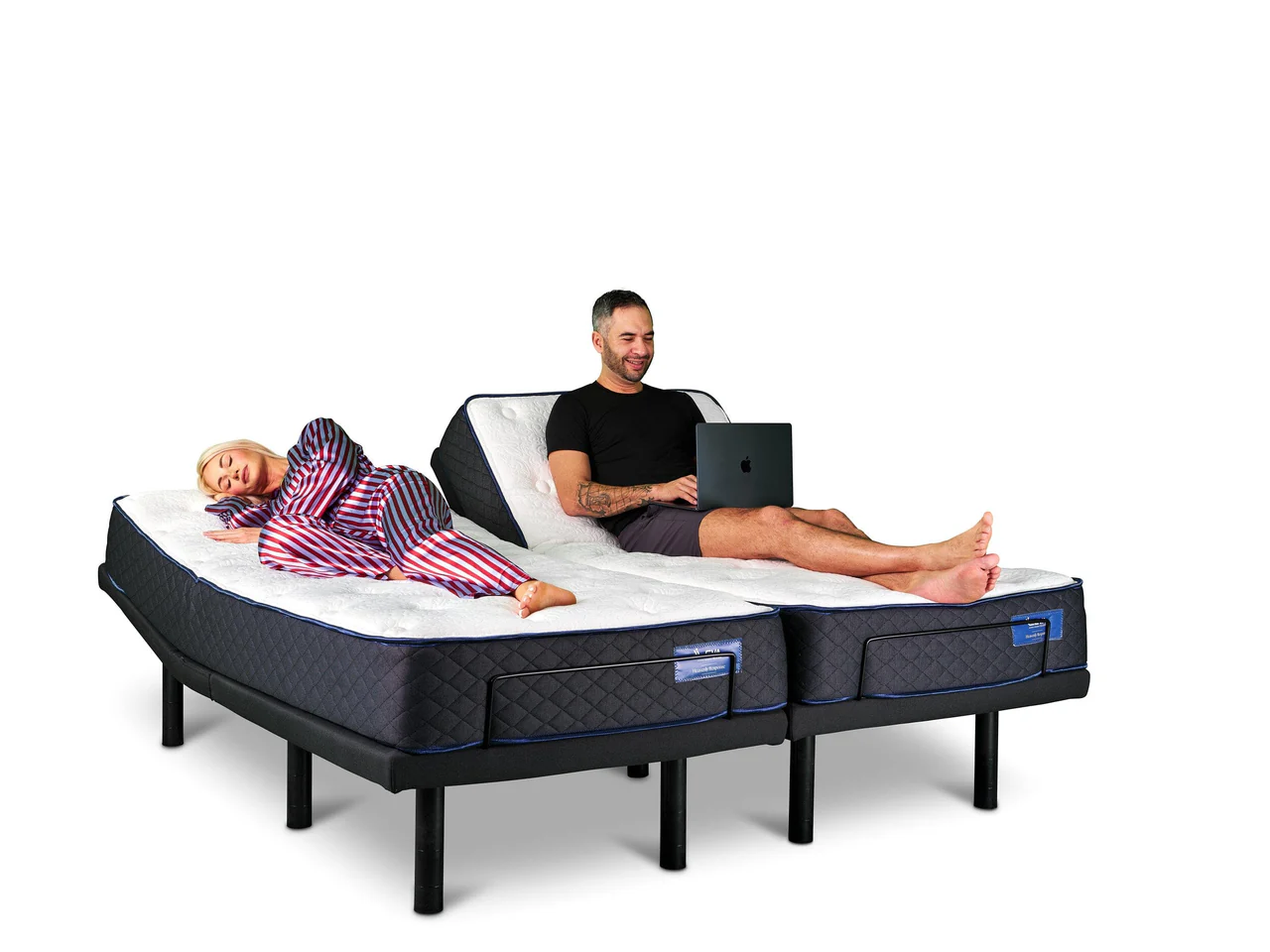
Couples where one partner uses a CPAP and the other does not, or where one sleeps hot and the other cold, gain extra flexibility from split systems with per-side temperature control and independent elevation. This configuration keeps both partners in the same bed while allowing each person to fine-tune comfort instead of compromising.
Experience split adjustable systems firsthand at Leva Sleep’s La Jolla showroom.
Frequently Asked Questions
Will an adjustable bed stop my snoring completely?
For back sleepers with mild positional snoring or mild positional sleep apnea, head elevation at 12–20 degrees can meaningfully reduce snoring frequency and intensity. One pilot study found that snoring stopped entirely in 67% of participants at 20 degrees. Complete elimination is not guaranteed and depends on snoring severity, sleep position, and consistent use of elevation throughout the night. People with moderate-to-severe obstructive sleep apnea should consult a physician before treating elevation as a primary solution.
I tried an adjustable base and it became uncomfortable after a few weeks. What went wrong?
Discomfort after extended use at elevation usually comes from one of three causes. The mattress may not be designed to flex with an articulating base. The base may lack lumbar support at the hinge between the elevated head section and the flat body section. The elevation angle may simply be too steep for that person’s body. A mattress engineered for adjustable bases, combined with a base that offers adjustable lumbar support, resolves most of these problems. Starting at a lower angle and increasing gradually over one to two weeks also gives the body time to adapt.
Can an adjustable bed replace a CPAP machine?
For mild positional sleep apnea, head-of-bed elevation can reduce the apnea-hypopnea index in a meaningful way, with one study recording a 31% reduction at 7.5 degrees. Adjustable bed elevation does not replace CPAP for moderate-to-severe obstructive sleep apnea, however. Couples dealing with a diagnosed sleep apnea condition should treat positional therapy as a complement to physician-recommended treatment. Elevation offers a practical advantage because adherence is passive and effortless, while CPAP compliance often declines over time.
My partner and I have completely different sleep preferences. Can one adjustable base work for both of us?
A split adjustable base, available in Split Queen and Split King sizes, gives each partner independent control over head elevation, foot elevation, lumbar support, massage intensity, and in advanced models, temperature regulation. The snoring partner can sleep at an elevated angle while the non-snoring partner stays flat. One partner can choose a firmer mattress while the other selects a softer one. Anti-snore automation activates only on the side where snoring occurs. This setup is designed to remove the compromise that often pushes couples toward separate beds.
How loud are adjustable base motors during nighttime adjustments?
Motor noise varies widely by product tier. Basic adjustable bases use motors that create noticeable mechanical sounds during movement, which many user reviews and Reddit threads mention as a key complaint. Premium bases use German-engineered whisper-quiet motors that operate at a volume similar to a quiet fan. For couples using automatic anti-snore modes that activate during the night, motor noise becomes a critical specification, because a loud adjustment that wakes the non-snoring partner defeats the purpose of the feature.
Conclusion: Choosing the Right Adjustable Setup for Your Bedroom
Clinical evidence supports head-of-bed elevation as a meaningful, low-risk option for back sleepers with mild positional snoring or mild sleep apnea. Reddit skepticism often traces back to low elevation angles, incompatible mattresses, noisy motors, and single-base setups that force one partner to accept the other’s preferred position. These problems reflect specific product choices rather than inherent flaws in adjustable beds.
Couples considering an adjustable base for snoring should first assess snoring severity and sleep position. They should then confirm that the base offers independent split controls, verify that the motor runs quietly enough for mid-night adjustments, and choose a mattress built for articulation. A wedge pillow works as a low-cost test of whether elevation helps a particular snorer before investing in a full system. When the evidence supports moving to a base, the features that separate a truly couple-focused system from a basic frame include independent controls, whisper-quiet motors, anti-snore automation, and bedding that stays secure at elevation.
Find the right adjustable base configuration for your needs at Leva Sleep.