
Written by: Matthew Timmins, Founder and Managing Director, Leva Sleep
Key Takeaways for Couples Considering Adjustable Beds
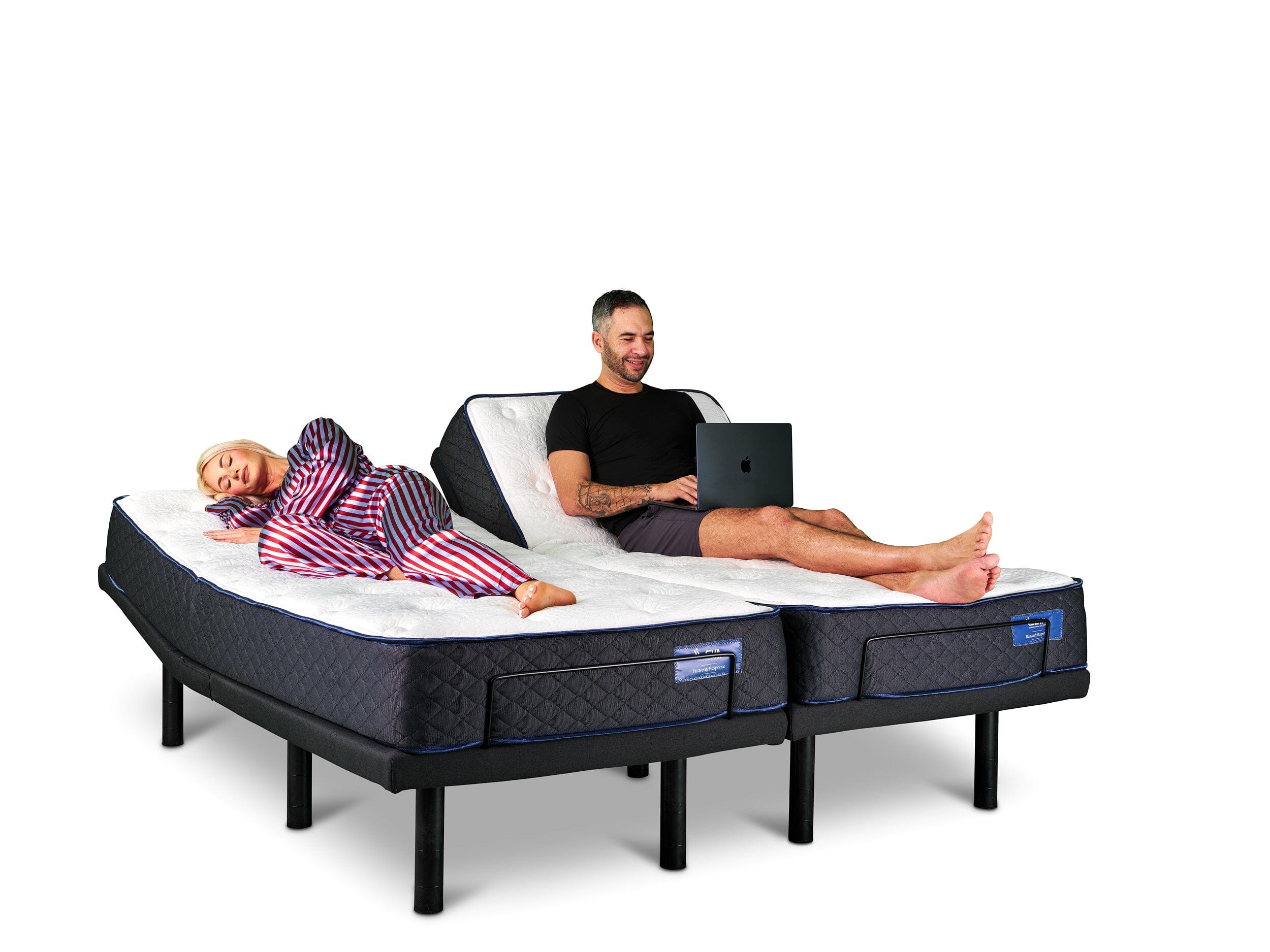
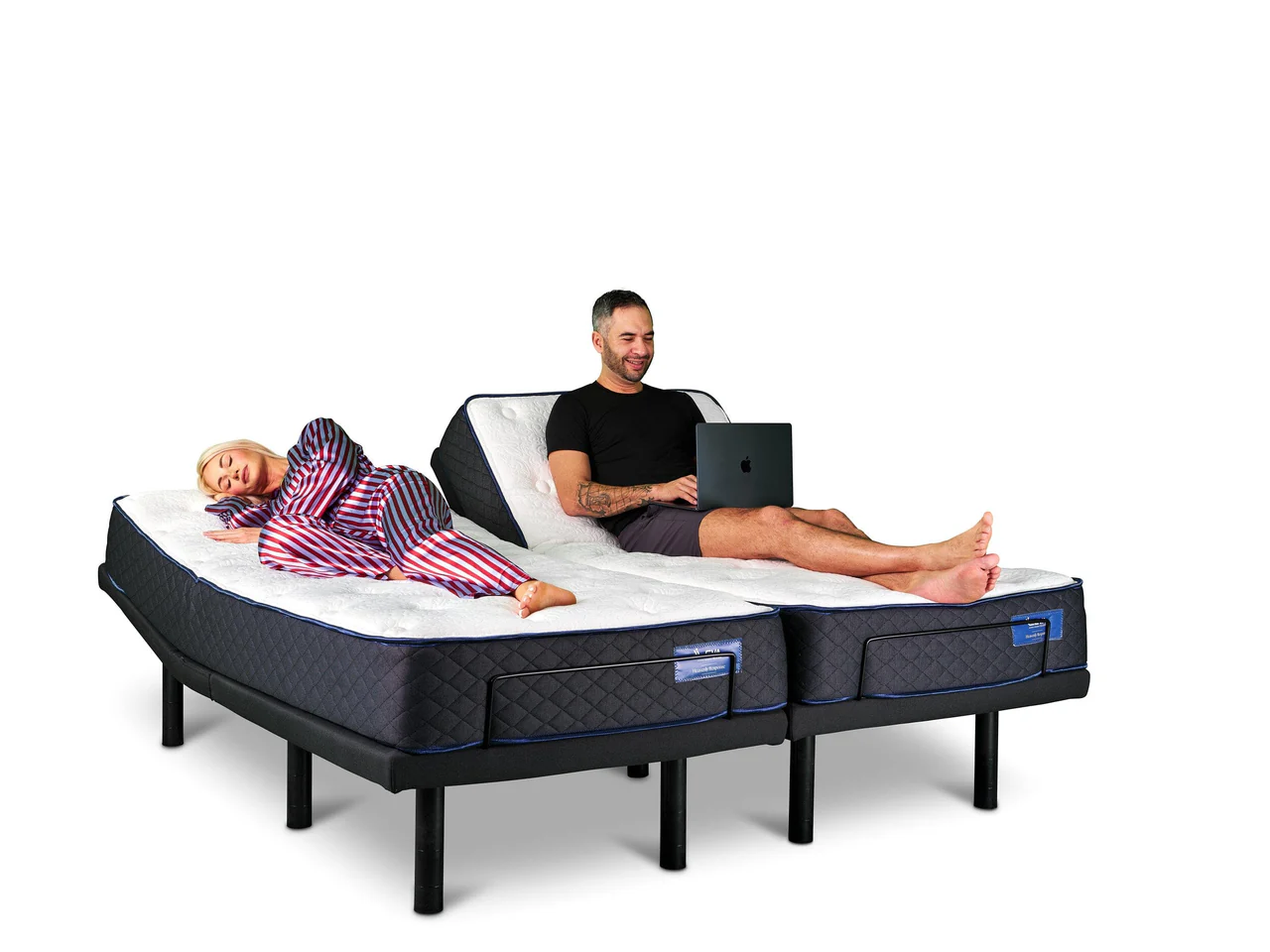
- Split-king adjustable beds often create a widening center gap when one or both sides elevate. Foam gap fillers, connector straps, and center-sync frames close or minimize this separation.
- Mattress drift is reduced by non-slip pads, reinforced connector straps, deep-pocket fitted sheets, and regular hardware checks that keep both mattresses aligned during movement.
- Premium adjustable bases with whisper-quiet German DC motors operate at near-silent levels. Incremental anti-snore micro-adjustments further reduce nighttime noise disruption for couples.
- Specialized bedding with extra-depth elastic, duvet clips, and app-based presets supports conflicting sleep schedules and repeated position changes without excess wear or disturbance.
- Leva Sleep offers integrated split adjustable systems, quiet motor technology, purpose-built bedding, and white-glove delivery that address all seven common couple issues. Explore Leva Sleep’s integrated split systems.
Managing the Center Gap in Split-King Adjustable Beds
The most cited disadvantage of a split-king adjustable bed is the center gap that forms between two Twin XL mattresses. When one or both partners elevate their side, the gap widens and creates an uncomfortable ridge that disrupts sleep and limits closeness.
Consider a couple where one partner elevates the head to manage acid reflux while the other lies flat. The resulting gap can widen noticeably at peak elevation, wide enough to interrupt sleep and make the bed feel divided.
Several practical measures close or minimize the center gap:
- Place a high-density foam gap filler between the two mattresses at the same height as the mattress surface.
- Use a split-king mattress topper that bridges both sides when both partners are in a flat or low-elevation position.
- Select an adjustable base with a center-sync frame that keeps both bases physically connected at the foot and head rails.
- Choose all-foam mattresses, which compress slightly at the edges and reduce the perceived gap width compared with innerspring models.
Leva Sleep’s split configurations use frame geometry that minimizes lateral separation. The all-foam and hybrid mattress options available through Leva compress predictably at the edges, which reduces the functional gap during elevation.
Keeping Split-King Mattresses Together and Aligned
Closing the center gap solves only part of the problem, because split-king mattresses can also drift apart laterally. Split-king mattresses drift apart because two independent bases move separately and standard bed frames often provide no lateral restraint.
Mattress drift ranks as the second most common complaint among couples using split adjustable systems. A couple who wakes to find a two-inch gap between their mattresses and a fitted sheet that has popped off one corner is experiencing the combined effect of motor movement, body weight shifts, and inadequate restraint hardware.
The following checklist addresses mattress drift directly:
- Install non-slip rubber or silicone pads between each mattress and its base platform.
- Use a mattress connector strap or bridge strap that runs under both mattresses and cinches them together at the center.
- Verify that the bed frame’s side rails include mattress-retention lips or brackets designed for split configurations.
- Choose fitted sheets with deep pockets and reinforced all-around elastic rather than corner-only elastic, which loses grip during position changes.
- Re-check strap tension monthly, because repeated motor cycles gradually loosen hardware.
Leva Sleep supplies connector straps and non-slip pads as part of its integrated accessory line. Its bedding uses extra-depth elastic specifically designed to maintain grip across the full range of base positions.
Noise Levels of Adjustable Beds for Couples
Motor noise can wake a sleeping partner, especially during late-night position changes. Entry-level adjustable beds often use AC motors that produce a noticeable hum and mechanical clicking during movement.
Premium systems with DC motors, particularly those built to German engineering standards, operate at noise levels comparable to a quiet conversation or lower. At those levels, the sound is effectively inaudible to a sleeping partner in most bedrooms.
When evaluating motor noise in an adjustable base, use these criteria:
- Ask the retailer for the motor’s decibel rating during operation. Whisper-quiet DC motors typically operate at low noise levels.
- Test the base in a showroom during night-equivalent quiet conditions rather than on a noisy retail floor.
- Confirm whether the anti-snore micro-adjustment feature uses slow, incremental motor movements instead of a single rapid repositioning cycle, which generates more noise.
- Check whether the app allows scheduled position changes during defined quiet hours to prevent unintended nighttime motor activation.
Leva Sleep’s bases use whisper-quiet German motors. The anti-snore mode, available in 2026 models, detects snoring and makes incremental micro-adjustments to the head position over time, which spreads motor activity out and keeps acoustic disruption low.
Specialized Bedding for Conflicting Sleep Schedules
Adjustable bases place more stress on bedding than flat foundations, so standard fitted sheets often fail early. Most conventional sheets are not engineered for the repeated stretching that occurs when an adjustable base moves through its full elevation range.
When evaluating bedding for adjustable beds, focus on these criteria:
- Select fitted sheets with all-around reinforced elastic and pocket depth at least two inches deeper than the mattress height. This extra depth helps the sheet survive repeated position cycles and normal laundering shrinkage.
- Use duvet clips or a split duvet system so each partner’s bedding moves independently without pulling the other partner’s cover.
- Program app-based sleep presets so the early-to-bed partner can reach their preferred position without manual motor activation when the other partner arrives later.
- Enable a vibrating alarm on one side only so one partner can wake without sound that disturbs the other.
Conflicting sleep schedules compound bedding stress and relationship strain. Larger gaps between partners’ bedtimes correlate with more frequent conflict, and more than one-third of people occasionally or consistently sleep in another room to accommodate a bed partner. Premium adjustable systems aim to keep both partners in the same bed while still honoring different schedules.
Leva Sleep designs its entire bedding line, including fitted sheets with extra-depth elastic, duvet clips, and remote pockets, specifically for adjustable bases. The Leva Sleep app supports saved position presets and side-specific vibrating alarms, which directly address schedule conflicts.
Delivery, Setup, and Total Cost for Adjustable Beds
Adjustable bed delivery is more complex than standard furniture delivery, so couples benefit from understanding the full service scope. When reviewing delivery and total cost of ownership, use the following checklist:
- Confirm whether delivery includes in-room placement, full assembly, and leg-height adjustment, or only curbside drop-off.
- Ask whether old-bed removal and disposal are included or billed as a separate fee.
- Verify that the quoted price bundles the base, mattress, and core accessories rather than pricing them separately, because bundled offers usually provide lower per-item pricing.
- Compare the total cost of ownership, including base, mattress, bedding, delivery, and setup, across vendors instead of comparing base prices alone.
- Check whether the retailer provides a product tutorial at delivery so both partners understand all features before the technician leaves.
Curbside drop-off leaves couples responsible for carrying heavy base components upstairs, assembling motorized hardware, and disposing of an existing mattress. These tasks often result in installation errors, voided warranties, or physical strain. Hidden costs such as old-bed haul-away fees and specialty frame modifications also tend to appear after purchase.
Leva Sleep’s white-glove delivery service, available for a fee, includes in-room delivery, full assembly, leg-height adjustment, a product tutorial, and removal of the old bed through donation or recycling. Because Leva designs and assembles its systems locally and sells direct to consumers, it offers premium-engineered systems at 30–50% less than comparable luxury competitors, without the hidden add-on costs that inflate piecemeal purchases.
Split Queen vs. Split King: Choosing the Right Size for Your Room
| Feature | Split Queen | Split King | Best For |
|---|---|---|---|
| Total bed width | 60 inches (two 30-inch bases) | 76 inches (two Twin XL bases) | Split Queen for smaller rooms, Split King for master suites |
| Independent side control | Yes, each side adjusts separately | Yes, each side adjusts separately | Both configurations serve couples with differing preferences |
| Mattress availability | Limited, Leva builds to customer specifications | Wide, standard Twin XL mattresses fit | Split King for easier long-term mattress replacement |
| Center gap management | Narrower gap due to smaller overall width | Wider gap potential, requires connector straps and gap fillers | Split Queen for couples prioritizing closeness, Split King for maximum per-side space |
Frequently Asked Questions
Can an adjustable bed help with sleep apnea or snoring without a CPAP machine?
Head elevation can reduce some snoring and mild obstructive sleep apnea symptoms, but it does not replace prescribed medical treatment. Elevating the head of the bed between seven and thirty degrees can reduce airway obstruction by allowing gravity to keep soft tissue from collapsing into the airway.
This positional approach does not substitute for a prescribed CPAP device in cases of moderate to severe sleep apnea. Anyone with a diagnosed sleep disorder should follow their physician’s treatment plan.
For couples where one partner snores without a formal diagnosis, head elevation through an adjustable base offers a practical first step. Leva Sleep’s anti-snore mode, available in 2026 models, detects snoring acoustically and makes incremental micro-adjustments to head elevation automatically, without requiring the snoring partner to wake up.
How do you maintain an adjustable bed base to prevent motor problems over time?
Routine maintenance extends motor life and reduces the mechanical noise that develops in aging bases. Keep the area under the base clear of debris that could enter motor housing.
Inspect and re-tighten connector straps and frame bolts every three to six months, because repeated motor cycles gradually loosen hardware. Avoid exceeding the base’s stated weight capacity, which accelerates motor wear.
Use the app’s position-memory feature rather than cycling through positions manually, because incremental adjustments create less motor stress than full-range movements. Contact the manufacturer if the motor produces new sounds such as clicking, grinding, or high-pitched whining, since early intervention prevents minor issues from becoming full motor failures.
Will standard mattresses work on an adjustable base, or do couples need a specialized mattress?
Many standard mattresses are not compatible with adjustable bases, so couples should confirm flexibility before pairing a mattress with a motorized frame. Innerspring mattresses with a rigid Bonnell coil system do not flex adequately and can sustain structural damage when elevated.
Compatible options include all-foam mattresses, latex mattresses, and hybrid mattresses with individually wrapped pocket coils. These designs flex through the base’s range of motion without damage.
When evaluating compatibility, bend a corner of the mattress by hand. If it resists strongly, it will not perform well on an adjustable base. Leva Sleep’s mattress lineup, including all-foam and hybrid pocket-coil models, is engineered specifically for use with adjustable bases, and all partner mattresses available through Leva are pre-vetted for full adjustable-base compatibility.
How do couples manage different firmness preferences on a split adjustable system?
A split configuration separates elevation and massage control for each side, but firmness still comes from the mattress itself. Couples with significantly different firmness needs should select different mattresses for each side of a split-king or split-queen setup.
This approach requires purchasing two separate mattresses rather than one shared mattress, which is standard practice for split-king configurations using Twin XL mattresses. For split-queen setups, Leva Sleep builds to customer specifications, which makes it possible to pair different mattress models on each side.
Couples should each test mattresses independently, spending at least ten to fifteen minutes in their preferred sleep position before selecting a model. This process avoids compromise on a single firmness level that may not suit either partner.
When should a couple consult a doctor before purchasing an adjustable bed?
Medical guidance should come first when a health condition drives the decision to buy an adjustable bed. Couples should consult a physician before purchasing if either partner has a diagnosed spinal condition such as herniated discs or spinal stenosis, has undergone recent back, hip, or knee surgery, has a cardiovascular condition that affects circulation in the legs, or has been prescribed a specific sleep position by a medical professional.
Elevation angles that relieve one condition can aggravate another, so a physician or physiotherapist should recommend appropriate head and foot elevation ranges. Leva Sleep’s showroom staff can discuss general use cases, but medical guidance from a qualified clinician should precede any purchase decision where health is the primary driver.
Conclusion: How Leva Sleep Solves the Seven Biggest Couple Concerns
The seven most common issues couples face with adjustable beds, including center gap, mattress drift, motor noise, bedding failure, conflicting sleep schedules, delivery complexity, and unclear costs, all have direct, engineering-based solutions. Foam gap fillers and center-sync frames close the center gap. Connector straps and non-slip pads stop mattress drift.
Whisper-quiet German DC motors and incremental anti-snore micro-adjustments reduce noise disruption. Purpose-built bedding with reinforced deep-pocket elastic survives repeated position cycles and laundering. App-based presets and side-specific vibrating alarms support different schedules. White-glove in-room delivery and transparent bundled pricing remove setup risk and hidden costs.
Leva Sleep addresses all seven problems within a single integrated system. Its split queen and king bases offer independent app control, the German motor technology described earlier, lumbar support, pillow tilt, anti-snore positioning, a full proprietary bedding line, and white-glove delivery at 30–50% less than comparable luxury competitors. With more than 25,000 customers served over eight years and 15–20 adjustable models available, Leva provides specialist expertise that general mattress retailers rarely match.
Visit Leva Sleep in La Jolla or start configuring your split adjustable system online today.