
Written by: Matthew Timmins, Founder and Managing Director, Leva Sleep
Key Takeaways from iDealBed Split Queen Reviews
- iDealBed split queen adjustable bases earn praise for frame construction and relatively quiet motors, yet reviews repeatedly cite warranty problems, missing wall-hugger features, remote issues, and sheet slippage.
- Split queen designs support couples with different sleep needs by providing independent head, foot, and firmness controls on two 30-inch mattresses.
- Category-wide challenges include motor noise, specialized sheet requirements, mattress compatibility limits, and shorter electrical warranties compared with typical bed lifespans.
- Leva Sleep addresses these gaps with whisper-quiet German motors, true wall-hugger mechanisms, purpose-built bedding, and a spring 2026 anti-snore sensor update.
- For a reliable split queen adjustable base that tackles common iDealBed complaints, compare Leva Sleep’s 15–20 specialist models at levasleepusa.com.
The Problem: Why Couples Turn to Split Queen Adjustable Bases
A 2025 American Academy of Sleep Medicine survey found that 39% of U.S. adults aged 35–44 engage in a sleep divorce by sleeping separately from their partner, and one-third of Americans report going to bed at a non-preferred time to accommodate their partner’s sleep routine. The downstream consequences extend well beyond fatigue. Nearly one-third of U.S. adults do not get enough sleep, and long-term poor sleep can reduce lifespan.
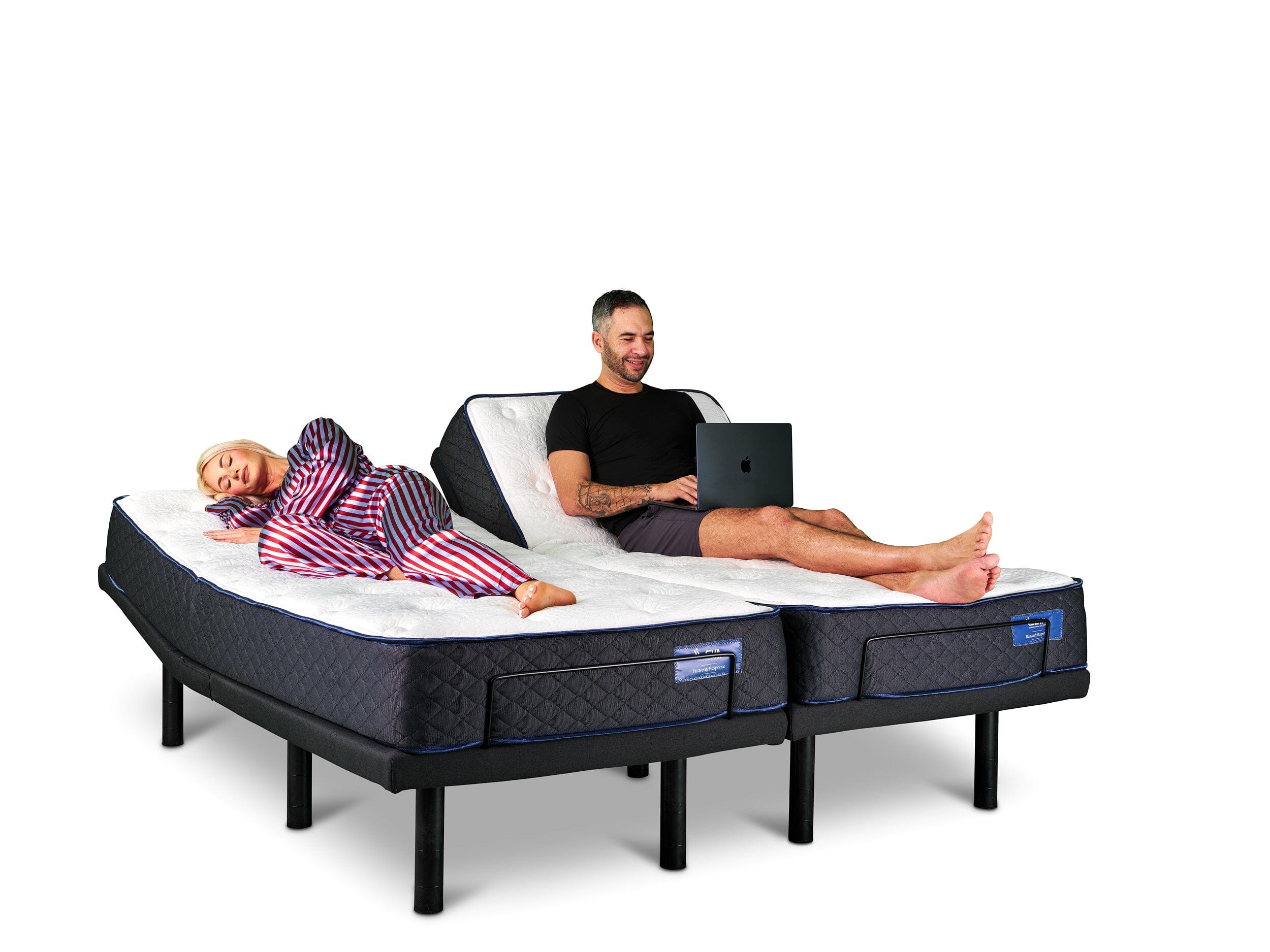
Split queen adjustable bases give each partner independent head and foot elevation, massage, and firmness control on two 30-inch-wide mattresses that sit side by side. In a split queen configuration, each sleeper has a separate remote, a 30-inch-wide mattress, and an independent mechanical base, allowing fully independent head and foot articulation for each side. This format suits couples where one partner snores, experiences acid reflux, or requires medically elevated positioning while the other prefers a flat surface.
Common Problems with Split Queen Adjustable Beds
Buyers researching split queen adjustable bed problems face several category-wide limitations before comparing brands. Motors can still produce noise that wakes light sleepers even in newer models, and because mattresses on split adjustable beds bend, slide, and reach different heights between partners, users often need specialized sheets with straps, deeper-pocket fitted sheets, or larger bedding to accommodate the setup.
Mattress compatibility creates another structural concern. Foam and latex mattresses that are soft, light, and relatively thin work with most adjustable beds, while innerspring mattresses and thick, firm mattresses will not work with split queen adjustable bases. Innerspring models with rigid perimeter frames resist bending, while individually wrapped coil, memory foam, and latex constructions flex properly without damage or pressure points. Finally, adjustable beds are often incompatible with electric blankets, depending on the bed model and mattress type, which adds a compatibility factor many buyers overlook. These category-wide challenges become more consequential when warranty support fails to address them, a pattern that appears clearly in iDealBed customer feedback.
iDealBed Warranty and Customer Service Issues
Across retailer review aggregators and consumer complaint boards, iDealBed buyers describe a consistent cluster of post-purchase frustrations. Warranty claim timelines often extend weeks beyond stated response windows, and replacement parts sometimes arrive incomplete or never arrive. Several reviewers report submitting multiple support tickets before receiving acknowledgment, and some question whether the company consistently honors its stated coverage terms for motor and frame defects. The warranty gap noted earlier, where electrical coverage ends years before the bed’s expected lifespan, becomes a concrete concern when buyers report weeks-long claim delays and incomplete part shipments. Buyers evaluating iDealBed should request written confirmation of what the warranty covers, the claims process timeline, and whether replacement motors are stocked domestically before purchasing.
Split Queen Compatibility and Control Challenges in iDealBed Reviews
iDealBed 4i reviews highlight a recurring issue with missing wall-hugger functionality. iDealBed 5i, 6i, and 7i models include a wall-hugger mechanism (also called WallSnug), while the 4i does not.
A good adjustable sleep system should include a wall-hugging design so the mattress stays positioned close to the nightstand even when the head of the bed is fully raised. Without this feature, elevating the head section pulls the sleeper away from the nightstand, making water, phones, and medications unreachable during adjustments. For older adults, that reach problem becomes a meaningful safety concern.
Remote failures represent a second documented pain point. Buyers report Bluetooth connectivity drops between the remote and the base motor, which require power cycling or factory resets that interrupt sleep. This control reliability issue compounds a third recurring complaint, sheet slippage. Standard queen fitted sheets cannot accommodate the independent elevation of two 30-inch halves, and iDealBed does not bundle purpose-built bedding with its systems, so users wrestle with bedding that was never designed for this setup. These documented failure patterns, including motor noise, control drops, and missing accessories, point to specific evaluation criteria buyers should verify before purchase: motor warranty minimums of at least five years, weight capacity per side including the mattress, and noise level by testing DC versus AC motors in person.
Considerations for Seniors and Long-Term Adjustable Bed Use
Adjustable beds allow users to adjust positions to relieve pressure on sore areas, providing relief from arthritis and joint pain symptoms that commonly flare at night for seniors, and elevating the legs with an adjustable base may help optimize circulation to reduce swelling from edema and balance fluid levels to address nocturia. These benefits depend entirely on the long-term mechanical reliability of the base.
A major red flag when evaluating adjustable bases is a loud, jarring motor, and bases with high-quality, smooth-operating motors should be chosen instead to avoid disrupting the sleep environment. For seniors who wake easily, motor noise during nighttime adjustments is not a minor inconvenience. It becomes a disqualifying defect. A wall-hugging feature on adjustable bases keeps nightstands reachable as the head elevates, improving long-term usability and safety during nighttime use. Controls should be intuitive enough to operate in low light without reading glasses, and the system should integrate with voice assistants or a smartphone app for users with limited dexterity.
Leva Sleep Split Queen Adjustable Bases as a Targeted Alternative
Leva Sleep’s Split Queen adjustable bases are engineered as direct responses to the documented iDealBed shortcomings. Where iDealBed buyers report motor noise, Leva’s bases use whisper-quiet German motors designed for smooth, near-silent operation. Where iDealBed lacks a wall-hugger mechanism on some models, Leva’s systems maintain nightstand proximity throughout the full range of head elevation. Where iDealBed ships without purpose-built bedding, Leva designs fitted sheets with deep pockets and extra elastic, duvet clips, and remote pockets specifically for adjustable configurations, which reduces sheet slippage at the source.
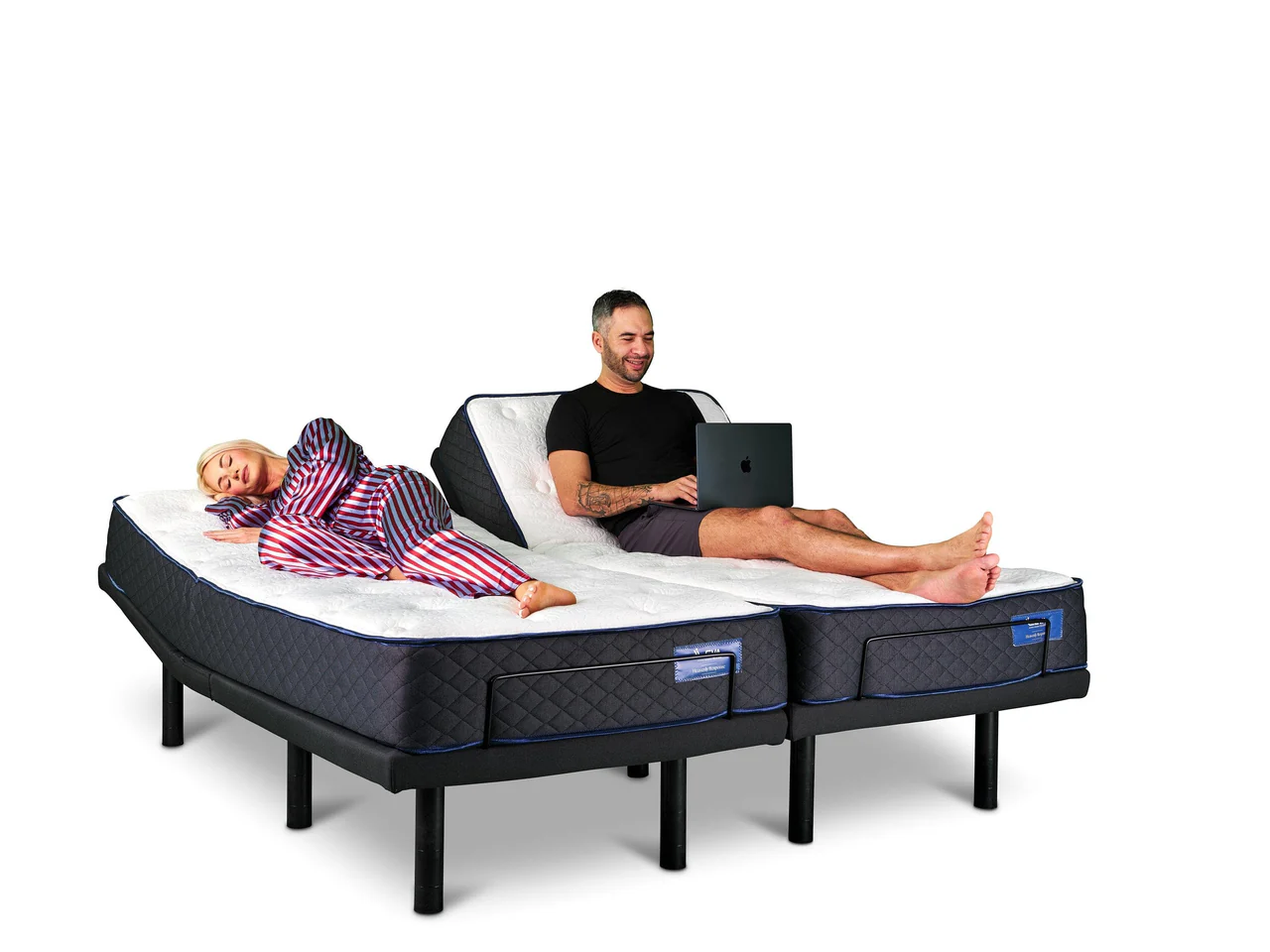
Leva offers 15–20 adjustable base models, compared with the three to five found at a standard mattress retailer, and its spring 2026 anti-snore update uses built-in sensors to detect snoring and make micro-adjustments to head elevation automatically. The anti-snore sensor applies the 10–30% elevation range shown earlier to reduce airway obstruction, making automatic adjustments that would otherwise require manual repositioning multiple times per night. Full app control via Bluetooth allows each partner to save custom positions, set vibrating alarms, and adjust independently without disturbing the other side. All Leva mattresses are made in the United States and are explicitly designed to flex with adjustable bases. White-glove delivery, including bedroom setup, leg-height adjustment, product tutorial, and old-bed removal, is available for a fee and replaces the assembly burden that iDealBed buyers frequently cite as a post-purchase frustration.
Comparison: iDealBed Models vs. Leva Sleep Split Queen (2026)
The following table shows how Leva Sleep’s engineering choices address the motor noise, control limitations, and delivery gaps documented in iDealBed customer reviews.
| Feature | iDealBed 4i / 5i | iDealBed 6i / 7i | Leva Sleep Split Queen |
|---|---|---|---|
| Motor Noise | Buyer reviews report audible motor noise on 4i/5i, and loud, jarring motors are a documented red flag in adjustable base evaluation | Marginally quieter per reviewer reports, yet noise complaints persist in long-term use threads | Whisper-quiet German motors, with smooth, near-silent operation |
| App Control & Anti-Snore | Remote control only on 4i, with no dedicated anti-snore mode documented in buyer reviews | App control available on 6i/7i, while anti-snore mode appears absent or limited per reviewer reports | Full Bluetooth app control and spring 2026 anti-snore sensor update that detects snoring and auto-adjusts head elevation, and newer adjustable beds may include automatic anti-snore response features that use built-in sensors to detect snoring and elevate the head while the user sleeps |
| Wall-Hugger & Delivery | Wall-hugger absent on 4i per buyer reports, with standard freight delivery and buyer-managed assembly | Wall-hugger absent on 6i/7i per buyer reports, and delivery experience varies by retailer | Wall-hugger included, and wall-hugging design keeps the mattress close to the nightstand even when the head is fully raised, with white-glove delivery and bedroom setup available for a fee |
| Price Positioning | Split queen adjustable bed bases are available from at least $1,699, with other models priced around $2,500, and iDealBed 4i/5i sit at the lower end of this range | iDealBed 6i/7i occupy a mid-range position within the $2,000–$7,500 category band | Leva prices 30–50% below comparable luxury competitors, with specialist engineering and white-glove service included in the value calculation |
Frequently Asked Questions
What are the common problems with split queen adjustable beds?
Split queen adjustable beds present several recurring challenges regardless of brand. Motor noise is the most frequently cited issue, particularly for light sleepers who adjust positions during the night. Sheet slippage occurs because standard queen fitted sheets cannot accommodate two independently elevating 30-inch mattress halves, which requires purpose-built bedding with deep pockets and extra elastic. Mattress compatibility is a structural concern, since only foam, latex, and specifically designed pocket-coil mattresses flex properly with adjustable bases, while traditional innerspring models with rigid perimeter frames resist bending and degrade over time. The center seam gap between the two mattress halves can cause discomfort for couples who sleep close together, though foam bridge pads reduce but do not fully eliminate this gap. Finally, warranty coverage on electrical components often runs shorter than the expected lifespan of the base, which creates out-of-pocket repair costs in years six through ten of ownership.
What are the disadvantages of adjustable beds for seniors?
For seniors, the primary disadvantages of adjustable beds center on control complexity, motor reliability, and safety design. Remotes with small buttons or complex menu structures are difficult to operate in low light or for users with reduced dexterity. Loud or jerky motors can startle light sleepers during nighttime adjustments, which undermines the therapeutic benefit of repositioning. Bases without a wall-hugger mechanism pull the sleeper away from the nightstand when the head elevates, making water, medications, and phones unreachable and creating a safety concern. Mattress compatibility must be confirmed before purchase, because not all mattresses labeled “adjustable-compatible” flex smoothly enough for repeated daily use over a five-to-ten-year lifespan. The cost of split queen systems, combined with potentially short electrical component warranties, also requires careful evaluation of total cost of ownership before committing.
How does Leva Sleep’s anti-snore mode work in 2026?
Leva Sleep’s spring 2026 anti-snore update uses built-in sensors in the adjustable base to detect snoring sounds during sleep. When snoring occurs, the system makes automatic micro-adjustments to the head elevation of the affected partner’s side of the split queen base, gently opening the airway without fully waking the sleeper. Each partner’s side operates independently, so the adjustment affects only the snoring partner. The feature is controlled and customized through the Leva Sleep app, where users can set sensitivity thresholds and preferred elevation ranges. This approach aligns with clinical guidance that elevating the upper body reduces the likelihood that soft tissues fall back and block the airway, and that elevations in the 10–30% range may reduce airway obstruction associated with snoring.
Is a split queen adjustable base worth it for couples with different sleep needs?
For couples where partners have meaningfully different firmness preferences, elevation needs, or medical requirements such as snoring, sleep apnea, acid reflux, or joint pain, a split queen adjustable base provides documented benefits that a flat mattress cannot replicate. Each partner controls their own side independently, which removes the compromise that pushes many couples toward separate sleeping arrangements. The format becomes particularly valuable when one partner requires medically elevated positioning while the other prefers a flat surface. The investment makes sense when the system includes whisper-quiet motors, purpose-built bedding, a wall-hugger mechanism, and a warranty that covers electrical components for at least five years. Buyers should evaluate total cost of ownership, including bedding, delivery, and potential warranty claims, rather than comparing base prices alone. Couples in Southern California gain the most confidence by visiting a specialist showroom to test motor noise, app controls, and elevation range in person before purchasing.
Conclusion: Choosing the Right Split Queen System
iDealBed split queen adjustable base customer reviews present a consistent picture of tradeoffs. Buyers describe solid frame construction and acceptable motor performance at entry price points, yet they also report warranty claim failures, absent wall-hugger design, remote connectivity issues, and no integrated bedding solution. For couples whose sleep health, relationship quality, and long-term physical comfort depend on getting this decision right, those gaps represent structural risks rather than minor inconveniences.
Leva Sleep’s Split Queen systems address each documented iDealBed shortcoming through specialist engineering. The lineup includes whisper-quiet German motors, wall-hugger design, spring 2026 anti-snore sensor technology, purpose-built bedding, U.S.-made mattresses, and white-glove delivery with professional setup. With 15–20 adjustable base models and eight years of specialist experience serving over 25,000 customers, Leva provides depth of expertise and end-to-end support that general mattress retailers and direct-ship brands rarely match. When evaluating the best split queen adjustable bed in 2026, the criteria that matter most, including motor quality, wall-hugger functionality, app control, bedding compatibility, and warranty transparency, favor a specialist provider over a general-market brand.