
Written by: Matthew Timmins, Founder and Managing Director, Leva Sleep
Key Takeaways for Couples with Back Pain
- Couples with chronic back pain and mismatched sleep preferences must compare integrated smart beds and split adjustable-base systems across seven clear criteria.
- Bryte Balance Signature offers real-time surface pressure adjustment on a unified mattress without a center gap, but depends on app connectivity and has a shorter technology lifespan.
- Split adjustable bases provide independent mechanical positioning, zero-gravity lumbar relief, and 10–15 year durability without requiring apps or internet connectivity.
- The primary trade-off is between Bryte’s gapless surface and split bases’ stronger motion isolation, with the 2–4 inch center gap being a common complaint among couples.
- Explore split adjustable systems with Leva Sleep by visiting the La Jolla showroom or shopping online today to match your back-pain needs.
How Bryte and Split Adjustable Systems Work
The Bryte Balance Signature uses pneumatic Bryte Balancers organized into independent zones that adjust firmness in real time per side. The system operates on a single unified mattress surface, so both partners share one continuous bed with no physical gap. Firmness changes and sleep tracking run through a dedicated app.
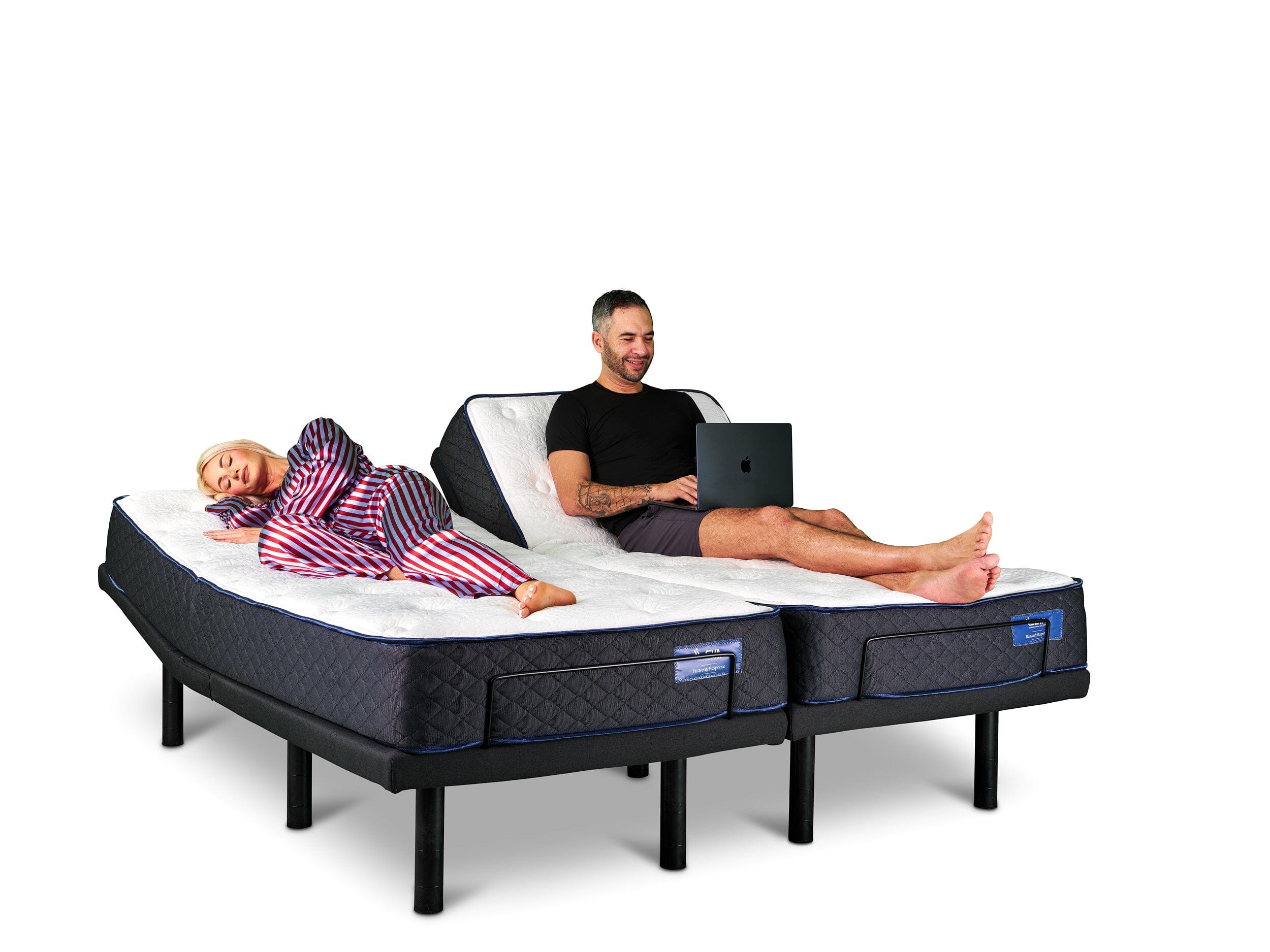
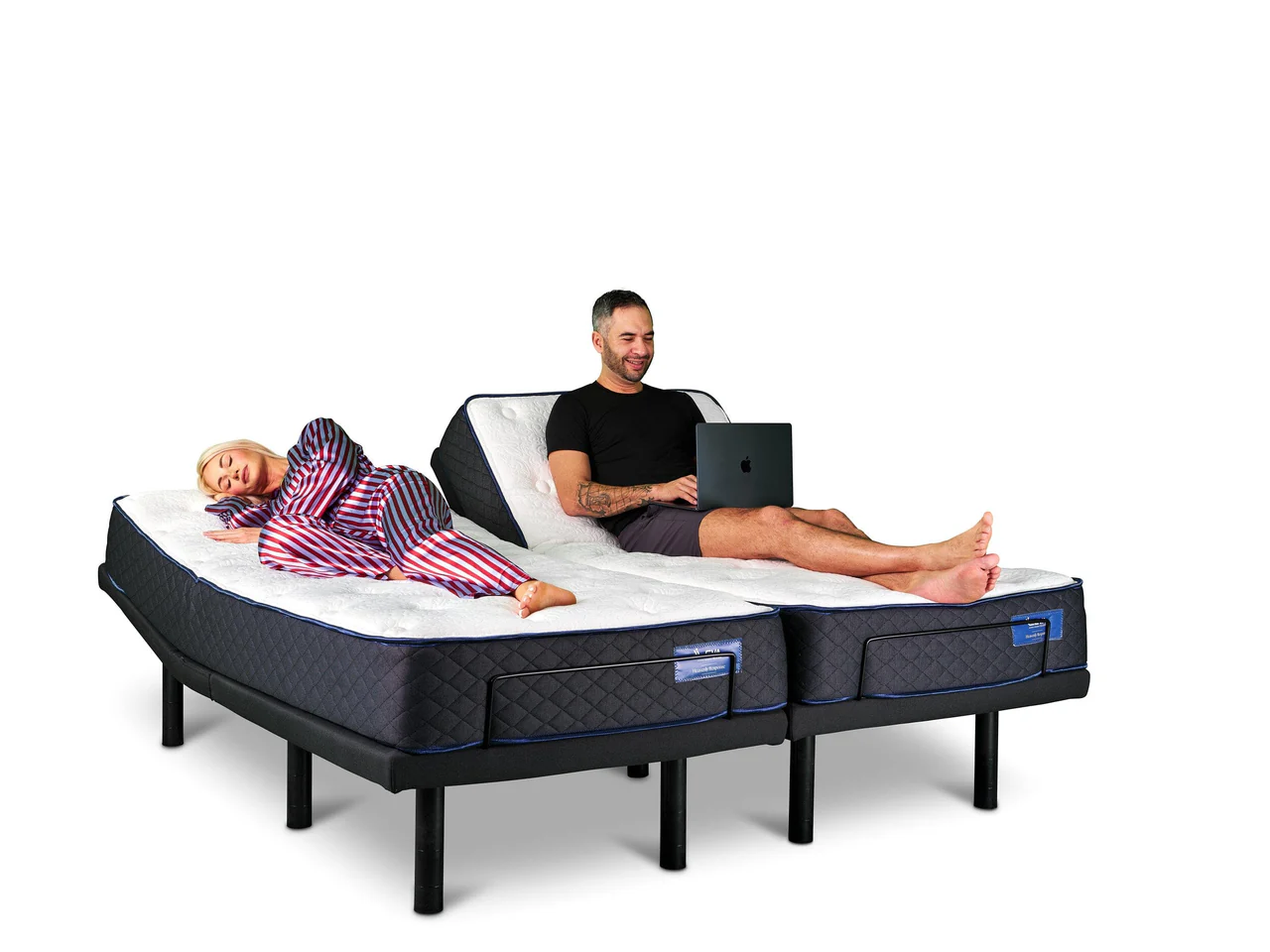
Split adjustable-base systems pair two independent motorized bases, typically Twin XL for a Split King configuration or a proprietary Split Queen format, placed side by side under compatible mattresses. Each base controls head elevation, foot elevation, lumbar support, and massage independently. Premium models use whisper-quiet motors and can connect to companion apps for position presets, anti-snore adjustments, and vibrating alarms. The mattress choice, such as memory foam, latex, or pocketed-coil hybrid, is selected separately and must be rated for adjustable-base use. How these systems deliver spinal support in practice depends on both surface firmness and body positioning.
Comfort and Support for Spinal Alignment
Both systems address spinal alignment, but they do it in different ways. A Lancet clinical trial of 313 adults with chronic low-back pain found that medium-firm mattresses produced 2.36× greater pain improvement, 1.93× greater improvement in pain on rising, and 2.10× better disability outcomes than firm mattresses over 90 days. This finding applies to the mattress surface chosen for either system.
Bryte’s active pressure relief addresses surface-level spinal support dynamically through real-time zonal adjustment, which can help reduce pressure points. No verified 2024 study in the British Journal of Hospital Medicine documenting an AI-powered mattress achieving 99% body curve fit or lower sleep disturbance scores was identified in the evidence. This context matters when evaluating marketing claims about AI-driven pressure adaptation.
Split adjustable bases address spinal alignment through positioning rather than surface adaptation. The zero-gravity position, with head and feet slightly elevated and knees above heart level, takes pressure off the lumbar spine and provides relief for chronic back pain and sciatica that standard pillows cannot replicate. Premium adjustable bases with a third lumbar hinge zone provide more precise lower-back support than standard two-hinge models. These features are particularly relevant for hip or back pain sufferers.
The practical distinction is clear. Bryte adjusts the surface around the sleeper’s body in real time. Adjustable bases change the angle of the entire sleep surface, which directly unloads spinal structures through gravity. Both approaches have clinical support, but they target different mechanisms of back pain relief.
Adjustability and Personalization for Two Sleepers
No Halstead survey reports 65% of couples disagreeing on mattress comfort or a 51%/49% firmness split. Both systems aim to solve differing comfort needs, but they rely on different tools.
Bryte delivers independent firmness zones on a single surface without a physical gap. Each partner sets a firmness value through the app, and the pneumatic balancers adjust in real time. All adjustments are app-dependent, so changing a setting requires a device, a working app, and an active internet or Bluetooth connection.
Split adjustable bases provide independent mechanical control of elevation, lumbar support, and massage for each side. Position changes can be made via remote control without any app or connectivity requirement. Each partner can also select a completely different mattress type, such as one side firm hybrid and the other soft foam, because the two bases are physically separate units. This level of surface-level personalization is not available on a unified smart-bed surface. The long-term usefulness of these personalization features, however, depends on each system’s durability and technology lifespan.
Durability, Build Quality, and Long-Term Performance
Traditional mattresses typically last 7–15 years depending on type and use. Smart mattress technology components, including pumps, sensors, and software, introduce a separate obsolescence timeline because they depend on manufacturer support and software ecosystems. When that support ends, smart mattresses may retain their physical structure but lose app features and hardware functionality, which shortens the product’s useful lifespan even if the foam remains intact.
A high-quality adjustable base can last 10 to 15 years, with motors described as durable when paired with proper maintenance and manufacturer warranties that cover mechanical parts for several years. The mechanical components of an adjustable base, including motors, frames, and hinges, do not depend on software ecosystems or manufacturer server maintenance to continue functioning.
When a smart mattress’s technology fails or support ends, owners may be left with a product whose smart functions no longer work even while the underlying foam or structure remains physically usable. For couples making a long-term investment in back-pain management, this obsolescence risk is a material consideration.
Noise, Motion Isolation, and Partner Disturbance
Motion isolation and noise control both affect how often partners wake each other. When evaluating motion isolation, consider that split king setups place two physically separate mattresses side by side, so vibration from one side cannot travel to the other through the mattress material. Bryte’s unified surface uses low-bounce foam construction to absorb motion, but some transfer remains possible across a single continuous surface.
The split-base gap introduces its own consideration. Industry professionals describe the 2–4 inch gap in split king setups as “the biggest complaint,” with 60% of couples finding it intolerable for maintaining physical closeness and intimacy. Bryte’s unified surface eliminates this gap entirely.
Noise is a material factor in partner disturbance. Adjustable air chamber smart mattresses use pumps that can be audible during nighttime auto-adjustments, while premium split adjustable bases with whisper-quiet motors are designed to minimize mechanical noise, although buyers should verify motor noise specifications before purchasing.
Both motion and noise matter because studies on bed-sharing couples indicate that a significant portion of nighttime awakenings can be caused by the other partner. Minimizing motion transfer and mechanical noise therefore becomes a primary functional requirement for any shared sleep system.
Get Expert Help Choosing a Split Adjustable System
Couples evaluating split adjustable systems for back pain and partner disturbance benefit from expert guidance rather than online-only research. Visit Leva Sleep’s La Jolla showroom or shop online, where specialists in split adjustable systems can match your specific back-pain profile and firmness preferences to the right configuration.
Real-World Use-Case Scenarios for Bryte vs Split Bases
Different back-pain and sleep-disturbance profiles map to different system strengths. Use the following scenarios to identify which system fits your situation, then apply the decision framework in the next section to confirm your choice.
- Chronic lower-back pain with zero-gravity positioning needs: Split adjustable bases with lumbar hinge zones and zero-gravity presets directly unload the lumbar spine through elevation. Bryte addresses surface pressure but does not change the angle of the sleep surface.
- Snoring partner causing repeated awakenings: Split adjustable bases with anti-snore mode gently elevate the head to open airways. Bryte does not include positional anti-snore adjustment as a core feature.
- Post-surgery recovery requiring specific elevation protocols: Adjustable bases allow precise, repeatable head and foot elevation angles on a per-side basis. Medical positioning requirements are easier to replicate mechanically than through surface-pressure adjustment alone.
- Athletic recovery with asymmetric pressure needs: Bryte’s 16-zone real-time pressure adjustment addresses asymmetric loading across the body on a single surface. Split bases with compatible foam mattresses also reduce pressure points through surface selection.
- Couples prioritizing physical closeness alongside independent positioning: Bryte’s unified surface eliminates the center gap. Split bases with a foam bridge connector reduce but do not fully eliminate the gap.
Total Value: Learning Curve, Maintenance, Delivery, and Changing Needs
Bryte requires app setup, periodic software updates, and ongoing connectivity to access core features. Smart mattresses rely on WiFi connectivity, app maintenance, and periodic software updates, which adds to the normal mattress care burden. If the manufacturer discontinues app support, firmness personalization features become inaccessible.
Split adjustable bases operate via physical remote controls that function independently of any app or internet connection. App integration is available on premium models for convenience but is not required for core functionality. Adjustable bases require mattresses specifically designed for flexibility, such as memory foam, latex, or pocketed-coil hybrids, so buyers must verify compatibility before purchasing.
White-glove delivery and professional setup are available for split adjustable systems through specialists like Leva Sleep. This service covers installation, height adjustment, product tutorials, and old-bed removal. The end-to-end model reduces the setup burden that often accompanies large adjustable-base purchases and helps ensure that the base, mattress, and bedding are configured correctly from the first night.
Experience Leva Sleep’s white-glove delivery, including professional setup tailored to your back-pain and positioning needs, by visiting the La Jolla showroom or shopping online today.
Decision Framework and Checklist for Couples
Use the following criteria to map your situation to the system that fits you best before committing to either option.
- Primary pain mechanism: Determine whether your back pain is driven by surface pressure, which favors Bryte’s dynamic zonal adjustment, or by spinal angle and lumbar loading, which favors adjustable-base zero-gravity positioning.
- Firmness divergence: Decide whether you and your partner need different mattress types entirely or just different firmness levels on the same surface. Different mattress types require physically separate bases.
- App dependency tolerance: Assess whether you are comfortable with core features tied to a manufacturer’s app ecosystem for the life of the product, or whether you prefer mechanical controls that function independently.
- Intimacy and gap tolerance: Clarify whether the 2–4 inch center gap of a split configuration is a dealbreaker or whether near-complete motion isolation is the higher priority.
- Technology obsolescence horizon: Decide whether a 10–15 year mechanical lifespan matters more than 3–5 years of active smart-technology features.
- Anti-snore and elevation requirements: Identify whether one partner requires head elevation for snoring, sleep apnea, or acid reflux. Mechanical elevation on an adjustable base addresses this directly.
- Service and setup expectations: Consider whether you require professional installation, old-bed removal, and ongoing specialist support, or whether self-setup is acceptable.
Conclusion: Choosing Between Bryte and Split Adjustable Systems
The Bryte Balance Signature offers real-time surface pressure adaptation on a unified mattress with no center gap, which benefits couples who prioritize physical closeness and dynamic pressure relief. Its limitations include app dependency, a 3–5 year technology obsolescence window, and the absence of mechanical positional adjustment for spinal unloading.
Split adjustable-base systems provide independent mechanical control of sleep position, zero-gravity lumbar relief, anti-snore elevation, and 10–15 year mechanical durability without connectivity requirements. Their primary trade-off is the center gap, which a meaningful share of couples find disruptive to intimacy.
For couples aged 40–60 managing chronic back pain where positional relief, long-term durability, and independent partner control are the primary requirements, split adjustable systems address those criteria more directly. The decision depends on which trade-off, gap versus app dependency and surface adaptation versus positional control, aligns with your specific health and relationship priorities.
Work with Leva Sleep’s adjustable-base specialists to map your back-pain profile to the right split configuration by visiting the La Jolla showroom or shopping online to get started.
Frequently Asked Questions
How does motion isolation differ between the Bryte Balance Signature and a split adjustable-base system?
The Bryte Balance Signature uses a unified foam surface with low-bounce construction designed to absorb motion before it transfers across the bed. A split adjustable-base system places two physically separate mattresses side by side, so vibration from one side cannot travel to the other through the mattress material. The split configuration generally produces stronger motion isolation because the two sleep surfaces are mechanically disconnected. The trade-off is a 2–4 inch center gap that some couples find disruptive to physical closeness. Buyers who prioritize motion isolation above all other factors should evaluate split configurations, while those who prioritize a gapless surface should evaluate Bryte’s foam absorption approach.
Do sleep specialists or chiropractors recommend adjustable bases for chronic back pain?
Adjustable bases are frequently recommended for chronic lower-back pain, sciatica, herniated discs, and post-surgical recovery because the zero-gravity position, with head and feet slightly elevated and knees above heart level, mechanically reduces lumbar spine loading in ways that a flat surface cannot replicate. Premium models with a third lumbar hinge zone provide additional precision for lower-back support. Smart beds like Bryte address surface pressure through dynamic zonal adjustment, which is a different mechanism. Patients with specific elevation protocols from a physician or physiotherapist typically find adjustable bases easier to configure to exact angle requirements than app-controlled pressure systems.
What are the realistic long-term reliability expectations for each system?
High-quality adjustable bases are built around mechanical motors and frames with an expected lifespan of 10 to 15 years. The core functionality, including elevation, lumbar support, and massage, operates via remote control and does not depend on software ecosystems. Smart mattress technology components, including sensors, pumps, wireless modules, and app infrastructure, have a shorter effective lifespan of approximately 3 to 5 years before becoming outdated or losing manufacturer support. A smart mattress purchased today may have non-functional app features within five to six years while the underlying foam structure remains physically intact. Couples making a long-term investment in back-pain management should weigh this obsolescence risk against the active pressure-relief benefits of smart technology.
How does app dependency affect the day-to-day use of each system?
The Bryte Balance Signature requires app interaction to set and adjust firmness zones, access sleep data, and modify comfort profiles. If the manufacturer updates or discontinues the app, or if connectivity is interrupted, the bed defaults to a fixed state and personalization features become inaccessible. Split adjustable bases with app integration use the app as a convenience layer rather than a requirement. Position presets, anti-snore mode, and vibrating alarms are app-accessible, but the same functions are also available through physical remote controls that operate via Bluetooth or infrared without internet connectivity. For couples who prefer not to manage a technology ecosystem as part of their sleep routine, adjustable bases offer more operational independence.
What should couples consider when evaluating the center gap in split adjustable configurations?
The center gap, discussed earlier as a common complaint, measures 2–4 inches between two Twin XL mattresses in a split king configuration. Some manufacturers and third-party retailers offer foam gap fillers or bridge connectors that reduce the gap’s physical presence, although these do not fully replicate the feel of a unified surface. Couples for whom physical closeness and intimacy are high priorities should test a split configuration in person before purchasing, rather than relying on product descriptions alone. Leva Sleep’s La Jolla showroom allows couples to evaluate split configurations directly, including how gap fillers perform in practice, before committing to a system.