Written by: Matthew Timmins, Founder and Managing Director, Leva Sleep
Key Remote Benefits for Couples
- Independent split control with dedicated remotes or app profiles lets each partner adjust their side without disturbing the other.
- One-touch anti-snore presets and memory positions remove guesswork and cut down on nighttime disruptions.
- Quiet DC motors keep adjustments from waking a lighter-sleeping partner during the night.
- Physical remotes with backlit controls work reliably in a dark room, while apps add scheduling, unlimited profiles, and health tracking.
- Leva Sleep’s Split Queen and Split King bases combine these features with whisper-quiet German motors and white-glove delivery to help couples sleep better together.
Top Remote Features Ranked by Couple Impact
The table below lists eight key remote features and their potential relevance to couples sharing a bed. Compare each feature to your household’s specific pain points before purchasing.
| Feature | Couple Impact | Physical Remote | App Control |
|---|---|---|---|
| Independent Split Control | Critical, eliminates partner disturbance during adjustments | Separate remotes per side | Per-profile settings in app |
| One-Touch Presets (Anti-Snore) | High, immediate airway relief without waking partner | Dedicated preset button | Tap or voice trigger |
| Memory Positions | High, removes nightly guesswork for each partner | Programmable slots on remote | Unlimited saved profiles |
| Quiet Motors | High, prevents adjustment noise from waking lighter sleeper | DC motor hum only | Same motor, app adds no noise |
| Backlit / Flashlight Controls | Moderate, allows dark-room operation without room lights | Built-in flashlight on select remotes | Phone screen provides light |
| App Integration | Moderate, enables scheduling, alarms, and health tracking | Not applicable | Full feature access |
| Massage / Under-Bed Lighting | Moderate, comfort and safety for nighttime movement | Button-controlled on premium remotes | Schedulable via app |
| Sync / Wall-Hugger | Lower, convenience feature that reduces nightstand gap on adjustment | Sync button on some remotes | Configurable in app |
Independent Split Control for Uninterrupted Sleep
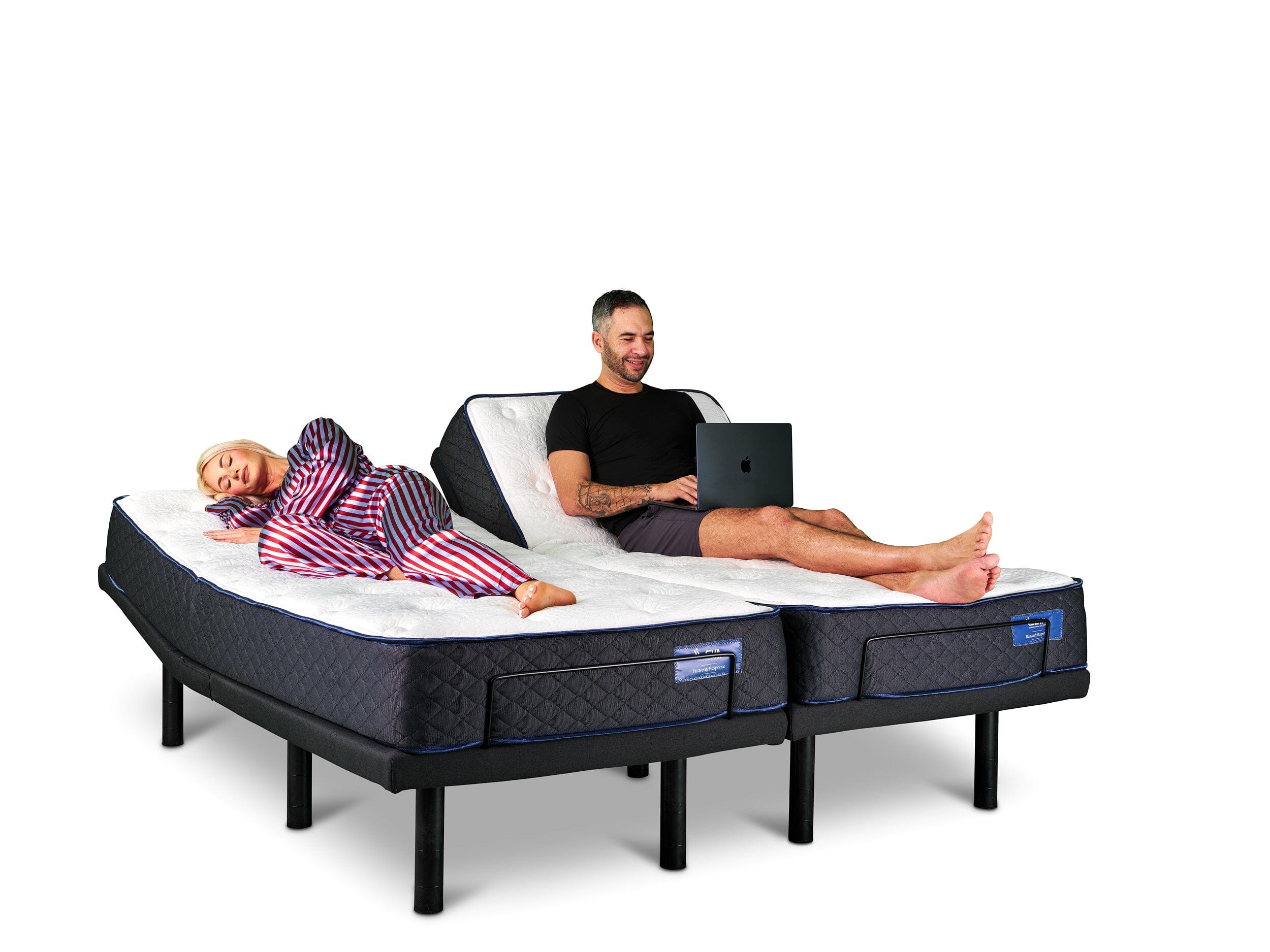
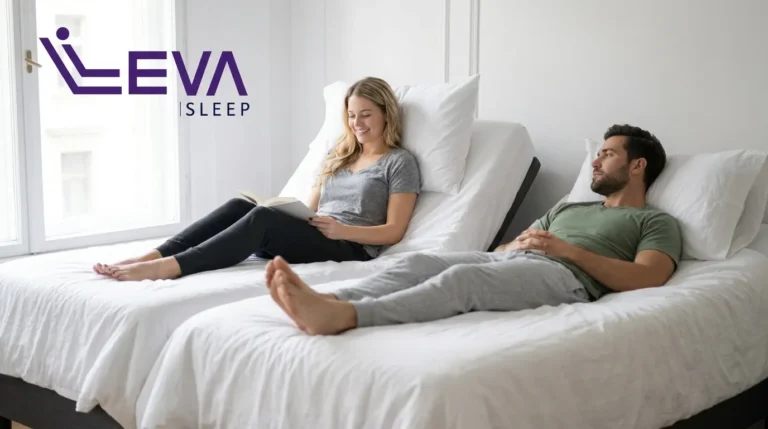
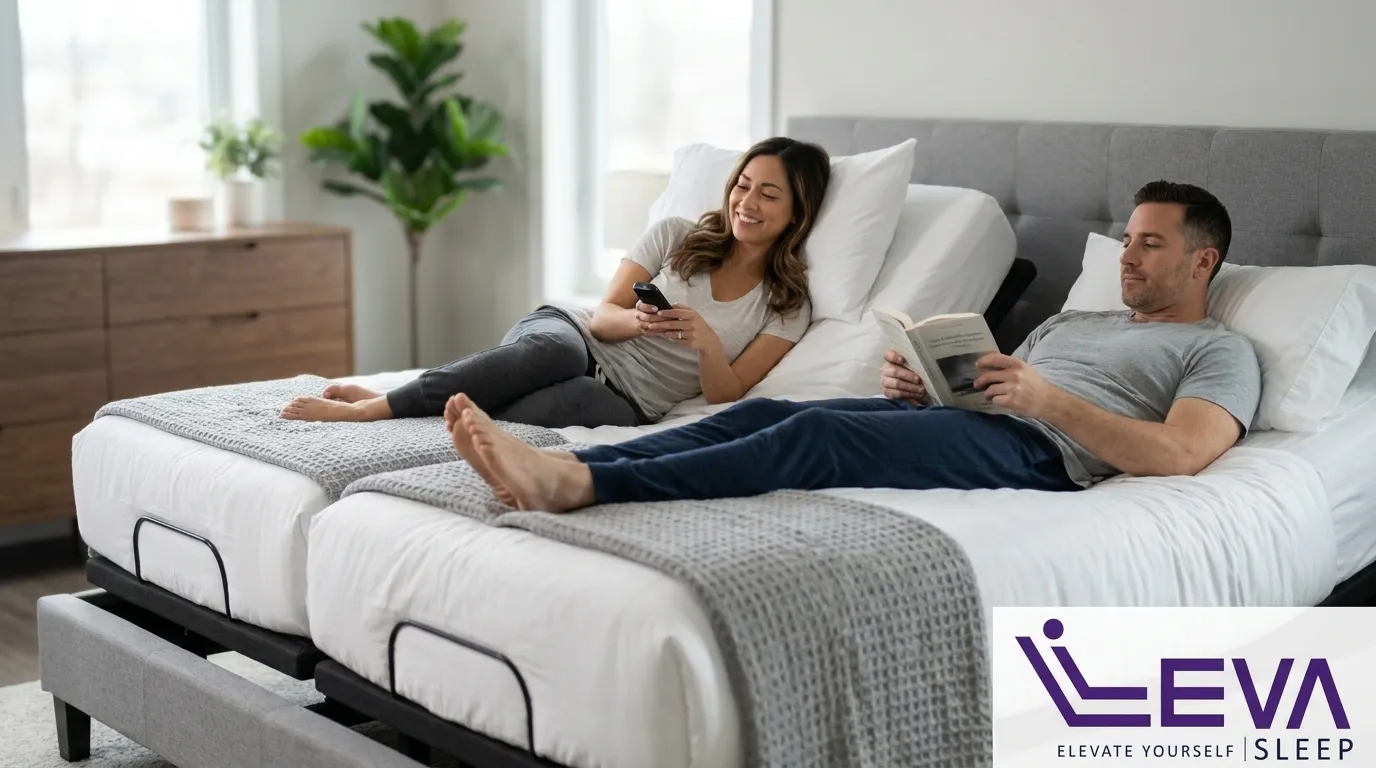
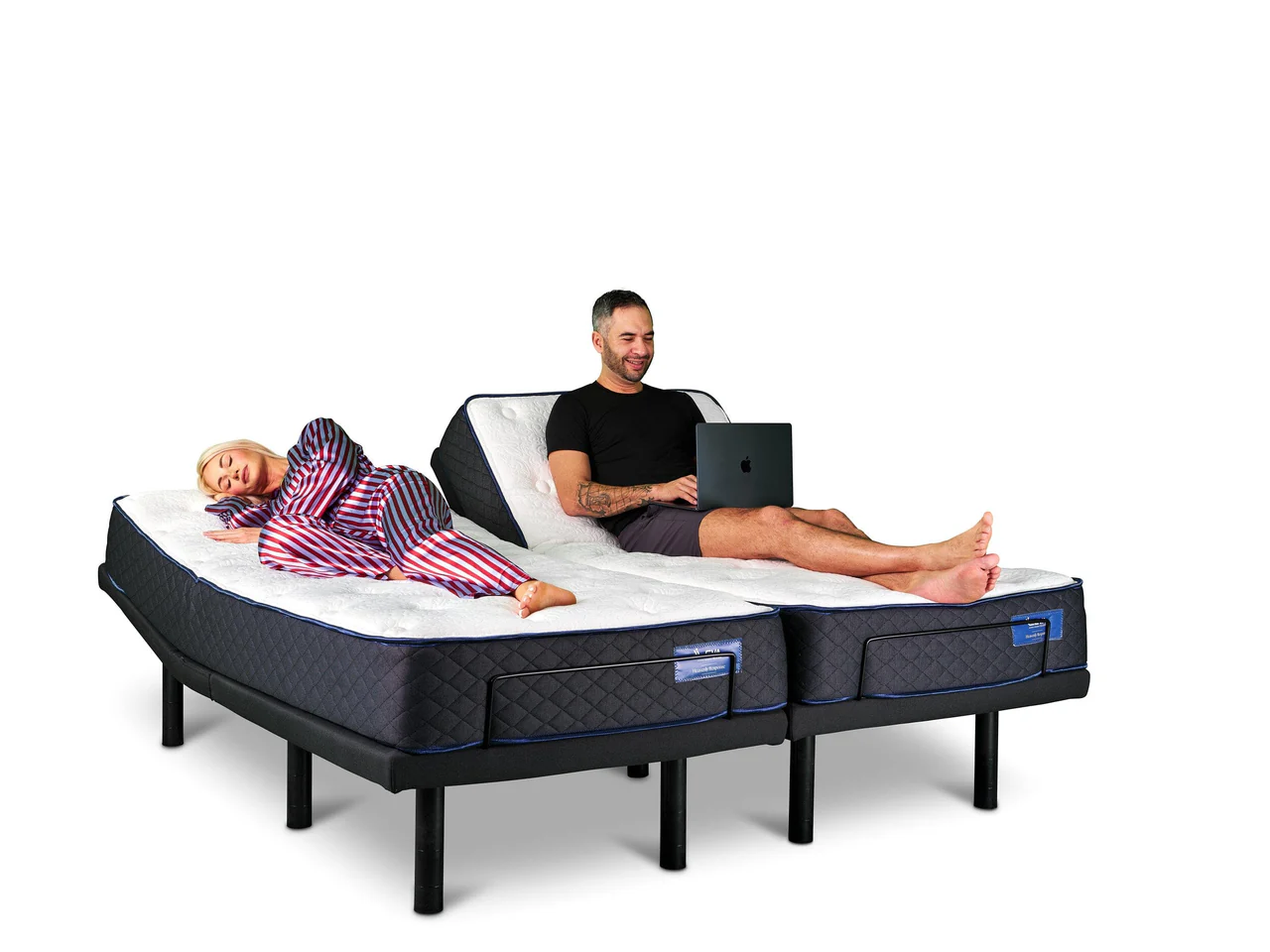
Independent split control lets each partner operate their own side of the bed through a dedicated wireless remote or app profile with no mechanical linkage. A Split King setup uses two Twin XL adjustable bases positioned side by side, giving each sleeper total independent control via wireless remote, smartphone app, or voice commands. Split configurations allow one partner to sleep flat while the other elevates their head or runs massage without the other feeling it.
The trade-off between physical and app-based split control centers on reliability versus flexibility. A physical remote stays charged, needs no Wi-Fi, and can be operated by touch in complete darkness. An app profile allows unlimited saved positions and remote scheduling but depends on Bluetooth or Wi-Fi connectivity.
For couples where one partner adjusts frequently at night, a physical remote with a backlit display keeps those changes quick and low friction. Leva Sleep’s Split Queen and Split King adjustable bases provide independent controls for each side, which helps when one partner needs head elevation for reflux while the other prefers a flat position.
One-Touch Presets and Anti-Snore Relief
One-touch presets are factory-programmed or user-defined positions that you access with a single button press. Anti-snore preset positions raise the head section slightly to open the airway, which can reduce snoring and improve breathing for couples where one partner experiences this issue. Sleep Number’s FlexFit 2 includes Partner Snore technology that lets one partner raise the other partner’s head with a single button press on the wireless remote.
A manual anti-snore preset still requires the non-snoring partner to wake up and press a button. Leva Sleep’s upcoming anti-snore detection, arriving in 2026, addresses this limitation by detecting snoring acoustically and making micro-adjustments to the head of the bed automatically.
Scenario: One partner begins snoring at 2 a.m. The other partner, instead of nudging or leaving the room, presses the anti-snore preset on their side’s remote. The snoring partner’s head rises a few degrees, the airway opens, and both return to sleep within minutes.
Memory Positions for Consistent Comfort
Memory positions let each partner save preferred head and foot angles to numbered slots on the remote or app. For couples sharing a split base, separate programmable presets for each side are worth prioritizing to ensure genuine positional control without compromise. Models like the Nectar Adjustable Bed Frame come with remotes that include slots for saving favorite positions.
The practical trade-off is slot count. Physical remotes on mid-range bases typically offer two to three memory slots per side. App-based systems on premium bases can store unlimited named profiles, which helps couples who use different positions for reading, sleeping, and post-surgery recovery.
Scenario: A partner recovering from knee surgery needs a specific 15-degree leg elevation each night. Instead of manually adjusting the foot section by feel in the dark, they press memory slot one and the base moves to the saved angle.
Quiet Motors That Protect Shared Sleep
Modern adjustable bases use DC motors that produce only a low hum similar to a refrigerator, not loud enough to wake a sleeping partner when one person adjusts their side independently. A base that makes audible noise every time position is adjusted will get used less and will wake a partner, so quiet motor operation matters for couples. Motor noise is the single most cited reason couples stop using adjustable features after purchase.
The trade-off is cost. Whisper-quiet DC motors appear on mid-range and premium bases, while budget bases often use older AC motor technology that produces more mechanical noise. When evaluating a base in a showroom, ask for a live demonstration at night-simulation volume levels and do not rely on decibel ratings alone.
Leva Sleep’s adjustable bases use whisper-quiet German motors, a specification that directly addresses the most common complaint about basic adjustable beds: motor noise that defeats independent split control by waking the partner.
Best Adjustable Bed Setup for Different Sleep Preferences
Quiet motors solve the noise problem, but many couples still face a broader challenge with fundamentally different sleep needs. Couples with mismatched sleep preferences, such as one partner needing firm support for back pain and the other needing pressure relief for hip pain, benefit from remote systems that control elevation, firmness, and temperature independently. Split-king adjustable bases consist of two independent Twin XL units that give each partner fully separate control over head and foot positions, which suits couples with mismatched sleep preferences or health conditions such as snoring or reflux.
When evaluating bases for differing preferences, prioritize remote systems that include:
- Per-side independent elevation control with no mechanical linkage
- Per-side massage intensity and zone settings
- Compatibility with temperature-regulating pads controlled independently per side
- App profiles that save each partner’s full configuration separately
Leva Sleep’s Split Queen option extends these capabilities to smaller room configurations where a Split King is not practical, a size that most competitors do not offer.
Choosing Between Remote App and Physical Remote
Nolah’s Smart Adjustable Base can be controlled via wireless remote or voice commands, which helps users with mobility issues. The Saatva Adjustable Base includes a wireless remote and optional smartphone app control, while the built-in flashlight is a feature of the Adjustable Base Plus remote.
The core comparison between app and physical remote breaks down across three dimensions that matter to couples.
- Reliability: Physical remotes function without Wi-Fi or Bluetooth range issues and do not require a charged phone. Apps depend on connectivity and device battery, which can fail at night.
- Ease of use at night: A backlit physical remote with tactile buttons can be operated by touch without looking. A phone app requires unlocking the screen, which produces light that may disturb a lighter sleeper.
- Feature depth: Apps provide scheduling, sleep tracking integration, unlimited memory profiles, and firmware updates. Physical remotes are limited to the buttons present at manufacture.
Most couples benefit from a system that offers both, with a physical remote for immediate nighttime adjustments and an app for configuration, scheduling, and health data review.
Quiet Adjustable Bed Motors for Couples
Saatva designs the motors on its Adjustable Base to be especially quiet, making the model suitable for light sleepers in shared sleeping environments. As noted earlier, motor noise remains the top barrier to consistent use of adjustable features. A base with independent split control only helps if both partners feel comfortable using it at night.
When evaluating motor noise, consider:
- Whether the manufacturer specifies DC versus AC motor technology
- Whether massage mechanisms operate quietly at all intensity levels
- Whether the base has been tested in a showroom environment at low ambient noise levels
- Whether the motor noise profile changes when the base is loaded with a mattress and two sleepers versus an empty demonstration unit
Leva Sleep’s German motors are engineered for whisper-quiet operation under load, which narrows the gap between showroom demonstrations and real-world bedroom use.
Real-World Couple Scenarios and Matching Features
The following scenarios map common couple pain points to the remote features most likely to resolve them.
- Snoring partner: One partner snores intermittently. The other wakes, reaches for the physical remote, and presses the anti-snore preset. The snoring partner’s head rises four to six degrees, the airway opens, and snoring reduces without either partner fully waking. With Leva Sleep’s upcoming auto-detection, this adjustment happens without any manual intervention.
- Elevated head for sleep apnea: One partner uses a CPAP alternative, head elevation, to manage mild apnea. Their memory position is saved to slot one on their side’s remote. Each night they press one button and the base moves to the angle their physician recommended, while the other partner’s side remains flat.
- Differing temperature needs: One partner sleeps hot, the other cold. Each side of the split base is paired with an independent temperature-regulating pad controlled through the app. Each partner adjusts their thermal setting without affecting the other side, which ends the blanket-stealing dynamic that disrupts sleep.
Practical Considerations Before You Buy
Remote features only help when the overall system fits your household. Before purchasing, review the following factors that affect long-term usability.
- Learning curve: App-controlled bases with extensive feature sets require initial setup time. Confirm that both partners feel comfortable with the interface before delivery, ideally through a showroom demonstration, so nightly use feels natural.
- Maintenance: Wireless remotes can be lost or damaged. Confirm whether replacement remotes are available and at what cost. App-controlled systems reduce this risk but require ongoing software compatibility with phone operating systems, which affects long-term reliability.
- White-glove delivery impact: A professional setup ensures the base is calibrated correctly, the app is paired to both partners’ devices, and memory positions are programmed before the delivery team leaves. This professional calibration shortens the learning curve and encourages regular use of advanced features.
- Future health changes: A couple’s needs at 45 may differ significantly at 60. Prioritize bases with firmware-updatable features and modular accessories, such as lumbar support add-ons, that you can add as needs evolve without replacing the entire system.
Decision Checklist for Couples
Use the checklist below to match your top two pain points to the features that address them most directly.
- Partner disturbed by your adjustments at night → Prioritize independent split control and quiet DC motors.
- Snoring disrupts shared sleep → Prioritize one-touch anti-snore presets and consider bases with automatic snore detection.
- Different preferred sleeping angles → Prioritize memory positions with at least two slots per side.
- Difficulty operating remote in the dark → Prioritize a backlit physical remote or voice control integration.
- Different temperature preferences → Prioritize app-controlled split bases compatible with independent thermal pads.
- Mobility limitations → Prioritize voice control via Alexa or Google Home alongside a physical remote.
- Smaller bedroom requiring a non-King size → Confirm Split Queen availability, since most competitors offer Split King only.
Frequently Asked Questions
Do both partners need separate remotes on a split adjustable base?
On a properly configured split adjustable base, each side operates independently and each partner receives their own wireless remote. One partner can raise their head section, activate massage, or recall a memory position without sending any signal or mechanical movement to the other side.
Some systems also let both partners control their respective sides through individual profiles in a shared app. This setup helps with scheduling features like vibrating alarms or under-bed lighting without relying only on a physical remote.
How noisy are adjustable bed motors when one partner adjusts at night?
Premium adjustable bases use DC motors that produce a low, consistent hum during movement, comparable in volume to a refrigerator running in an adjacent room. This level of noise usually does not wake a sleeping partner, especially when the adjusting partner moves slowly through a position change instead of jumping between extreme angles.
Budget bases using older AC motor technology tend to produce more mechanical noise and vibration. The most accurate way to evaluate motor noise is to request a live demonstration in a showroom with ambient noise levels reduced and to ask specifically about noise under a loaded mattress rather than an empty frame.
Is app control more reliable than a physical remote for nighttime adjustments?
Physical remotes are generally more reliable for immediate nighttime adjustments because they do not depend on Wi-Fi connectivity, Bluetooth range, or phone battery. A backlit physical remote with tactile buttons can be operated entirely by touch without producing screen light that might disturb a lighter sleeper.
App control offers advantages in feature depth, including unlimited memory profiles, scheduling, sleep tracking integration, and firmware updates, but it introduces dependency on device and network conditions. Most premium bases offer both options, which suits couples who want reliability for nighttime use and flexibility for daytime configuration.
What is an anti-snore preset and how does it work on a split base?
An anti-snore preset is a factory-programmed position that raises the head section of the bed by a set number of degrees, typically between four and twelve, to gently open the sleeper’s airway and reduce the soft-tissue vibration that causes snoring. On a split base, the anti-snore preset applies only to the side it is activated on, so the snoring partner’s head rises while the other partner’s position remains unchanged.
Some systems require the non-snoring partner to press a button on the snoring partner’s remote or through the app. More advanced systems, including Leva Sleep’s upcoming auto-detection feature, identify snoring acoustically and trigger the adjustment automatically without any manual input from either partner.
Can a Split Queen adjustable base accommodate two partners with very different sleep needs?
A Split Queen adjustable base provides the same independent per-side control as a Split King but in a smaller footprint, which suits couples in rooms where a King-size bed is not practical. Each side operates as an independent unit with its own motor, remote, and memory positions.
One partner can sleep flat with no elevation while the other uses a zero-gravity or anti-snore position. The primary limitation compared to a Split King is mattress availability, since Split Queen requires two Twin mattresses rather than two Twin XL mattresses, which are more widely available. Leva Sleep builds Split Queen configurations to customer specifications, addressing the availability gap that prevents many couples from accessing split adjustability in a Queen footprint.
Conclusion: Building a Couple-Friendly Adjustable Bed System
The main challenge for couples evaluating adjustable bed remote systems lies in choosing features that genuinely reduce partner disturbance and support independent sleep. Independent split control and quiet motors form the non-negotiable foundation for shared comfort.
One-touch anti-snore presets and memory positions address the most common nighttime disruptions. App integration adds scheduling and health-tracking depth for couples who want a connected sleep environment, while physical remotes with backlit controls remain the most reliable option for dark-room adjustments.
Leva Sleep’s Split Queen and Split King systems combine these capabilities with the German-engineered quiet motors described above, app control, and white-glove delivery. This combination creates a complete solution for couples who want to stay in the same bed and still sleep comfortably on their own terms.