Written by: Matthew Timmins, Founder and Managing Director, Leva Sleep
Key Takeaways for Snoring Couples
- Adjustable beds can reduce positional snoring by elevating the head between 7.5 and 30 degrees, which clinical studies link to lower OSA severity.
- Single adjustable bases like standard Tempur-Pedic king models move the entire mattress together, so both partners share the same angle.
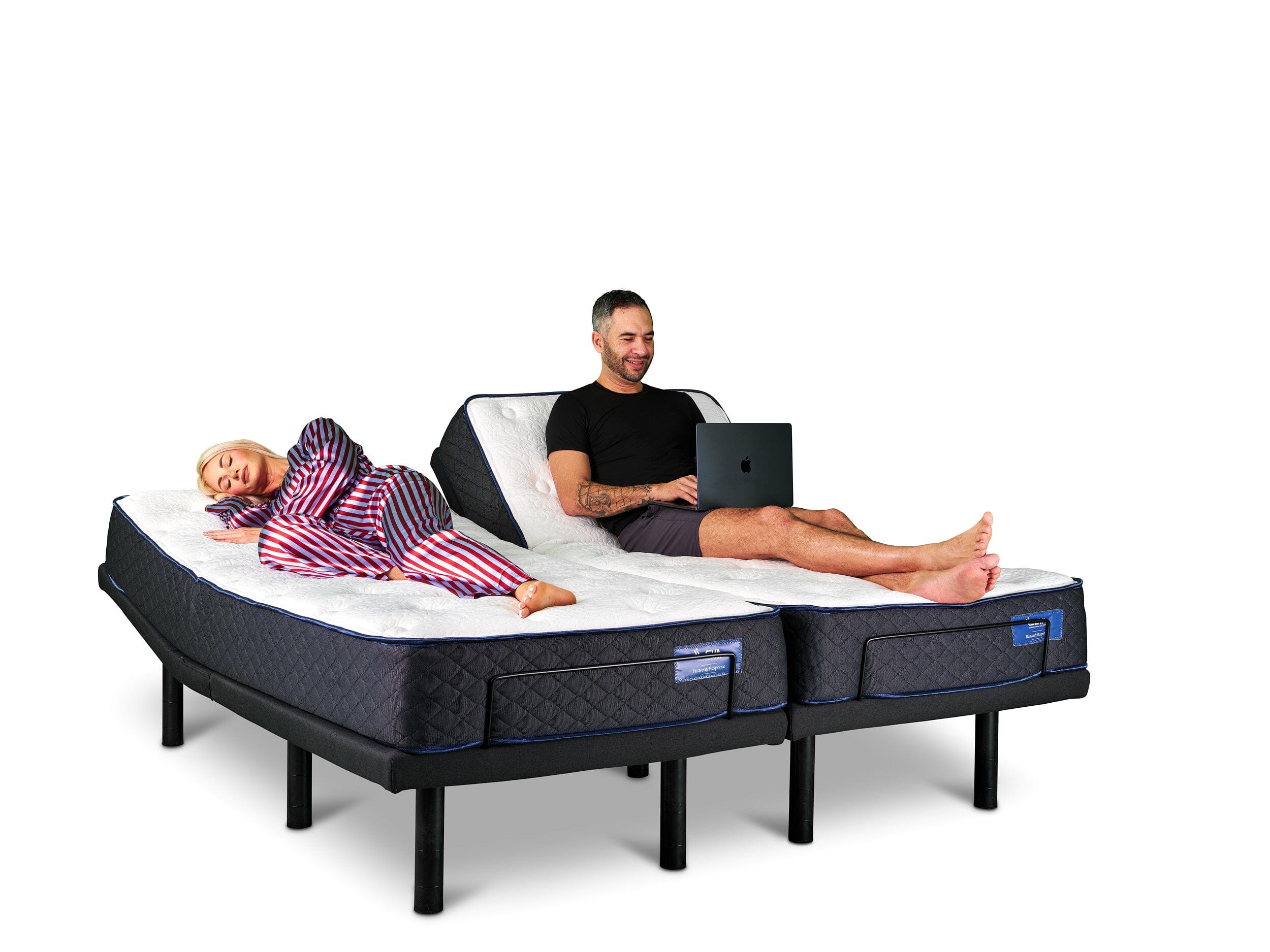
- Split adjustable systems give each partner independent elevation control, motion isolation, and personalized presets without disturbing the other sleeper.
- Head elevation supports positional snoring relief but does not replace CPAP or treat non-positional causes of snoring.
- Couples who want customizable, quiet, and affordable split configurations can explore Leva Sleep’s split king and split queen options built for independent snoring relief.
How Different Bed Setups Change Snoring Relief
The three main configurations couples consider are flat beds, single adjustable bases, and split adjustable systems. Each option handles positional snoring and two sleepers in very different ways.
Flat beds
- Flat beds offer no elevation. Sleeping flat on the back allows throat tissue to relax and narrow the airway.
- Wedge pillows or bed risers act as workarounds, yet they rarely match the comfort or precision of motorized angles.
- Patients in clinical settings often could not tolerate a 20-centimeter foam wedge because it created a sensation of falling.
- Flat beds offer no independent control when partners have different snoring patterns or comfort needs.
Single adjustable bases (including standard Tempur-Pedic king configurations)
- These bases provide motorized elevation from roughly 7.5 to 30 degrees, which can open the airway and ease positional snoring.
- Research shows that a 30-degree elevation can reduce AHI from 15.7 to 10.7 events per hour in controlled settings.
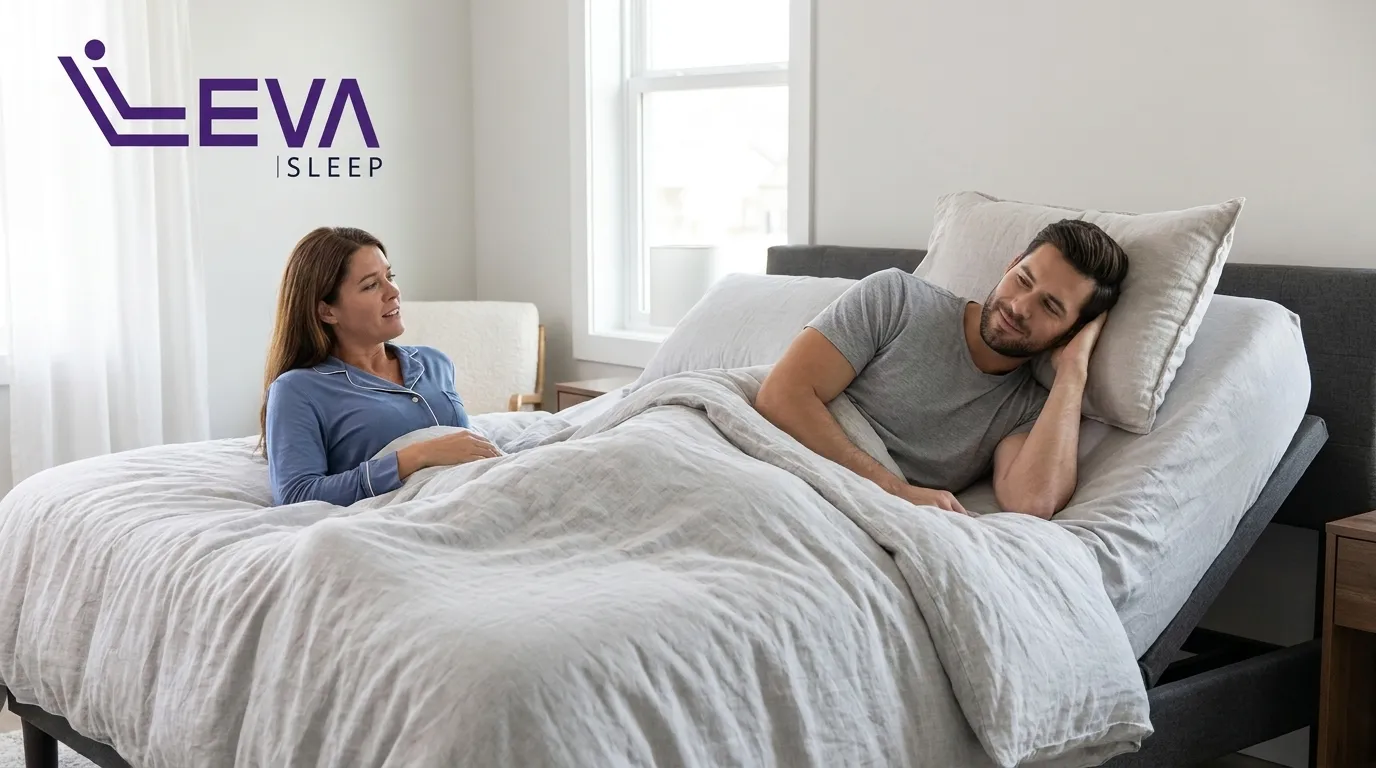
- Both partners share the same incline angle, so one partner usually compromises on comfort or snoring relief.
- On a single-unit mattress, motion from one side transfers to the other when a partner changes position or adjusts the base.
Split adjustable systems (Leva Sleep Split King and Split Queen)
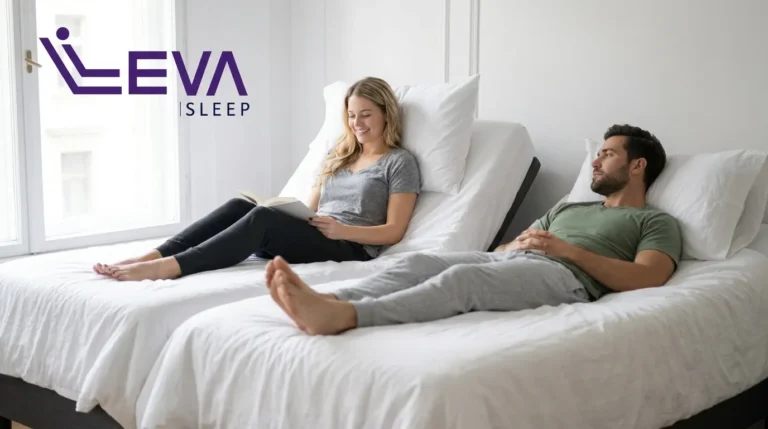
- One partner can maintain a 20-degree head incline while the other sleeps flat, since no shared angle is imposed.
- Independent bases isolate motion, so adjustments on one side do not disturb the other sleeper.
- Each side has its own controls, including app-based presets and massage functions tailored to that partner.
- Leva’s whisper-quiet German motors limit noise, which helps couples avoid the disruption common with basic adjustable bases.
How Tempur-Pedic Handles Snoring Relief
Tempur-Pedic offers two main adjustable configurations that relate to snoring. The standard TEMPUR-Ergo Power Base provides motorized elevation but moves both sides of a king mattress together, so both partners share one angle. The TEMPUR-Ergo Smart Base adds AI-powered snoring detection and automatically raises the head about 12 degrees to a position that may reduce positional snoring in otherwise healthy individuals. That automation carries a price premium over the standard Power Base.
The Tempur-Pedic Split King solves the shared-angle problem by separating the base. Two remotes allow each side to function individually or in tandem, so each partner can adjust head and foot elevation independently. Tempur-Pedic’s adjustable base lineup, however, remains relatively narrow. Standard mattress retailers often stock three to five adjustable models, while Leva Sleep carries 15 to 20 configurations, including the Split Queen size, which most brands do not offer and which Leva builds to customer specifications.
For couples where only one partner snores, the automatic 12-degree detection on a single Tempur-Pedic base still elevates both partners unless they choose a split configuration. For couples where both partners snore at different intensities, sleep specialists often suggest 10–15 degrees for light snoring and 20–30 degrees for moderate to heavy snoring. Those ranges differ enough that a shared preset usually fails to serve both partners well.
Best Adjustable Setup When Both Partners Snore
When both partners snore, a single adjustable base from any brand creates a built-in conflict. The elevation that eases one partner’s snoring often feels excessive or ineffective for the other. A split configuration addresses that conflict directly by separating control.
On a standard king adjustable base the entire mattress moves as one unit, while a split king uses two independent Twin XL bases. Each side articulates separately, so partners can fine-tune angles without compromise.
Common situations where split systems outperform single bases include the following.
- Partner A needs 20–30 degrees for moderate snoring, while Partner B needs only 10 degrees or prefers flat. A single base cannot satisfy both at once.
- One partner snores positionally and improves with elevation. The other snores from nasal congestion and gains little from incline but still feels the shared angle.
- Partners differ on firmness as well as elevation, which makes a full split configuration more suitable than a split-top king with one shared firmness.
A split-top king with a single-firmness base works best when the only need is independent head elevation and both partners like the same feel. When firmness and elevation needs diverge together, a full split system becomes the better fit.
Limits of Head Elevation for Sleep Apnea and Other Causes
Head elevation supports positional therapy but does not act as a stand-alone medical treatment. Several documented limits shape what couples can expect.
- Response to head elevation varies widely between individuals, so not every patient experiences meaningful benefit.
- Elevation tends to reduce hypopneas more than apneas, which makes it less helpful for many people with severe OSA.
- Central sleep apnea arises from brain signaling issues rather than airway collapse, so elevation does not address that condition.
- CPAP therapy remains the most effective treatment for obstructive sleep apnea–related snoring, and adjustable beds mainly support mild positional cases.
- Head-of-bed elevation may be unsafe for some patients with lower limb edema and venous insufficiency.
- Snoring from nasal congestion often responds better to nasal strips or dilators, while snoring from excess throat tissue requires separate clinical evaluation.
Any couple who notices snoring with breathing pauses, gasping, or significant daytime fatigue should schedule a clinical sleep study. No split or single adjustable base resolves the underlying medical condition of obstructive sleep apnea. Diagnosis and treatment, often including CPAP, still matter.
Real-World Feedback from Couples Using Adjustable Beds
Clinical data explains what adjustable beds can do, but long-term satisfaction comes from daily use. Couples who own adjustable bases often highlight a few practical factors.
- Motor noise: Basic adjustable bases can sound loud enough to wake a light sleeper during nighttime changes. Leva Sleep’s whisper-quiet German motors aim to prevent that disruption.
- Motion transfer: On a single-unit king mattress, one partner’s movement or angle change travels across the bed. Split bases with separate mattresses largely remove that motion.
- Bedding compatibility: Standard fitted sheets can pop off during elevation. Leva designs deep-pocket sheets with extra elastic and duvets with clips that stay in place on adjustable setups.
- Learning curve: App-controlled bases with multiple presets require some setup. Leva’s white-glove delivery includes in-home tutorials and live adjustments so couples start with dialed-in positions.
- Health changes over time: A snoring pattern that improves at 15 degrees today may shift with weight, nasal health, or sleep habits. Motorized bases with app control let couples adjust settings over time without replacing equipment.
Cost and Value: Tempur-Pedic vs. Leva Sleep Split Systems
Tempur-Pedic positions itself as a premium brand with strong mattress recognition, and its adjustable bases sit at the top of the price range. The TEMPUR-Ergo Smart Base adds automated snoring detection, which helps single-base setups, yet that feature set narrows when compared with a full split system that includes independent app control, lumbar support, pillow tilt, and an upcoming anti-snore mode that detects snoring and makes micro-adjustments to head position.
Leva Sleep’s direct-to-consumer model designs and assembles systems locally while managing manufacturing. This approach removes retail markup and delivers premium materials and engineering at roughly 30–50 percent less than comparable high-end competitors. That price gap becomes especially important for couples who need a split configuration. A Tempur-Pedic Split King with the Smart Base upgrade represents a major investment. Leva’s split systems provide independent controls, quiet motors, and app integration at a lower price point, with white-glove delivery and setup available for a fee.
Decision Guide: Matching a Bed to Your Snoring Pattern
Use the following criteria to match your situation to the right configuration and avoid trial-and-error purchases.
- Only one partner snores lightly and positionally: A single adjustable base with elevation presets may be enough. Confirm that the snoring clearly improves with position changes before skipping a split system.
- Both partners snore at different intensities: A split adjustable base usually becomes the right choice because independent angle control matters in this scenario.
- Partners differ on firmness as well as elevation: A full split system with separate mattresses on each side works better than a split-top base with one shared firmness.
- Snoring appears with breathing pauses or gasping: Schedule a clinical sleep study first. No adjustable base replaces medical diagnosis or CPAP therapy for obstructive sleep apnea.
- Motor noise or bedding fit is a concern: Focus on brands that design specifically for adjustable use, including quiet motors and bedding that stays in place during elevation.
- Budget matters: Compare split configurations directly. Leva Sleep’s 30–50 percent price advantage over similar luxury brands makes split systems more attainable without cutting features.
Frequently Asked Questions
Do adjustable beds actually stop snoring, or just reduce it?
Adjustable beds mainly reduce positional snoring by elevating the head so gravity pulls less on the tongue and soft palate. Clinical research shows meaningful reductions in airway obstruction events at modest elevation angles. However, elevation does not resolve snoring caused by nasal congestion, excess throat tissue, or central sleep apnea. Most positional snorers see a noticeable reduction rather than complete silence, and about 60 percent of patients in studies show meaningful benefit.
Is a split king adjustable bed worth it for couples where only one partner snores?
A split king often makes sense even when only one partner snores, especially if partners also differ on firmness or temperature. The snoring partner can elevate to a comfortable angle without forcing the other into an incline. The non-snoring partner gains motion isolation because adjustments on one side do not transfer across the bed. If firmness preferences match and the only need is independent head elevation, a split-top king with a single-firmness base can work. When differences span elevation, firmness, and temperature, a full split system usually delivers the most tailored setup.
What elevation angle is recommended for snoring relief?
Sleep specialists often recommend 10–15 degrees for light snoring and 20–30 degrees for moderate to heavy snoring. Lower angles can still help some people, while higher angles may feel uncomfortable for others. The ideal angle depends on anatomy, body weight, and the specific cause of snoring. Motorized adjustable bases with app control let couples test and save different angles over time, which proves more practical than fixed wedges or pillows.
Can an adjustable bed replace a CPAP machine for sleep apnea?
No. Adjustable beds support mild to moderate, position-dependent obstructive sleep apnea but do not replace CPAP therapy. CPAP remains the most effective treatment across OSA severity levels. Head elevation may reduce the frequency and intensity of obstruction events in positional cases, yet it does not correct the underlying anatomical or neurological causes. Anyone who experiences breathing pauses, gasping, or major daytime fatigue should consult a sleep medicine physician before relying on positional therapy alone.
How does Leva Sleep’s anti-snore mode differ from Tempur-Pedic’s automatic snoring detection?
Tempur-Pedic’s TEMPUR-Ergo Smart Base uses AI to detect snoring and then raises the head about 12 degrees on the affected side of a split configuration. Leva Sleep is developing an anti-snore mode that detects snoring and makes small, targeted head adjustments to reduce or stop it. This feature operates within Leva’s broader split system ecosystem, so each side responds independently to that partner’s snoring. Leva’s system also connects with app-based sleep tracking and custom position presets, creating a more flexible adjustment framework than a single fixed response angle.
Conclusion: A Bed That Works for Both of You
Head elevation offers an evidence-backed, non-invasive way to reduce positional snoring. Single adjustable bases, including Tempur-Pedic’s standard options, provide that elevation but lock couples into a shared angle that often fails one partner. Split adjustable systems solve this by giving each partner independent control over elevation, firmness, and presets while limiting noise, motion transfer, and bedding issues.
Leva Sleep’s split king and split queen systems focus on couples in this exact situation. They combine whisper-quiet German motors, app-controlled independent sides, adjustable-specific bedding, and an upcoming anti-snore mode that responds to each partner individually. With 15 to 20 adjustable models, white-glove delivery, and pricing 30–50 percent below similar luxury competitors, Leva offers a targeted and accessible alternative to general-purpose single bases from traditional mattress brands.
Transform your sleep with Leva Sleep by visiting the La Jolla showroom or shopping online today.