
Written by: Matthew Timmins, Founder and Managing Director, Leva Sleep
Key Takeaways for Adjustable-Base Mattresses
- Adjustable bases work best with mattresses that flex at the lumbar hinge without bunching, bridging, or losing support at changing angles.
- Memory foam, split-layer latex, and pocketed-coil hybrids are the only constructions that consistently meet six key performance needs for articulating bases.
- Mattress thickness between 10–12 inches usually delivers a strong mix of flexibility, comfort, and long-term durability on adjustable frames.
- Compatible mattresses on adjustable bases do not wear out faster when the manufacturer certifies them for articulation use.
- Leva Sleep offers integrated mattress and split-base systems engineered for repeated articulation. Explore the full lineup of certified adjustable-base mattresses.
Quick Comparison: Memory Foam, Latex, and Pocketed Hybrids
The table below compares the three compatible mattress types by thickness range, articulation performance, and fit for common sleep challenges. Use it to narrow your choices before you dive into the detailed guidance that follows.
| Mattress Type | Recommended Thickness | Adjustable-Base Compatibility | Couples / Medical Considerations |
|---|---|---|---|
| Memory Foam | 10–12 inches optimal, 8–14 inches generally acceptable | Highest, with no rigid internal components and viscoelastic material that conforms to the articulating surface without resisting the hinge point | Strong motion isolation that suits light sleepers and many side sleepers with hip or shoulder pain, though some models retain heat without gel-infused or open-cell designs |
| Latex (split-layer or Talalay) | Under 12 inches for single-core designs, while split-layer configurations articulate cleanly at a wide range of thicknesses | High, with thousands of flex and recovery cycles, although single molded cores at 12 inches or thicker can resist bending and place extra stress on the motor | Naturally cooler and more responsive than memory foam, a good match for many stomach and back sleepers, with a longer lifespan that supports shared investments for couples |
| Pocketed-Coil Hybrid | 10–14 inches, with some 14-inch models performing well when they use individually pocketed coils | High when coils are individually pocketed, while Bonnell or continuous coil hybrids remain incompatible and can deform or puncture comfort layers | Blends foam comfort layers with coil bounce and airflow, suiting couples with different firmness needs and back or stomach sleepers who want firmer support |
Mattress Thickness That Works on Adjustable Bases
Mattresses between 10 and 14 inches generally perform well on adjustable frames. Within that range, 10–12 inches often feels comfortable while still flexing cleanly at the hinge. Construction quality in each layer matters as much as total height, and a well-built 10-inch mattress can outperform a thicker 14-inch or 16-inch model because thickness alone does not signal quality.
Mattresses above 14 inches introduce two main risks. Extra height can exceed the base’s weight rating and can create a bending radius that strains thick foam or latex cores. Many base manufacturers specify maximum mattress heights to preserve full articulation and warranty coverage. Taller mattresses also raise the sleeping surface, which can make getting in and out of bed harder for shorter sleepers or anyone with mobility challenges.
Sleep position also shapes preferred thickness. Back sleepers often do well with medium profiles. Side sleepers usually prefer thicker options for added pressure relief at the shoulders and hips. Stomach sleepers often benefit from lower profiles that help maintain spinal alignment. On a split base, each partner can choose a thickness that suits their own position without affecting the other side.
How Adjustable Bases Affect Mattress Wear
Adjustable bases do not damage compatible mattresses. Many modern memory foam, latex, and hybrid models are engineered to flex with adjustable frames without bunching or sagging. Construction compatibility remains the deciding factor, so focus on these visible cues when you evaluate a mattress for long-term articulation.
- Lumbar hinge behavior: When the head section rises, the cover at the mid-section should stay smooth and taut. Visible gathering or ridging at the lumbar zone signals that the cover or comfort layer is not built for repeated flex.
- Edge support when raised: The mattress perimeter should hold its profile when the head or foot section elevates. Foam-encased edge support usually bends more cleanly on adjustable bases than steel-rod borders, which can press into the base mechanism.
- Cover behavior on split movement: On a split base, each Twin XL or Split Queen mattress cover should flex independently without pulling at the seam or distorting the neighboring surface.
- Manufacturer certification: Certification from the manufacturer offers the clearest signal of compatibility with adjustable bases because it confirms testing through articulation cycles.
When you pair an adjustable bed with a mattress designed for repeated flex, articulation does not shorten the mattress lifespan. Certification for adjustable-base use also helps preserve warranty coverage.
Mattress Types for Arthritis and Scoliosis Relief
Adjustable bases paired with suitable mattresses can ease chronic pain by supporting healthier spinal angles and reducing tension. The most helpful construction depends on the specific condition and preferred sleep position.
For many arthritis sufferers, memory foam distributes pressure across the joint surface instead of concentrating it at a single point. Its viscoelastic contouring often helps side sleepers with back pain because it follows the shoulders, hips, and lumbar curve closely. When the base elevates the head or legs, the foam continues to conform to the new angle without forming pressure ridges.
For scoliosis and broader spinal alignment needs, pocketed-coil hybrids often perform well. Zoned support can limit sinkage at the hips while still cushioning the shoulders. Hybrids provide enough bounce to make position changes easier while still limiting motion transfer, which helps couples managing arthritis or mobility issues. Split-layer latex offers a firmer and more responsive surface that pushes back against the body rather than allowing deep contouring, which some scoliosis patients prefer for consistent lateral support.
Effective pressure relief on an adjustable base keeps stress off sensitive areas, which can reduce discomfort or pain when you wake up.
Pocketed Coils Compared to Solid Innersprings
Hybrid mattresses with individually pocketed coils flex well on adjustable bases because the coils move relative to each other instead of acting as a single rigid grid. Each coil sits in its own fabric pocket and can compress and tilt independently as the base moves. This design allows the mattress to bend at the hinge without the coil system fighting the motor.
Traditional innerspring systems behave very differently. Interconnected coils resist flex on adjustable bases, which creates pressure points at the bend and shortens mattress life. Bonnell coils, offset coils, and continuous coil designs are engineered for rigidity across the full surface. That rigidity works on a flat foundation but becomes a liability on an articulating base. Bending one section pulls on surrounding coils and can eventually cause permanent bends, fabric punctures, or lasting dips at fold points.
Leva Sleep Mattresses for Adjustable Bases
Leva Sleep designs its mattresses and split bases as a single integrated system, which removes the compatibility guesswork that comes with mixing brands. Leva all-foam and pocketed-coil hybrid mattresses use extra stretch panels and reinforced covers that handle the lateral movement of a Split Queen or Split King base without bunching at the lumbar hinge or tearing at the perimeter seam.
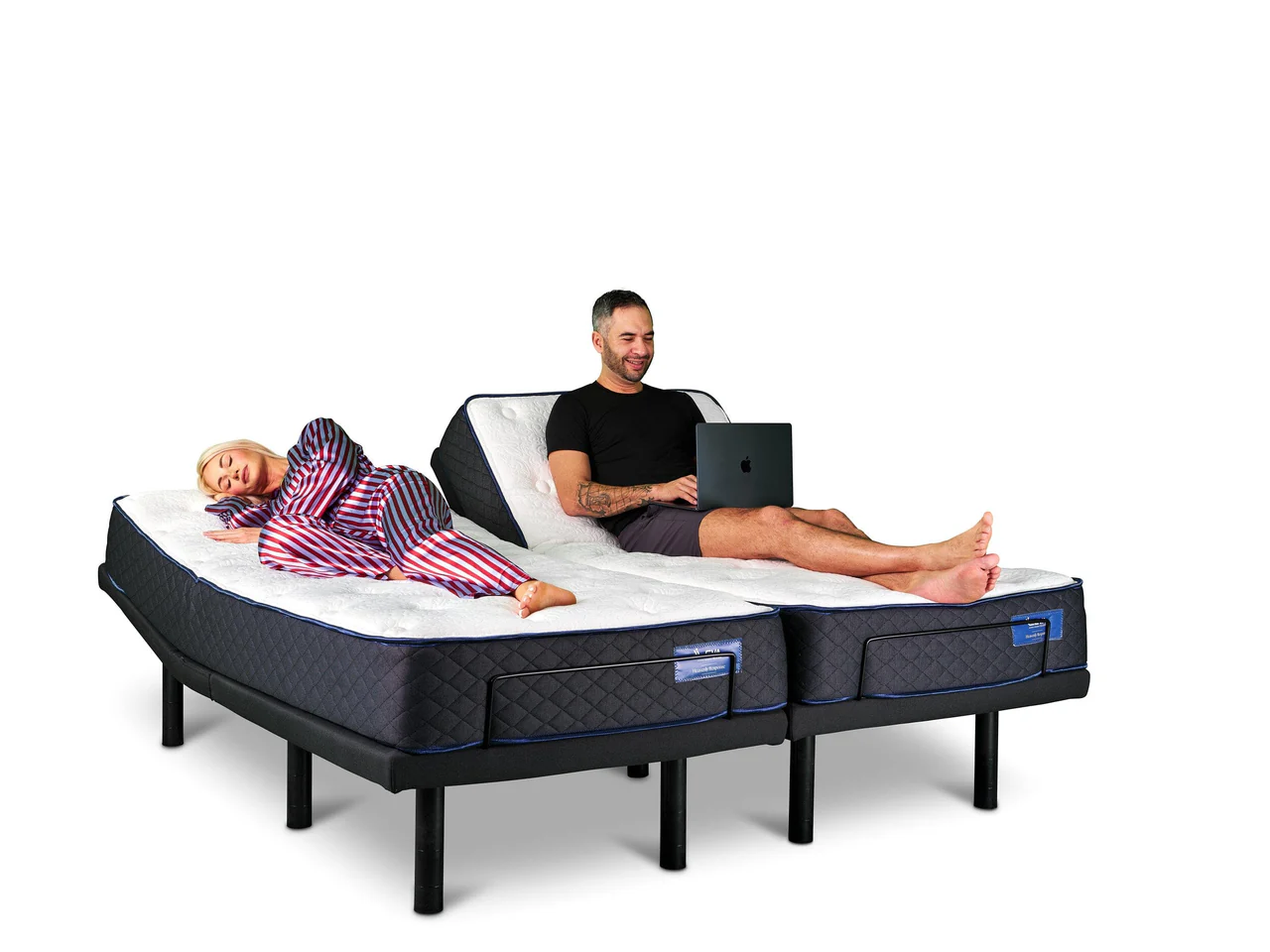
Because Leva assembles its systems locally and controls the full design process, every mattress in the lineup is verified for articulation compatibility before delivery. Whisper-quiet German motors in Leva bases are matched to mattress weight and thickness specifications, so the motor does not struggle against an overly rigid construction.
See how Leva’s integrated mattress and base systems eliminate compatibility guesswork.
Real Couples: Snoring, Firmness Differences, and Medical Positioning
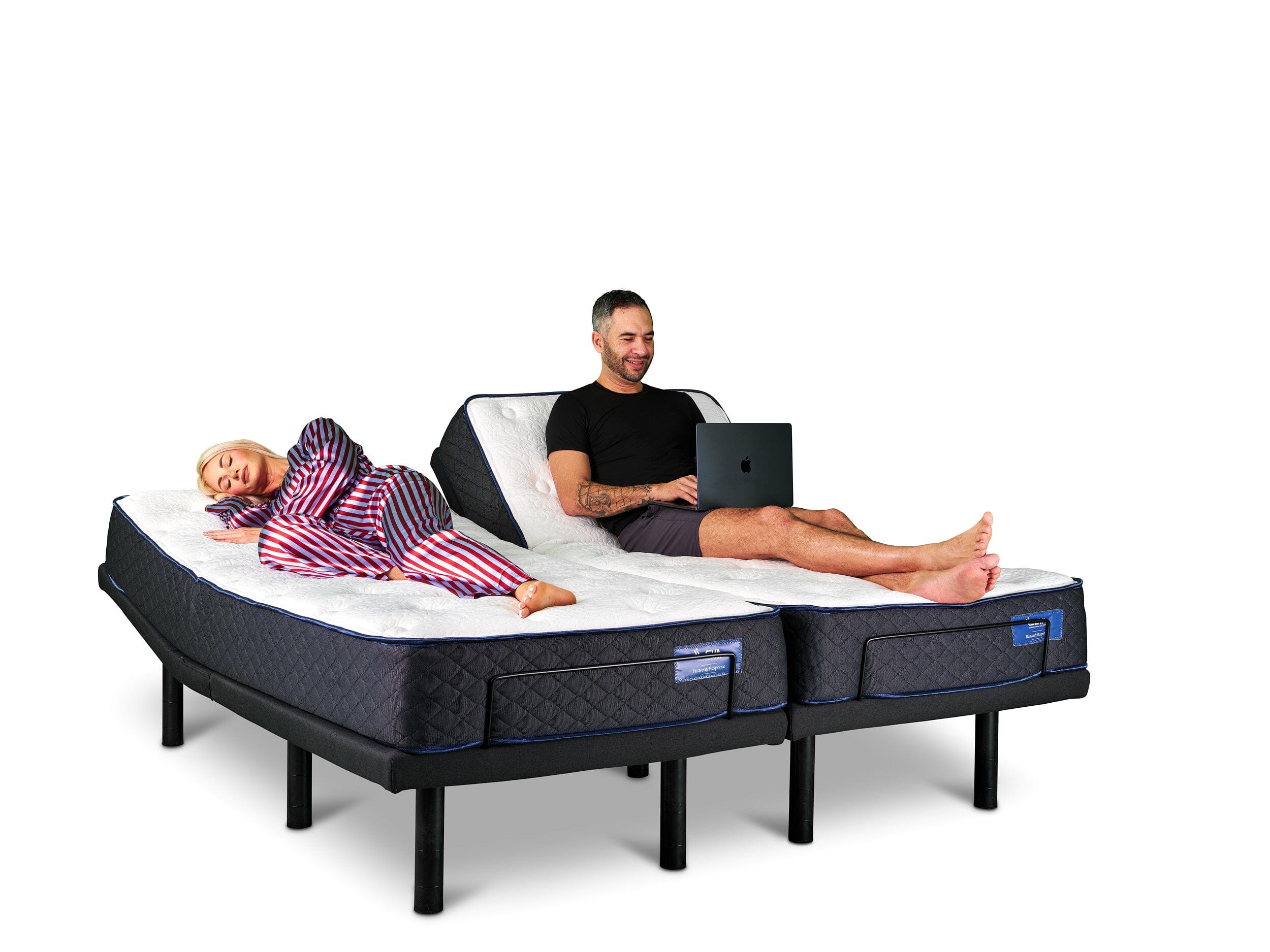
A split king adjustable bed with two independent Twin XL mattresses lets one partner use a 20-degree anti-snore incline while the other sleeps flat. This setup supports motion isolation for couples, and the mattress construction on each side determines how well the system handles independent movement.
Three common scenarios show how mattress type intersects with couples’ needs.
- Snoring and sleep apnea: Elevating the head of the bed can help reduce snoring by keeping airways more open. Memory foam handles this elevation smoothly because the viscoelastic material compresses evenly across the surface. On a split base, the snoring partner’s side elevates independently while the other remains flat, which calls for strong motion isolation on both mattresses.
- Differing firmness preferences: Pocketed-coil hybrids come in multiple firmness levels, so each partner on a split base can choose a different feel. Split king and super king adjustable setups use two separate mattresses placed side by side, which lets couples mix firmness levels or constructions on the same frame.
- Medical positioning for joint pain: Adjustable bases work well for sleepers who rest with their head elevated, including many people managing sleep apnea or acid reflux. Latex in a split-layer configuration provides a responsive, firmer surface that some orthopedic patients prefer, while still articulating cleanly with the base.
Mattress Types to Avoid on Adjustable Bases
Two broad mattress categories rarely work on adjustable bases and should be avoided regardless of price or brand reputation.
Solid innerspring mattresses with Bonnell, offset, or continuous coil systems resist bending and often damage both the mattress and the base. The rigid coil grid strains the motors and can create sharp pressure points at the hinge. Pillow-top and Euro-top innerspring models perform especially poorly because the extra upholstery adds bulk and stiffness on top of an already rigid core.
Low-density foam mattresses under 10 inches fail in a different way. Models below this threshold usually provide weaker overall performance. On an adjustable base, a thin foam mattress with a weak support core can bottom out under compression at elevated angles, which removes the pressure relief the position should provide.
Using an incompatible mattress on an adjustable base increases the risk of premature sagging, permanent creasing at fold lines, broken or shifted coils, and potential loss of manufacturer warranty coverage.
Decision Framework for Matching Mattress and Base
Use this checklist to connect your main sleep challenge with the construction features that address it directly.
- Primary concern: joint pain or pressure relief — Prioritize memory foam or a pocketed-coil hybrid with a soft-to-medium comfort layer, since these designs spread pressure across joints instead of concentrating it. After you identify a suitable construction, confirm that the mattress is rated for adjustable-base use and falls within 10–12 inches so it can flex cleanly at the hinge while preserving that pressure relief.
- Primary concern: sleeping hot — Focus on latex, which sleeps naturally cooler, or a pocketed-coil hybrid with open-cell foam comfort layers and coil airflow. Avoid dense, single-pour memory foam that lacks gel infusion or open-cell construction.
- Primary concern: snoring or sleep apnea positioning — Any of the three compatible constructions can work, while the split-base configuration becomes the key factor. Confirm that the mattress cover includes stretch panels that handle independent head elevation on each side.
- Primary concern: differing firmness preferences — Choose a split base with two separate mattresses, such as a Split Queen or Split King, so each partner can select the construction and firmness that matches their sleep position and body weight.
- Primary concern: long-term durability — Consider latex, which often outlasts foam and supports long-term shared investments for couples. Pocketed-coil hybrids also tend to last longer than many all-foam models. Confirm manufacturer certification for adjustable-base use to protect the warranty.
- Primary concern: motion isolation for a light sleeper — Choose memory foam when motion transfer is the main issue, since these models absorb movement and help partners sleep through position changes.
Frequently Asked Questions
Can any mattress be used on an adjustable base?
No. Memory foam, latex in split-layer or Talalay configurations, and pocketed-coil hybrids are compatible with adjustable bases because they flex without rigid internal components fighting the hinge. Traditional innerspring mattresses with interconnected coil systems, including Bonnell, offset, and continuous coil designs, are not compatible and can sustain permanent damage at the fold points. Always verify that the mattress manufacturer explicitly approves adjustable-base use, since incompatible pairings can void both mattress and base warranties.
What is the best mattress thickness for an adjustable bed base?
The 10–12 inch range usually balances comfort, flexibility, and articulation performance for many sleepers. Mattresses under 8 inches often lack enough comfort layering, while those above 14 inches can resist bending at the hinge, strain the base motor, and raise the sleeping surface to a height that feels awkward to enter or exit. Side sleepers may prefer the upper end of the range, around 12–14 inches, for added shoulder and hip cushioning. Stomach sleepers often do better with 8–10 inches to help maintain spinal alignment.
Do adjustable bases wear out mattresses faster?
A mattress that is engineered and certified for adjustable-base use does not usually experience faster wear from articulation. Problems such as bunching at the lumbar hinge, permanent creasing at fold lines, or broken and shifted coils occur when an incompatible construction sits on an articulating base. Memory foam, split-layer latex, and pocketed-coil hybrids are built to flex and recover repeatedly without structural fatigue. Checking for manufacturer certification and choosing an appropriate thickness remain reliable ways to protect long-term durability.
What is the best mattress type for couples with different sleep preferences on a split adjustable base?
A split base with two separate mattresses, such as a Split Queen or Split King, removes the need for compromise. Each partner can choose the construction and firmness that matches their sleep position, body weight, and health needs. Memory foam suits many side sleepers and light sleepers who value motion isolation. Pocketed-coil hybrids often suit back or stomach sleepers who need firmer support and better airflow. Latex works well for partners who sleep hot or prefer a more responsive, buoyant surface. Leva Sleep Split Queen and Split King systems are designed to support different mattress selections on each side with independent elevation controls.
Are adjustable bases effective for snoring and sleep apnea?
Elevating the head of the bed 4 to 6 inches, which corresponds to roughly a 10–30 degree incline, often helps keep airways more open and can reduce snoring. On a split base, the snoring partner’s side can elevate independently while the other partner sleeps flat, which calls for a mattress with strong motion isolation and a cover built for independent articulation. Leva Sleep’s anti-snore mode, available on select bases, detects snoring and makes small head-position adjustments automatically. For diagnosed sleep apnea, adjustable-base elevation works as a positioning tool alongside medical treatment that a physician supervises.
Conclusion: Match Mattress Construction to Your Adjustable Base
Memory foam, split-layer latex, and pocketed-coil hybrids are the three constructions that flex reliably with adjustable bases. Each one addresses a different mix of flexibility, sustained support, durability, temperature regulation, motion isolation, and split-base compatibility, so the right choice depends on the primary sleep challenges each partner faces.
Thickness within the 10–14 inch range matters, yet construction quality and manufacturer certification matter more than height alone. Solid innersprings and low-density foam under 10 inches tend to fail at the hinge and should be avoided on articulating frames.
Leva Sleep designs mattresses and split bases as a unified system, using stretch-panel covers, reinforced perimeters, and whisper-quiet motors matched to mattress specifications. Split Queen and Split King configurations let each partner choose independent elevation, firmness, and positioning without added noise or the need for separate beds. White-glove delivery and setup help ensure every component works together from the first night.
Start with a Split Queen or Split King system designed for your sleep challenges.