Written by: Matthew Timmins, Founder and Managing Director, Leva Sleep
Key Takeaways for Couples
- Many couples deal with partner disturbance, clashing firmness or temperature preferences, and medical elevation needs. Smart mattress covers, dual-chamber air beds, and split adjustable bases solve these issues in different ways.
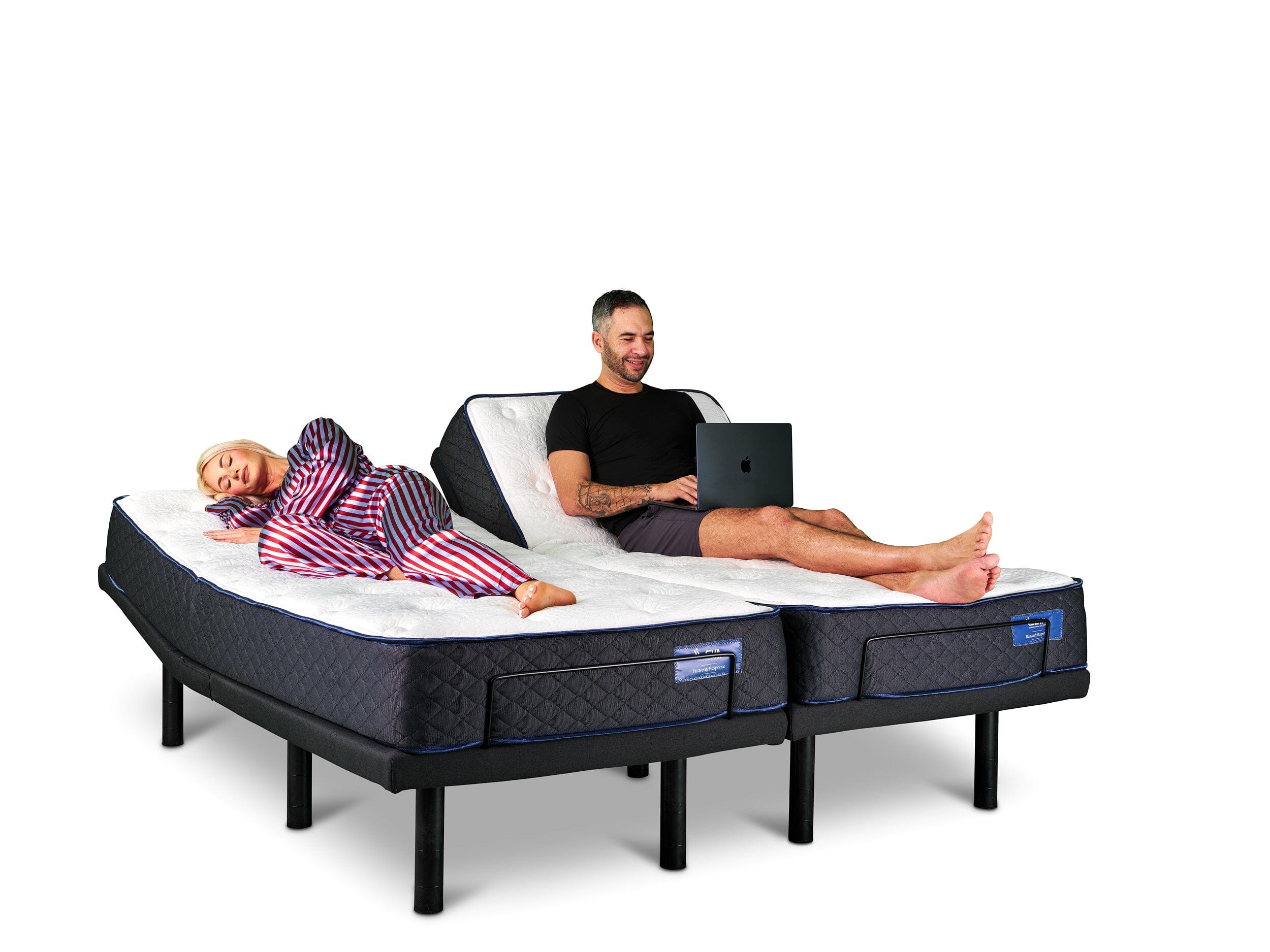
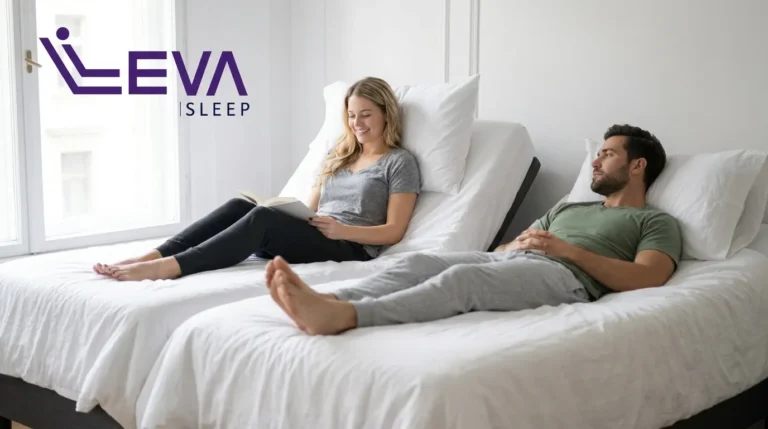
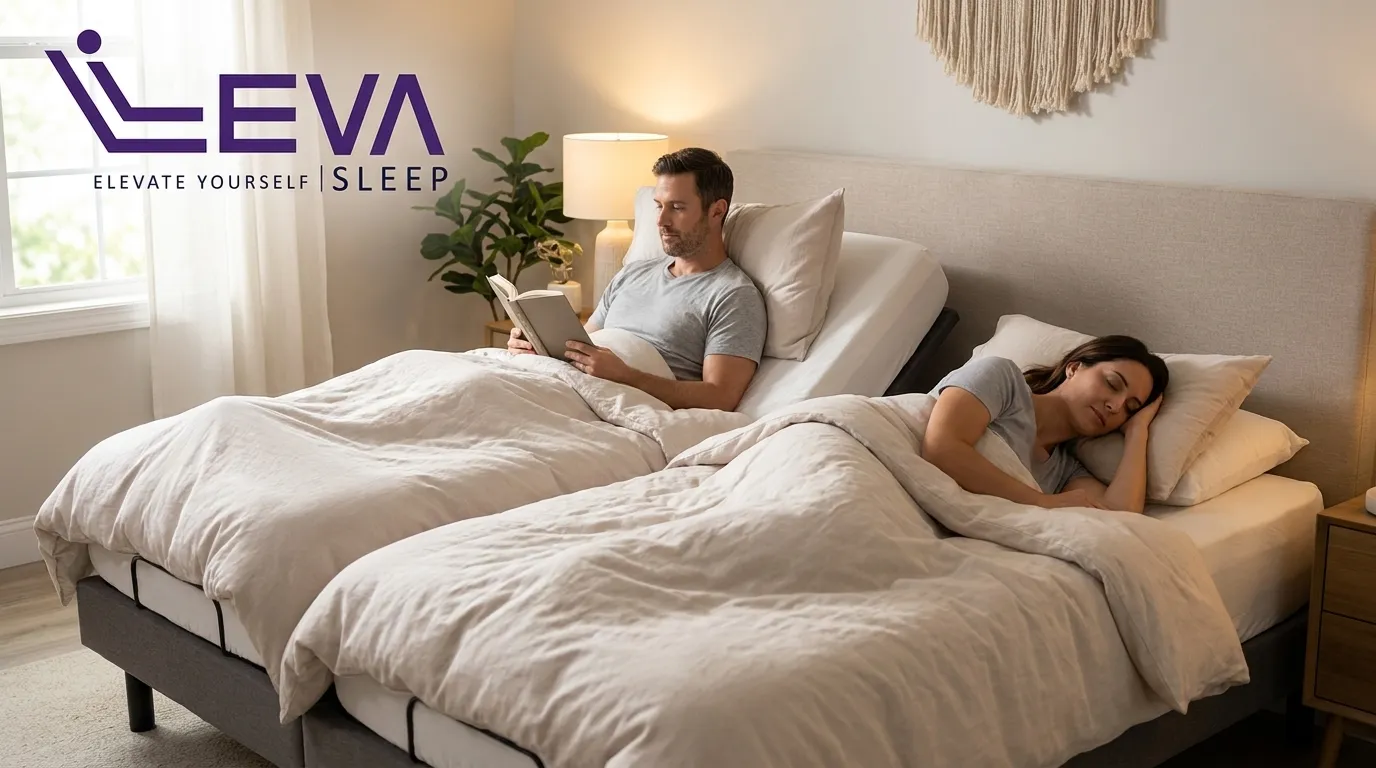
- Split adjustable bases provide independent head and foot elevation on each side. They are the only option that supports doctor-recommended positions for sleep apnea, acid reflux, and post-surgery recovery.
- Motion isolation and noise levels differ a lot between systems. Split adjustable bases with separate Twin XL mattresses offer the strongest isolation and very quiet motors. Dual-chamber air beds create more noise and weaker isolation because of air rebound.
- Smart mattress covers excel at per-side temperature control and non-wearable sleep tracking. They require ongoing subscription fees and do not change elevation or firmness.
- Leva Sleep focuses on split adjustable systems for couples and offers expert guidance and white-glove service to help you choose a system that fits your needs.
Comfort and Pain Relief Features by System
Comfort depends on pressure relief, spinal alignment, and how precisely you can elevate different parts of the body. The table below shows how each system handles these comfort factors.
| Criteria | Smart Mattress Covers | Dual-Chamber Air Beds | Split Adjustable Bases |
|---|---|---|---|
| Pressure Relief | Depends on the underlying mattress; the cover mainly adds temperature regulation | Per-side firmness adjustment supports different body types; heavier individuals can increase firmness while lighter partners decrease it | Each partner chooses their own mattress; foam or hybrid pocket coil options improve pressure distribution for each sleeper |
| Spinal Alignment | No positional adjustment; alignment depends on mattress construction | Firmness tuning improves alignment for different body weights; no elevation capability | Zero-gravity position (head and feet slightly elevated, knees above heart level) takes pressure off the lumbar spine in a way pillows cannot match |
| Head and Foot Elevation | None | None | Independent elevation on each side; raising the head 15–20 degrees helps keep stomach acid down for GERD and opens the airway to reduce positional snoring |
When you compare split adjustable systems, focus on features that solve your specific pain points and sleep disruptions. Lumbar support motors fine-tune lower-back positioning and work well with zero-gravity presets. Pillow tilt extends that precision to the head and neck on each side.
For couples dealing with snoring, anti-snore mode uses sensors to detect snoring and gently raises the head section without waking the sleeper. This feature already appears in systems like the Tempur Ergo Smart base. Per-side active temperature regulation through water-cooled microtubes or air systems helps when one partner sleeps hot and the other runs cold. App-controlled position memory lets each partner return to their ideal settings with a single button press.
Partner Compatibility and Motion Control
Partner compatibility depends on motion isolation, noise during adjustments, and how independently each person can control their side. Nearly two-thirds of American adults share a bed, and partner movement ranks among the top causes of fragmented sleep. A 2026 systematic review found partner disturbance in every clinical study of healthy co-sleeping couples.
Viscoelastic memory foam absorbs motion energy and converts it to heat instead of bouncing it back. Smart mattress covers placed over a memory foam mattress benefit from that isolation. Air chamber beds rebound motion energy, so they isolate movement less effectively. Dual-chamber airbeds can also create a center trench that pulls partners toward the middle.
Split adjustable bases with two separate Twin XL mattresses provide strong motion isolation because each surface is physically independent. The main trade-off is the center gap. Purpose-built accessories such as gap fillers and deep-pocket fitted sheets help bridge that space comfortably.
Noise also affects partner compatibility. Airbed mattresses often produce pump whirring and surface noise during firmness changes. Some dual-zone beds create a noticeable hum in a quiet bedroom. Split adjustable bases with whisper-quiet motors avoid pump cycling noise during position changes.
Technology and Sleep Tracking Capabilities
Non-wearable sleep tracking has become far more capable by 2026. Advances in ballistocardiography, radar sensing, and pressure sensors, combined with AI analytics, now support both self-monitoring and clinical evaluation.
Smart mattress covers such as Eight Sleep place sensors in a removable layer and provide per-side biometric data, including heart rate, breathing, and estimated sleep stages. BCG-based smart mattresses can track heart rate and respiration with medical-grade accuracy, with sleep stage estimates compared to polysomnography.
Dual-chamber air beds differ widely in tracking. Some models include under-mattress sensors, while others skip embedded tracking and rely on wearables.
Split adjustable bases with integrated AI tracking combine elevation control with biometric monitoring. Modern non-wearable trackers use AI and machine learning to analyze sleep stages, flag anomalies, offer personalized recommendations, and generate predictive insights from large datasets. When you pair this with anti-snore automation, the system can detect snoring and raise the head section without waking either partner. Mattress-only systems cannot match this response because they lack motors.
Under-mattress sleep trackers are projected to hold a 51.6% share of the non-wearable tracker market, growing from USD 1.6 billion in 2025 to USD 4.1 billion by 2035 at a 9.5% CAGR. The smart mattresses market generated about USD 1.72 billion in 2025 and is forecast to grow at a 10.9% CAGR through 2035.
Setup and Everyday Use in Real Life
Tracking features matter, but daily setup, noise, and maintenance determine whether you will enjoy using the system long term. The table below compares how each system fits into everyday life.
| Criteria | Smart Mattress Covers | Dual-Chamber Air Beds | Split Adjustable Bases |
|---|---|---|---|
| Delivery and Setup | Ships in a box; self-install over an existing mattress; no professional setup | Usually shipped flat; self-inflation via pump; moderate assembly complexity | Works best with professional delivery; white-glove service sets leg height, mattress pairing, and app configuration correctly |
| Noise During Use | Eight Sleep Pod 5 Hub produces a soft fan sound during active temperature changes | Motorized pumps create whirring and surface noise during firmness adjustments | Whisper-quiet motors make minimal sound during elevation changes; no pump cycling |
| Daily Maintenance | Eight Sleep Pod 5 needs a distilled water refill about once per year; the app sends low-water alerts | Requires occasional pump checks; no water maintenance | Minimal upkeep; occasional inspection of motor connections and bedding fit; no fluids unless you add a temperature pad |
Long-Term Reliability and Costs
Long-term reliability affects both comfort and cost. A high-quality adjustable base can last 10 to 15 years.
Smart mattress covers involve hardware and subscription costs. Eight Sleep Pod 5 Core hardware ranges from about $2,799 to $3,199 in 2026, with an Autopilot subscription of $199–$399 per year required for the first 12 months. Over five years, subscriptions add roughly $995 to $1,995 to total ownership cost. Without an active subscription, users lose AI temperature control, sleep tracking, and special modes.
Active temperature systems on any base need periodic care. Water-cooled chillers, a common water-based cooling technology, typically last 15–30 years with proper maintenance. Dual-chamber air bed owners should factor in pump replacement risk and compare motion isolation across models.
Split adjustable bases with no subscription fees and 10–15-year motor lifespans usually deliver the lowest recurring cost over a full ownership period.
Couple Scenarios and Best-Fit Systems
The scenarios below connect common couple situations to the system features that matter most.
Scenario 1 — Hot sleeper and cold sleeper with different firmness preferences: This couple needs per-side temperature control and independent firmness. A split adjustable base with a temperature-regulating pad and separate mattresses, such as one foam and one hybrid, manages both variables separately. Smart mattress covers on a shared mattress handle temperature but not firmness.
Scenario 2 — One partner snores: Given the significant sleep loss snoring causes, as detailed in the Partner Compatibility section, only a split adjustable base with anti-snore automation can detect snoring and raise the head section without waking either partner. Mattress-only systems cannot provide this mechanical response.
Scenario 3 — Chronic back or hip pain: For chronic back or hip pain, the zero-gravity position described earlier offers meaningful relief that smart covers and air beds cannot match. Neither of those systems provides elevation-based pain relief.
Scenario 4 — Post-surgery recovery requiring medical elevation: The NHS recommends elevating the head and upper body to improve sleep quality for people with acid reflux. Post-surgical patients who need specific head or leg elevation benefit from a motorized adjustable base. The partner’s side can stay flat or at a different angle without disrupting their position.
Guided Decision Matrix for System Selection
Use this checklist to connect your top priorities to the system type most likely to fit them.
- Medical elevation required (sleep apnea, acid reflux, post-surgery, circulation): Split adjustable base. It is the only system that provides independent motorized head and foot elevation on each side.
- Different firmness preferences between partners: Dual-chamber air bed or split adjustable base with separate mattresses. Both allow per-side firmness, and a split adjustable base also adds elevation.
- Temperature mismatch between partners: Smart mattress cover or split adjustable base with a temperature pad. Both provide per-side thermal control, so compare subscription costs and maintenance before choosing.
- Snoring or mild sleep apnea: Split adjustable base with anti-snore automation. Mattress-only systems cannot offer automated head elevation.
- Noise sensitivity during adjustments: Split adjustable base with whisper-quiet motors. Air pump systems create an audible hum during firmness changes.
- Space constraints (smaller than King): Split Queen adjustable base. This configuration is rare in the market and is a specialty product from Leva Sleep.
- White-glove delivery and professional setup: Split adjustable base from a specialist. Box-shipped covers and air beds require self-installation.
- Lowest long-term cost of ownership: Split adjustable base with no subscription. Smart covers with required subscriptions add $995–$1,995 over five years on top of hardware cost.
- Comprehensive sleep tracking without wearables: Smart mattress cover or split adjustable base with integrated sensors. Review per-side biometric separation and AI features for each model.
Frequently Asked Questions
How well do split adjustable bases isolate motion between partners?
Split adjustable bases use two separate Twin XL mattresses on independent bases. Because the sleep surfaces do not share a single structure, movement on one side does not transfer to the other. This setup offers the strongest motion isolation available in a shared bed. Center gap management remains the main consideration, and accessories such as deep-pocket fitted sheets with reinforced elastic and gap-bridging pads handle that effectively. Couples who previously struggled with partner movement on a shared mattress usually notice a clear improvement.
Can a split adjustable base help with snoring without waking either partner?
Advanced split adjustable bases can help with snoring without waking either partner. These models use embedded sensors to detect snoring vibrations and then raise the head section on the snoring partner’s side in a gradual, subtle way. The change is gentle enough that both partners stay asleep. Mattress-only systems, including smart covers and dual-chamber air beds, cannot provide this response because they do not include motorized elevation. For couples where snoring drives most sleep disruption, this feature addresses the cause rather than just the symptoms.
Is a Split Queen adjustable base available, and how does it differ from a Split King?
A Split Queen adjustable base uses two 30-inch-wide bases placed side by side to fill a standard Queen footprint of 60 × 80 inches. A Split King uses two Twin XL bases to fill a 76 × 80 inch King footprint. Split Queen setups are far less common because most manufacturers focus on King-size splits. Leva Sleep offers Split Queen adjustable bases in the United States. This size works well for couples who want independent control but do not have room for a King.
How loud are split adjustable bases during position changes?
Leva Sleep’s adjustable bases use whisper-quiet German motors that operate with very low noise. Dual-chamber air beds, by contrast, use motorized pumps that cycle audibly during firmness changes. Some forced-air temperature systems also create fan noise near the pillow. For couples where one partner adjusts position while the other sleeps, motor noise becomes an important factor. When you evaluate any adjustable base, request a live motor demonstration in the showroom or ask the manufacturer for decibel ratings.
Do split adjustable bases support doctor-recommended sleep positions for medical conditions?
Split adjustable bases support doctor-recommended sleep positions more effectively than other consumer systems. They provide independent, motorized elevation of the head and foot sections on each side. This design aligns with physician guidance for sleep apnea, acid reflux and GERD, post-surgical recovery, hip and knee pain, and circulation issues. Each partner can follow their own prescribed position while the other remains flat or chooses a different angle. Smart mattress covers and dual-chamber air beds do not offer this capability. Customers with medical positioning needs should consult their physician and share those requirements with a sleep specialist when selecting a base.
Conclusion: Choosing the Right System and Next Steps
Smart mattress covers deliver strong per-side temperature control and non-wearable tracking but require ongoing subscriptions and do not offer elevation. Dual-chamber air beds solve per-side firmness for couples whose main conflict is support level, yet they create more noise during adjustments, provide weaker motion isolation, and lack positional control. Split adjustable bases address firmness, temperature, elevation, snoring, motion isolation, and medical positioning in one integrated system and usually carry the lowest long-term cost when you choose subscription-free models.
Couples who need elevation, anti-snore automation, or medical positioning will still require a compatible base if they start with mattress-only solutions. Choosing a split adjustable base first, then pairing it with the right mattress and temperature accessories, simplifies the decision and avoids duplicate purchases.
Leva Sleep specializes in split adjustable systems for couples, with Split King and Split Queen options, 15–20 adjustable base models, American-made mattresses, and white-glove delivery and setup. The La Jolla showroom lets couples experience motor noise, elevation range, and mattress pairing in person before they buy.