Written by: Matthew Timmins, Founder and Managing Director, Leva Sleep
Key Takeaways for Couples with Back Pain
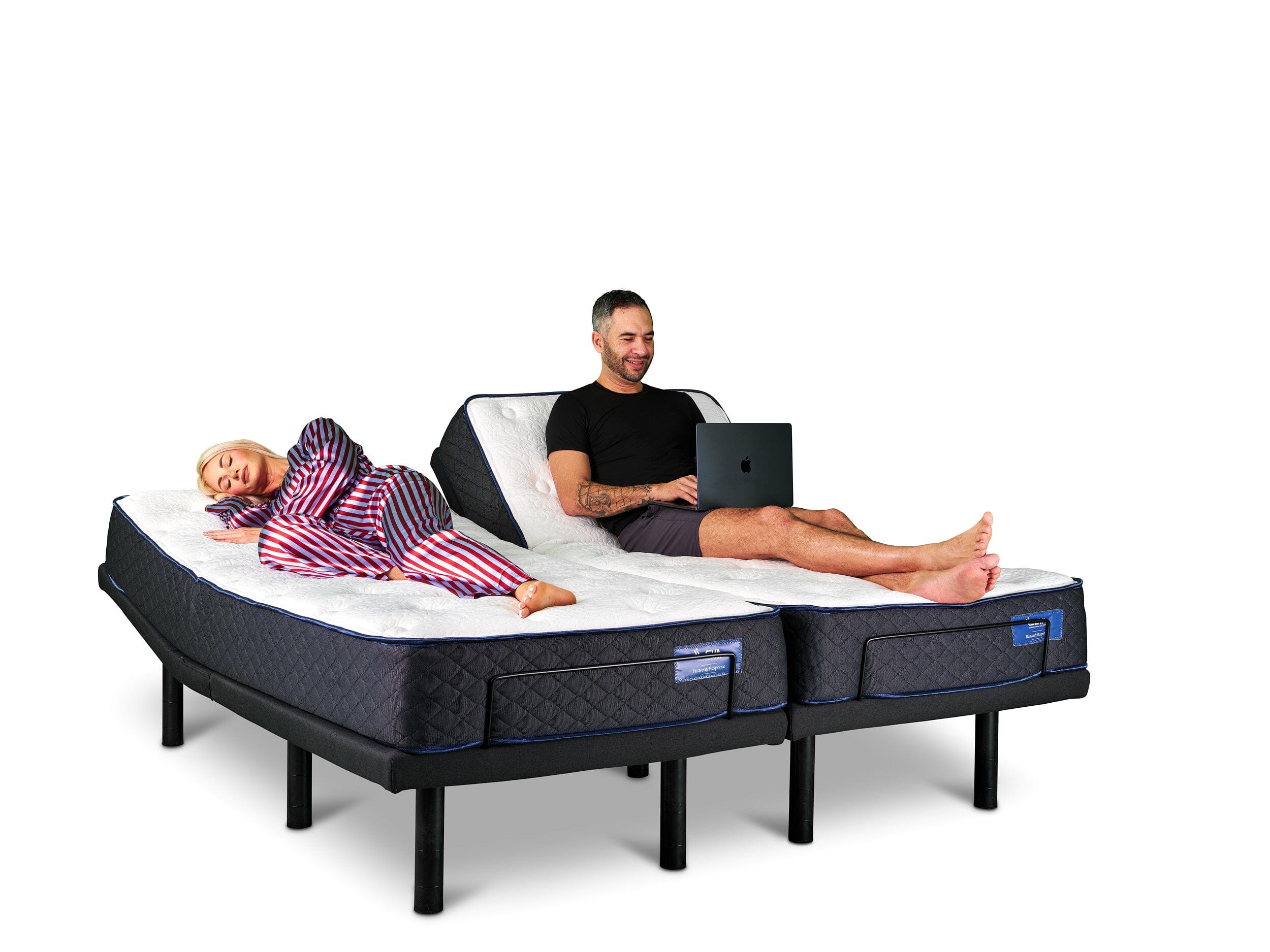
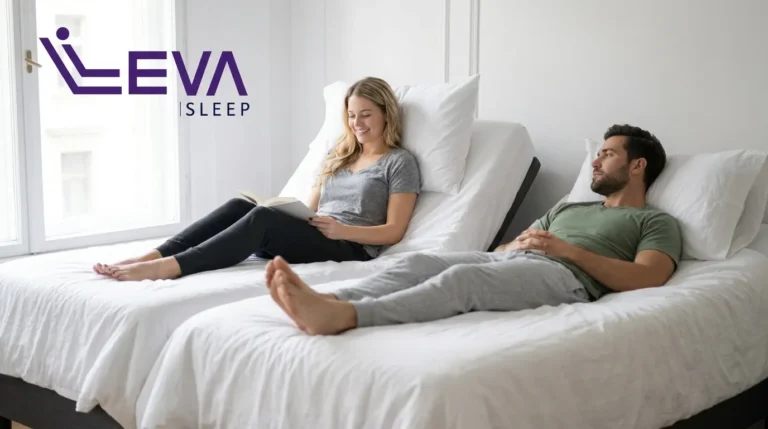
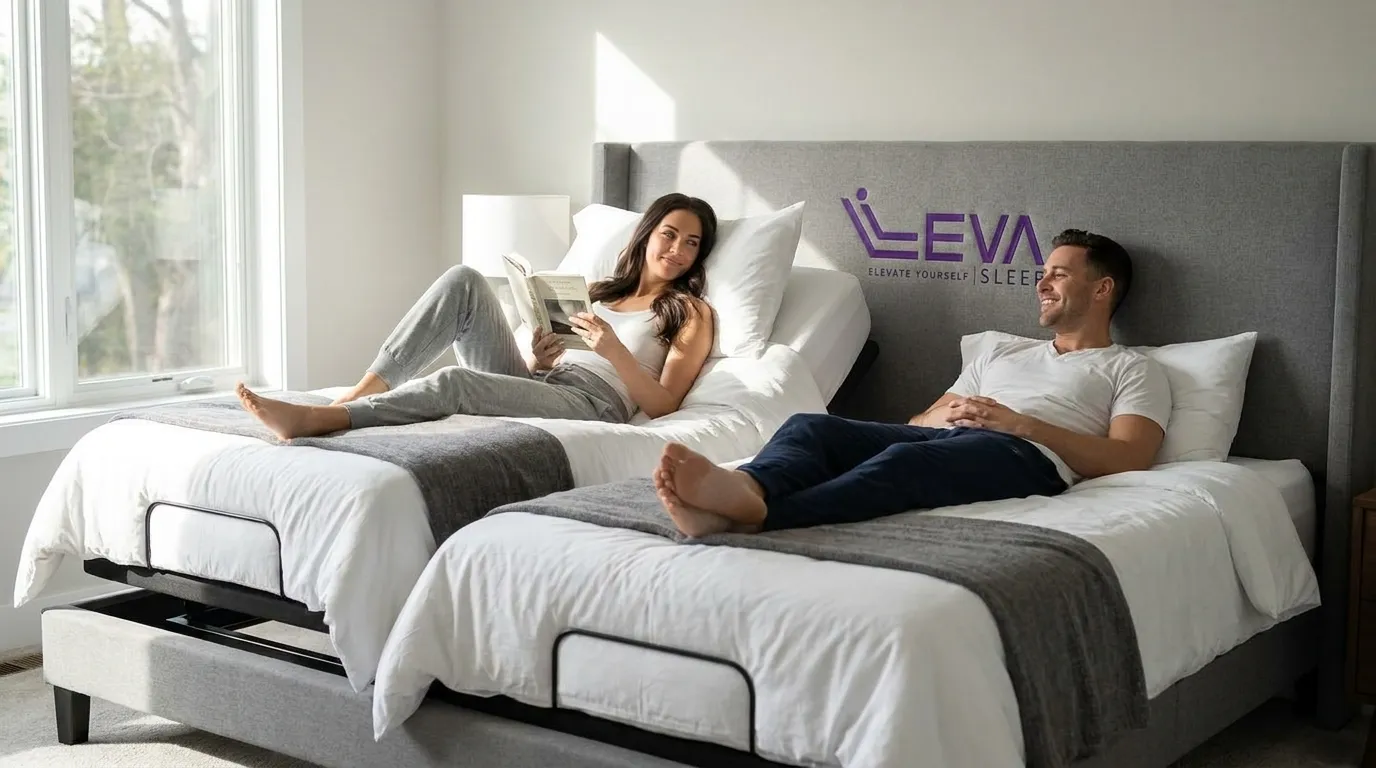
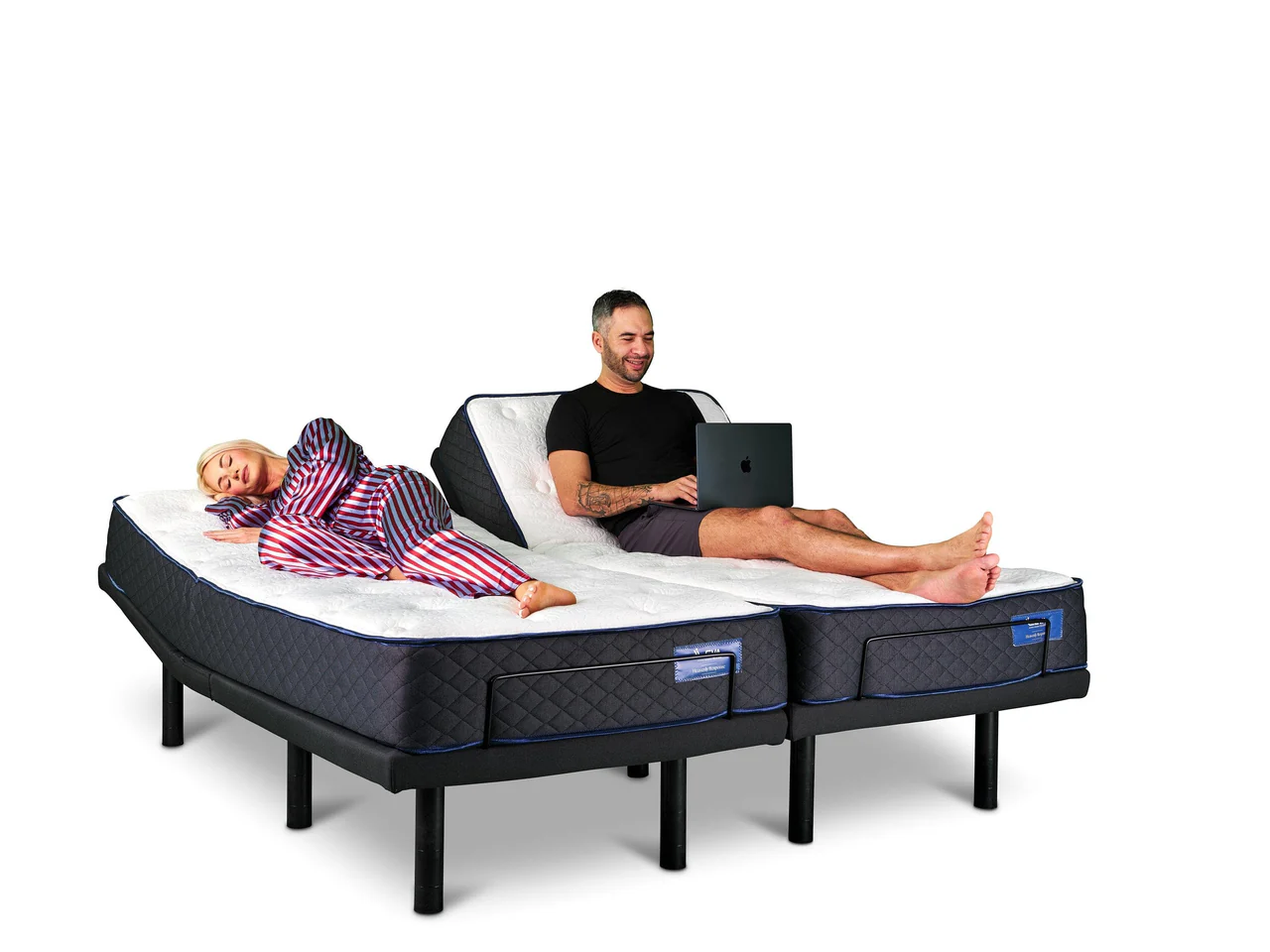
- Split configurations let each partner adjust independently, which reduces sleep disturbances from shared movement.
- Zero-gravity positioning eases spinal compression by elevating the head and legs at the same time.
- Independent lumbar control targets lower-back support without changing overall head or foot angles.
- Quiet brushless DC motors and adjustable-bed-compatible sheets help prevent nighttime disruptions from noise and bedding slippage.
- Leva Sleep specializes in Split King and Split Queen adjustable bed frames for couples with back pain, and you can visit the La Jolla showroom or shop online.
1. Split Configuration vs. Single Frame
A single adjustable frame moves as one unit, so any elevation change affects both partners at once. A split configuration removes that limitation and lets each person move independently. No 2016 Richter et al. study exists; a 1994 study in Sleep found that bed partners produce concordant movements in about one-third of epochs but did not test independent surfaces, which still supports the clinical case for split designs. One partner with lumbar pain can elevate to zero-gravity while the other remains flat, without either position affecting the other side.
Measure the bedroom carefully to see which footprint fits your space. A Split King uses two Twin XL halves to form a 76″ × 80″ footprint, while a Split Queen uses two 30″ × 80″ halves inside a standard 60″ × 80″ queen footprint. Once you confirm the dimensions work, ask the retailer whether the frame ships as a single unit or two separate bases, because that affects delivery and setup. Finally, confirm that the gap between the two platforms is covered by a center-fill strip or compatible mattress design so you avoid a comfort gap and slipping bedding.
Use these questions to check whether a split system will work smoothly in your home:
- Does each side have its own motor and remote, or is control shared?
- Is the gap between the two mattress halves addressed by a connector or fill strip?
- Will the combined footprint fit through doorways and around bedroom furniture?
Watch for frames marketed as “split” that share a single motor, and for retailers who cannot confirm independent head and foot control per side. Consult a physician or physical therapist before choosing elevation angles if either partner has had spinal surgery or a diagnosed disc condition.
A split configuration is often the most impactful structural decision for couples with back pain. Compare Leva Sleep’s Split King and Split Queen adjustable bed frames in person or online.
2. Zero-Gravity Positioning for Spinal Relief
Zero-gravity positioning elevates the head to roughly 30–45 degrees and raises the legs slightly above heart level. This posture distributes body weight across the mattress surface instead of concentrating it at the lumbar spine and hips. This position reduces pressure on intervertebral discs and can ease the muscular tension that builds up on a flat surface. For couples where one or both partners have chronic lower-back pain, a one-touch zero-gravity preset removes nightly guesswork.
Start by checking whether the zero-gravity preset is programmable or fixed, because that determines how well it can match each person’s anatomy. A programmable preset lets each partner save a personalized angle instead of relying on a factory setting that may not fit their spine. However, even a programmable preset helps only if the frame’s articulation range is sufficient, so confirm that it reaches at least 45 degrees at the head and 30 degrees at the foot. Shallower ranges limit the therapeutic benefit regardless of how precisely you can save your preferred angle.
Clarify how the zero-gravity feature behaves in daily use with these questions:
- Can each partner save a custom zero-gravity angle, or is it a single shared preset?
- Does the frame return to flat with one button press, or does it require manual repositioning?
- Is the transition between flat and zero-gravity smooth enough to avoid waking a sleeping partner?
Zero-gravity positioning does not replace medical treatment. Partners with cardiovascular conditions, glaucoma, or recent abdominal surgery should talk with a physician before sleeping in elevated positions regularly.
3. Independent Lumbar Control for Targeted Support
Standard adjustable bases move only at the head and foot. Lumbar control adds a third articulation point, a gentle arch in the lower-back zone of the platform, that supports the lumbar area without changing overall head or foot elevation. For partners with lumbar disc issues or sacroiliac pain, this feature can reduce pressure that builds at the L4–L5 region during long periods in one position.
Test the lumbar lift range in person when possible so you can feel the difference. A lift that moves only a few millimeters offers little therapeutic value. Confirm that lumbar adjustment is available on each side independently in a split configuration, because a shared lumbar motor cannot address different pain profiles.
Focus on these details while you compare lumbar systems:
- Is lumbar control available on both sides of a split base, or only one?
- What is the maximum lumbar lift height in millimeters or inches?
- Can lumbar position be saved as part of a custom sleep preset?
Lumbar control is a premium feature that usually does not appear on entry-level bases. Couples where one partner has a diagnosed lumbar condition should treat it as a required specification. A physical therapist can suggest a target lumbar lift range based on individual anatomy. Independent lumbar control, combined with a split configuration and a zero-gravity preset, creates a strong therapeutic foundation for couples with back pain. Even the most supportive setup can still cause frustration if the motors are noisy, so motor noise becomes the next key factor.
See how independent lumbar control works at Leva Sleep’s La Jolla showroom
4. Motor Noise Levels During Nighttime Adjustments
Motor noise is one of the most common complaints in adjustable bed forums. Sounds at 50–60 decibels during nighttime adjustments can pull a sleeping partner from deep sleep into a lighter stage. For couples sharing a bed, one partner’s 2 a.m. position change can quickly become the other partner’s unwanted alarm.
Ask the retailer to demonstrate the base in motion in a quiet showroom so you can hear it clearly. Request the manufacturer’s published decibel rating and confirm whether it reflects the brushless DC or AC motor version, since these differ in noise and vibration. Use these questions to guide your evaluation of motor noise:
- What is the published decibel rating during head and foot articulation?
- Does the base use a brushless DC motor or an AC motor?
- Is there a vibration dampening system between the motor housing and the frame?
Brushless DC motors usually cost more than standard AC motors but last longer and create less vibration. That premium often compares favorably with the ongoing cost of repeated sleep disruption. Consult a sleep specialist if either partner is a very light sleeper, because even 35 dB can be noticeable in a quiet bedroom.
5. Sheet Retention and Bedding Compatibility on Adjustable Bases
Sheet slippage ranks as a major frustration among adjustable bed owners in consumer forums. When a base elevates the head to 45 degrees, standard fitted sheets typically fit mattresses up to 12 inches thick and often use corner-only elastic rather than all-around elastic, which can lose grip at the corners and bunch under the sleeper. That bunching creates friction and discomfort and can cancel out the comfort of an elevated position, while the noise of re-tucking sheets at night adds another disturbance.
Sheets designed for adjustable beds use deeper pockets, reinforced elastic that runs around the full perimeter, and stretch-knit fabric that flexes with the mattress during movement. Confirm that any sheet set is clearly rated for adjustable bases and that the pocket depth matches the combined height of the mattress and any topper.
Use this checklist when you evaluate bedding for a new adjustable base:
- Does the retailer offer sheets designed specifically for adjustable bases, or only standard bedding?
- What is the pocket depth, and does it accommodate the mattress plus any topper?
- Is the elastic full-perimeter or corner-only?
- For split configurations, are split-top sheet sets available to allow independent duvet positioning?
Specialty bedding usually costs more and may come in fewer colors and materials than standard sheet sets. Some couples also need time to adjust to split-top duvets, which separate at the center for independent movement. Buying bedding from the same specialist who supplies the base greatly reduces compatibility issues.
Browse Leva Sleep’s bedding accessories designed for adjustable bases
6. App-Controlled Anti-Snore Micro-Adjustments
Elevating the head of the bed 10–15 degrees can help open the airway and may reduce snoring and ease mild sleep apnea symptoms. App-controlled anti-snore modes automate this process by detecting snoring through a microphone or paired wearable and making a gentle micro-adjustment, typically 5–10 degrees, without waking the snoring partner. For the non-snoring partner, this removes the need to nudge or wake their partner manually, which often causes its own sleep disruption.
Differentiate between a static anti-snore preset, which is a fixed head elevation angle you activate manually, and a dynamic anti-snore mode, which uses sensors to adjust during sleep. The dynamic version usually works better but needs Bluetooth connectivity and a compatible app. Confirm that the feature operates only on the snoring partner’s side in a split configuration so the other partner’s position stays stable.
Clarify how advanced and independent the anti-snore feature is by asking:
- Is the anti-snore mode sensor-triggered or manually activated?
- Does it operate independently per side on a split base?
- What is the adjustment increment in degrees per trigger event?
- Does the app log snoring events for review the following morning?
Anti-snore positioning does not treat obstructive sleep apnea. Partners with diagnosed OSA should continue any prescribed therapy, including CPAP, and consult a sleep medicine physician before replacing treatment with positional adjustment. The feature works best for positional snoring or mild airway restriction.
Split King vs. Split Queen Comparison
Once you know which features matter most for your back pain and sleep habits, the next decision is footprint. Some bedrooms can accommodate a wider Split King, while others require a standard queen width. The table below compares Split King and Split Queen configurations across key factors that affect daily use.
| Feature | Split King | Split Queen |
|---|---|---|
| Footprint | 76″ × 80″ (two Twin XL halves) | 60″ × 80″ (two 30″ × 80″ halves) |
| Independent Adjustment | Full independent head and foot control per side | Full independent head and foot control per side within queen frame |
| Lumbar Relief Access | Available on premium models with independent lumbar control per Twin XL side | Available on premium models with independent lumbar control per 30″ half where offered |
| Best For | Couples with more bedroom space who want maximum surface area per partner | Couples who need a queen footprint but still want independent adjustment |
Real Couples Say
The specifications above explain what to look for, but real-world feedback shows which details matter most night after night. Consumer forum threads on adjustable bed purchases highlight three recurring complaints that rarely appear in manufacturer marketing. Motor noise ranks first, and buyers who skipped decibel checks often report that their partner’s nighttime adjustments wake them, especially with AC-motor bases. Sheet slippage appears next, with standard fitted sheets described as “popping off by 3 a.m.” after head elevation. Delivery and setup come third: buyers who received white-glove service report higher satisfaction than those who assembled frames from boxed components, citing complex wiring for dual motors and the challenge of moving large bases through narrow hallways. These three pain points, noise, bedding, and delivery, can be addressed at purchase by choosing a specialist retailer who solves all three as part of the package.
Frequently Asked Questions
Are adjustable bed frames safe to use during post-surgery recovery?
Adjustable bed frames are often recommended by orthopedic surgeons and physical therapists for post-operative recovery because they allow elevation of the upper body or legs without manual repositioning, which reduces strain on surgical sites. Raising the head can ease pressure on the lumbar spine after back surgery, while leg elevation supports circulation after hip or knee procedures. Specific elevation angles and duration should come from the treating surgeon or physical therapist, since protocols vary by procedure and healing progress. A split configuration helps during recovery because the recovering partner can adjust independently without disturbing the other partner’s sleep.
How loud are adjustable bed motors at night?
Motor noise varies widely by motor type and build quality. Brushless DC motors, which appear in many premium bases, can operate quietly. Mid-range bases usually create moderate noise. Budget bases with AC motors can reach 50–60 decibels, which is loud enough to wake a light sleeper during a nighttime adjustment. When you evaluate a base, request the manufacturer’s decibel rating and ask whether it reflects the brushless DC version. Demonstrating the base in motion in a quiet showroom gives the clearest sense of how it will sound at home.
Will my fitted sheets stay on an adjustable base when it is elevated?
Standard fitted sheets, which were discussed earlier as fitting only up to about 12 inches with corner-only elastic, often lose grip when the head of the bed rises to 30–45 degrees. That loss of tension lets the sheet slide toward the center of the mattress. Adjustable-bed-specific sheets solve this with full-perimeter elastic, deeper pockets, and stretch-knit fabric that flexes during movement. For split configurations, split-top sheet sets let each half of the mattress move independently without pulling across the center gap. Buying sheets from the same specialist who supplies the base remains the most reliable way to match sheet depth and articulation range.
Does Leva Sleep offer financing options?
Leva Sleep offers financing options to make its Split King and Split Queen adjustable systems more accessible without requiring full payment upfront. Financing terms and available plans are best confirmed directly with Leva Sleep, because options can vary by system configuration, accessories, and current promotions. Visiting the La Jolla showroom lets couples review financing while seeing a full product demonstration, and financing details are also available on the Leva Sleep website. Since Leva Sleep’s systems are priced about 30–50% below comparable luxury competitors, financing a complete system, including base, mattress, and purpose-built bedding, often costs less overall than buying components separately from multiple retailers.
Conclusion: Bringing the Right Criteria to the Showroom
The six criteria covered here, split configuration, zero-gravity positioning, independent lumbar control, motor noise levels, sheet retention, and app-controlled anti-snore micro-adjustments, create a clear framework for couples researching adjustable bed frames for back pain. Each one addresses a specific weakness of traditional flat beds and basic single-frame adjustable bases, including partner disturbance, spinal compression, lumbar pressure, nighttime noise, bedding slippage, and airway restriction.
Measure the bedroom before you contact a retailer so you know whether a Split King or Split Queen footprint fits the space, and decide which partner’s pain profile needs the most targeted features. Bring that information to a showroom where staff can demonstrate bases in motion, let you hear motor noise in person, and confirm bedding compatibility with the mattress height you choose.
Leva Sleep has spent more than eight years and 25,000 customer relationships focused on adjustable sleep systems as a dedicated specialty, not as a side category in a general mattress store. The company offers 15–20 models, purpose-built bedding, and in-house white-glove delivery. Schedule your personalized consultation at Leva Sleep’s La Jolla showroom