Written by: Matthew Timmins, Founder and Managing Director, Leva Sleep
Key Takeaways from 2025–2026 Owners
- Owner reports reveal a consistent gap between marketing claims and real-world performance in motor noise, snore-detection accuracy, and app reliability.
- Manual anti-snore positioning produces more predictable results than automatic detection for light sleepers, and many owners turn off auto modes because of false triggers.
- Brushless DC motors operating at 30–40 dB are significantly quieter than budget AC motors at 50–60 dB, which makes motor type a critical factor for couples.
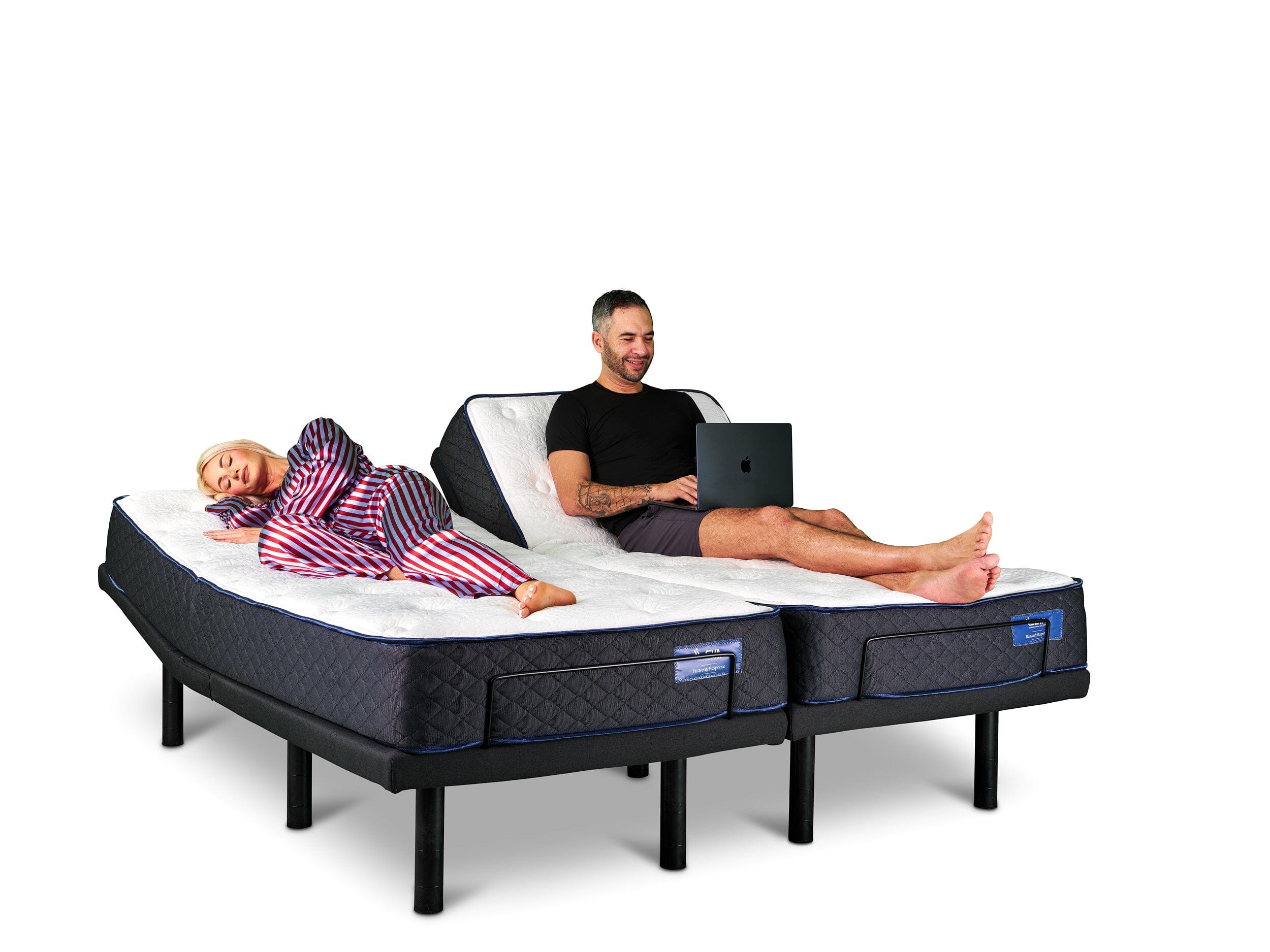
- Split configurations solve partner compatibility issues but introduce sheet slippage and center gap problems that require specialized bedding solutions.
- Leva Sleep addresses these common pain points with thoughtfully designed anti-snore modes, split-config bedding, and in-house white-glove delivery, available online or at the La Jolla showroom.
Snore Detection: What Real Owners Actually Experience
Snoring consistently shows up as a disruptive sleep habit for couples. The 2026 Talker Research survey found snoring to be among the most annoying partner sleep habits. Snoring appeared in 62% of free-text responses describing why respondents ended a relationship in that same survey.
Premium adjustable bases with anti-snore modes use sensors to detect snoring sounds or vibrations and then raise the head section automatically. A 2026 Mattress Miracle review notes that automatic adjustment can wake the snorer or their partner. Common complaints include false triggers from coughing, heavy breathing, traffic noise, or partner movement. The same source reports that some systems take 3–5 minutes to respond or raise the head too aggressively.
Owner forums consistently report that manual anti-snore positioning, where you set a preferred head elevation before sleep, produces more predictable results than fully automatic detection for light sleepers. Leva Sleep’s anti-snore mode, launching spring 2026, focuses on micro-adjustments instead of aggressive repositioning. This approach addresses the false-trigger complaints owners cite most frequently.
To avoid the false-trigger issues owners describe, ask vendors specific questions before you buy. How many decibels of sound trigger the sensor, and does that threshold fit your bedroom environment. Can you adjust sensitivity in the app, or are you locked into a fixed setting. Does the system log false-trigger events so you can see what caused unwanted movement. Is there a delay setting before the head rises, which can reduce the chance of waking you.
Quietest Adjustable Bed Bases in 2026
Motor noise shows up as the most frequent mechanical complaint in owner forums, especially for couples when one partner adjusts position at night. No July 2026 KeptList analysis of owner reports is documented; available sources report quietest adjustable bases at 30–40 dB and budget models at 50–60 dB. These sources highlight a consistent gap between quiet-operation marketing claims and actual reported sound levels.
Brushless DC motors typically operate at 30–40 dB, equivalent to a whisper, while budget AC motors can reach 50–60 dB, loud enough to wake a sleeping partner. Brushless DC motors also last longer because they have no carbon brushes to wear out, and they reduce vibration transferred to the bed frame. Brushed DC motors often get louder after 3–5 years of regular use as carbon brushes wear.
Studies indicate that relatively quiet sounds can disturb sleep in sensitive individuals. Even mid-range motors therefore carry real disruption risk for light sleepers.
Quality motors from reputable brands are rated to lift 300–600 kg or more. Better motors also complete adjustments faster, often moving from flat to full elevation in 8–10 seconds, while cheaper motors can take 15–20 seconds. When you evaluate motor noise, ask about motor type, the decibel rating under load, and whether the brand includes a physical remote as a fallback option.
Split King Adjustable Beds: Common Problems and Fixes
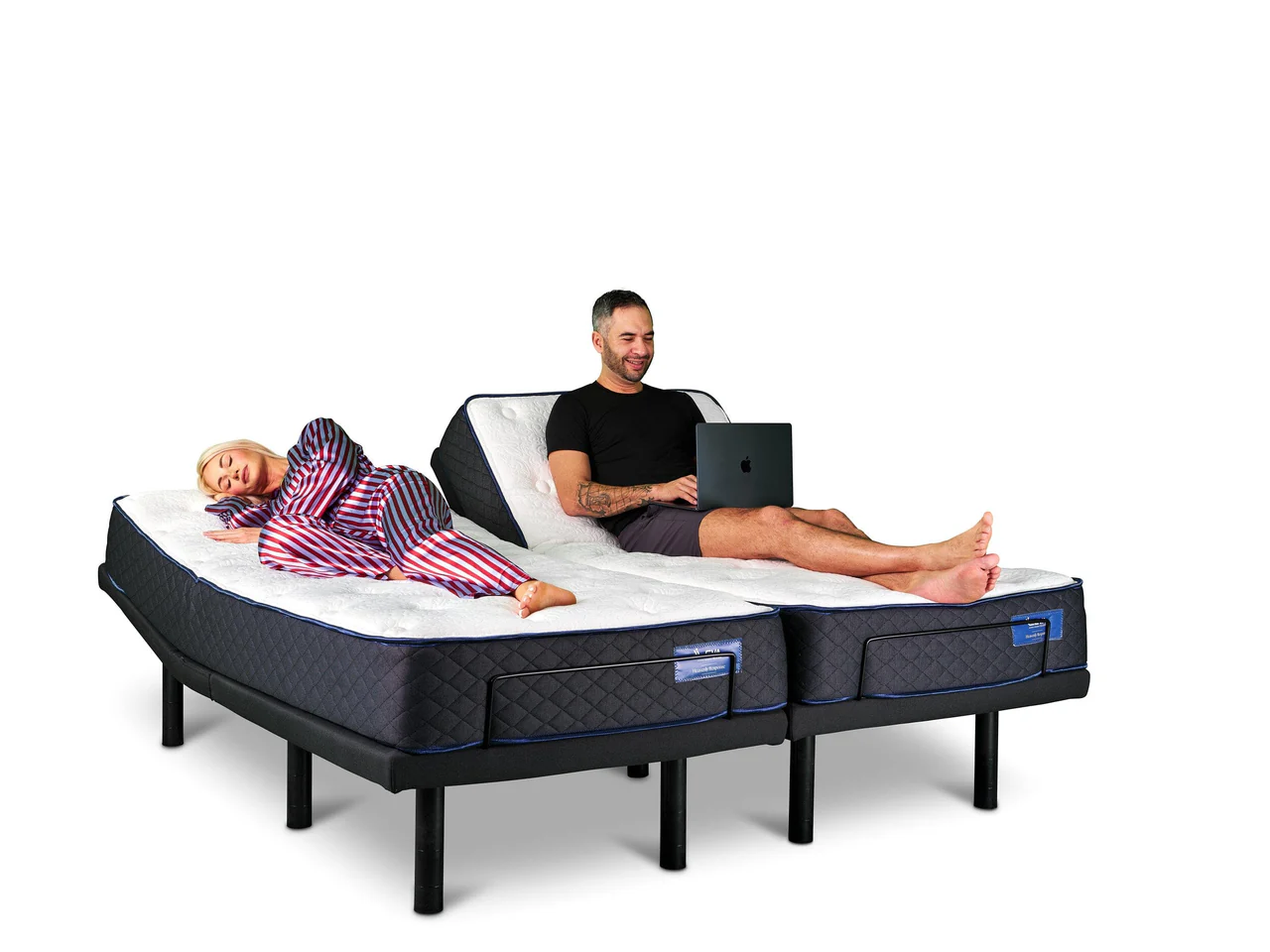
Split configurations help couples with different sleep needs share a bed comfortably. Owners also report a distinct set of mechanical and practical issues that appear repeatedly across forums.
The most common complaints fall into three categories.
- Sheet slippage: Standard fitted sheets are not designed for the gap that forms between two independent bases at different elevations. Owners report sheets popping off at the corners within minutes of adjustment. Sheets with deep pockets and reinforced elastic, or sheets designed specifically for adjustable bases, serve as the standard workaround.
- Center gap: When two twin XL bases elevate independently, a gap forms at the center of the bed. Owners often use gap fillers or mattress bridges, though these can shift during the night.
- Independent control lag: Some owners report that Bluetooth or app-based controls introduce a delay between command and movement, which feels more noticeable when both partners adjust simultaneously. Wired remotes remove this lag but reduce convenience.
A January 2026 Wopilo survey found that 24% of couples say they are incompatible in terms of sleep. Leva Sleep addresses the bedding problem directly with fitted sheets that use extra elastic and duvet clips designed for split adjustable configurations.
Comfort, Pain Relief, and Spinal Alignment Benefits
Approximately 75–85% of adults will experience some form of significant back pain during their lives, according to the American Association of Neurological Surgeons. Adjustable beds appear most helpful for conditions such as spinal stenosis, sciatica, and herniated discs, although they do not resolve every type of back pain.
Danielle Wall, MD, an internal medicine physician and sleep advisor at Sit ‘n Sleep, notes that adjustable beds can support better spinal alignment by allowing the body to rest in a more neutral position rather than lying completely flat. Slight elevation of the head and legs can reduce strain on the lower back and help maintain the spine’s natural curvature, which becomes increasingly important with age.
The zero-gravity position places the spine in a slightly flexed position that can open the spinal canal and reduce nerve compression. This position can help spinal stenosis patients who experience pain that worsens with spinal extension. Elevating the knees by 15 to 30 degrees relaxes the hamstrings and reduces tugging on the lower back for sciatic nerve relief.
Dr. Nicholas Callahan notes that many patients with osteoarthritis find that the subtle movements of an adjustable base help prevent joints from locking up overnight. An adjustable base that raises the head section also makes it easier to get in and out of bed, which reduces strain on arthritic joints and can improve blood flow to affected joints during sleep.
Technology Reliability and App Performance in Daily Use
Smart features such as Sleeptracker AI, anti-snore modes, and app-controlled positioning expanded significantly in post-2024 models. Owner reports from 2025–2026 identify app connectivity as the most variable part of the smart adjustable bed experience.
Recurring owner complaints across forums include Bluetooth disconnections that require re-pairing, app updates that reset saved positions, and voice-assistant integrations that respond inconsistently. Owners who keep a wired remote as a backup report higher satisfaction than those who depend only on app control.
Sleeptracker AI systems that monitor breathing and movement to generate sleep scores receive mixed reviews. Owners value the data but report that scores do not always match how rested they feel, and that sensors need periodic recalibration. The technology works better as a trend indicator over weeks than as a precise nightly diagnostic.
A July 2026 KeptList analysis found a consistent gap between manufacturer quiet-operation marketing claims and actual reported performance. Owners describe a similar pattern for smart-feature reliability claims. Many recommend confirming that any smart base includes a physical remote as a fallback before purchasing.
Delivery, Setup, and Long-Term Durability Expectations
Well-maintained adjustable bed bases typically function reliably for 8–15 years according to owner reports, with motors identified as the most common failure point. Quality motors from reputable brands often last more than a decade with normal use, while budget motors may start showing wear after several years.
Remotes and control boxes commonly require replacement because of battery corrosion, drops, or power surges, often before motors fail. A 5-year or longer warranty on motors and actuators serves as a more reliable proxy for build quality than horsepower or lift-weight ratings.
Delivery experience divides sharply between white-glove and standard options in owner reports. Standard delivery owners frequently describe assembly confusion, missing hardware, and no guidance on leg height or position programming. White-glove owners report higher satisfaction scores and fewer setup-related support calls in the first 90 days. When you compare delivery options, check whether white-glove delivery is available, what it includes, and whether setup professionals work in-house or as contractors.
Couples, Compatibility, and Shared Sleep
Couples often want to share a bed but struggle with very different sleep needs. A YouGov survey found that 66% of Americans said their ideal sleeping arrangement with a partner was to share a bed. Yet a 2025 American Academy of Sleep Medicine survey found that 31% of U.S. adults have opted for some form of sleep divorce, rising to 39% among adults aged 35 to 44.
Common reasons couples sleep separately include snoring, sleep apnea, restless movement, differing sleep schedules, and temperature fluctuations during perimenopause. The same Talker Research survey found that 17% of respondents had ended a relationship solely because of a partner’s disruptive nighttime habits.
Independent controls on split bases address firmness and elevation mismatches directly. Temperature regulation usually needs a separate solution, such as a split base paired with a dual-zone cooling pad or separate duvets with clips to prevent overlap when positions diverge. Jennifer Martin, PhD, spokesperson for the American Academy of Sleep Medicine, notes that couples often have differing body weights, sleeping positions, and health concerns that complicate choosing a single mattress firmness level. Split configurations solve this by allowing each side to pair with a different mattress.
Real Owner Quote Bank
| Quote | Source | Criterion | Year |
|---|---|---|---|
| “The anti-snore mode triggered three times in one night from traffic noise outside. My husband didn’t snore once.” | Mattress Miracle owner review | Snore Detection | 2026 |
| “It raised the head so fast it woke both of us up. We turned the auto mode off and just set a position manually before bed.” | Mattress Miracle owner review | Snore Detection | 2026 |
| “Most bases are marketed as whisper-quiet but run at conversation volume. The difference between 58 dB and 68 dB is enormous at 2 a.m.” | KeptList owner report analysis | Motor Noise | 2026 |
| “The sheet pops off the corner every single time I raise the foot. We bought specialty sheets and it’s mostly solved.” | KeptList owner report analysis | Split Configuration | 2026 |
| “Zero gravity changed everything for my lower back. I was skeptical but I wake up without the stiffness I had for years.” | NCOA owner report | Pain Relief | 2025 |
| “My app disconnects at least once a week and I have to re-pair it. The physical remote is what I actually use.” | KeptList owner report analysis | App Reliability | 2026 |
| “White-glove delivery was worth every penny. They adjusted the leg height, showed us every feature, and took the old frame away.” | SleepSetupUK owner report | Delivery & Setup | 2025 |
| “The motor started grinding after about six years. The frame is fine, it’s always the actuator.” | TalkBeds owner report | Long-Term Durability | 2026 |
| “We were sleeping in separate rooms. The split king brought us back to the same bed. I can’t overstate how much that matters.” | ABC News couple sleep report | Couple Compatibility | 2026 |
| “He snored like a chainsaw. I couldn’t take it anymore.” | Talker Research / NY Post survey | Snoring Impact | 2026 |
Decision Framework and Checklist
Use the criteria below to map your household’s specific needs before you evaluate any brand or model. No single base excels across every dimension, and the right weighting depends on which problems feel most urgent for your situation.
- Snoring or sleep apnea: Prioritize bases with manual anti-snore positioning and adjustable head elevation. Check whether automatic snore detection sensitivity can be tuned in the app, and confirm there is a physical remote fallback.
- Back pain or spinal stenosis: Look for zero-gravity preset positions and lumbar support adjustment. Confirm mattress compatibility, because a rigid mattress on an adjustable base reduces the positional benefit.
- Partner compatibility: Require independent controls on each side. Evaluate the center-gap solution, sheet compatibility, and whether the brand sells bedding designed for the base.
- Motor noise sensitivity: Request the motor type and ask for the decibel rating under load. Under 40 dB usually avoids waking a light sleeper.
- App and technology reliability: Confirm a physical wired or RF remote is included. Ask whether saved positions persist through app updates and whether the brand offers a direct support line for connectivity issues.
- Delivery and setup: Determine whether white-glove delivery is available, what it includes, and whether setup professionals are employed in-house or contracted.
- Long-term durability: Require a minimum 5-year motor warranty. Ask whether the control box and remote are covered separately, because these components fail more frequently than motors.
- Budget and value: Compare total system cost including mattress, bedding, and delivery. Direct-to-consumer specialists without retail markup can provide equivalent engineering at 30–50% lower cost than legacy brands.
Frequently Asked Questions
What is the difference between a smart adjustable bed and a standard adjustable base?
A standard adjustable base raises and lowers the head and foot sections using a wired or basic wireless remote. A smart adjustable bed adds sensor-based features such as sleep tracking, snore detection, automatic position adjustment, app control, and integration with smart home systems. The core mechanical function stays the same, while the difference lies in how much of the adjustment happens automatically instead of manually. Smart features add convenience but also introduce connectivity variables such as app reliability, sensor calibration, and software updates. Owners who prioritize simplicity and durability sometimes choose a high-quality standard base with a brushless DC motor instead of a smart base with unreliable app performance.
Can an adjustable bed replace a CPAP machine for sleep apnea?
An adjustable bed does not replace a CPAP machine prescribed for moderate to severe obstructive sleep apnea. Head elevation on an adjustable base can reduce airway obstruction by using gravity to keep soft tissue from collapsing, which may reduce snoring and mild apnea events. For diagnosed sleep apnea, a physician should determine whether positional therapy alone is sufficient or whether CPAP remains necessary. Many patients use both, with the adjustable base improving positional comfort and reducing some apnea events while CPAP manages events that occur despite positioning. Anyone with suspected sleep apnea should seek a formal sleep study before relying on positional therapy as a primary intervention.
How do I prevent fitted sheets from slipping on a split king adjustable bed?
Standard fitted sheets are not engineered for the range of motion an adjustable base creates. When the head or foot section elevates, the sheet pulls away from the corners. Owners report success with sheets that have deep pockets of at least 18 inches, reinforced elastic that runs around the full perimeter, and sheet straps or suspenders that clip underneath the mattress. The most reliable fix is purchasing sheets designed specifically for adjustable bases, which account for the geometry of elevation. Leva Sleep designs its bedding line with extra elastic and adjustable-base-specific construction to solve this problem at the product level instead of relying on aftermarket fixes.
How long should a quality adjustable base motor last, and what signs indicate it is failing?
Quality brushless DC motors in mid-range to premium adjustable bases are often rated for 15–20 years of normal use. Budget motors with brushed DC or AC actuators typically show wear after 4–8 years, especially when used near maximum weight ratings or with incompatible rigid mattresses. Early failure signs include slower or jerkier movement than when new, grinding or clicking sounds during adjustment, the base stopping mid-motion, uneven lift between the head and foot sections, and delayed response to remote commands. The control box and remote usually fail before the motor itself, often every 3–5 years, because of battery corrosion or power surges. A warranty of at least 5 years on the motor and actuator provides the clearest indicator of expected mechanical lifespan.
Is Medicare or insurance likely to cover an adjustable bed base?
Medicare does not cover adjustable bed bases purchased for general comfort or sleep quality improvement. Coverage may apply in limited situations when a physician prescribes a hospital-style adjustable bed as durable medical equipment for a specific diagnosed condition, such as severe GERD, congestive heart failure, or post-surgical recovery that requires sustained elevation. Consumer adjustable bases sold by sleep retailers usually do not qualify as durable medical equipment under Medicare definitions, even when they include medical-grade positioning features. Patients seeking coverage should consult their physician and insurance provider before purchase and obtain any required prior authorization in writing. Flexible spending accounts and health savings accounts may cover adjustable bases when accompanied by a letter of medical necessity from a licensed provider, although eligibility varies by plan.
Conclusion: Turning Owner Insights into a Better Purchase
Owner reports from 2025–2026 show a clear pattern. The gap between marketing claims and real-world performance runs widest in motor noise, snore-detection accuracy, and app reliability. Couples who research these criteria directly, instead of relying on brand reputation or listicle rankings, report higher satisfaction with their purchase at the 12-month mark. The decision framework above helps surface those criteria before you buy rather than after problems appear.
Leva Sleep offers 15–20 adjustable base models, in-house white-glove delivery, split configurations in both King and Queen sizes, and pricing 30–50% below comparable luxury competitors. These choices position the company as a specialist resource for couples navigating the specific problems documented in this comparison.