
Written by: Matthew Timmins, Founder and Managing Director, Leva Sleep
Key Takeaways
- Adjustable beds relieve hip pain by elevating the head and legs into a zero-gravity position that redistributes body weight and reduces pressure on the hips and shoulders.
- Split configurations let each partner independently adjust their side of the bed, which helps couples with different pain levels or firmness preferences.
- Integrated adjustable systems with zero-gravity presets, independent leg elevation, and quiet motors outperform traditional flat beds and basic adjustable bases in comfort and partner compatibility.
- Professional setup, long-term reliability, and mattress compatibility determine whether an adjustable bed delivers lasting hip pain relief.
- Transform your sleep with Leva Sleep, the split-configuration specialist for hip pain relief, by visiting the La Jolla showroom or shopping online today.
The Problem: How Hip Pain Disrupts Couples’ Sleep
Hip pain during sleep affects both rest and daily function. More than one-third of U.S. adults report that hip, knee, or foot pain keeps them awake at night. Among adults aged 45–64 and older, chronic pain prevalence rises with age and is highest among those 65 and older. Hip osteoarthritis is prevalent among Americans over age 50, and sleep disturbance affects a majority of adults living with chronic pain.
The relationship impact often matches the physical toll. When one partner wakes repeatedly from hip discomfort, both partners lose sleep as repositioning, tugging covers, or leaving the bed interrupts rest. In patients with osteoarthritis, sleep disturbance is characterized primarily by frequent awakenings due to pain and reduced sleep efficiency. For couples, this pattern can push them toward separate bedrooms, which erodes both rest and relationship quality.
The root cause is mechanical. A flat mattress concentrates pressure at the hips and shoulders. A single, flat surface cannot adapt to two people with different body types, pain profiles, and preferred sleep positions at the same time.
Evaluation Criteria That Matter for Hip Pain Relief
Choosing a sleep system for hip pain works best when you compare options against seven clear criteria that reflect both pain relief and relationship needs. Each criterion addresses a specific part of the problem couples face at night.
- Comfort and pain relief: How effectively the system reduces hip joint pressure and allows muscles to relax.
- Partner compatibility: Whether each sleeper can personalize their position without disturbing the other.
- Technology and features: Whether the system includes zero-gravity presets, independent leg elevation, and quiet motors.
- Setup and everyday use: How easy the system is to install, learn, and operate daily.
- Long-term reliability: How durable the motors, frames, and materials remain over years of use.
- Aesthetics: How well the system fits into a modern bedroom instead of looking like clinical equipment.
- Service and delivery experience: Whether professional setup is available and how the purchase is supported after delivery.
Comfort and Pain Relief: How Each Bed Type Performs
Comfort and pain relief determine whether a sleep system truly addresses hip pain or simply helps you tolerate it.
Traditional flat beds
- Concentrate pressure at the hips and shoulders for side sleepers, with no mechanism to redistribute load.
- Offer no elevation adjustment, so the sleeper must adapt to the surface instead of the surface adapting to the sleeper.
- Rely on a single firmness level, which rarely suits both hip and shoulder pressure zones at the same time.
Basic adjustable bases
- Provide head and foot elevation, which can reduce hip pressure when dialed in correctly.
- Often lack independent lumbar support or pillow tilt, which limits precision for hip-specific positioning.
- May use louder motors that interrupt sleep during adjustments, which can offset comfort gains.
Integrated adjustable systems
- Use zero-gravity presets that raise the head and legs slightly while sleeping on the back, relieving pressure on the lumbar region and hips and allowing muscles to relax fully.
- Add lumbar control and pillow tilt motors for zone-specific support beyond simple head and foot elevation.
- Pair with compatible all-foam or hybrid pocket-coil mattresses that flex evenly across incline points, reducing gaps or ridges at the lumbar break that can discomfort side sleepers.
Real-world scenario: side sleeper with hip osteoarthritis
A 58-year-old side sleeper with hip osteoarthritis wakes two to three times per night from pressure on the affected hip. On a flat mattress, the only option is to roll to the other side, which often wakes a partner. On an integrated adjustable system, a gentle 15-degree head incline and 10-degree foot lift create a subtle curve that mirrors the natural S-shape of the spine and keeps hips and shoulders in better alignment. This positioning reduces the pressure that triggers waking. Adding a pillow between the knees, as recommended by the Canadian Chiropractic Association for reducing pelvic tilt during side sleeping, completes the strategy.
Partner Compatibility: Keeping Both Sleepers Comfortable
Traditional flat beds
- Offer one surface, one firmness, and one position, so both partners must compromise.
- Transfer motion across the surface, so repositioning often wakes the other partner.
- Provide no way to address one partner’s hip pain without affecting the other’s comfort.
Basic adjustable bases (shared, non-split)
- Change elevation on both sides at once, so one partner cannot raise their legs without raising the other’s.
- Transmit massage or vibration functions across the shared frame.
- Sometimes offer split configurations, but with limited independent control ranges.
Integrated split configurations
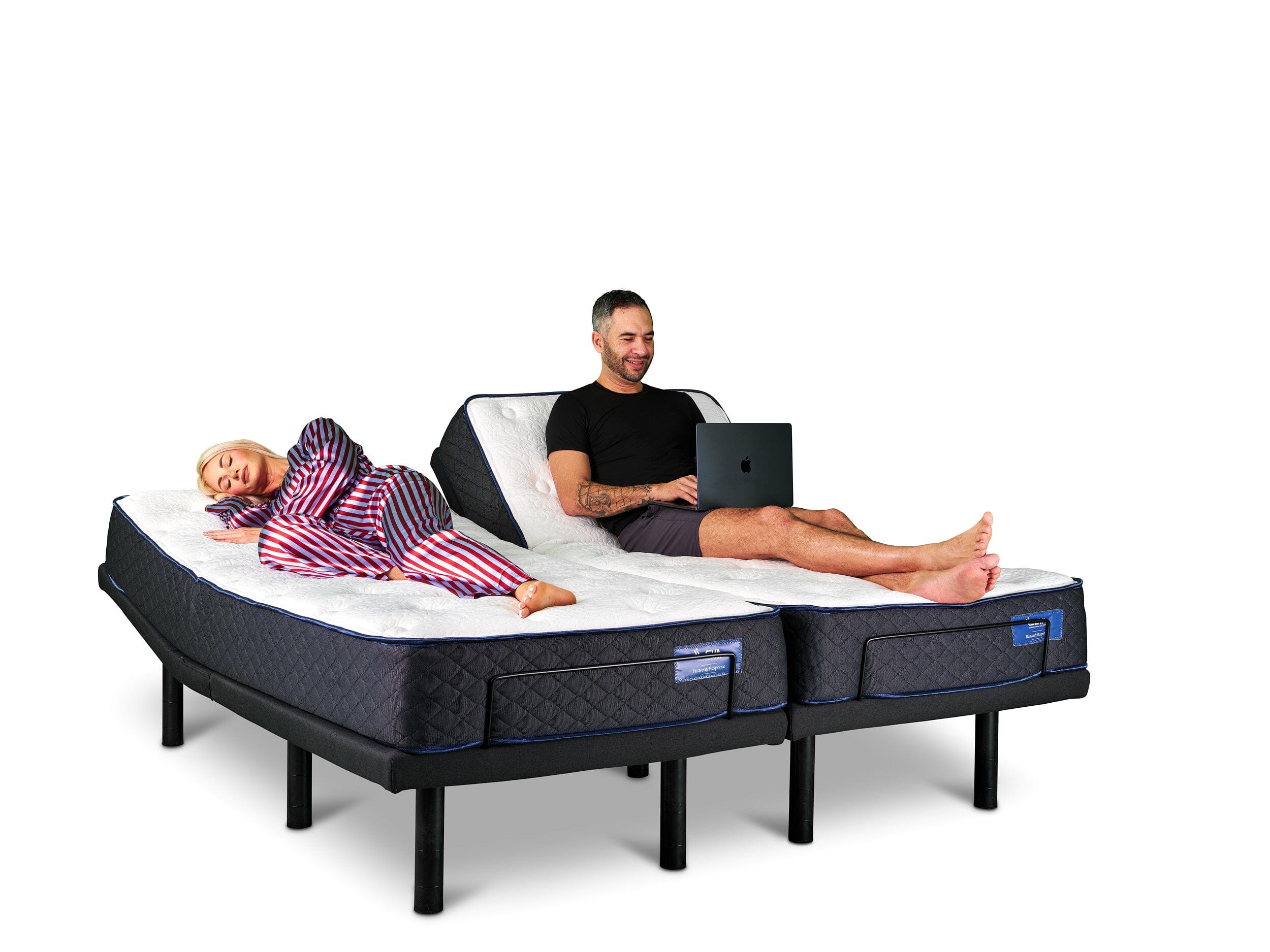
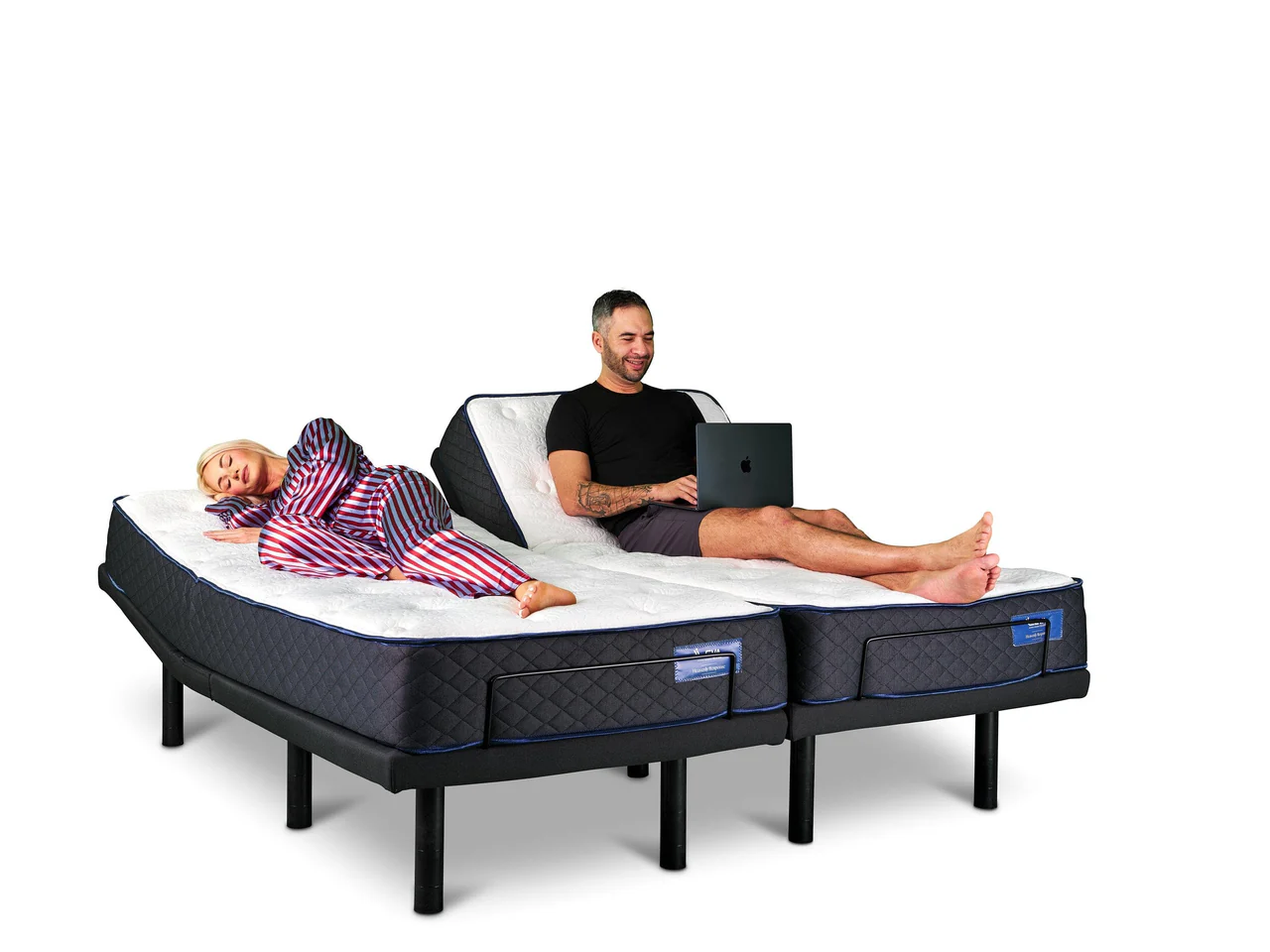
- Use a split king made of two separate Twin XL bases, each with its own motor, remote, and controls, so each partner independently sets head elevation, foot elevation, and massage settings.
- Allow one partner to use full zero-gravity positioning for hip pain while the other remains completely flat.
- Extend independent adjustability to smaller rooms with split queen configurations, which Leva Sleep builds to customer specifications.
- Pair with hybrid mattresses using individually wrapped pocket coils that deliver superior motion isolation and prevent one partner’s position changes from disturbing the other.
Real-world scenario: differing firmness needs
One partner needs a softer surface for hip pressure relief, while the other prefers firm support for lower back stability. A split king integrated system lets each side use a different mattress firmness on the same frame. Both partners keep their preferred feel without giving up the experience of sharing a bed.
Technology and Features That Support Hip Relief
Traditional flat beds: No adjustable technology. Comfort remains static and depends entirely on mattress selection.
Basic adjustable bases: Provide head and foot elevation through a wired or basic wireless remote. Zero-gravity presets may exist but usually as a single fixed angle instead of a customizable range. Motors in older or entry-level models can exceed comfortable noise thresholds, while quieter premium models achieve nearly silent position changes that help light sleepers.
Integrated adjustable systems:
Integrated systems address hip pain through a connected set of positioning and control features. Zero-gravity presets modeled on NASA’s neutral body position, which redistributes G-forces and minimizes musculoskeletal stress, form the base by creating an approximate 120-degree angle at the hips. Building on that base, independent foot elevation lets hip flexors relax instead of pulling on the lumbar spine all night and also supports blood return from the legs. These adjustments reach full value when whisper-quiet German motors allow repositioning without waking a partner, which separates premium systems from basic bases where motor noise can interrupt sleep.
App control then extends this precision. Custom sleep position memory, vibrating alarms, and micro-adjustments without fumbling for a remote in the dark make it easier to fine-tune hip-friendly positions. Anti-snore mode adds another layer by detecting snoring and making subtle head-elevation changes, which reduces a common source of partner disruption. Brushless motor architecture, debuted at the Winter Las Vegas Market, offers advances in design freedom, performance, and long-term system intelligence. This technology signals where premium integrated systems are heading.
Real-world scenario: post-surgery recovery
A partner recovering from hip replacement surgery needs consistent leg elevation to reduce swelling and support circulation. Raising the feet on an adjustable base can improve comfort and spinal alignment when a mattress alone does not adequately support the spine. The recovering partner can program a precise recovery position, while the other partner sleeps flat and undisturbed on their own side.
Setup and Everyday Use in Real Bedrooms
Traditional flat beds: Offer simple setup with no ongoing operational requirements beyond standard mattress care and have no learning curve.
Basic adjustable bases: Usually arrive in a box and require self-assembly, which can be physically demanding. Remote controls are simple but provide limited programmability. Shoppers must verify mattress compatibility, since not all mattresses flex correctly on an adjustable base.
Integrated adjustable systems: Include more components and benefit from professional setup for correct assembly, leg height calibration, and mattress seating. Leva Sleep’s white-glove delivery service, available for a fee, handles old bed removal, full assembly, leg height adjustment, and a product tutorial. This approach removes the physical and technical burden from the customer. App-based control has a short learning curve and then allows far greater personalization. Leva’s purpose-designed bedding accessories, including deep-pocket fitted sheets with extra elastic, solve the common problem of sheets pulling free during elevation changes.
Long-Term Reliability and Support
Traditional flat beds: Rely entirely on mattress construction for durability. They have no mechanical components to fail but also cannot adapt as sleep needs change.
Basic adjustable bases: Show wide variation in motor longevity by brand and price point. Brushed motors in entry-level bases are more prone to wear and noise degradation over time. Warranty coverage and replacement part availability differ significantly across general retailers.
Integrated adjustable systems: Use premium components, including whisper-quiet German motors and precision fabrication, to support daily use over many years. Brushless motor architecture simplifies cable management through daisy-chain connections and enables plug-and-play upgradability for accessories, which extends the functional lifespan of the base. Leva Sleep’s vertical integration, with systems designed and assembled locally, supports consistent quality control and direct post-purchase service without relying on third-party retailers.
Decision Checklist: Matching Bed Types to Your Situation
Use the following matrix to identify which bed category aligns with your situation. Each row represents a common sleep challenge, and the columns show how well each bed type addresses that specific need. “Not suitable” means the bed type cannot address the problem. “Partial relief” indicates limited effectiveness. “Best fit” signals the strongest match for that scenario. Evaluate each factor honestly before committing to a purchase.
| Your Situation | Traditional Flat Bed | Basic Adjustable Base | Integrated Adjustable System |
|---|---|---|---|
| Chronic hip pain requiring nightly position adjustment | Not suitable | Partial relief, limited precision | Best fit |
| Couple with different firmness or elevation needs | Not suitable | Suitable only if split configuration available | Best fit, split king or split queen |
| Post-surgery or medically recommended elevation | Not suitable | Adequate for basic elevation | Best fit, programmable precision positions |
| Noise sensitivity or light sleeping | No motor noise | Variable, older motors can be disruptive | Best fit, whisper-quiet German motors |
| Budget-primary decision | Lowest upfront cost | Mid-range | Higher upfront, 30–50% below comparable luxury competitors at Leva Sleep |
| Bedroom aesthetics matter | Standard furniture appearance | Often utilitarian | Best fit, furniture-quality design |
| Hands-off delivery and setup required | Standard delivery | Often box delivery requiring self-assembly | Best fit, white-glove professional setup available |
Frequently Asked Questions
Will an adjustable bed actually help with hip pain?
An adjustable bed helps hip pain by changing the mechanical relationship between your body and the sleep surface. A flat mattress concentrates pressure at the hips and shoulders, especially for side sleepers. As explained in the technology section, zero-gravity positioning redistributes body weight and changes the load on the hip joint instead of just softening the feel. The degree of relief depends on the cause of the pain, the mattress paired with the base, and how precisely you set elevation. People with hip osteoarthritis, bursitis, or post-surgical needs often see the greatest benefit. Persistent hip pain that does not improve with positioning adjustments should be evaluated by a health professional.
How do I stop my hip from hurting when I sleep on my side?
Side sleepers often feel hip pain because a flat surface cannot provide different support levels at the shoulder, waist, and hip. Several adjustments reduce this pressure. A gentle head incline of 15–20 degrees and a foot lift of 10–15 degrees on an adjustable base create a contour that mirrors the spine’s natural S-curve and reduces pelvic load. Placing a pillow between the knees keeps the hips stacked and prevents the top leg from pulling the pelvis out of alignment, a combination recommended by the Canadian Chiropractic Association for reducing pelvic tilt during side sleeping. Pairing the adjustable base with an all-foam or hybrid pocket-coil mattress designed to flex evenly across incline points removes pressure ridges at the lumbar break that can worsen hip discomfort.
What makes a split king or split queen adjustable bed better for couples where one partner has hip pain?
A split king uses two Twin XL adjustable bases placed side by side, each with its own motor and controls. The partner with hip pain can elevate their legs and head to a therapeutic angle while the other partner sleeps completely flat. Neither person’s position affects the other’s side of the bed. Motion isolation improves further when each side uses a hybrid mattress with individually wrapped pocket coils, which absorb movement locally instead of transmitting it across the surface. A split queen offers the same independent adjustability in a smaller footprint, a configuration that most general retailers do not carry but that Leva Sleep builds to customer specifications.
How quiet are the motors on premium adjustable bases, and does noise matter for hip pain relief?
Motor noise matters because hip pain relief often requires repositioning during the night without waking a partner. Basic or older adjustable bases can produce motor noise that disrupts light sleepers. Premium integrated systems use whisper-quiet motors, including German-engineered motors in Leva Sleep’s lineup, that operate at levels low enough for mid-night adjustments without disturbance. The 2026 introduction of brushless motor architecture by LOGICDATA delivers minimized noise levels and optimized driving dynamics. When you evaluate any adjustable base for hip pain, ask about decibel ratings and request a live demonstration before purchasing.
Does mattress compatibility affect hip pain relief on an adjustable base?
Mattress compatibility strongly affects hip pain relief. An adjustable base can only deliver its positioning benefits if the mattress flexes correctly at the articulation points. Firm innerspring mattresses and older foam constructions resist bending and can create pressure ridges at the lumbar break that worsen hip and lower back discomfort. All-foam and hybrid pocket-coil mattresses designed for adjustable bases flex evenly across incline points and maintain consistent surface support at every elevation angle. Leva Sleep designs its mattress lineup, including American-made all-foam and hybrid options, specifically to work with its adjustable bases so the full pressure-relief benefit of zero-gravity positioning is not lost to an incompatible mattress.
Conclusion: Why Integrated Adjustable Systems Win for Hip Pain
Traditional flat beds offer no way to address hip joint pressure, and basic adjustable bases provide only partial solutions with limited precision, potential motor noise, and no true independent control for couples. Integrated adjustable systems with split configurations, zero-gravity presets, independent leg elevation, and whisper-quiet motors meet all seven evaluation criteria at once. For couples aged 35–70 managing chronic hip pain, differing firmness needs, or medically recommended elevation, integrated systems are the only category that lets both partners sleep in therapeutic positions without compromise or separate beds.
Leva Sleep has spent more than eight years and 25,000 customer experiences refining this solution. The company offers a curated selection of 15–20 adjustable models, purpose-designed mattresses and bedding, and white-glove delivery that handles every detail from assembly to tutorial. The result is a sleep system built around your body, your partner, and your long-term health.