Written by: Matthew Timmins, Founder and Managing Director, Leva Sleep
Key Takeaways for Couples Comparing Aireloom, Beautyrest, and Leva Sleep
- Both Aireloom and Beautyrest offer premium hybrid mattresses with strong spinal support and pressure relief, but their flat design creates unavoidable trade-offs for couples with differing firmness needs or back pain.
- Medium-firm options from both brands align with clinical evidence for reducing chronic lower-back pain, yet neither can provide individualized firmness zones on a single flat mattress.
- Shared flat mattresses accelerate sagging patterns under dual occupancy, often developing bilateral valleys within 5–7 years that compromise spinal alignment for both partners.
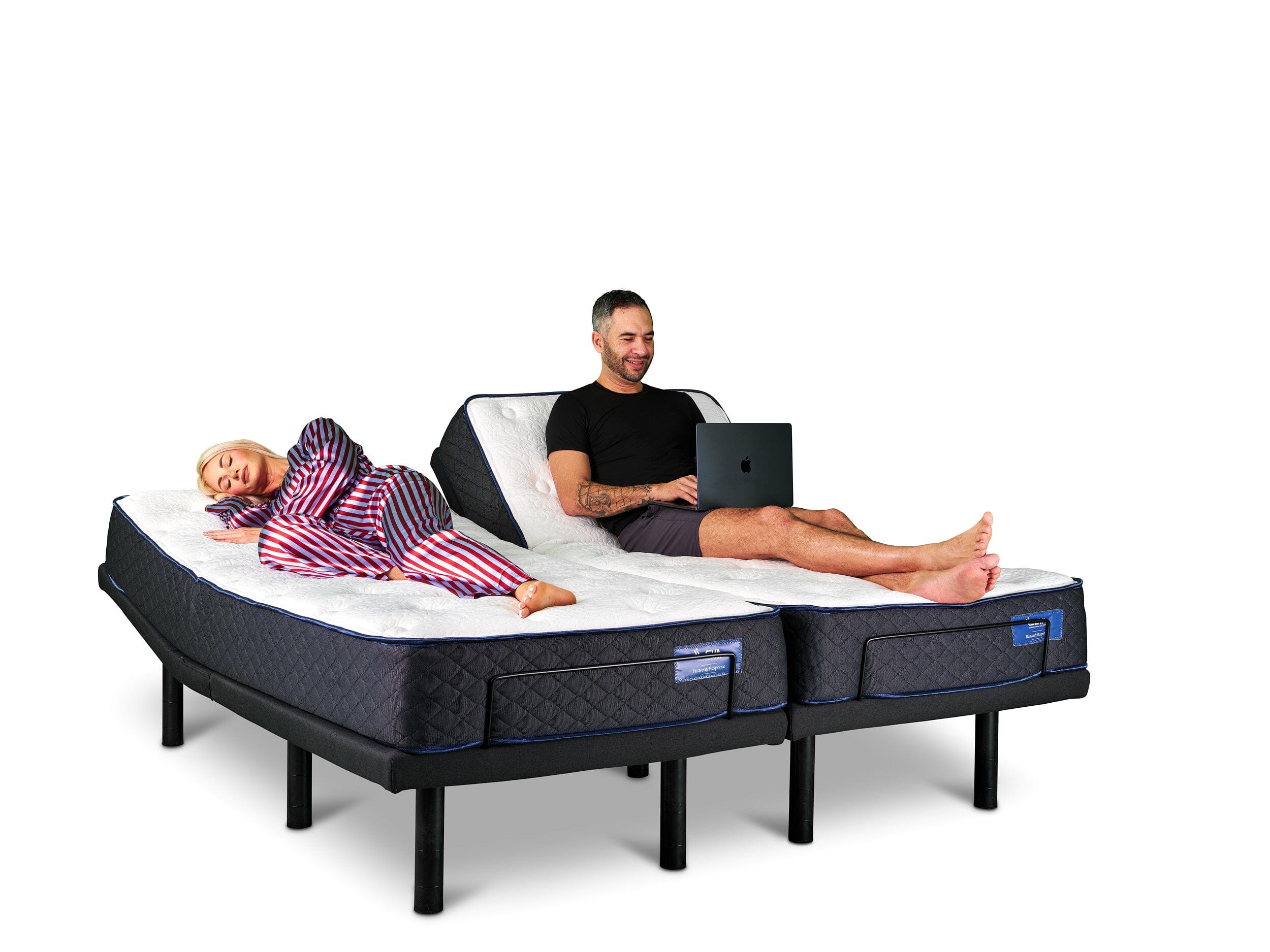
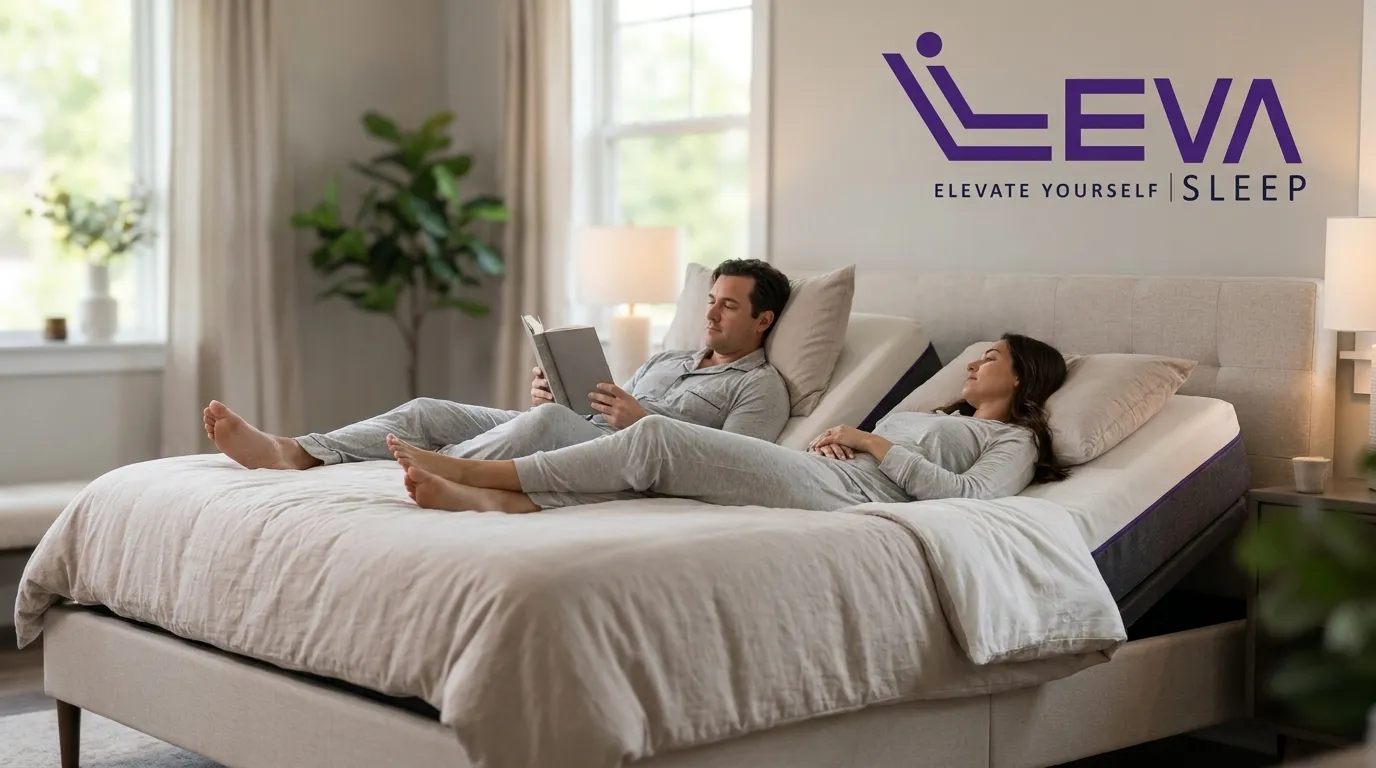
- Adjustable bases solve the core limitations of flat mattresses by enabling independent head and foot elevation, improving lumbar support, reducing snoring, and accommodating mismatched sleep preferences.
- Leva Sleep offers split adjustable bases paired with curated Aireloom mattresses, delivering personalized positioning and premium support, shop online or visit the La Jolla showroom today.
How Flat Mattresses Limit Couples with Back Pain
The seven criteria that matter most when evaluating a mattress for two adults with back pain are spinal alignment and pressure relief, motion isolation and edge support under two bodies, durability under shared weight, adjustability and personalization, noise and motion, aesthetics and integration, and service and delivery. Flat mattresses can perform well on spinal support, motion isolation, durability, noise, aesthetics, and service, but they structurally cannot deliver true adjustability and personalization for each partner.
On flat mattresses, gravity creates a bridging effect that leaves the lower back unsupported or flattens its natural curve, forcing muscles and ligaments to remain engaged and contributing to stiffness and chronic discomfort. When two people with different body weights and sleep positions share that flat surface, one partner’s optimal firmness almost always becomes the other’s compromise.
Neutral Overview of Aireloom Mattresses
Aireloom is a California-made luxury brand built around hand-tufted natural materials and precision coil engineering. Aireloom hybrid models use 15-gauge wrapped coils in the support system, with some models also featuring 18- or 19-gauge micro-coils in the comfort layers. One Summit model instead uses 13.75-gauge coils, which creates a firm initial feel that then transitions into contouring support.
The hand-tufting process anchors the comfort layers without adhesives, which preserves loft and breathability over time. For back sleepers with chronic lower-back pain, Aireloom’s coil architecture resists excessive hip sinkage while the micro-coil layer provides targeted contouring at the lumbar curve. The brand’s natural material composition, including wool, cashmere, and organic cotton, also supports temperature regulation without relying solely on gel infusions.
Aireloom mattresses sit at the premium end of the market and are available through a limited network of authorized retailers, which affects both price and the quality of the purchasing experience.
Neutral Overview of Beautyrest Mattresses
Beautyrest’s T3 Pocketed Coil system uses triple-stranded steel coils, creating stronger and more durable support than standard single-wire innersprings while also providing motion isolation through individually pocketed coils. The Black series adds nano-coils on top of the main T3 system to deliver micro-contouring for hips and shoulders, which matters for side sleepers with chronic pain.
The Beautyrest Hybrid mattress features multiple foam layers beneath the BlackICE cover for heat dissipation, spinal alignment, support, motion isolation, and cooling, above the Triple-Stranded Pocketed Coil base. Beautyrest offers Plush, Medium, and Firm configurations, giving couples some ability to select firmness, although both partners must share the same firmness level on a standard queen or king.
Comfort and Pain Relief on Aireloom and Beautyrest
For back pain specifically, firmness selection is the most consequential decision on a flat mattress. A 2003 RCT in The Lancet (Kovacs et al., n=313) found that medium-firm mattresses reduced chronic non-specific low back pain significantly compared to firm mattresses. Both Aireloom and Beautyrest offer medium-firm options that align with this evidence.
For back sleepers with chronic back pain, Beautyrest recommends medium or medium-firm models because the T3 coils prevent excessive hip sinkage that would strain the lumbar spine, while foam layers supply enough cushion to maintain neutral spinal alignment. Aireloom’s micro-coil layer serves a similar function through a different mechanical approach, using physical contouring rather than foam compression.
The critical limitation appears when two people with different pain profiles share one surface. Both mattress firmness and sleep position matter significantly and interact: the optimal mattress for a back sleeper differs from that for a side sleeper with the same pain condition, and no sleep position adjustment can fully compensate for a fixed flat mattress that creates pressure points or allows spinal misalignment.
Partner Compatibility and Zoned Support Limits
When one partner needs a firmer surface for lumbar support and the other needs pressure relief at the hips and shoulders, a single flat mattress firmness cannot satisfy both. Zoned support is a key orthopedic feature in mattresses such as the Helix Midnight Luxe and Saatva Rx, providing firmer support under the lower back and more contouring under the shoulders and hips. Beautyrest’s nano-coil layer in the Black series provides some zoning, and Aireloom’s micro-coil construction offers localized response, but neither brand can provide different firmness zones for each side of the bed on a standard mattress.
Snoring compounds the problem for many couples. When one partner elevates their head to open airways, a flat mattress requires stacking pillows, which creates an imprecise solution that shifts cervical alignment and often collapses during the night. Split King mattress configurations on adjustable bases enable partners with mismatched back pain needs to adjust each side independently for individualized spinal alignment and pressure relief.
Durability and Sagging Risks for Shared Mattresses
High-quality hybrid mattresses typically last 7–10 years, while better-built models with higher-grade materials can reach 8–12 years or more with proper care. Low-quality hybrids with inferior coils may sag in only 5–6 years. Both Aireloom and Beautyrest use premium coil systems that support the longer end of that range under single-occupancy conditions.
Dual occupancy accelerates wear in predictable patterns. Couples sleeping on the same mattress in fixed positions for 5 or more years commonly develop bilateral valleys, two parallel impressions flanking a raised center ridge, due to localized compression under the pelvis while the less-loaded center maintains height. A sagging mattress fails to provide uniform support to the spine and joints. This inadequate support forces your body to maintain stressed positions during sleep, potentially contributing to aches and pains in the morning.
Many major manufacturers use a 1.5-inch sagging depth as the common warranty benchmark for structural failure. Aireloom’s hand-tufting and Beautyrest’s triple-strand T3 coils both contribute to sagging resistance, but neither eliminates the bilateral valley pattern under consistent dual-occupancy use.
Motion Isolation and Edge Support for Couples
Motion isolation is where coil architecture most directly affects sleep quality for couples. Pocketed coils wrapped individually in fabric isolate motion better than traditional connected innersprings because each coil compresses independently rather than transferring movement like a row of dominoes. Both Aireloom and Beautyrest use pocketed coil systems, which provides a baseline advantage over traditional innersprings.
Edge support under differing body weights requires separate evaluation. When comparing either brand, consider whether the perimeter coils are reinforced or foam-encased, and whether the mattress will be used on a compatible foundation.
Noise and Motion from the Base
Both Aireloom and Beautyrest hybrid models use pocketed coil systems that minimize coil noise during position changes. The primary noise variable for couples is not the mattress itself but the base. Standard flat foundations stay silent but remain static. Adjustable bases introduce motor sound, and that sound level varies significantly by product quality.
Leva Sleep’s systems use whisper-quiet German motors specifically engineered to minimize audible disruption during nighttime adjustments, which creates a meaningful distinction from basic adjustable bases sold as retail add-ons.
Bedroom Aesthetics and System Integration
Aireloom’s hand-tufted surface and natural material construction give it a furniture-quality appearance that integrates naturally into premium bedroom environments. Beautyrest’s BlackICE cover and pillow-top options offer a more conventional luxury hotel aesthetic.
Neither brand was designed specifically for use on an adjustable base, which can affect how the mattress flexes and whether the cover material accommodates repeated articulation. Mattresses engineered in partnership with adjustable base specialists, as Leva Sleep’s curated lineup is, are built to flex at the correct zones without stressing seams or comfort layers.
Service, Delivery, and Setup Experience
Aireloom is available through a limited authorized dealer network, which means the delivery and setup experience depends entirely on the retailer. Beautyrest is more widely distributed, including through large-format mattress chains where adjustable base expertise can be inconsistent.
For couples investing in a complete sleep system, the delivery and setup experience directly affects whether the system is configured correctly from the first night. Leva Sleep’s in-house white-glove delivery includes bedroom-level setup, leg height adjustment, product tutorials, and old bed removal, treating the installation as part of the product rather than a logistics afterthought.
Decision-Framework Checklist: Flat vs Adjustable Options
Before selecting between Aireloom and Beautyrest or any flat mattress, evaluate the following questions honestly.
- Do both partners have the same preferred firmness level, or does one need more pressure relief than the other?
- Does either partner experience lower-back pain that is worse when lying flat or better with knee and head elevation?
- Does snoring or sleep apnea affect either partner’s sleep quality or breathing at night?
- Have previous flat mattresses, regardless of brand or price, failed to resolve ongoing morning stiffness or pain?
- Is the goal a mattress replacement, or a complete sleep system that addresses positioning, pressure, and partner compatibility simultaneously?
If the answer to two or more of these questions points toward individualized positioning needs, the comparison between Aireloom and Beautyrest becomes secondary to the question of adjustability.
Frequently Asked Questions
Do chiropractors recommend Aireloom or Beautyrest for back pain?
Orthopedic and chiropractic specialists generally recommend medium-firm mattresses for chronic back pain because they balance spinal support with pressure relief at the hips and shoulders. Both Aireloom and Beautyrest offer medium-firm configurations that align with this guidance.
Specialists increasingly note that mattress firmness alone does not address positioning, particularly for patients whose pain is worse when lying flat. Adjustable bases that allow head and foot elevation are recommended for conditions including lumbar disc issues, spinal stenosis, and hip arthritis, because they allow the spine to decompress in ways a flat surface cannot replicate regardless of firmness.
How long before a mattress sags under two people?
While the lifespan estimates mentioned earlier assume ideal conditions, dual occupancy introduces specific wear patterns that accelerate functional support loss. Under shared use, the more relevant pattern is bilateral valley formation, with two parallel body impressions that develop over years of sleeping in fixed positions and a raised center ridge that can cause both partners to roll inward.
This warranty threshold does not account for functional support loss that often begins before 1.5 inches of visible sagging occurs. Rotating the mattress every 3–6 months and using a compatible foundation with adequate center support slows this process.
Are Aireloom mattresses compatible with adjustable bases?
Aireloom mattresses can be used with adjustable bases, but compatibility depends on the specific model and coil construction. Mattresses with rigid perimeter coils or thick foam borders may not flex adequately at the head and foot zones required for full articulation.
Leva Sleep’s curated lineup includes Aireloom models selected and paired specifically for use with adjustable bases, ensuring the mattress flexes correctly without stressing the cover material or internal layers. This creates a meaningful distinction from purchasing an Aireloom mattress through a general retailer and pairing it with a separately sourced adjustable base.
What is the price difference between Aireloom and Beautyrest mattresses?
Beautyrest offers a wide price range, with entry-level models like Silver starting below $1,000 for a queen and Black series models reaching up to around $4,200. Aireloom is positioned exclusively at the luxury tier, with queen models typically starting above $2,500 and reaching $6,000 or higher for hand-tufted natural material constructions.
Neither brand’s price includes an adjustable base, which adds $1,000–$4,000 depending on features. Leva Sleep’s vertically integrated model, which covers design, assembly, and delivery in-house, offers adjustable sleep systems at 30–50% less than comparable competitors, making a premium Aireloom-plus-adjustable-base system more accessible than purchasing the components separately through traditional retail channels.
Can a split adjustable base work with a standard king or queen mattress?
A split adjustable base requires a split mattress, two twin XL mattresses for a Split King, or two custom-width mattresses for a Split Queen. A standard one-piece king or queen mattress cannot articulate independently on a split base.
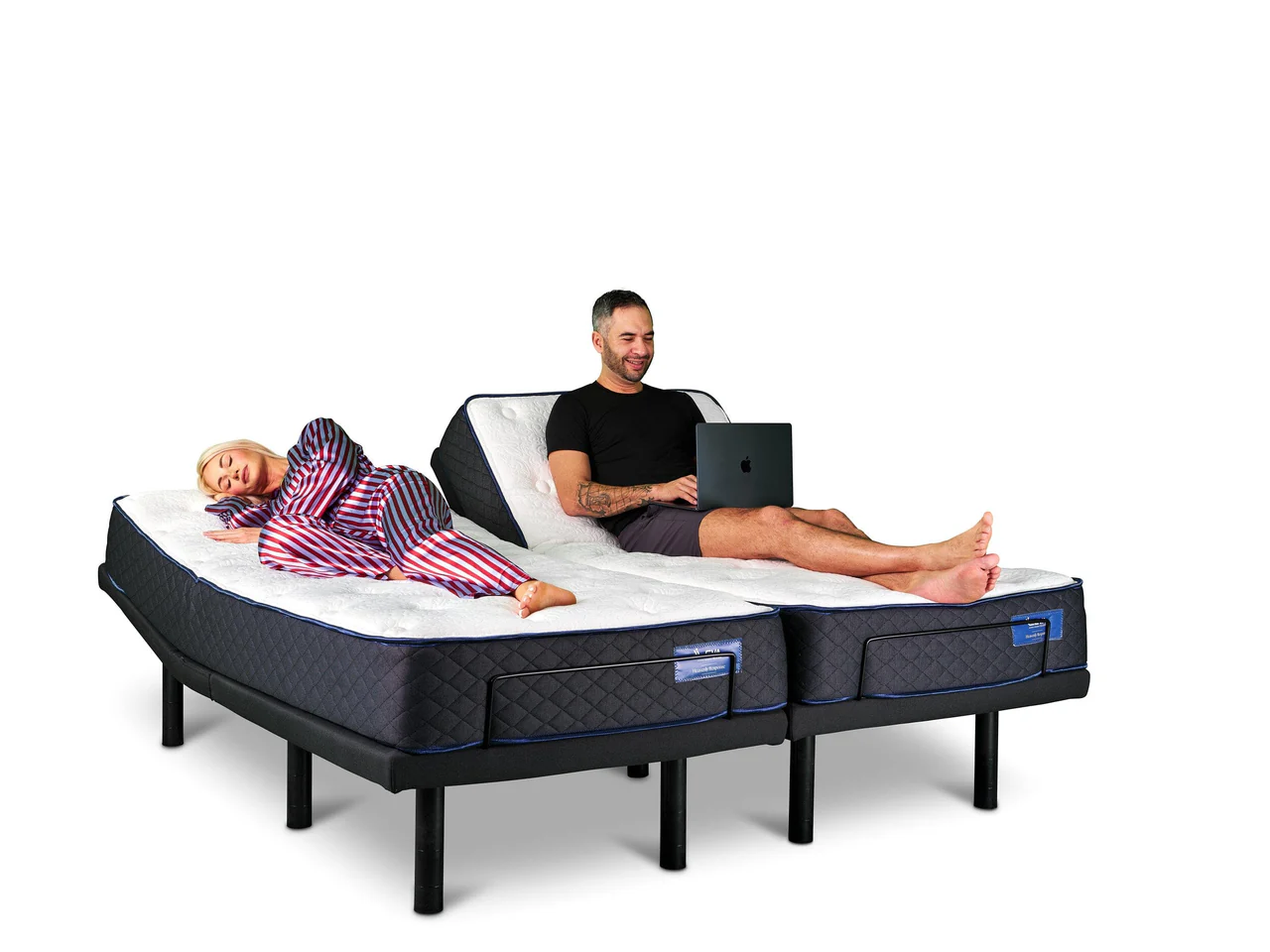
This requirement means mattress selection and base selection must be coordinated from the start. Leva Sleep’s Split Queen configuration is a specialized offering that few retailers provide, built to customer specifications and paired with mattresses engineered to flex correctly on the base. The visual result, when properly configured with the right bedding, is a unified bed surface that does not look or feel like two separate beds.
Conclusion: Why Adjustable Systems Remove Compromise
Aireloom and Beautyrest are both excellent mattresses. Aireloom’s hand-tufted natural materials and micro-coil construction deliver genuine luxury and strong spinal support for back sleepers. Beautyrest’s T3 pocketed coil system and multi-layer foam architecture provide reliable pressure relief and motion isolation for couples. Evaluated on their own terms, either brand represents a sound investment for a single sleeper or a couple with closely matched needs.
For couples with chronic back pain and mismatched sleep preferences, however, both brands share the same structural ceiling because they remain flat. As noted earlier, adjustable positioning adapts to individual body shapes rather than forcing a straight, flat alignment, a fundamental advantage that no premium flat mattress can replicate regardless of price or construction.
Leva Sleep’s split adjustable base paired with a curated Aireloom mattress delivers what the flat-mattress comparison cannot: independent elevation for each partner, whisper-quiet German motors, anti-snore positioning, lumbar control, and a furniture-quality design that belongs in a premium bedroom rather than a medical supply catalog. After eight years and more than 25,000 customers, Leva Sleep has built its entire model around this specific problem, serving couples who refuse to accept that one partner must compromise their health for the other’s comfort.