Written by: Matthew Timmins, Founder and Managing Director, Leva Sleep
Key Takeaways for Couples
- Couples dealing with snoring, firmness conflicts, or pain from flat mattresses often turn to adjustable systems for better sleep.
- Leva Sleep pairs a motorized adjustable base with a conventional mattress, while Sleep Number builds firmness control into an air-chamber mattress.
- Leva offers dedicated lumbar and pillow-tilt motors, Split Queen options, and whisper-quiet German motors. Sleep Number does not match these specific features.
- Sleep Number’s Climate360 provides active in-mattress temperature control. Leva uses a separate heating and cooling pad for independent temperature settings.
- Explore Leva Sleep’s Split King and Split Queen systems online or in the La Jolla showroom to see which setup fits your bedroom and budget.
How This Comparison Is Structured
This comparison focuses on the criteria couples care about most when sharing a bed. The eight criteria used throughout this article are:
- Comfort and support
- Adjustability and personalization
- Temperature control
- Noise and motion isolation
- Durability and maintenance
- Aesthetics and bedroom integration
- Health and wellness impact
- Service and delivery experience
Core Technology: How Each System Works
Leva Sleep builds its systems around a motorized adjustable base paired with a separately chosen conventional mattress, either all-foam or a hybrid with pocket coils. The base articulates the head and foot independently, and higher-end models add lumbar lift and pillow-tilt motors. The mattress uses standard foam or coil construction, so you can replace it independently of the base as your preferences or health needs change.
Sleep Number integrates the firmness mechanism directly into the mattress. Sleep Number mattresses use adjustable air chambers in the support core that let each sleeper set firmness on a 1–100 scale. The mattress and its air-pump system function as a single proprietary unit, while the base is a separate purchase. The Climate360 tier adds active heating and cooling within the mattress surface.
Browse Leva’s adjustable base models and compatible mattresses online or in the La Jolla showroom to see how the base-plus-mattress approach fits your needs.
Comfort and Pain Relief for Different Bodies
Leva and Sleep Number support spinal alignment and pressure relief in different ways. A 2026 orthopedic support guide separates firmness from support and notes that ideal alignment depends on sleep position, body weight, pain location, and conditions such as herniated discs or muscle tension.
Key comfort and pain-relief differences between the two systems:
- Lumbar control: Leva’s higher-end bases include a dedicated lumbar motor that lifts the lower-back zone independently of head and foot elevation. Sleep Number’s lumbar support comes from air-chamber firmness adjustment and zoned foam layers rather than a separate articulating motor.
- Pillow tilt: Leva offers a pillow-tilt motor that adjusts the top section of the head panel independently, which allows finer neck and shoulder positioning. Sleep Number does not offer a comparable pillow-tilt feature.
- Hip and shoulder pressure: The 2026 orthopedic support guide highlights shoulder pressure under 32 mmHg and hip sink under 2 inches as key thresholds for back pain relief. Both systems can support these thresholds. Leva does this through mattress material choice and base elevation, while Sleep Number relies on air-chamber firmness tuning.
- Zero-gravity positioning: Both systems offer zero-gravity presets that raise the head and legs together to reduce spinal compression.
Partner Compatibility and Split Options
Both brands focus on independent customization for two people sharing one bed. A January 2023 International Housewares Association survey found that 21% of US adults maintain a separate bedroom from their partner, and 46% of those cite snoring or incompatible sleep habits.
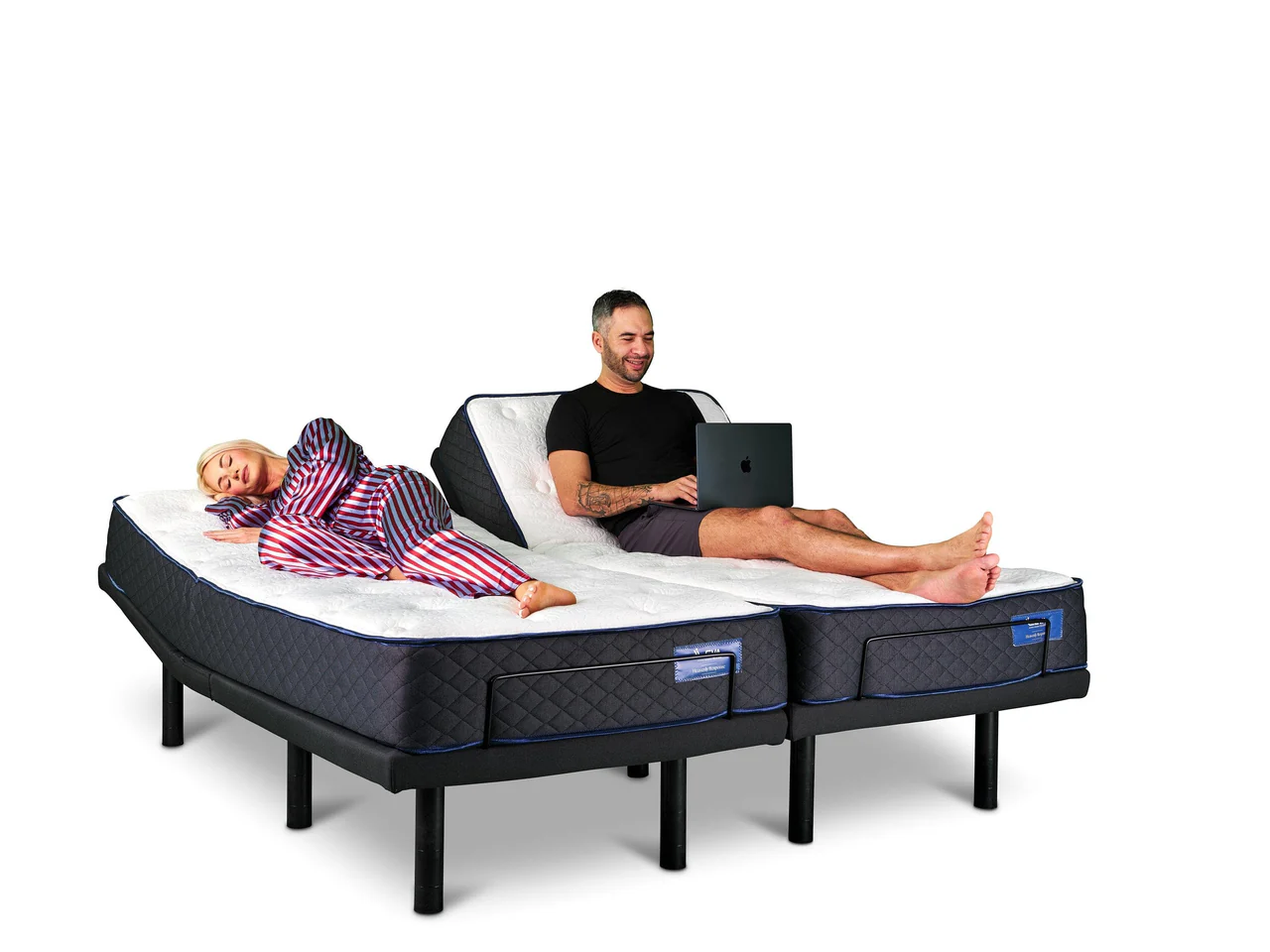
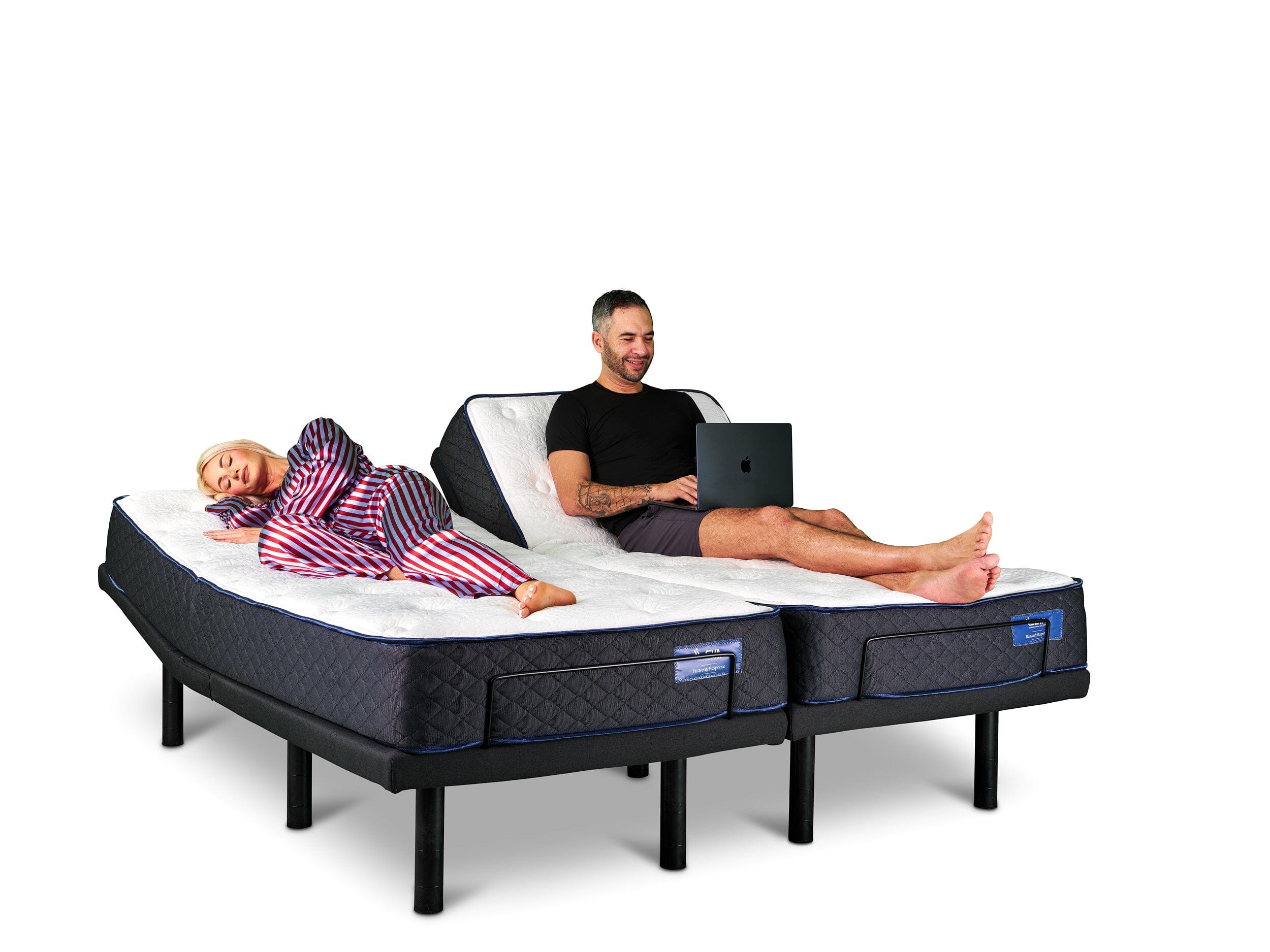
- Split configurations: Leva offers both Split King and Split Queen configurations with fully independent bases. A split king places two Twin XL mattresses on separate bases side by side, so each partner adjusts elevation independently without disturbing the other. Leva’s Split Queen offers the same independence in a smaller footprint, which is uncommon among competitors. Sleep Number offers Split King but not Split Queen.
- Independent firmness: Separate mattresses in a split king let each partner choose a different firmness level, directly addressing firmness conflicts. Sleep Number provides per-side firmness through dual air chambers within a single mattress surface.
- Motion isolation: A split configuration with independent bases significantly reduces motion transfer, so one partner’s movements are barely felt by the other. Sleep Number’s single-mattress design with dual air chambers offers less physical separation.
Temperature Control Approaches
Temperature regulation represents one of the biggest differences between these systems.
Sleep Number’s Climate360 integrates active heating and cooling directly into the mattress surface. A June 2026 Sleep Number release, based on nearly 82,000 Climate360 users and more than one million sleep sessions, found that users who adjusted mattress temperature gained up to nearly an hour of additional sleep per night compared with those who did not adjust temperature. The Climate360 allows independent temperature adjustment of up to 15 degrees cooler or warmer on each side of the mattress.
Leva Sleep manages temperature through a compatible heating and cooling pad that works with its adjustable base system, so each partner sets an independent thermal environment. Because Leva’s temperature solution sits as a separate accessory layer rather than inside the mattress core, couples can add, upgrade, or replace it without changing the mattress. Couples comparing temperature control should request each brand’s current temperature range and response time before purchasing.
Smart Features and App Control
Both brands invest in app-based control and automated adjustments, and their smart features affect couples differently.
- Anti-snore mode: Leva’s anti-snore mode, scheduled for spring 2026, detects snoring and makes small head-of-bed adjustments to open the airway. Raising the head of the bed to a gentle incline helps reduce positional snoring by keeping the upper airway open. Sleep Number’s 360 Smart Bed platform includes a responsive air feature that adjusts firmness automatically based on movement.
- App control: Leva’s app uses Bluetooth to control elevation, massage, lumbar, pillow tilt, and temperature pad settings. It also supports custom position presets and a vibrating alarm. Sleep Number’s SleepIQ platform integrates biometric sleep tracking, air-chamber firmness control, and personalized sleep analytics.
- Motor noise: Leva uses whisper-quiet German motors across its base lineup, which helps light sleepers. Sleep Number’s air-pump system produces audible inflation and deflation sounds when users adjust firmness during the night.
- AI and tracking: The smart mattress segment is projected to grow at a compound annual rate of 8.2% through 2033, driven by AI-led sleep adjustment and smart-home connectivity. Both brands are developing AI-assisted features, and Sleep Number’s SleepIQ platform currently has a longer commercial track record.
Setup, Delivery, and Daily Use
Leva Sleep offers in-house white-glove delivery for a fee. Trained professionals deliver to the bedroom, assemble the base and mattress, adjust leg heights, provide a product walkthrough, and remove the old bed. Specialized bedding such as deep-pocket fitted sheets with extra elastic, duvet clips, and mattress protectors is designed for adjustable bases to keep sheets in place during elevation changes.
Sleep Number sells through its own retail stores and website, where delivery and setup services are available. However, the system’s air-pump components and proprietary mattress construction mean installers must understand Sleep Number’s specific setup process to ensure proper operation. This proprietary design also affects bedding, since sheets and protectors must fit the mattress’s integrated air-chamber structure, which differs from standard mattress dimensions.
Both systems involve a short learning curve for app controls and position presets. Most couples spend one to two weeks fine-tuning nightly settings for each partner.
Long-Term Reliability and Maintenance
The durability of each system reflects its construction. Hybrid mattresses generally last between 7 and 10 years, while adjustable air mattresses typically last 8 or more years.
Air mattresses are more likely to develop leaks from small punctures or worn seals and may lose air overnight, which requires periodic reinflation, while hybrid mattresses may develop gradual sagging or body impressions over time. Hybrid mattresses need minimal maintenance such as occasional rotation and use of a mattress protector, while air mattresses require more care, including leak checks, thorough cleaning to prevent moisture buildup, and careful storage when not in use.
Leva’s adjustable base motors carry manufacturer warranties, and the base and mattress function as separate components, so you can replace one without replacing the entire system. Sleep Number’s integrated design means mattress or pump issues may require service or replacement of the full unit.
Real-World Scenarios for Couples
Five common scenarios show how each system aligns with specific needs:
- Chronic back pain: A sleeper with lumbar tension benefits from Leva’s dedicated lumbar motor, which lifts the lower-back zone independently. Sleep Number’s air-chamber tuning can reduce hip sink but does not articulate the lumbar zone separately.
- Snoring partner: Leva’s 2026 anti-snore mode automates head elevation when it detects snoring. Sleep Number’s Responsive Air adjusts firmness based on movement but does not include a dedicated snore-detection elevation feature.
- Differing firmness preferences: Both systems address firmness conflicts through split configurations discussed earlier. Leva uses separate mattresses on separate bases, while Sleep Number uses dual air chambers within one mattress.
- Post-surgery recovery: Leva’s base articulation supports prescribed elevation angles for hip, knee, or abdominal recovery. Its furniture-style design avoids the clinical look of hospital beds.
- Athletic recovery: Zero-gravity positioning on either system reduces spinal compression after intense training days. Leva’s massage function and temperature pad add recovery-focused options that each partner can control independently.
Pricing, Value, and Practical Tradeoffs
Leva Sleep prices its systems at roughly 30–50% less than comparable premium competitors by selling direct to consumers, using local assembly, and avoiding retail markups. The brand offers 15–20 adjustable base models, compared with the 3–5 models typically found at general mattress retailers, which allows closer matching of features to budget and health priorities. The global sleep aid technology market reached about $103.5 billion in 2025 and is projected to reach $136 billion by 2030. Bobby Cleveland, president of Verlo Mattress, notes that consumers increasingly view these purchases as health investments rather than simple furniture buys.
Sleep Number’s pricing reflects its integrated technology platform and national retail presence. The Climate360 tier, which includes active temperature management, sits at the upper end of the premium segment. Buyers should compare total system cost, including base, mattress, bedding, and delivery, across both brands before deciding.
Guided Decision Framework for Your Priorities
Use the following criteria to see which system aligns more closely with your needs:
| Priority | Leva Sleep | Sleep Number |
|---|---|---|
| Targeted lumbar and pillow-tilt control | Dedicated lumbar motor and pillow-tilt motor on higher-end bases | Air-chamber firmness adjustment, no separate lumbar articulation motor |
| Split Queen availability | Available, built to specification | Not available |
| Active in-mattress temperature control | Compatible heating and cooling pad accessory | Climate360 with ±15° per-side control (see Temperature Control section) |
| Motor noise during nighttime adjustments | Whisper-quiet German motors | Audible air-pump inflation and deflation when adjusting firmness |
| Mattress longevity | Hybrid: 7–10 yrs (see Reliability section) | Air: 8+ yrs (see Reliability section) |
| Budget relative to comparable premium tier | About 30–50% lower than comparable competitors | Full retail pricing, Climate360 at upper premium tier |
| White-glove in-home setup | In-house white-glove delivery and setup available for a fee | Retail store and delivery service available |
Talk with a Leva adjustable base specialist online or in La Jolla to match these priorities to a specific setup before you buy.
Frequently Asked Questions
What are common complaints about Sleep Number beds?
Commonly reported issues with Sleep Number beds include audible noise from the air pump when users adjust firmness at night and the complexity of the proprietary system, which makes independent repairs difficult. Some owners note that air chambers can lose pressure gradually and require periodic reinflation. The integrated design also means that if the pump or air chamber fails, the entire mattress unit may need service rather than a simple component swap.
Why do my hips hurt on my Sleep Number bed?
Hip pain on an air-chamber mattress usually comes from a firmness setting that is either too high or too low. A setting that is too firm creates excess pressure on the greater trochanter for side sleepers, while a setting that is too soft lets the hip sink below neutral spinal alignment. Because air-chamber adjustment changes the feel of the entire surface instead of a specific zone, dialing in a setting that eases hip pressure without sacrificing lumbar support can take extended trial and error. Elevating the legs slightly on an adjustable base can also shift pressure away from the hips on both Leva and Sleep Number systems.
What adjustable bed works better than Sleep Number for couples with different firmness needs?
Couples with very different firmness preferences usually benefit from a true split configuration that uses two separate mattresses, each with its own materials and feel. Leva Sleep’s Split King and Split Queen systems place two independent mattresses on two independent bases, so each partner can choose a different mattress model, such as one all-foam and one hybrid, instead of sharing a single air mattress with different pressures. This approach also removes the motion transfer that occurs when one partner adjusts firmness on a shared air-chamber mattress.
Does an adjustable base actually help with snoring?
Head elevation works as a recognized positional strategy for snoring. Raising the head of the bed to a gentle incline helps keep the upper airway open and reduces the tissue vibration that causes positional snoring. Effectiveness depends on the cause of the snoring, since anatomical factors or sleep apnea may require medical treatment. Leva Sleep’s 2026 anti-snore mode automates this adjustment by detecting snoring sounds and making small head-of-bed elevations without requiring either partner to wake up and change the position manually.
Can I use my existing mattress with a Leva Sleep adjustable base?
Leva Sleep’s adjustable bases work with mattresses flexible enough to bend with the base, typically all-foam or hybrid pocket-coil designs. Traditional innerspring mattresses with interconnected coils usually do not pair well with adjustable bases because the rigid coil structure resists articulation. Leva’s in-house specialists can assess compatibility during a showroom visit or online consultation. Leva also offers a curated lineup of mattresses, including brands such as Airloom, Helix, and Tempur-Pedic, that are specifically matched to its bases.
Conclusion: Matching Leva or Sleep Number to Your Priorities
The choice between Leva Sleep’s adjustable-base-plus-conventional-mattress system and Sleep Number’s air-chamber technology depends on which problems you want to solve first. Sleep Number’s Climate360 delivers documented active in-mattress temperature management with independent per-side control, supported by large-scale user data. Leva Sleep offers dedicated lumbar and pillow-tilt motors, whisper-quiet German motors, a Split Queen option that Sleep Number does not provide, and conventional mattress construction that typically outlasts air-chamber systems while costing about 30–50% less than comparable premium competitors. Industry specialists report that consumers increasingly arrive with a checklist that includes back-pain relief, separate firmness zones, one-touch elevation, and app-based tracking, and both brands address that checklist through different engineering choices. Couples who prioritize positional lumbar control, quiet operation, Split Queen availability, and long-term mattress durability will usually find Leva’s system more closely aligned with those needs.