
Written by: Matthew Timmins, Founder and Managing Director, Leva Sleep
Key Takeaways
-
Smart adjustable beds with acoustic or vibration sensors can automatically raise the head section 15–30° to open the airway and reduce snoring in positional snorers.
-
Split configurations deliver independent head and foot control so both partners receive personalized anti-snore positioning without compromise.
-
Clinically supported elevation between 20–30° measurably lowers apnea-hypopnea index and snoring intensity while remaining comfortable for most sleepers.
-
Premium features such as whisper-quiet German motors, Split Queen options, and white-glove delivery set top-performing bases apart in 2026 comparisons.
How Anti-Snore Technology Works
Anti-snore adjustable beds use accelerometers or microphones embedded in the base or a bedside unit to detect snoring sounds or vibrations. When a snoring event is registered, the system triggers the head motor to rise, either in a single preset jump or in micro-adjustments of 2 to 3 degrees at a time to minimize sleep disruption.
The clinically supported target range is 20 to 30 degrees of head elevation. Souza et al. (2017) in Sleep & Breathing found that 7.5° head-of-bed elevation reduced median AHI from 15.7 to 10.7 events/h (~32 %) in patients with obstructive sleep apnea. Ravesloot et al. (2012) in Sleep and Breathing concluded that positional therapy has undervalued potential as a treatment for position-dependent snoring and obstructive sleep apnea. Elevating the upper body can help keep the airway open.
These clinical findings explain why most anti-snore systems target the 20–30° range. Below 15 degrees the gravitational effect on airway tissue is insufficient, while above 35 to 40 degrees most sleepers find the position uncomfortable. Some automatic systems take 3 to 5 minutes to respond and may falsely trigger on coughing, heavy breathing, traffic noise, or partner movement, so response speed and detection accuracy deserve close attention before purchase.
2026 Smart Adjustable Bed Model Comparison
The following table compares detection method, elevation range, split options, motor noise, and price across four leading anti-snore adjustable bases in 2026. These factors most directly affect snoring reduction, partner comfort, and long-term value for couples.
|
Model |
Detection Method |
Elevation Range |
Split Options |
Motor Noise |
Price Positioning |
|---|---|---|---|---|---|
|
Tempur-Pedic TEMPUR-Ergo Smart Base |
Sleeptracker-AI sensor array; most refined automatic snore detection currently available |
~12° head elevation |
multiple sizes including Twin XL, Queen, King, Split King, and others |
QuietMode included |
$2,099 per base |
|
ErgoSportive |
Garmin-linked biometric sensors |
10–30° (clinically supported range) |
Split King |
Low |
Premium bundle pricing |
|
Sleep Number 360 |
Proprietary biometric sensors |
0–30° |
Split King |
Moderate |
Mid-premium |
|
Leva Sleep 2026 |
Acoustic sensor + app-based control |
Adjustable elevation range |
Split King and Split Queen |
Whisper-quiet German-engineered motors |
30–50% below luxury peers |
Note: ErgoSportive and Sleep Number list prices vary by configuration and retailer, so contact each brand for current quotes. Leva Sleep pricing is available directly at the La Jolla showroom or online.
Split Bases That Keep Couples in the Same Bed
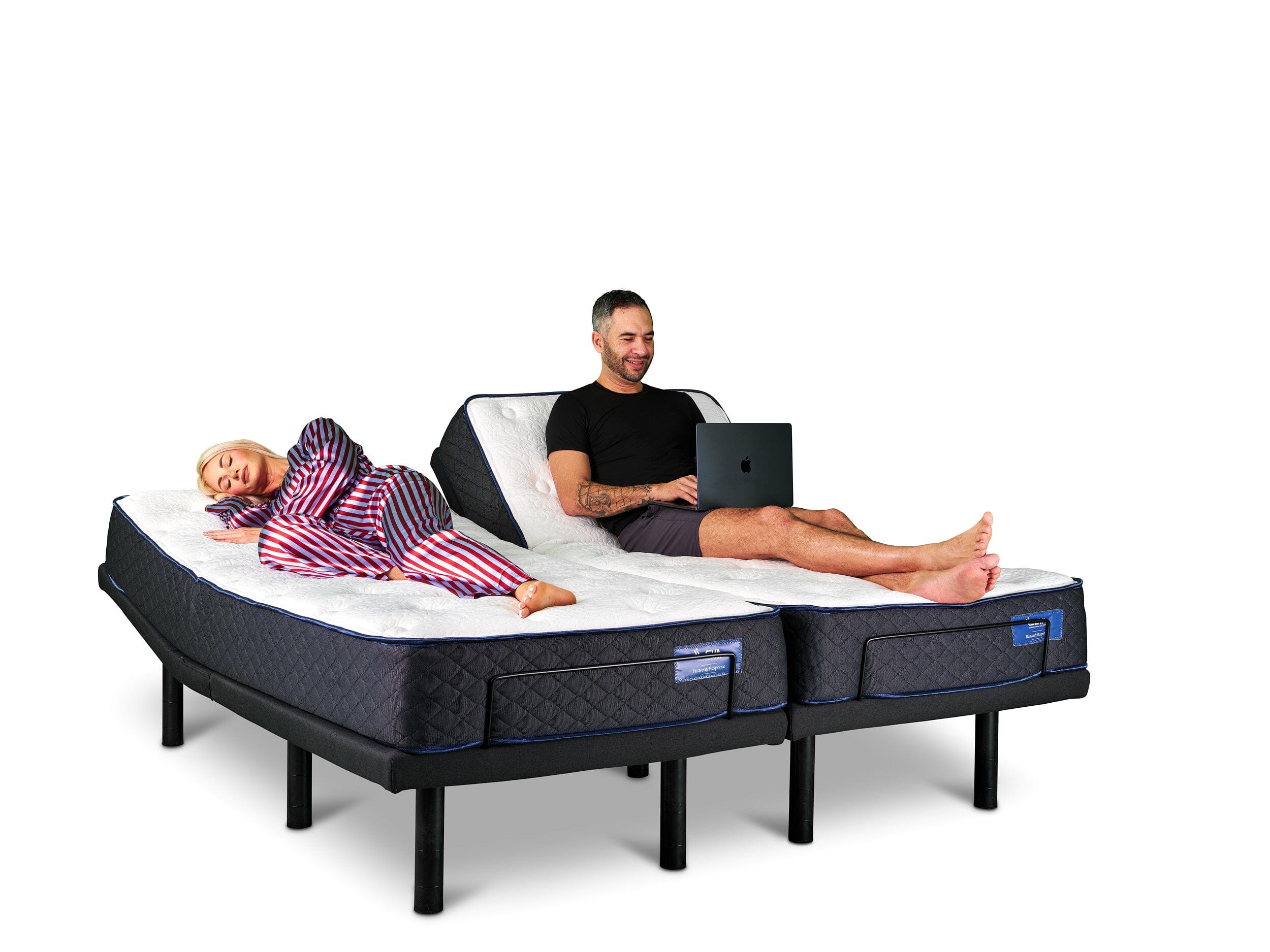
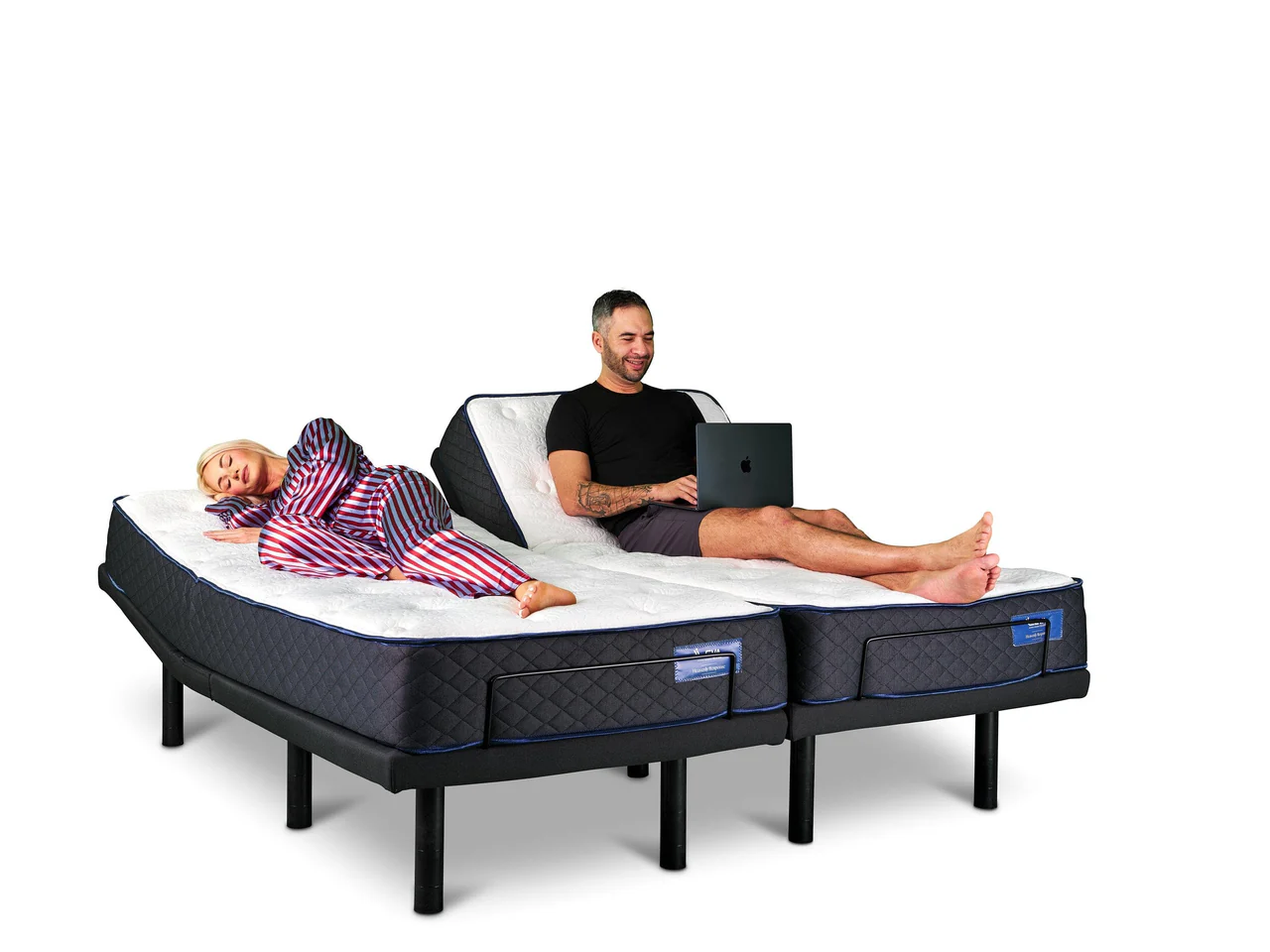
A split king adjustable bed allows couples to adjust each side independently so one partner can use an anti-snore incline without forcing the same angle on the other. This setup directly addresses the “sleep divorce” problem, where one partner’s snoring or positional needs push the other toward a separate room.
Some manufacturers offer a partial alternative. A split head king features a vertical split at the head section extending roughly one-third of the mattress length, while the lower portion remains connected. This preserves a shared sleep surface but limits full-body independence. Couples who need independent foot elevation for circulation, knee pain, or zero-gravity positioning benefit more from a full split base.
Multiple providers, including Leva Sleep, offer a Split Queen configuration, which delivers full bilateral independence in a smaller footprint. Couples in moderately sized bedrooms who cannot accommodate a king can still access personalized head and foot positioning.
Motor Noise and Motion Isolation
Premium adjustable bases should have motors that are nearly silent, and German-engineered motors are known for quiet power and durability, which keeps every movement smooth and steady. Standard motors in entry-level or mid-tier bases can produce audible grinding or whirring that wakes a light sleeper, which undermines the benefit of automatic anti-snore adjustments.
This is where motor engineering becomes a key differentiator. Leva Sleep’s 2026 bases use whisper-quiet German motors across all split configurations. When the anti-snore mode triggers a micro-adjustment at 2 a.m., neither partner should notice the sound or the motion as a disturbance.
Mattress and Bedding Compatibility on Elevated Bases
Elevation changes the geometry of a bed surface, and standard bedding is not designed for that shape. When the head section rises above 20 degrees, fitted sheets pull free at the corners because standard elastic cannot stretch across the longer surface distance. The same geometry problem causes duvets to bunch at the fold point between two independently adjusted halves, since the fabric has nowhere to go.
Leva Sleep addresses these issues by designing its entire accessory line specifically for adjustable bases. The fitted sheets use deep pockets and reinforced elastic that stay in place through the full elevation range. Duvet clips keep the comforter anchored at the fold point, and mattress protectors flex without tearing or shifting. All Leva mattresses, whether all-foam or hybrid pocket coil, are engineered to flex through the full elevation range without damaging internal components.
When evaluating any adjustable bed, confirm that the mattress warranty remains valid with regular elevation use and that compatible bedding is available from the same supplier.
Delivery and Setup Experience for Integrated Systems
A split adjustable base with two independent motors, a mattress, and a full accessory kit involves more complexity than a standard bed frame. That complexity matters because box-in-a-box delivery places the entire setup burden on the customer and provides no calibration for bed height, leg leveling, or app pairing, and any of these gaps can prevent the anti-snore system from working correctly.
Leva Sleep’s white-glove delivery service, available for a fee, addresses this setup challenge. Trained professionals bring the system to the bedroom, handle old bed removal with donation or recycling, assemble every component, adjust leg height, and walk the customer through a full product tutorial before leaving. For a system this integrated, that level of service functions as part of the product rather than a simple convenience add-on.
What Is an Adjustable Bed with Anti-Snore Mode?
An adjustable bed with anti-snore mode is a motorized base that responds to detected snoring by raising the head section, either automatically through onboard sensors or through a manually saved preset. Automatic systems raise the head section without a button press when snoring is detected. Manual presets require the sleeper or partner to activate the position intentionally before sleep.
Among the four models compared here, Tempur-Pedic’s Sleeptracker-AI and Leva Sleep’s acoustic sensor system both operate automatically. ErgoSportive uses Garmin biometric data to inform adjustments. Sleep Number’s 360 system uses proprietary sensors but relies partly on app-based manual confirmation for elevation changes. Fully automatic systems can intervene mid-sleep without waking either partner, which often delivers the smoothest experience.
Do Smart Beds Help with Snoring?
Adjustable beds reduce snoring by elevating the head and torso, using gravity to prevent collapse of soft tissues in the throat and keep the airway open. The effect is strongest for positional snorers, whose snoring worsens when lying flat on their back.
As noted earlier, the 20–30° range works best for moderate to heavy snorers, while light snorers may find relief at 10–15°. Stacking pillows to achieve a similar angle compresses the airway further and often causes neck pain, while an adjustable bed lifts the entire upper torso and maintains neutral spinal alignment.
Adjustable beds provide secondary benefits including relief from acid reflux, sinus congestion, sleep apnea symptoms, and improved circulation, but they remain a non-medical lifestyle solution rather than a cure for snoring. For diagnosed moderate-to-severe OSA, a sleep physician should be consulted alongside any positional intervention.
Decision Checklist for Choosing a Smart Base
The clinical evidence and model comparison above highlight three core variables that shape results: snoring severity, bedroom footprint, and budget. Use the following checklist to connect those variables to a specific base configuration.
-
Light snorer, queen bedroom, value-conscious: Leva Sleep Split Queen with anti-snore mode, which delivers full independence in a space-efficient format at 30–50% below luxury competitors.
-
Moderate-to-heavy snorer, king bedroom, technology-first: Leva Sleep Split King or Tempur-Pedic TEMPUR-Ergo Smart Base. Both offer automatic detection, so compare the 15–30° micro-adjust range of Leva against Tempur’s ~12° ceiling and $2,699–$4,198 price point.
-
Couple with divergent full-body positioning needs (head and foot): Any full split base, since partial split head designs do not provide foot independence.
-
Noise-sensitive light sleeper: Prioritize German-engineered motors and request a motor demonstration before purchasing any base.
-
Buyer who needs white-glove setup: Leva Sleep is the only option among those compared here that offers in-home removal, assembly, height calibration, and a product tutorial as a purchasable service.
Final Recommendation Framework
For couples evaluating the best smart adjustable bed to reduce snoring in 2026, the decision narrows to detection accuracy, elevation range, and split configuration. Tempur-Pedic leads on sensor refinement but caps elevation at approximately 12° and does not offer a Split Queen. ErgoSportive and Sleep Number reach the full clinical range but carry premium-bundle pricing and Split King-only availability.
Leva Sleep combines the full 15–30° micro-adjust range, acoustic detection, Split King and Split Queen availability, whisper-quiet German motors, and optional white-glove delivery at a price point 30–50% below luxury peers. That mix makes Leva Sleep a strong choice for couples who want to stay in the same bed, reduce snoring, and control total system cost.
Frequently Asked Questions
Is an adjustable bed a medical treatment for snoring or sleep apnea?
An adjustable bed functions as a non-medical lifestyle intervention, not a prescribed treatment. Head elevation in the 15–30° range has strong clinical support for reducing snoring frequency and intensity in positional snorers, and secondary benefits for acid reflux and mild sleep apnea symptoms are well documented. For diagnosed moderate-to-severe obstructive sleep apnea, a sleep physician should guide treatment, which may include CPAP therapy alongside positional adjustments. Leva Sleep’s anti-snore mode is designed to complement a healthy sleep routine, not replace medical care.
How loud are the motors during an automatic anti-snore adjustment?
Motor noise varies significantly by base quality. Entry-level and mid-tier bases can produce audible grinding or whirring during movement. Leva Sleep’s 2026 bases use German-engineered motors specifically selected for whisper-quiet operation, which produce smooth, steady movement that is unlikely to register as a disturbance during a nighttime micro-adjustment. When evaluating any adjustable base, request a live motor demonstration in a showroom or via a video call before purchasing.
What size options are available for couples who cannot fit a king bed?
Most adjustable bed brands with split configurations offer Split King only, which requires a king-size bedroom footprint. Leva Sleep is one of the few providers offering a Split Queen configuration, built to customer specifications. This gives couples in standard queen-size bedrooms access to full bilateral independence, including separate head and foot elevation, independent massage, and individual anti-snore positioning, without requiring a room upgrade.
Will standard sheets and bedding work with an adjustable base at high elevation angles?
Standard fitted sheets are not designed for the geometry changes that occur when a head section rises above 20 degrees. They pull free at the corners and bunch at the fold point between two independently adjusted halves. Leva Sleep designs its entire bedding line, including fitted sheets with deep pockets and reinforced elastic, duvet clips, and mattress protectors, specifically for adjustable bases. Purchasing bedding from the same supplier as the base helps ensure all components are tested to work together through the full elevation range.
Does insurance cover an adjustable bed for snoring?
Insurance coverage for adjustable beds is limited and condition-specific. Coverage may be available when a base qualifies as Durable Medical Equipment for conditions such as severe sleep apnea or GERD, and only when prescribed by a physician. General snoring without a formal diagnosis does not qualify for coverage under standard health insurance plans. Contact your insurer with the specific product details and a physician’s letter if you believe your condition may meet DME criteria. Leva Sleep’s team can provide product documentation to support that process.