Written by: Matthew Timmins, Founder and Managing Director, Leva Sleep
Key Takeaways for Side Sleepers with Back Pain
- Adjustable beds with independent head and leg elevation plus lumbar articulation give side sleepers targeted spinal support that flat mattresses cannot match.
- Zero-gravity presets and adjustable lumbar zones reduce pressure on hips, shoulders, and the lower back while keeping the spine neutral.
- High-impact features include whisper-quiet motors, split configurations for couples, pillow-tilt options, and programmable memory positions.
- Pairing an adjustable base with a compatible all-foam or hybrid mattress 12 inches or thinner allows smooth flex without bunching and maintains pressure relief.
- Explore how Leva Sleep’s smart adjustable bases and mattresses support side sleepers with back pain by shopping online or visiting the La Jolla showroom.
1. How Adjustable Bases Support Side Sleepers with Back Pain
The table below compares five adjustable bases using criteria that matter most for side sleepers with chronic back, hip, or shoulder pain. All feature data comes from published manufacturer specifications and third-party sources cited inline. Because noise levels, head-tilt ranges, and split availability use different units, each column lists the measurement native to that attribute.
| Base | Lumbar Support | Zero-Gravity Preset | Head-Tilt Range | Noise Level | Split Availability |
|---|---|---|---|---|---|
| Leva Sleep Pro Split | Adjustable lumbar zone | Yes | Adjustable with pillow tilt | Whisper-quiet German motors | Split Queen & Split King |
| Reverie R650 | Adjustable lumbar with Tilt motor | Yes, programmable memory | Adjustable with Tilt | Not published by manufacturer | Split King and Split California King |
| Reverie R550 | Adjustable lumbar zone | Programmable positions | Adjustable | Not published by manufacturer | Split King and Split California King |
| Ergomotion 700 Series | Lumbar support | Available | Adjustable | Not published by manufacturer | Split King available |
| Ghostbed Adjustable | None listed | Yes | 0–70° | Not published by manufacturer | Twin XL, Queen, and Split King |
2. Why Flat Beds Fail Side Sleepers
Flat mattresses cannot change shape to match the curves of a side-sleeping body. The gap between the waist and the mattress stays unsupported regardless of firmness, which places steady sideways load on the lumbar spine all night. Hip and shoulder pressure builds because a flat surface carries most of the weight on those two bony points instead of letting the spine rest in a gentle, neutral arc.
Changing firmness alone does not solve this problem. A softer mattress reduces shoulder pressure but allows the lumbar area to sag. A firmer mattress supports the lumbar region but increases pressure on the shoulders and hips. Adjustable articulation changes the angle of the sleep surface and breaks this trade-off by supporting curves instead of forcing the body to adapt to a flat plane.
Start by confirming the base offers independent lumbar articulation, not just head and foot elevation, because this directly addresses the unsupported waist gap. Next, verify that the zero-gravity preset raises both head and legs at the same time to decompress the spine and share load across more surface area. Check that the head-tilt range reaches at least 45 degrees so you gain meaningful airway and pressure benefits rather than a shallow, cosmetic lift. If you share the bed, choose a split configuration so each partner can adjust their side without disturbing the other. Finally, confirm that the paired mattress flexes smoothly without bunching or losing coil support, since even a premium base cannot perform well with a rigid or incompatible mattress.
3. Features That Drive Lumbar Support and Pressure Relief
Zero-gravity positioning reduces pressure on the lower back and often feels more supportive than lying flat, so it becomes the most valuable preset for many people with back pain. Lumbar articulation adds a second layer of targeted support by inflating or extending a zone directly behind the lower back, independent of head or foot position. Leva Sleep bases and Reverie’s R650 models both include this type of feature.
Pillow tilt uses a dedicated motor to adjust only the uppermost section of the head panel. This allows fine-tuning of neck angle without lifting the entire upper body. Reverie’s Tilt feature changes the overall angle of the sleep surface for a traction-like feel without bending at the waist, which helps side sleepers who need elevated head or feet positioning. App control with programmable memory positions then locks in your preferred combination so a favorite lumbar-plus-zero-gravity setup loads with a single button at bedtime.
- Adjustable lumbar zone, not fixed padding, for dynamic lower-back support
- Zero-gravity preset with simultaneous head and leg elevation
- Pillow tilt or head-section micro-adjustment for precise neck alignment
- Programmable memory positions accessible through an app or remote
- Whisper-quiet motors rated for minimal noise during nighttime adjustments
- Anti-snore automation that detects snoring and makes micro-adjustments to the head of the bed without waking either partner
4. Best Mattress Pairings for Adjustable Bases
Even an advanced adjustable base cannot deliver full benefit when paired with a mattress that resists bending or slides out of place. A mattress that bunches, shifts, or fights articulation can cancel out the lumbar support and zero-gravity positioning described above. Mattresses for adjustable bases need to flex without bunching or sliding, so all-foam and hybrid constructions no thicker than about 12 inches work better than traditional innersprings. Hybrid mattresses such as the Helix Midnight Luxe flex easily with adjustable base movements and offer zoned lumbar support that complements the base’s articulation for side sleepers.
Body weight strongly shapes the right firmness choice. Sleepers under 130 pounds usually do better on medium-soft mattresses with responsive comfort layers, while those over 200 pounds often need medium-firm mattresses with thicker comfort layers and a strong support core. Only the 11.5-inch Saatva Classic is compatible with adjustable bases because the taller 14.5-inch profile lacks enough flexibility. This example highlights how profile height matters as much as construction type. Leva Sleep’s U.S.-assembled all-foam and hybrid pocket-coil mattresses are engineered specifically for adjustable-base flex, which removes much of the compatibility guesswork that comes with general-market mattresses.
- Choose all-foam or hybrid pocket-coil constructions and avoid traditional innersprings
- Keep mattress profile at or under 12 inches for reliable flex
- Match firmness to body weight: medium-soft below 130 pounds, medium-firm above 200 pounds
- Prioritize pressure relief at the shoulders and hips while maintaining lumbar support
- Confirm the mattress is explicitly rated as adjustable-base compatible by the manufacturer
- Look for zoned lumbar support inside the mattress to complement base articulation
5. Split King vs. Split Queen for Couples
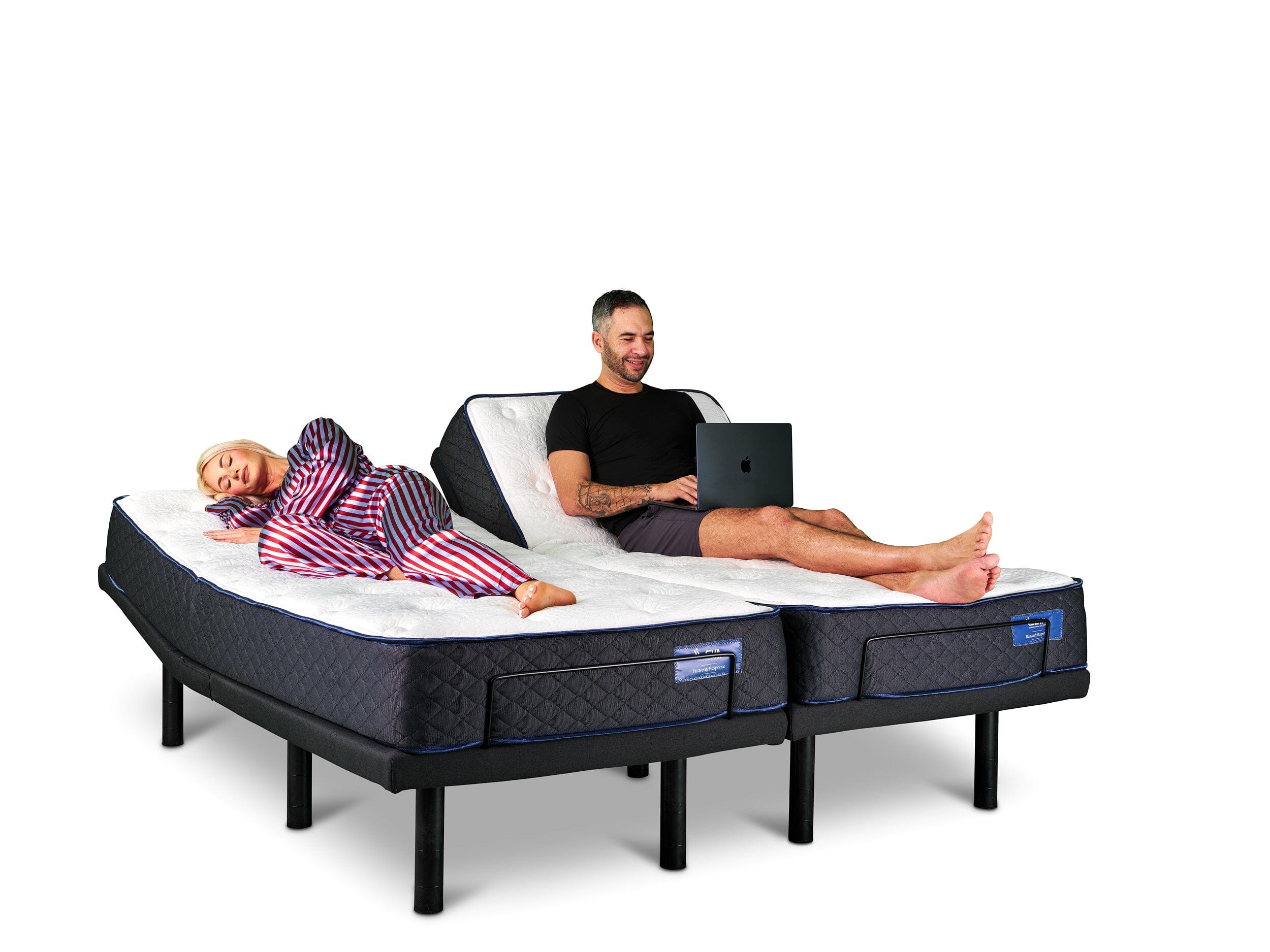
A Split King pairs two Twin XL mattresses, each 38 by 80 inches, on independent bases so each partner controls a full-length surface. This setup suits couples with distinct elevation or firmness needs who also have room for a 76-inch-wide bed. A Split Queen pairs two 30 by 80 inch mattresses on independent bases, creating a 60-inch total width, which matches a standard queen. This configuration fits couples in mid-size bedrooms who still want fully independent controls.
Leva Sleep is one of the only providers offering a Split Queen configuration built to customer specifications. This option fills a real market gap because most competitors limit split adjustability to king width and force couples in smaller rooms to choose between space and independence. Consider the following real-world scenarios when deciding which configuration fits your home and habits.
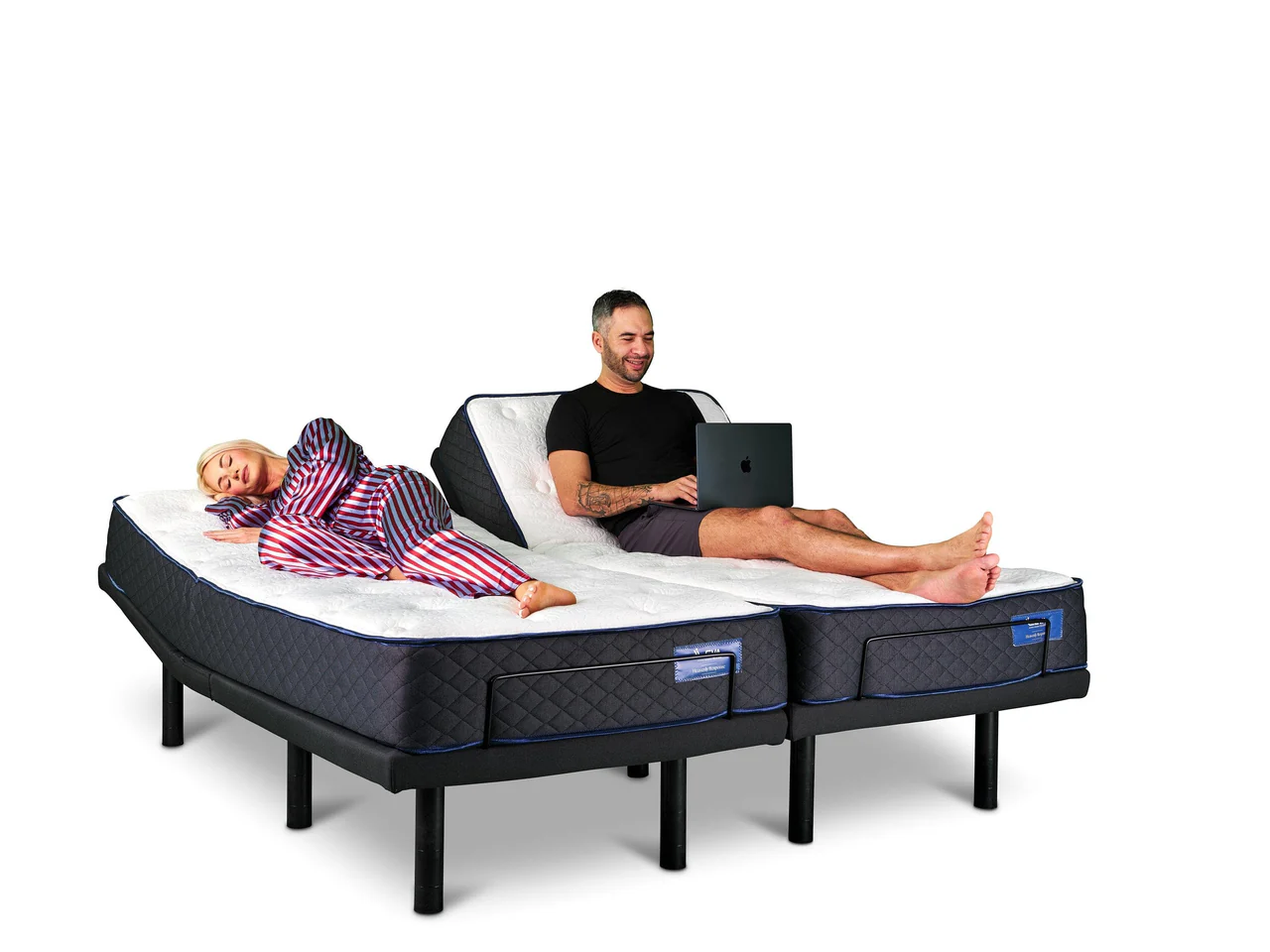
- Scenario A: Different elevation needs. One partner elevates the head 45 degrees for acid reflux while the other sleeps flat. A split configuration in either size allows both preferences without compromise.
- Scenario B: Smaller bedroom. A 12 by 12 foot room usually accommodates a Split Queen with nightstands, while a Split King may leave little clearance.
- Scenario C: Significant size difference. A partner who stands 6 feet 4 inches often needs the full 80 inch length of a Split King Twin XL, and a Split Queen’s 80 inch length offers the same reach.
- Scenario D: One snorer. Anti-snore automation on the snoring partner’s side adjusts only that half of the bed, so the other partner stays undisturbed on either split configuration.
- Verify that fitted sheets and other bedding designed for split bases are available in your chosen size before purchasing.
6. Noise, Setup, and Delivery Realities
Motor noise often becomes the main complaint among couples who try entry-level adjustable bases. Nighttime position changes on a loud base can wake a light sleeper as easily as snoring. Whisper-quiet motors, such as the German-engineered units Leva Sleep uses, function as a practical requirement for couples when one partner adjusts position at two in the morning.
Many first-time adjustable-base buyers underestimate setup complexity. A split base involves two independent frames, two mattresses, app pairing, leg-height calibration, and bedding configuration. Leva Sleep’s white-glove delivery service handles these steps in a single appointment. The team delivers to the bedroom, completes assembly, adjusts leg height, walks through the app, and removes the old bed. This service removes the most common post-purchase frustration reported by buyers who receive adjustable bases as boxed components.
- Ask for the motor decibel rating or request a live demonstration before purchasing
- Confirm whether delivery includes in-room setup or curbside drop-off only
- Verify that the delivery team calibrates leg height and pairs the app on-site
- Check whether old-bed removal is included or billed as a separate service
- Confirm that all bedding accessories, including sheets and mattress protectors, are installed and tested before the delivery team leaves
7. 2026 Smart Features That Change Nightly Comfort
Anti-snore positioning uses gentle head and upper-body elevation to support airflow and reduce snoring, and this preset appears across several Reverie models. Leva Sleep’s 2026 version advances beyond these passive presets by detecting snoring in real time and responding automatically, which closes the gap between manual adjustment and active intervention.
AI-powered sleep tracking built into the base represents the next tier of automation. Instead of relying on a wearable to log sleep stages separately, embedded sensors feed position, movement, and breathing data into the Leva Sleep app. The system can then suggest or apply micro-adjustments in real time. Programmable memory positions and infinite head and foot adjustability already enable repeatable, personalized comfort such as automated bedtime routines with anti-snore positioning and timed massage. The 2026 AI integration builds on this baseline by linking those presets to live data.
- Snore detection with automatic head-elevation response that requires no manual input
- AI sleep tracking embedded in the base instead of a separate wearable
- Real-time micro-adjustments triggered by movement or breathing pattern changes
- App-controlled heating and cooling pads with per-side temperature zones
- Vibrating wake alarms that rouse one partner without disturbing the other
- Voice-assistant integration for hands-free position changes
Why Leva Sleep Delivers More Value at Lower Cost
Leva Sleep’s direct-to-consumer model and regional assembly remove the retail markup that inflates prices at general mattress chains and department stores. This structure creates a 30 to 50 percent price advantage over comparable luxury adjustable systems. That advantage does not come from cutting specifications. Leva bases use German whisper-quiet motors, and the mattresses are U.S.-assembled all-foam or hybrid pocket-coil designs engineered for adjustable-base flex. The accessory line, including fitted sheets with deep pockets and extra elastic, duvet clips, and mattress protectors, is tailored for articulating bases.
With 15 to 20 adjustable models in the lineup, compared with the three to five typically found at a standard retailer, and more than 25,000 customers served across eight years, Leva Sleep operates as a specialist. This focus contrasts with generalist retailers that treat adjustable bases as a small add-on category.
Frequently Asked Questions
Are adjustable beds safe and effective for people with L4-L5 disc issues?
Adjustable bases are often recommended as a complementary tool for people managing L4-L5 disc problems because they allow the spine to rest in a decompressed position instead of lying flat. Elevating both the head and legs at the same time in a zero-gravity preset reduces compressive load on the lumbar discs by spreading body weight more evenly across the surface. Lumbar articulation then adds targeted support directly behind the L4-L5 region, which a flat mattress cannot provide.
Anyone managing a diagnosed disc condition should consult a physician or physical therapist before changing sleep position, yet adjustable bases usually fit within conservative management plans for lumbar disc issues. Leva Sleep’s split configurations let a partner with L4-L5 concerns use zero-gravity and lumbar support independently without forcing the other partner to adopt the same position.
Do fitted sheets stay on adjustable bases when the bed is elevated?
Standard fitted sheets often pop off adjustable bases because the corners pull free when the head or foot section rises. Leva Sleep designs its fitted sheets specifically for adjustable bases, using deeper pockets and reinforced elastic that maintain grip across the full range of articulation. The mattress protectors in Leva’s accessory line use the same deep-pocket construction.
For couples using a split configuration, Leva’s duvet clips keep the comforter in place when one side elevates and the other stays flat. Choosing bedding designed for adjustable bases, instead of adapting standard linens, removes this problem and highlights a practical benefit of buying from a specialist rather than a general retailer.
Can adjustable bed expenses be reimbursed through health insurance or an HSA/FSA?
Standard health insurance usually does not cover adjustable bases as durable medical equipment unless a physician prescribes them for a specific diagnosed condition and the purchase goes through a licensed medical supplier. Health Savings Accounts and Flexible Spending Accounts may allow reimbursement for adjustable bases when supported by a Letter of Medical Necessity from a licensed healthcare provider that explains the medical reason, such as sleep apnea, post-surgical recovery, or a diagnosed spinal condition.
Rules vary by plan administrator and change over time, so checking with your HSA or FSA administrator before purchase gives the most reliable guidance. Leva Sleep can provide itemized purchase documentation to support a reimbursement request, while customers remain responsible for confirming eligibility with their plan.
What trial period and return policy does Leva Sleep offer?
Leva Sleep offers a sleep trial period so customers can evaluate their adjustable base and mattress system at home before making a final commitment. Because adjustable bases involve professional setup and white-glove delivery, the return process differs from a standard mattress-in-a-box return. Leva’s team handles disassembly and removal, and the trial terms apply to both the base and the paired mattress.
Specific trial lengths and any restocking or return-delivery fees are confirmed at purchase and vary by product configuration. Prospective customers should discuss trial and return terms directly with a Leva Sleep specialist at the La Jolla showroom or through the website before finalizing an order, since split configurations and custom-built options may carry different conditions than standard inventory items.
Conclusion
Flat beds cannot resolve the lumbar gap, hip pressure, or partner-conflict issues that make side sleeping painful. A well-specified smart adjustable base with lumbar articulation, zero-gravity presets, whisper-quiet motors, and 2026 anti-snore automation can address these problems at the same time. The most effective next step involves a split-base consultation where both partners test independent controls, mattress pairings, and smart-feature configurations against their specific pain points before choosing a system.