Written by: Matthew Timmins, Founder and Managing Director, Leva Sleep
Key Takeaways
-
Aireloom Karpen mattresses use individually wrapped coils and Talalay latex to deliver fixed spinal support and pressure relief on a flat surface, though they transmit more motion than foam or hybrid alternatives.
-
Couples often face mismatched firmness preferences and partner disturbance; static innersprings cannot resolve these conflicts, while split adjustable systems allow independent customization on each side.
-
Adjustable bases provide positional relief options, such as knee elevation for lower-back pain or head elevation for snoring, that a fixed mattress cannot replicate regardless of material quality.
-
Leva split adjustable systems feature independent bases, app-controlled positioning, anti-snore modes, and modular construction that adapts to changing health needs without full replacement.
-
Couples who want independent control, medical positioning, and long-term flexibility often gain more value from a Leva Sleep split adjustable system than from a static luxury innerspring alone.
How Sleep Choices Affect Couples’ Health and Connection
Couples evaluating premium mattresses for back or hip pain face a compounding challenge. What relieves one partner’s discomfort may worsen the other’s, and static mattresses cannot resolve that conflict. A 2025 AASM survey found that 31% of U.S. adults have opted for sleep divorce, meaning separate beds or rooms, rising to 39% among adults aged 35–44. Separately, a 2025 study of 860 Taiwanese couples found that sleeping in separate rooms was associated with significantly lower well-being, including reduced happiness, life satisfaction, and fulfillment. The sleep system a couple chooses has measurable long-term consequences for both health and relationship quality. To evaluate which system best addresses these consequences, use clear criteria that reflect your specific needs as a couple.
How to Compare Sleep Systems as a Couple
A rigorous comparison between a static luxury innerspring and a split adjustable system should cover several concrete criteria. These include spinal support and pressure relief, independent adjustability and personalization, motion isolation, long-term durability, operational noise, health and medical positioning capability, and the end-to-end service experience including delivery and setup. Each criterion carries different weight depending on a couple’s specific pain profile, sleep habits, and health conditions, so identify which factors matter most before you decide.
Aireloom Karpen vs Leva Split Adjustable: Core Differences
The Aireloom Karpen is a high-end California-made innerspring mattress featuring individually wrapped coils, Talalay latex comfort layers, and a proprietary lift system. It is engineered for pressure reduction and spinal support on a fixed, flat surface. Its price range of approximately $7,000–$11,000 places it firmly in the luxury tier.
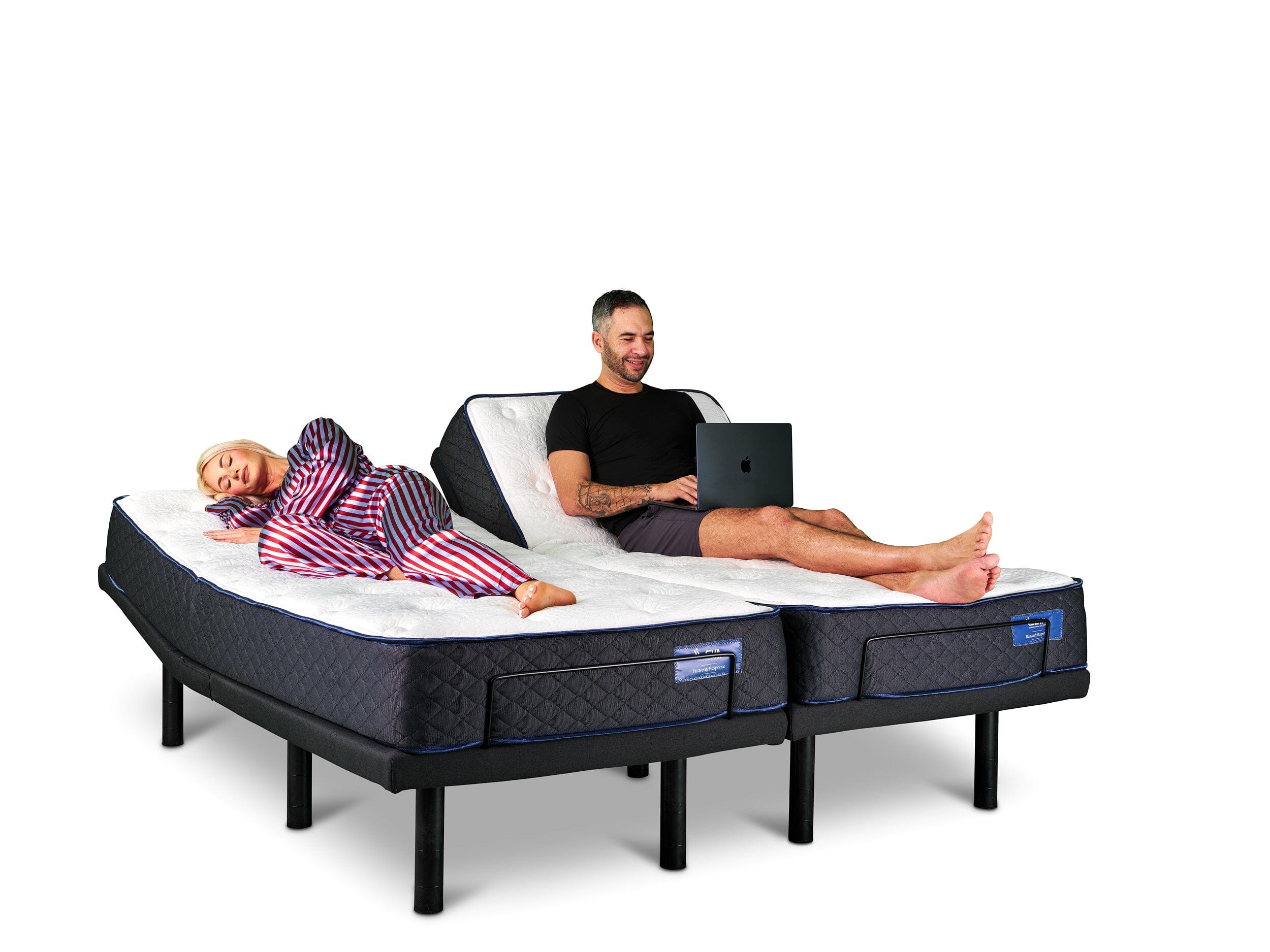
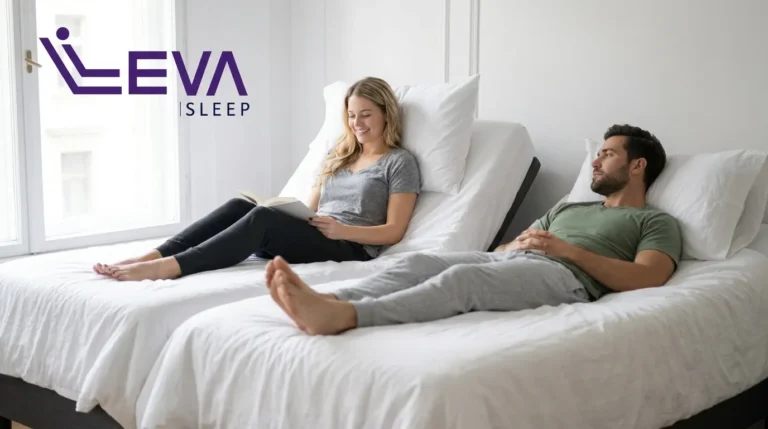
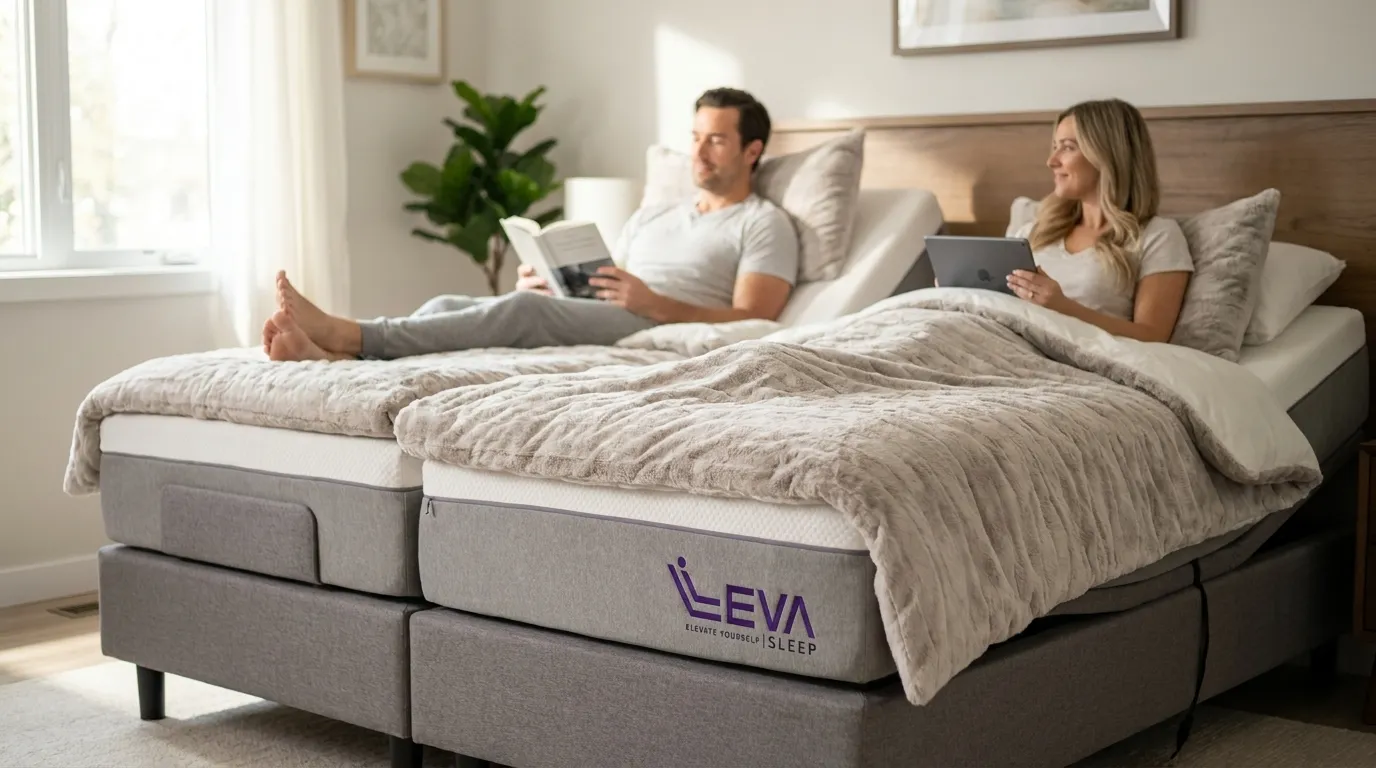
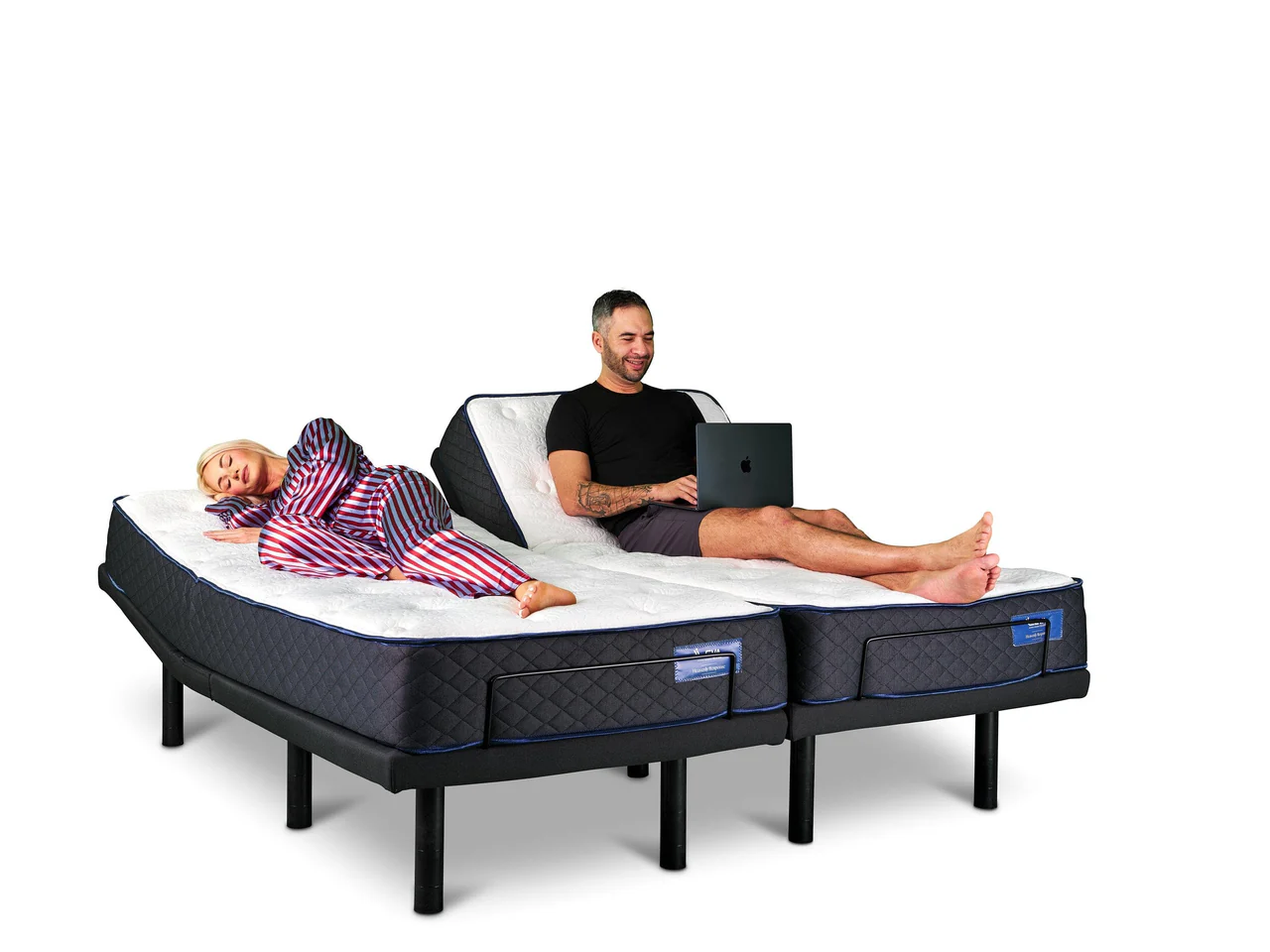
A Leva Sleep split adjustable system pairs a purpose-built all-foam or hybrid pocket-coil mattress with an independently controlled adjustable base for each side of the bed. Each partner controls head elevation, foot elevation, lumbar support, massage, and, on higher-end models, temperature and anti-snore positioning through a dedicated app. The system functions as a complete, integrated solution rather than a mattress with an add-on base.
Comfort and Pain Relief for Real-World Sleepers
Aireloom Karpen: Talalay latex and individually wrapped coils provide responsive pressure relief and spinal support on a flat surface. The patented lift feature reduces localized pressure at the hips and shoulders. Support remains fixed at the firmness level selected at purchase.
Leva Split Adjustable System: Head and foot elevation allow each partner to find a decompressed spinal position independent of the other. Users evaluating firmness should consider that medium-firm surfaces may reduce sleep latency compared to soft surfaces. Each side of a split system can be matched to the preferred firmness independently.
The following table compares how each system addresses motion isolation, pressure relief, and value considerations, three factors that most directly affect couples with mismatched sleep needs.
|
Criterion |
Aireloom Karpen (Static Innerspring) |
Leva Split Adjustable System |
|---|---|---|
|
Motion Isolation |
Pocketed coils reduce but do not eliminate motion transfer compared to all-foam construction |
Split bases physically separate each side, so motion on one side does not mechanically transfer to the other base unit |
|
Pressure Relief |
Talalay latex and individually wrapped coils reduce hip and shoulder pressure on a flat surface, fixed at purchase firmness |
Adjustable elevation redistributes pressure dynamically, and each partner selects firmness independently while evaluating how medium-firm surfaces affect sleep latency compared to soft surfaces |
|
Value Consideration |
$7,000–$11,000 for mattress only, with base purchased separately and a single fixed configuration |
Integrated system pricing, with Leva positioned at 30–50% below comparable luxury competitors and designed to adapt to changing medical needs without full replacement |
Partner Compatibility and Motion Isolation
Pocketed coils perform better than traditional innersprings, yet coil-based systems still transfer more motion than all-foam constructions. Foam layering can improve performance but does not eliminate the underlying spring-system limitation.
A Leva split adjustable system addresses motion transfer structurally. Two independent base units mean that one partner’s position changes, massage cycles, or nighttime adjustments do not travel through a shared spring system to the other side. As noted earlier, firmness mismatches affect approximately half of all couples, and partner disturbance is a documented concern in co-sleeping couples, so shared-surface motion represents a persistent problem rather than a minor annoyance. Couples who want to feel movement only on their own side can experience this separation in person at the Leva Sleep La Jolla showroom.
Adjustability for Medical Needs and Personal Preferences
Four real-world scenarios highlight where static and adjustable systems diverge most sharply.
-
Chronic lower back pain: A fixed mattress provides one support profile. An adjustable base allows the sleeper to elevate the knees slightly, which reduces lumbar compression and creates a position that a flat surface cannot match regardless of mattress quality.
-
Snoring partner: The Karpen offers no positional intervention for snoring. Leva’s anti-snore mode detects snoring and makes micro-adjustments to head elevation to help open airways without waking either partner.
-
Differing firmness preferences: With roughly half of couples preferring different firmness levels, a single-firmness mattress forces compromise. A split system allows each side to be configured independently.
-
Post-surgery or acid reflux recovery: Medical guidance often requires sustained head or leg elevation. A static mattress cannot provide this, while an adjustable base maintains the prescribed angle throughout the night without pillows that shift during sleep.
Couples managing any of these scenarios can test specific positions and presets at the Leva Sleep showroom or configure them remotely through Leva’s online tools.
Technology, Daily Use, and Lifestyle Fit
Aireloom Karpen: This mattress includes no active technology. Comfort comes from material engineering, including coil construction, latex layers, and the lift feature. The design offers no app, no position memory, and no ability to adjust settings after purchase. The experience remains consistent and passive.
Leva Split Adjustable System: Whisper-quiet German motors power independent head and foot articulation on each side. The Leva Sleep app enables custom position presets, vibrating alarms, and real-time anti-snore adjustments. Higher-end models include lumbar control, pillow tilt, AI-powered sleep tracking, and integrated heating and cooling pads. All controls operate independently per side, so one partner’s adjustments do not affect the other.
For couples who already use wearable health trackers or smart home devices, the app-controlled interface fits naturally into an existing health routine rather than creating a new habit. Those who want to explore these features can try Leva’s app-controlled sleep technology in person or walk through configurations online.
Long-Term Reliability and Overall Value
A Leva adjustable system is designed to adapt as health needs change. If a partner develops a new condition requiring elevated positioning, the base accommodates that without requiring a full system replacement. Leva’s mattresses are made in the United States, assembled locally, and delivered with white-glove setup that includes old-bed removal, height adjustment, and a product tutorial, which removes the assembly burden common with direct-ship alternatives.
Decision Framework and Practical Checklist
Use the following needs-to-options mapping to identify which system aligns with your household’s priorities. Start by identifying which scenarios match your situation. If several apply, prioritize medical needs such as pain, snoring, and mobility over preference mismatches, because health requirements should not be compromised.
-
Both partners share the same firmness preference and sleep without disturbance → A premium static innerspring like the Karpen may fully meet your needs.
-
One or both partners experience back, hip, or knee pain requiring positional relief → An adjustable base provides options that a flat mattress cannot replicate.
-
One partner snores or has mild sleep apnea → Head elevation and anti-snore positioning are available only on an adjustable system.
-
Partners have different firmness preferences → A split adjustable system removes the need for compromise.
-
Motion transfer disrupts sleep → Evaluate whether the Karpen’s coil construction meets your isolation threshold, or whether a split base’s structural separation feels necessary.
-
Medical conditions may evolve, such as post-surgery recovery, acid reflux, or circulation issues → An adjustable system adapts, while a static mattress does not.
-
You value a complete, integrated experience with expert setup → Leva’s vertical model, from design through white-glove delivery, addresses this end to end.
Couples who see themselves in several of these scenarios can schedule a visit to the La Jolla showroom or use Leva’s online consultation to match their checklist to a specific split adjustable configuration.
Frequently Asked Questions
Is an adjustable bed better than a static innerspring mattress for back pain?
The answer depends on the type and cause of back pain. A high-quality innerspring with individually wrapped coils and latex comfort layers can provide strong spinal support on a flat surface. An adjustable base adds the ability to elevate the head and knees, which reduces lumbar compression and redistributes pressure in ways a flat mattress cannot. For back pain that responds to positional changes, such as pain that worsens when lying flat, an adjustable system offers options that a static mattress, regardless of quality, cannot provide.
How does a split adjustable base reduce partner disturbance compared to a shared innerspring?
A split adjustable base consists of two physically independent units placed side by side. Because the bases are mechanically separate, movement, position changes, or massage cycles on one side do not travel through a shared spring system to the other. A shared innerspring, even with individually wrapped pocketed coils, transmits some motion because the comfort layers and mattress surface are continuous. The structural separation of a split base removes that transmission pathway entirely.
Can an adjustable base help with snoring without a CPAP machine?
Elevating the head of the bed between 7 and 15 degrees can help open the airway and reduce the soft-tissue collapse that causes snoring in many people. This does not replace a CPAP machine for diagnosed obstructive sleep apnea, but it can reduce snoring frequency and intensity for mild cases or positional snoring. Leva Sleep’s anti-snore mode automates this adjustment by detecting snoring sounds and making micro-elevations without requiring either partner to wake up and change the position manually.
What mattress types work best with an adjustable base?
All-foam and hybrid pocket-coil mattresses work best with adjustable bases because they flex with the articulating base without stressing the internal structure. Traditional innerspring mattresses with interconnected coil systems are generally not recommended for adjustable bases because the rigid coil grid resists bending and can be damaged by repeated articulation. Leva Sleep designs its own mattresses, both all-foam and hybrid pocket-coil, specifically to flex and perform with its adjustable bases.
How long does a split adjustable sleep system last compared to a luxury innerspring?
Premium innerspring and hybrid mattresses from high-end brands are generally rated for six to ten years depending on coil gauge, foam density, and construction quality, with comfort layer degradation typically occurring before the coil system fails. A split adjustable base, when built with quality motors and a durable frame, can outlast the mattress itself, so the base can be retained while the mattress is replaced as needed. This modularity can reduce long-term replacement costs compared to replacing an entire integrated mattress system.
Conclusion: Matching Your Sleep System to Your Priorities
The Aireloom Karpen is a well-engineered luxury innerspring that delivers consistent pressure relief and spinal support for sleepers whose needs align with a fixed, flat surface. Its limitations become relevant when couples have differing firmness preferences, when one partner’s movement disrupts the other, or when medical conditions require positional adjustment that a static mattress cannot provide.
A Leva split adjustable system addresses those limitations structurally through independent bases, adjustable positioning, and purpose-built technology, while also functioning as a complete sleep solution with integrated mattresses, accessories, and white-glove delivery. The right choice depends on which criteria are non-negotiable for your household. Couples who prioritize pain relief, motion isolation, and future medical flexibility can explore specific Leva configurations at the La Jolla showroom or through Leva’s online shopping experience.