Written by: Matthew Timmins, Founder and Managing Director, Leva Sleep
Key Takeaways for Light Sleepers
- Motor noise below 35 dB helps light-sleeping couples avoid wake-ups during nighttime position changes.
- Split King and Split Queen setups with true independent zone control let each partner move without disturbing the other.
- Automated anti-snore modes that detect snoring and adjust head height quietly support more continuous sleep.
- All-foam and pocketed-coil hybrid mattresses limit motion transfer and work well with adjustable bases.
- For quiet adjustable smart beds built for light sleepers, explore Leva Sleep’s whisper-quiet systems and premium configurations at Leva Sleep.
The Seven Criteria at a Glance
- Motor noise levels and long-term reliability
- Split configuration and independent zone control
- Anti-snore mode effectiveness and automation
- Mattress compatibility and motion isolation
- App control and programmable positioning
- Build quality, frame stability, and vibration transfer
- Delivery, setup, and integrated system support
1. Focus on Motor Noise Levels and Long-Term Reliability
Motor noise is the most disruptive factor for light-sleeping couples using adjustable bases. Premium adjustable bed bases with brushless DC motors typically operate at 30–40 dB, similar to a quiet whisper, while mid-range motors produce 35–50 dB and budget AC motors reach 50–60 dB. At 50 dB, the motor sounds like moderate rainfall. At 60 dB, it approaches normal conversation volume.
When you evaluate a base, request the manufacturer’s published dB specification and ask whether that figure applies at peak load or during a standard adjustment cycle. Some manufacturers share best-case numbers that do not match real-world use. This detail matters because brushless DC motors, the technology used in Leva Sleep’s German-engineered bases, create less friction, less heat, and less acoustic output than brushed motors. They also maintain that performance over years of nightly use.
Long-term reliability connects directly to noise control. A motor that starts quiet but develops mechanical noise within two years undermines the investment for light sleepers. Practical evaluation helps you avoid that outcome. Bring a free decibel meter app to any showroom demo, run a full head-elevation cycle from flat to 45 degrees, and record the peak reading. A result below 35 dB is a realistic target for couples where one partner is a light sleeper.
2. Choose Split Configuration and Independent Zone Control
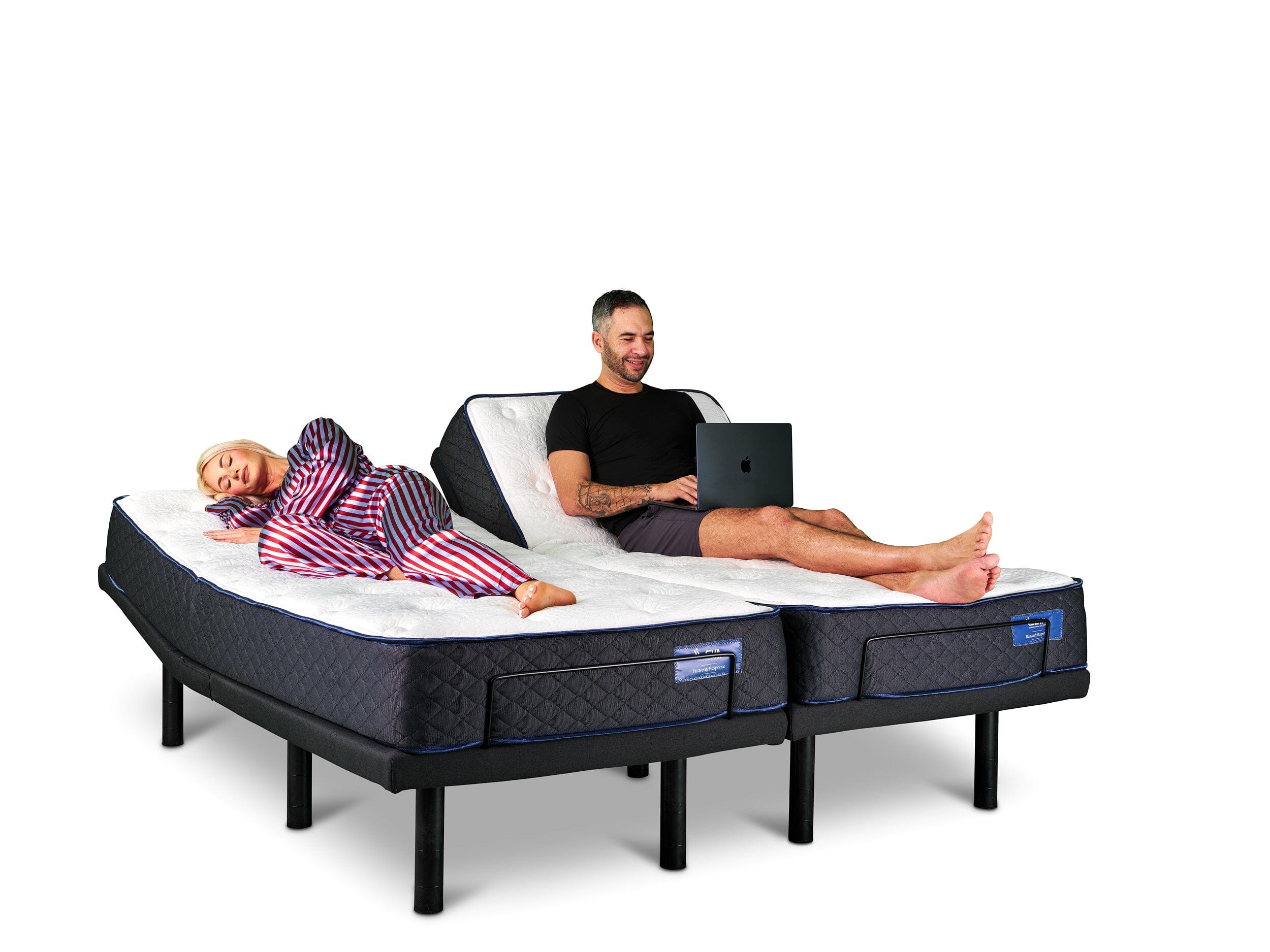
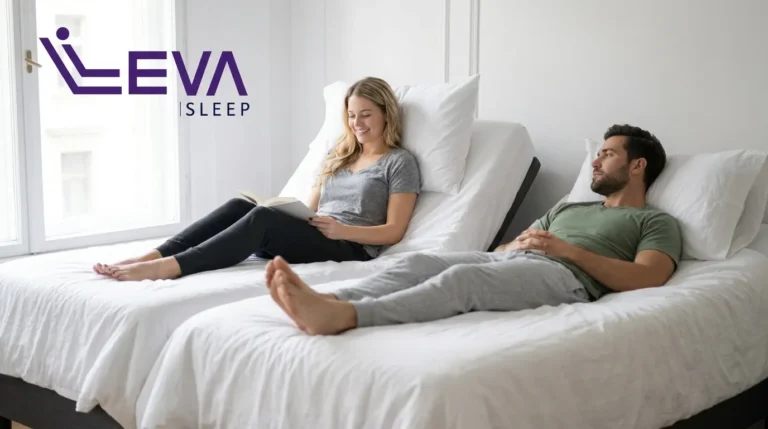
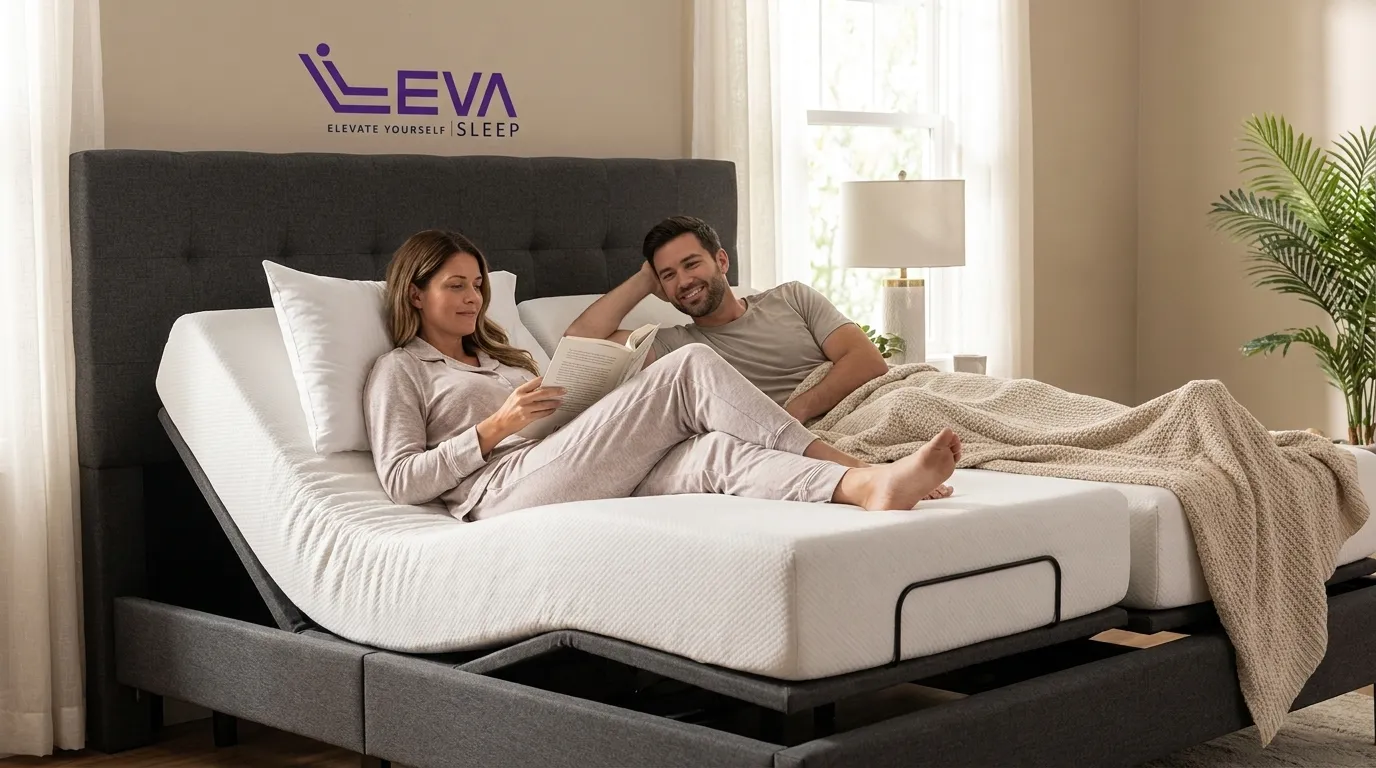
Once you confirm the motor operates quietly, consider whether each partner can adjust their side without disruption. A Split King adjustable bed uses two Twin XL mattresses and two independent adjustable bases placed side by side, so each sleeper can adjust head and foot elevation separately. Each half of a Split King is a Twin XL mattress (38″ × 80″), half the width of a traditional king (76″ × 80″). This layout also improves maneuverability through doorways and staircases.
For couples in smaller bedrooms or apartments, a Split Queen configuration delivers the same independent-control benefit in a more compact footprint. Leva Sleep offers both Split King and Split Queen adjustable bed configurations, which helps when a standard king does not fit the room. Check whether the split configuration includes connector straps to prevent gap separation and sync modes for simultaneous adjustment when desired. Also confirm that each partner has a separate remote or app profile.
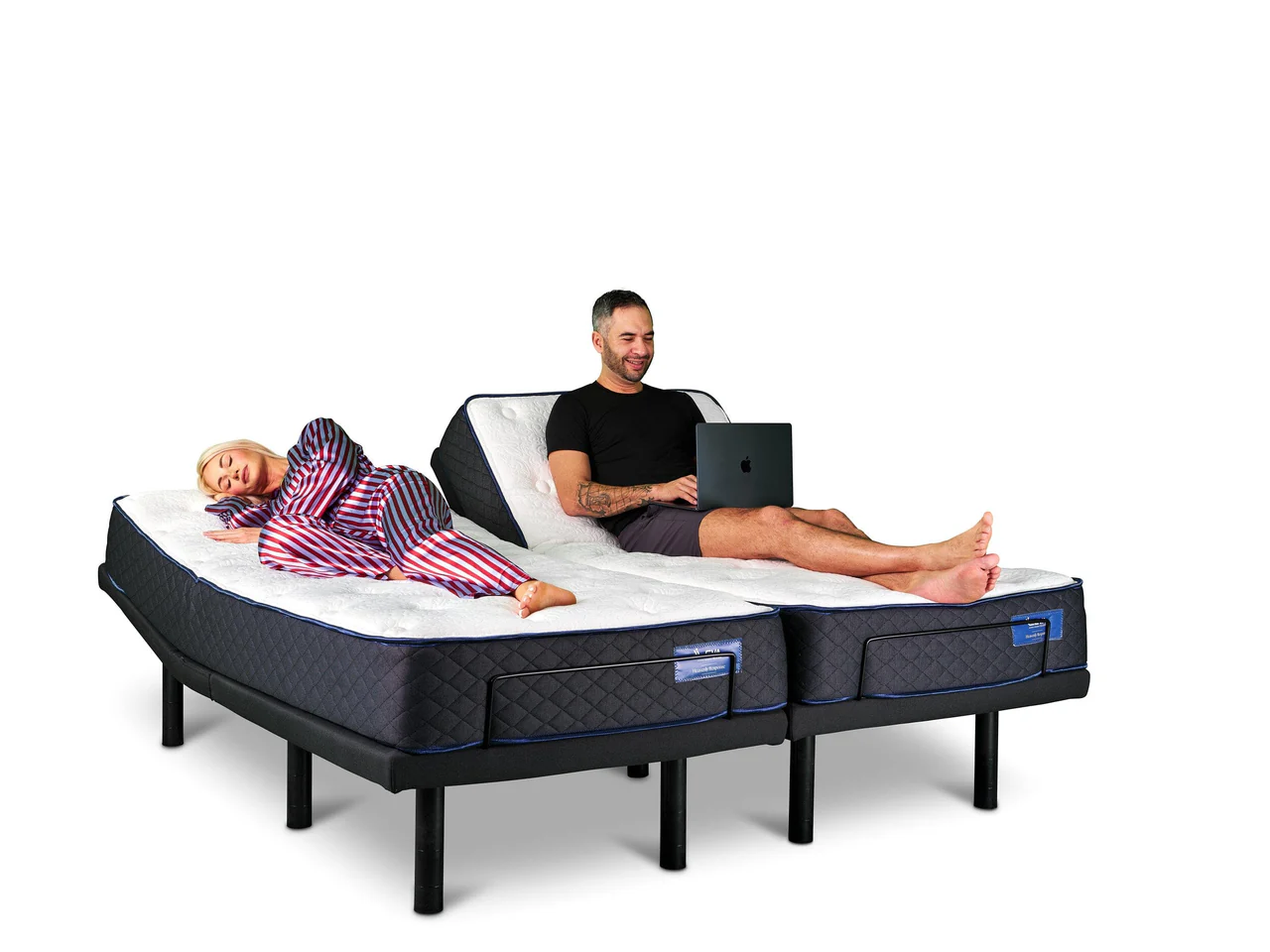
True zone independence is the goal. If one partner’s adjustment still shifts or vibrates the other side, the split design does not fully protect a light sleeper.
3. Compare Anti-Snore Mode Effectiveness and Automation
Anti-snore features can significantly reduce nighttime disruptions for couples. Head elevation of 10 to 30 degrees on an adjustable bed can help with snoring relief, with 20–30 degrees commonly suggested for moderate to heavy snorers. Raising the head often reduces snoring enough to protect a partner’s sleep.
The gap between manual anti-snore positioning and automated detection matters for light sleepers. Manual elevation requires the snoring partner to wake up, respond, and adjust the bed. Tempur-Pedic’s TEMPUR-Ergo Smart Base automatically raises the head about 12 degrees when snoring is detected. Leva Sleep’s anti-snore mode, launching spring 2026, detects snoring and initiates subtle head elevation through app-controlled automation. This approach addresses the same airway mechanism without requiring manual intervention.
When you compare systems, ask whether the anti-snore response is automated or manual, what the adjustment increment is, and whether it operates independently on each split side. Automated, side-specific adjustment offers the best experience for light-sleeping couples.
4. Match Mattress Compatibility and Motion Isolation
Mattress construction affects both comfort and how much movement a partner feels. Memory foam, latex, and pocketed-coil hybrid mattresses work well with Split King adjustable bases, while traditional innerspring mattresses with interconnected coils should be avoided. Interconnected coil systems resist the flex needed for head and foot articulation and transfer motion across the mattress surface.
Motion isolation describes how well a mattress absorbs movement on one side without sending it to the other. All-foam and individually pocketed-coil designs perform best in this area. When you evaluate a mattress-and-base pairing, ask whether the mattress was engineered specifically for use with an adjustable base or simply labeled as compatible. Leva Sleep designs its all-foam and hybrid pocket-coil mattresses to flex and recover with the base’s full articulation range, and all mattresses are made in the United States.
5. Use App Control and Programmable Positioning for Convenience
App control turns an adjustable base into a personalized sleep system for each partner. Check whether the app allows each person to save custom positions, such as a zero-gravity preset for pressure relief or a reading position, and recall them with one tap in the dark. Vibrating alarm features that wake one partner without disturbing the other can help couples with different schedules.
Bluetooth connectivity range, app update frequency, and compatibility with both iOS and Android affect daily usability. Leva Sleep’s app provides full control over elevation, massage intensity, and position presets, with individual profiles for each side of a split configuration. During any demo, confirm that the app works for basic position control without relying on Wi-Fi. A brief internet outage should not prevent a sleeper from adjusting their side of the bed.
6. Check Build Quality, Frame Stability, and Vibration Transfer
Frame design influences how much movement a light sleeper feels. A base that produces 33 dB from its motor but sends vibration through a loose frame still disturbs sleep. Frame rigidity determines whether motor vibration stays localized or travels across the bed surface.
During a showroom evaluation, run a full adjustment cycle and place one hand on the stationary side of a split base. Notice whether you feel vibration on the non-adjusting side. Perceptible vibration there suggests limited isolation between the two zones.
Steel gauge, weld quality, and leg-height adjustability all affect long-term stability. Bases that develop mechanical creaks in the first year often use lower-gauge steel or lack adequate cross-bracing. Ask for the frame’s weight capacity and the warranty terms that cover the motor and frame specifically, not just the mattress. Leva Sleep assembles its bases regionally and offers white-glove setup that includes leg-height calibration at delivery. This service reduces the risk of uneven load distribution that can create frame noise over time.
7. Plan for Delivery, Setup, and Integrated System Support
Proper setup is part of noise control for adjustable beds. An adjustable sleep system does not behave like a simple mattress-in-a-box product. Uneven legs, misaligned split bases, or incompatible bedding introduce noise and instability that even a quiet motor cannot offset.
Check whether the retailer offers professional in-home setup, old-bed removal, and a product tutorial that covers app pairing, position programming, and accessory installation. These services help couples use every feature from the first night.
Bedding compatibility also affects sleep quality. Standard fitted sheets often cannot handle the depth changes that occur when a base elevates to 45 degrees, and sheets that pop off during the night create their own disturbance. Leva Sleep designs fitted sheets with deep pockets and reinforced elastic for adjustable bases, along with duvet clips that maintain separation between split sides. Purchasing a complete, integrated system from a single specialist reduces compatibility issues after delivery.
Frequently Asked Questions
What decibel level should a quiet adjustable bed motor not exceed for light sleepers?
For light sleepers sharing a bed, a motor operating below 35 dB during a full adjustment cycle is a practical target. Sounds at or above 40 dB can disturb sensitive sleepers. Premium brushless DC motors, such as those in Leva Sleep’s German-engineered bases, typically operate in the 30–40 dB range. Budget AC motors can reach 50–60 dB, which is comparable to moderate rainfall or low-volume conversation and is likely to wake a light sleeper during a nighttime adjustment.
What is the difference between a Split King and a Split Queen adjustable bed, and which is better for couples?
A Split King uses two Twin XL mattresses and two independent adjustable bases to form a standard 76-by-80-inch king footprint. A Split Queen uses two narrower bases to create a queen-sized surface, typically 60 by 80 inches, which suits smaller bedrooms where a king does not fit. Both configurations let each partner control head and foot elevation, anti-snore positioning, and massage settings independently. The better choice depends on room size and each partner’s preferred sleeping width. Leva Sleep offers both Split King and Split Queen adjustable bed configurations, a range that many general mattress retailers do not provide.
Do anti-snore modes on adjustable beds actually reduce snoring?
Anti-snore modes can reduce snoring when they use effective positional therapy. Elevating the head opens the airway and often softens snoring. Head elevation of 10 to 30 degrees on an adjustable bed can help with snoring relief, with the higher end of that range for moderate to heavy snorers. Automated anti-snore modes that detect snoring acoustically and make micro-adjustments without waking either partner work especially well for light-sleeping couples. Leva Sleep’s anti-snore mode, launching spring 2026, automates this process through app-controlled detection and adjustment on the affected side of a split base.
Which mattress types work best with adjustable bases for couples who are light sleepers?
All-foam and individually pocketed-coil hybrid mattresses pair well with adjustable bases and provide strong motion isolation for light-sleeping couples. Traditional innerspring mattresses with interconnected coils resist the articulation needed for head and foot elevation and transfer movement across the surface. Memory foam and latex offer high motion isolation, so a partner shifting position on one side is less likely to be felt on the other. Leva Sleep’s mattresses, both all-foam and hybrid pocket-coil models, are made in the United States and engineered to flex and recover with the full articulation range of its adjustable bases.
Is white-glove delivery necessary for an adjustable bed, or can it be self-installed?
White-glove delivery strongly benefits light-sleeping couples. Self-installation is possible but introduces real risks. Uneven leg height creates frame instability that generates noise during adjustments. Misaligned split bases create gaps that affect mattress continuity. Standard fitted sheets without reinforced elastic can pop off during elevation and cause additional disturbance.
Professional white-glove delivery, such as Leva Sleep’s in-house service, includes leg-height calibration, app pairing, position programming, old-bed removal, and a full product tutorial. For a system where motor noise and vibration transfer are primary concerns, proper setup at installation functions as part of the noise-reduction strategy.
Conclusion: Start With Noise, Then Build the Rest of the System
Light-sleeping couples benefit most when they start with motor noise and then layer on other features. Motor noise is the first criterion because it creates the most immediate disturbance. Every other feature, including split control, anti-snore automation, and app programming, depends on a quiet mechanical foundation to deliver its benefits.
A split base with independent zone control loses value if the motor wakes the other partner during adjustment. Anti-snore automation also falls short if the base frame sends vibration across both sides. Leva Sleep’s approach, which includes German brushless DC motors, Split Queen and Split King configurations, spring 2026 anti-snore automation, US-made mattresses designed for adjustable articulation, and in-house white-glove delivery, addresses each criterion in sequence. With more than 25,000 customers served and 15–20 adjustable models available compared to the 3–5 found at general retailers, Leva Sleep operates as a specialist.
The next step is a direct motor-noise comparison. Bring a decibel meter app to any showroom demo, run a full adjustment cycle, and measure the result against the 35 dB threshold. Compare Leva Sleep’s quiet adjustable systems to your current bed by visiting the La Jolla showroom or shopping online.