Written by: Matthew Timmins, Founder and Managing Director, Leva Sleep
Key Takeaways for Couples with Back Pain
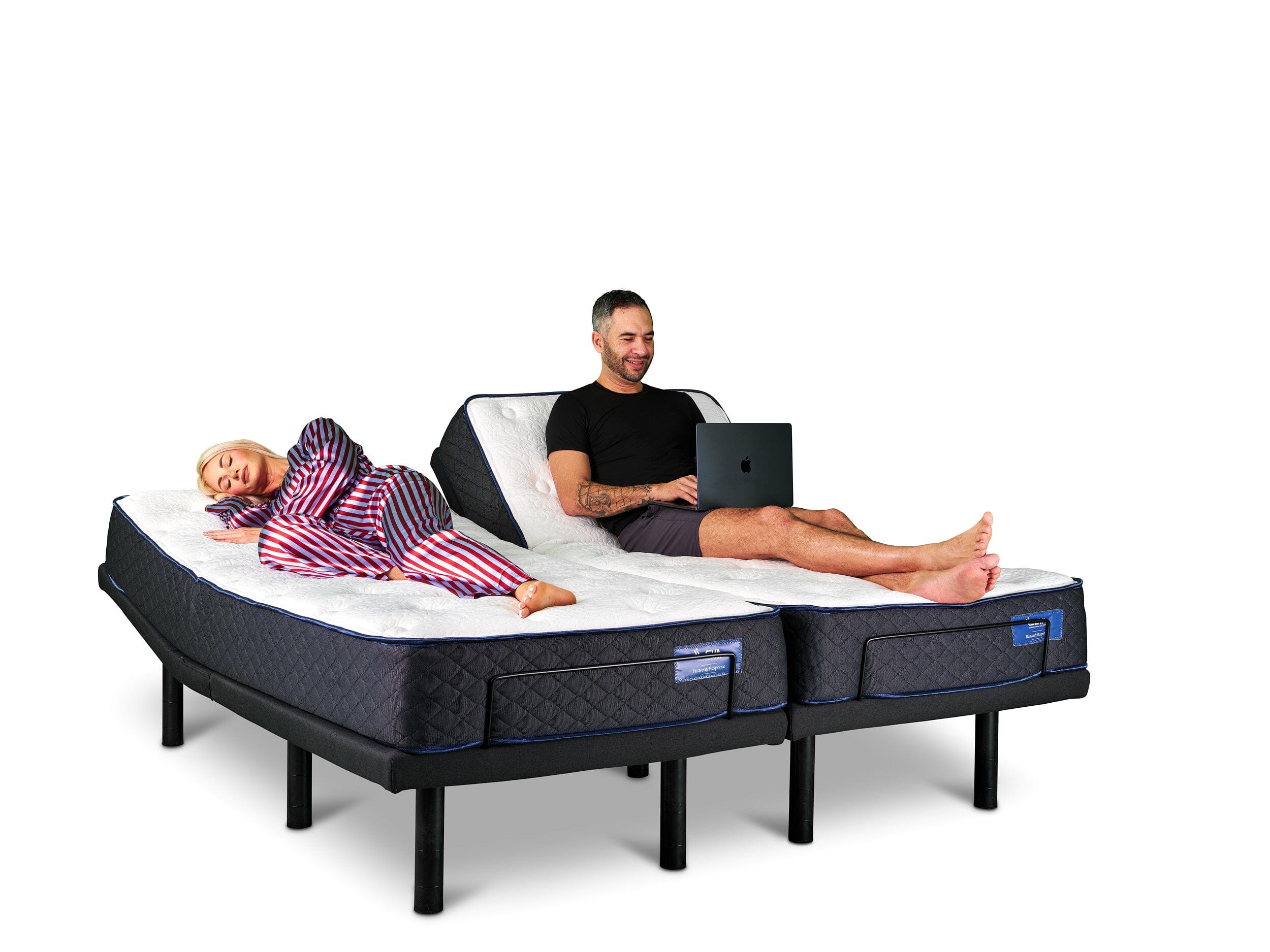
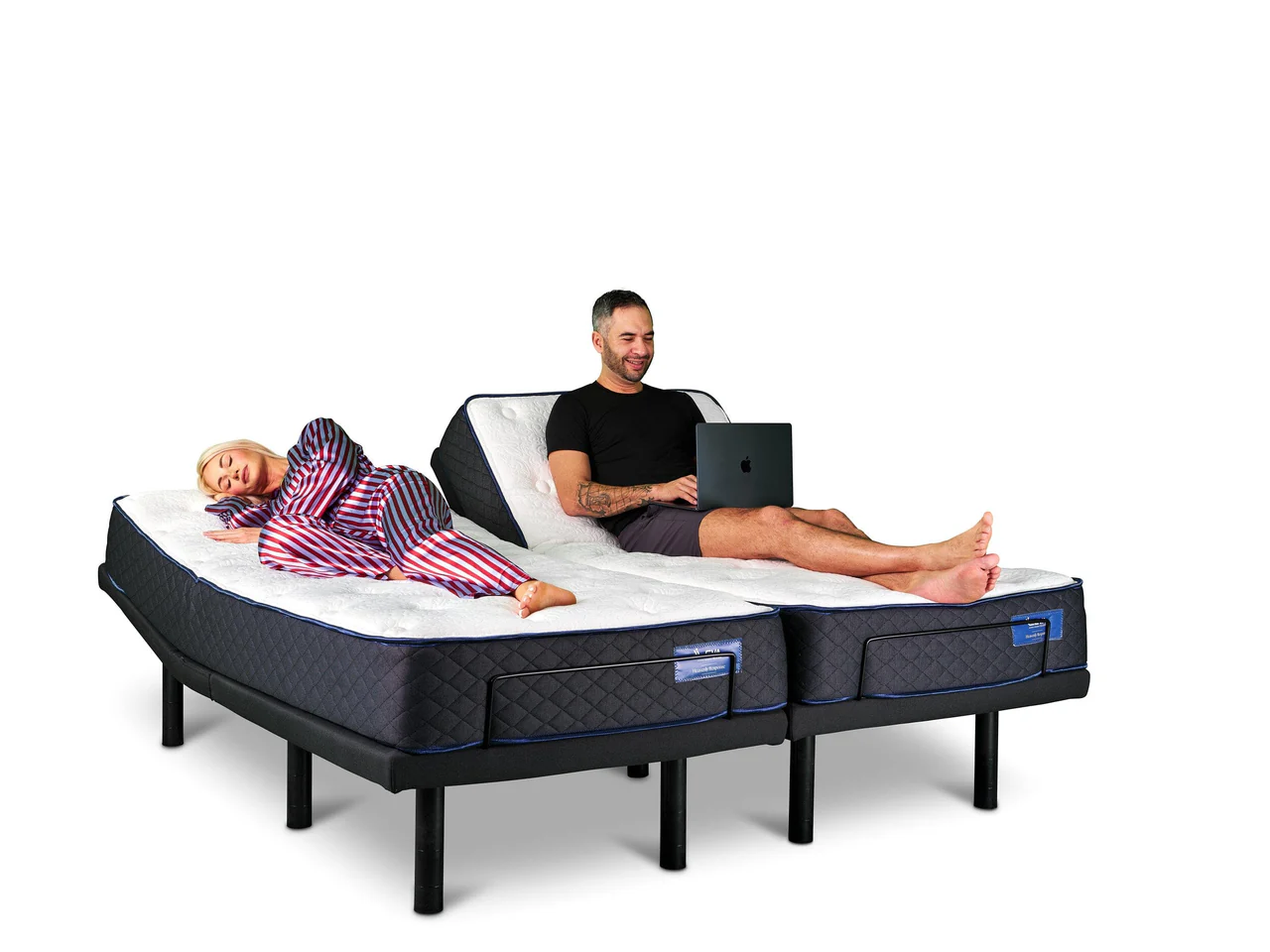
- Independent split-base adjustability lets each partner change head and foot elevation without disturbing the other, which supports asymmetric back pain and snoring.
- Zero-gravity and lumbar-support positions on fully integrated systems relieve lower-back pressure more effectively than flat or single-side adjustable beds.
- Brushless DC motors in the 30–40 dB range and anti-snore auto-adjust features reduce nighttime disruption, while app control and position memory add long-term convenience.
- White-glove delivery, deep-pocket sheets, and Split-Queen options help the system match both the couple’s physical needs and their bedroom layout.
- Couples ready to invest in lasting spinal alignment and partner compatibility can review premium split-base options at Leva Sleep.
How Adjustable Bases Improve Comfort & Spinal Alignment
A traditional flat mattress keeps both partners on a static surface that cannot shift to relieve lumbar pressure. Regardless of foam density or coil count, a flat surface holds the spine in a fixed plane that often fails to match the natural curve of either partner.
Single-side adjustable bases allow one partner to elevate the head or foot, but the shared mattress means every elevation affects both sleepers. The partner who does not need elevation still ends up in an angled position they did not choose.
Split-base systems solve this by giving each side of the bed its own articulating surface. Once each partner has independent control, they can use therapeutic positions such as zero-gravity, which is widely considered helpful for lower-back pain because it can take pressure off the pelvis and backbone. Upper-body elevation can help with GERD or sleep apnea, and leg elevation can help with swelling and lower-limb pain.
Fully integrated split-base systems add lumbar support zones and pillow-tilt motors that allow micro-adjustments within a single sleep position. This level of fine-tuning creates spinal support that flat or single-side configurations cannot match.
Priority prompt: If one or both partners experience lower-back pain, hip pressure, or a physician-recommended elevated sleeping position, start your evaluation with independent articulation on each side as the baseline requirement. Without it, any elevation affects both partners and prevents precise support for asymmetric medical needs.
Partner Compatibility & Independent Adjustability
Couples need both motion isolation and independent control for true sleep compatibility. A mattress can isolate motion well yet still force both partners into the same elevation angle. A split-base system addresses motion transfer and independent positioning at the same time.
Single-side bases with a shared mattress create a mechanical compromise. When one side elevates, the mattress bends across the full width and forms a ridge or tension point at the center that the non-adjusting partner feels. This effect becomes especially disruptive during nighttime position changes.
Split-base configurations such as Split King (two Twin XL bases) and Split Queen (two narrower bases joined) remove this cross-mattress tension. Each side operates on its own base with its own mattress, so a 3 a.m. elevation change on one side produces no meaningful movement on the other. Karena Wu, P.T., D.P.T., advises that adjustable beds can be helpful for those who have back and neck pain, chronic pains, respiratory issues like snoring or obstructive sleep apnea, digestive issues like gastric reflux, and circulatory issues, which makes independent positioning especially valuable when partners have different medical needs.
Split Queen configurations provide the same independent adjustability as Split King in a smaller footprint. This format often becomes the only practical split-base choice for couples in rooms that cannot fit a king-width bed.
Technology & Features That Matter at Night
Motor noise becomes a major comfort factor once the bed is in regular use. A base that seems quiet in a busy showroom can sound much louder during a 2 a.m. adjustment in a silent bedroom. Brushless DC motors operate at 30–40 dB. AC motors often reach 50–60 dB.
Research shows that even moderate sounds can disturb sleep in sensitive individuals, so motor noise can easily pull a partner out of deep sleep. The ideal whisper-quiet range for adjustable bases sits below 45 dB, and many tested models operate in the 35–40 dB range during position changes.
Fully integrated systems in 2026 add anti-snore auto-adjust, which detects snoring acoustically and makes small head elevations to open the airway. These systems also add app-based control via Bluetooth, custom position memory, vibrating alarms, and temperature integration through heating and cooling pads. Basic split-base systems and single-side bases usually offer wired remote control only, with no app connectivity or automated adjustments.
Mattress compatibility also shifts by technology tier. Memory foam and latex mattresses flex most easily on adjustable bases. Hybrids can work if they remain flexible enough, while traditional rigid innerspring mattresses often perform poorly. Individually wrapped coils tend to generate less noise when a mattress flexes on an adjustable base than crinkly cover materials.
Setup, Delivery & Everyday Use
Delivery quality and setup affect how well an adjustable system performs from the first night. A base that arrives disassembled, without professional calibration of leg height or mattress fit, may fall short of its potential.
Premium adjustable bed bases such as the Tempur-Pedic Tempur-Ergo Power Base commonly offer free white-glove delivery and in-home setup. Premium models such as those from Saatva and Tempur-Pedic include free white-glove delivery with in-room setup and old bed removal.
Everyday use also depends on bedding that works with articulation. Standard fitted sheets are not designed for the range of motion an adjustable base creates, and they often pull free from corners during elevation. Sheets with deep pockets and reinforced elastic, duvets with clips to keep each side in place at different angles, and remote pockets built into the bedding all support smoother daily use that many flat-mattress owners do not anticipate.
Adjustable leg heights on bases like the Helix (3–12 inches) allow customization of total bed height during setup. Professional setup that includes leg-height calibration helps the bed align with existing furniture and the users’ mobility needs.
Long-Term Reliability & Value for Couples
Warranty length and motor type provide the clearest early signals of long-term durability. Premium adjustable bases often include extended coverage on motors and key components.
Premium adjustable bases from Saatva and Tempur-Pedic carry 10- to 25-year limited warranties, with longer coverage on higher-end models providing protection against motor and mechanical failures. These extended warranties typically pair with weight capacities of 750 to 850 pounds, which suggests heavier-gauge components throughout.
Health needs rarely stay static over a decade of use, and a rigid sleep system cannot adapt to those changes. A couple buying a system for lower-back pain today may need anti-snore positioning or post-surgery recovery elevation within five years. A fully integrated split-base system with app-updatable firmware and modular accessories can adapt to those evolving needs without a full replacement, while basic flat mattresses and single-side bases offer no such flexibility.
Priority prompt: Review the warranty on the motor separately from the frame coverage. A 25-year frame warranty paired with a 2-year motor warranty leaves the most active mechanical component with the least protection.
Real-World Scenarios for Couples
Chronic lower-back pain (one or both partners): Zero-gravity positioning at a 120-degree thigh-to-torso angle provides the primary target. Independent articulation on each side keeps the partner without back pain from sharing the same elevation. A fully integrated split-base system with lumbar support zones offers the most capable configuration for this scenario.
Snoring partner: Head elevation on the snoring partner’s side opens the airway without disturbing the other side. Anti-snore auto-adjust on 2026 fully integrated systems automates this response during sleep. A basic split-base without this feature requires manual adjustment, which often fails in practice if the snoring partner remains asleep.
Differing firmness preferences: Split-base systems pair each side with its own mattress, so one partner can choose an all-foam surface for pressure relief while the other selects a hybrid with pocket coils for firmer support. A shared mattress on any base, flat or single-side adjustable, cannot deliver that level of customization.
Post-surgery recovery: Leg elevation for swelling reduction and upper-body elevation for respiratory support both appear in clinical recommendations. A fully integrated split-base system lets the recovering partner cycle through several therapeutic positions via app control without waking the other partner. As noted earlier, physical therapists often recommend adjustable beds for these specific conditions.
Decision Checklist for Comparing Systems
| Couple Constraint | Flat Mattress | Single-Side Adjustable | Basic Split-Base | Integrated Split-Base System |
|---|---|---|---|---|
| One partner has chronic lower-back pain | No independent positioning | Elevation affects both sides | Independent elevation, manual control | Independent elevation, lumbar zones, app control |
| Snoring disrupts the other partner | No adjustment possible | Elevates both sides together | Manual head elevation on one side | Auto-snore detection and micro-adjustment |
| Differing firmness preferences | One shared surface | One shared surface | Separate mattresses per side | Separate mattresses per side, curated pairing |
| Room cannot fit a king-width bed | Queen available | Queen available | Limited Split Queen availability | Split Queen available as a specialist configuration |
| Post-surgery recovery positioning | Not possible | Possible but affects both sides | Independent, manual | Independent, app-controlled, position memory |
| Noise sensitivity during adjustments | Not applicable | Varies by motor type | Varies by motor type | Brushless DC motors at 30–40 dB |
Neutral Summary of Trade-Offs for Couples
Traditional flat mattresses carry the lowest upfront cost and require no learning curve, yet they offer no positional adaptability and cannot address the medical or compatibility needs that push most couples to seek alternatives.
Single-side adjustable bases add elevation at a moderate cost, but the shared mattress surface means every adjustment affects both partners. That limitation reduces their usefulness for couples with asymmetric needs.
Basic split-base systems remove the shared-surface problem and allow independent positioning, but manual-only controls, variable motor quality, and limited accessory ecosystems create a wide range of experiences. Noise levels, warranty terms, and mattress compatibility all require close review before purchase.
Fully integrated split-base systems with brushless DC motors, anti-snore auto-adjust, app control, purpose-built mattresses, and white-glove setup address every criterion in this guide but carry the highest initial investment. For couples facing medical, chronic, or relationship-affecting sleep problems, the total cost of ownership over a 10-year period often compares favorably to the ongoing costs of poor sleep.
Use the seven criteria in this guide, including comfort and spinal alignment, partner compatibility, technology, setup, reliability, scenario fit, and total value, and weigh them against your specific constraints before making a final decision.
Frequently Asked Questions
Are adjustable beds recommended by chiropractors and orthopedic specialists?
Orthopedic physical therapists and spine surgeons do recommend adjustable beds for specific conditions. The zero-gravity position can help with lower-back pain by reducing pressure on the pelvis and spine. Upper-body elevation is recommended for GERD and sleep apnea, and leg elevation is recommended for lower-limb swelling and pain. Karena Wu, P.T., D.P.T., advises that adjustable beds can be helpful for those who have back and neck pain, chronic pains, respiratory issues like snoring or obstructive sleep apnea, digestive issues like gastric reflux, and circulatory issues. The recommendation remains condition-specific rather than universal.
What split configurations are available, and which works in a smaller bedroom?
The two primary split configurations are Split King and Split Queen. A Split King uses two Twin XL bases placed side by side, which produces a combined width equal to a standard king at 76 inches. A Split Queen uses two narrower bases joined together to match a standard queen width of 60 inches. Split Queen becomes the only split-base option for couples whose room cannot fit a king-width bed. It remains a less common configuration, so many general mattress retailers do not stock it, while specialist adjustable bed retailers are more likely to offer Split Queen as a standard product.
How do fitted sheets stay on an adjustable bed when the base elevates?
Standard fitted sheets are designed for flat surfaces and often pull free from mattress corners when a base elevates the head or foot. Sheets designed for adjustable beds use deeper pockets, typically 18 to 21 inches, and reinforced elastic that runs around the full perimeter of the sheet rather than only at the corners. On a split-base system where each side may sit at a different angle, a split-top sheet or two separate sets of single-size bedding usually work better than a single shared fitted sheet. Duvet clips keep a shared duvet from sliding toward the lower side when one partner elevates. These accessories are built for adjustable bases and do not perform the same as standard bedding.
What are realistic noise expectations during nighttime adjustments?
Motor type influences noise output more than brand or price tier. Brushless DC motors operate at 30–40 dB, which compares to a quiet library or soft whisper. AC motors often reach 50–60 dB. Research shows that moderate sounds can disturb sensitive sleepers. When you evaluate a base, request the manufacturer’s stated decibel range. A base that operates at 35–40 dB during adjustment is unlikely to wake a sleeping partner, while one operating at 55 dB is more likely to cause disruption.
What should couples look for in a warranty when buying an adjustable base?
A warranty on an adjustable base should be reviewed in two parts: the frame warranty and the motor warranty. These periods often differ, and the motor is the component most likely to need service over time. Entry-level bases may carry a 1–2 year motor warranty despite a longer frame warranty. Premium bases typically extend coverage up to 25 years on high-end models. Weight capacity also signals durability, since bases rated for 750–850 pounds generally use heavier-gauge components. Trial periods, where available, let couples test positioning and noise levels before the return window closes, although many premium models are final sale.