Written by: Matthew Timmins, Founder and Managing Director, Leva Sleep
Key Takeaways
- Adjustable bases relieve side-sleeper back pain by elevating the head and legs, which redistributes pressure and supports lumbar alignment.
- Effective bases include lumbar tilt articulation, incremental elevation ranges, and whisper-quiet motors for micro-adjustments that do not wake the sleeper.
- Medium to medium-firm mattresses (5–6.5 firmness) work best with adjustable bases and provide proper shoulder and hip cushioning.
- Split configurations let couples customize positions independently, while anti-snore and smart-adjustment technology provide automatic relief throughout the night.
- Leva Sleep offers premium adjustable bases with these features, so visit Leva Sleep today to find your ideal setup.
How Side Sleepers Can Reduce Back Pain
Side sleepers reduce back pain most effectively by pairing the right mattress with a supportive adjustable base. A medium to medium-firm mattress cushions the shoulder and hip without letting them sink out of alignment. An adjustable base that elevates the head between 10–20 degrees and the legs between 5–15 degrees helps decompress the lumbar spine and reduce hip-joint loading throughout the night.
Before evaluating specific models, assess whether your current setup addresses these seven criteria. If your existing base or mattress lacks any of these features, you will know which upgrades to prioritize:
- Mattress firmness compatibility with the base’s articulation range
- Incremental elevation range for head and foot sections
- Lumbar tilt articulation as a dedicated motor function
- Pillow tilt for cervical alignment
- Noise level during micro-adjustments
- Split configuration for couples
- Anti-snore and smart-adjustment technology
Each criterion addresses a specific biomechanical need for side sleepers with back pain. Together, they create a complete framework for evaluating any adjustable base. The next sections walk through each criterion in detail.
7 Criteria for Choosing the Best Adjustable Bed Frame for Side Sleepers with Back Pain
Criterion 1: Mattress Firmness Compatibility
A mattress that feels too firm blocks the shoulder and hip from sinking enough, which creates lateral pressure points that can radiate into the lumbar region. A mattress that feels too soft lets the hip sink below the spine’s centerline and produces a lateral curve. Medium to medium-firm mattresses in the 5–6.5 range on a standard 1–10 firmness scale flex with the base’s articulation without cracking or losing support at the bend zones.
Ask any retailer whether the mattress carries a flex-friendly or adjustable-base-compatible designation. Request documentation of the foam or coil construction at the head and foot thirds of the mattress, where bending stress concentrates. Avoid innerspring mattresses with interconnected coil systems, because they resist articulation and can void manufacturer warranties when used on an adjustable base.
Criterion 2: Incremental Elevation Range
Elevation range controls how precisely you can dial in the angle that relieves your specific pressure pattern. A head section that moves only between flat and a single preset angle offers limited therapeutic value. Look for bases that provide continuous or near-continuous adjustment from 0 to at least 60 degrees at the head and 0 to 45 degrees at the foot. Increments should be small enough to shift position by a single degree or two.
Ask retailers to demonstrate the full range of motion in the showroom and to confirm whether the remote or app allows single-degree increments. Wider elevation ranges usually require a longer base frame, which reduces under-bed storage clearance. If you rely on that storage space or care about how the frame looks, confirm the assembled height before purchase so you do not discover later that the base conflicts with your room layout.
Explore adjustable bases with full elevation ranges at Leva Sleep’s La Jolla showroom or online.
Criterion 3: Lumbar Tilt Articulation
Lumbar tilt uses a dedicated mid-section motor that raises the lower-back zone independently of the head and foot sections. For side sleepers, this feature fills the gap between the mattress surface and the natural inward curve of the waist. That support prevents the lumbar spine from collapsing toward the bed. Orthopedic research consistently identifies lumbar support as a primary factor in reducing lower-back pain during sleep.
Ask whether lumbar support comes from a passive foam insert or an active motorized zone. Active lumbar tilt allows real-time adjustment without getting out of bed, which matters for sleepers whose pain level shifts during the night. Passive inserts cannot be modified once the mattress is in place.
Criterion 4: Pillow Tilt for Cervical Alignment
Side sleepers need a higher loft at the head than back sleepers because the shoulder creates a gap between the neck and the mattress surface. A pillow tilt motor adjusts the uppermost section of the head panel by 5–15 degrees independently of the main head elevation. This adjustment helps the cervical spine remain parallel to the thoracic spine instead of angling downward. Without this feature, even a correctly elevated head section can create neck strain that radiates into the upper back.
Confirm whether pillow tilt is included in the base price or sold as an upgrade. Also verify that the compatible mattress does not have a rigid border wire at the head edge, which would block the tilt from functioning correctly.
Criterion 5: Noise Level During Micro-Adjustments
Loud or jerky motors undermine the benefits of an adjustable base, because a sleeper who wakes every time the base repositions gains little cumulative relief. Whisper-quiet motors, often German-engineered linear actuators, operate below 35 decibels, which is quieter than a library. These motors move in smooth, continuous arcs rather than stepped increments. Quiet motion matters especially for couples, where one partner’s adjustment should not disturb the other.
Request a live motor demonstration at the showroom at the slowest available adjustment speed, which is the speed most likely used during sleep. Ask the retailer for the motor’s decibel rating and whether the warranty covers motor replacement if noise increases over time.
Criterion 6: Split Configuration for Couples
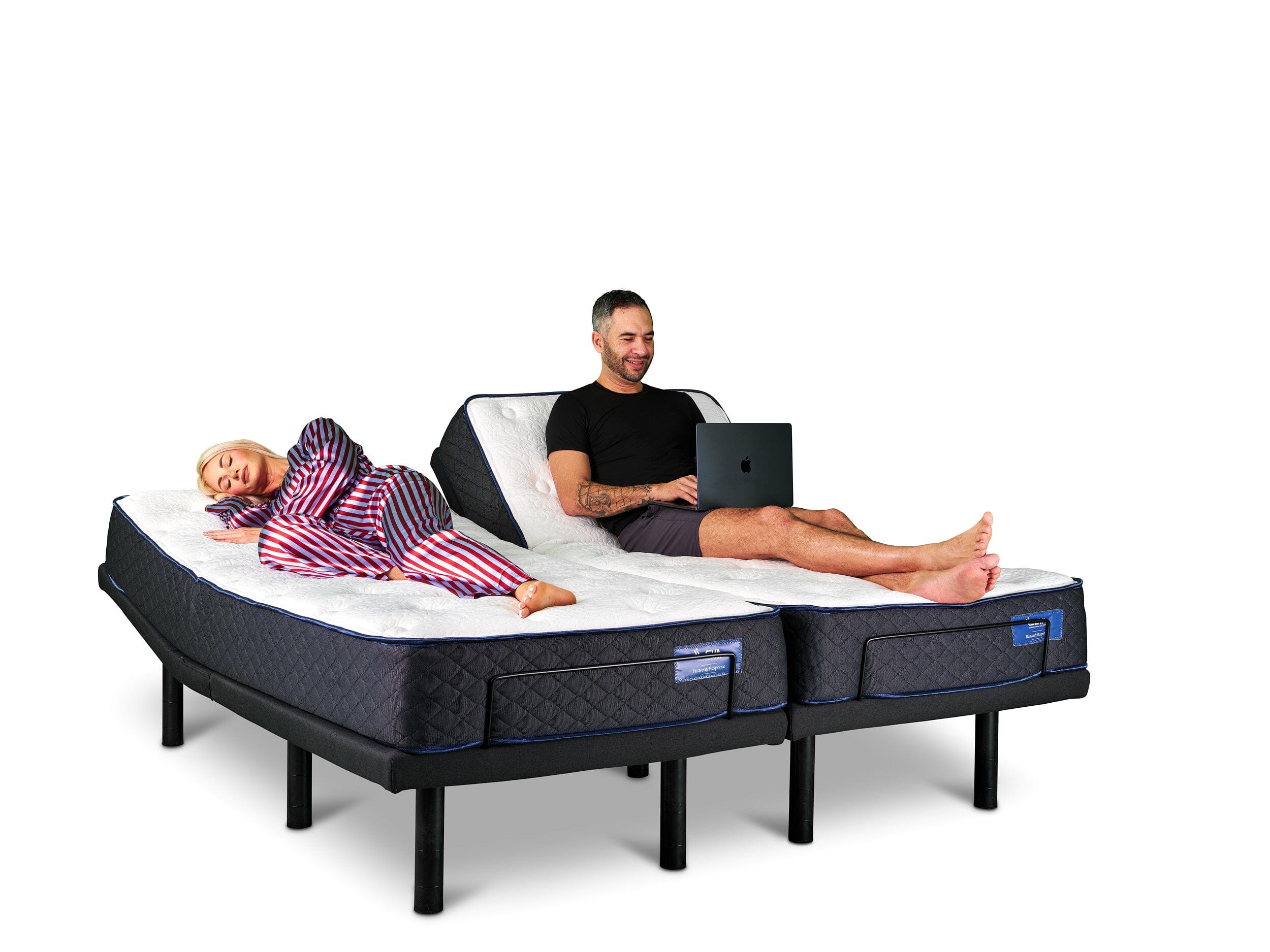
A split adjustable base divides the sleeping surface into two independently controlled halves. Each partner can set their own elevation, lumbar position, and massage intensity without affecting the other side. For couples where one partner is a side sleeper with back pain and the other is a back sleeper or has no pain, a split configuration removes the usual compromise where one person’s therapeutic position disrupts the other’s sleep.
Split King configurations, which use two Twin XL bases, are the most widely available. Split Queen configurations, which use two narrow Queen halves, are rarer and better suited to smaller bedrooms. Ask retailers whether their split bases use a shared frame or two independent frames joined by a connector. Independent frames allow each side to be adjusted to different heights for sleepers with hip or knee asymmetry.
Criterion 7: Anti-Snore and Smart-Adjustment Technology
Snoring often appears alongside back pain in adults aged 35–60 because flat sleeping positions compress the airway and flatten the lumbar curve at the same time. Anti-snore mode uses sensors to detect snoring and then elevates the head section by a small increment to open the airway without waking the sleeper. Smart-adjustment technology extends this idea to pressure and position monitoring and makes real-time micro-corrections throughout the night.
Ask whether the smart features operate through a Bluetooth app, onboard sensors, or both. Confirm whether the system stores sleep data for later review. Data logging allows sleepers and their physicians to correlate position changes with pain episodes, which supports more targeted adjustments over time.
Once you have identified a base that meets these seven criteria, the next step is dialing in your actual sleep position. The following guide offers starting degree ranges that you can fine-tune to relieve back pain.
Side Sleeper Position Guide: Recommended Degree Ranges
The following degree ranges provide general ergonomic guidance for side sleepers using adjustable bases. Because individual anatomy, mattress firmness, and pain location all affect which angle works best, treat these ranges as starting points rather than fixed rules. Begin at the lower end of each range and increase by one to two degrees per night, stopping when discomfort decreases.
- Head elevation: 10–20 degrees. This range reduces shoulder impingement and opens the cervical airway without creating a forward-head posture that strains the upper trapezius.
- Lumbar tilt: 3–8 degrees. This tilt fills the waist gap and reduces lateral lumbar flexion without pushing the pelvis into an anterior tilt.
- Leg elevation: 5–15 degrees. This elevation reduces hip-flexor tension and takes compressive load off the sacroiliac joint, which is a common pain source for side sleepers with lower-back issues.
- Pillow tilt: 5–10 degrees. This adjustment maintains cervical neutrality when the head section is elevated above 15 degrees.
Mattress-Pairing Matrix for Adjustable Bases
| Mattress Type | Firmness Guidance | Adjustable-Base Compatibility | Best For |
|---|---|---|---|
| All-Foam (Memory or Latex) | See Criterion 1 for ideal medium firmness range | Excellent — flexes fully at all articulation points | Hip and shoulder pressure relief; primary side-sleeper recommendation |
| Hybrid Pocket Coil | See Criterion 1 for medium to medium-firm guidance | Good — individually wrapped coils flex without damage | Side sleepers who need more lumbar rebound support |
| Firm Foam or Latex | Firmer feel with limited contour | Moderate — limited pressure relief at shoulder; may require softer topper | Combination sleepers who spend partial time on their back |
| Interconnected Innerspring | Any | Poor — coil grid resists articulation; warranty risk | Not recommended for adjustable base use |
Couples’ Guide: Split Queen and Split King Setups
Split adjustable bases remove the belief that one partner’s medical need must override the other’s comfort preference. Split King and Split Queen systems use independent whisper-quiet motors on each side, controlled through an app. Both partners can save custom positions, set vibrating alarms that do not disturb the other side, and activate massage or anti-snore features independently.
Split Queen configurations work especially well for couples in smaller bedrooms or those moving from a standard Queen who do not want to redesign the room around a King footprint. Split Queen bases can be built to customer specifications, which remains uncommon in the broader market where Split Queen inventory is limited or unavailable at general mattress retailers.
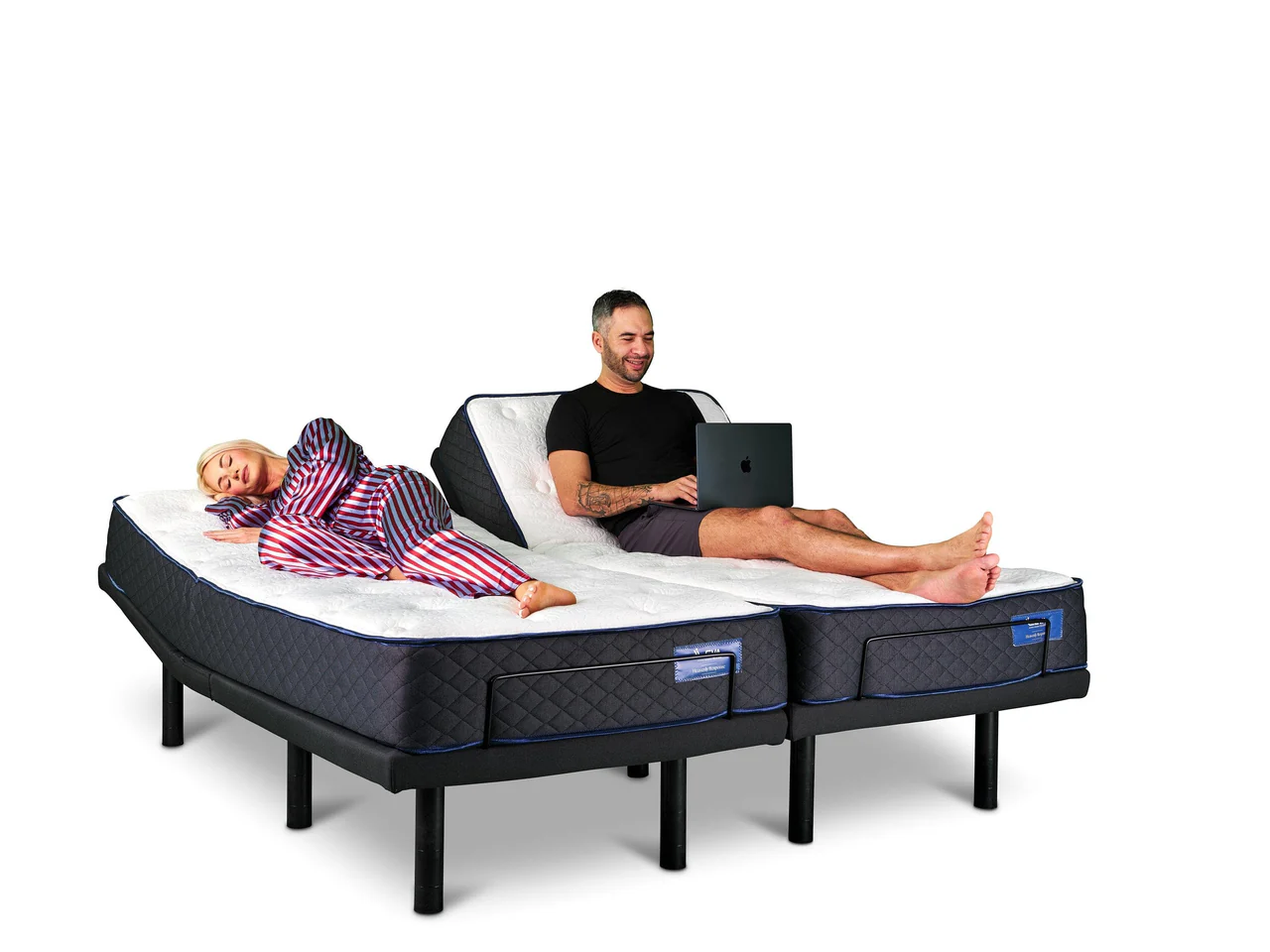
For couples where one partner is a side sleeper with back pain and the other has no positional requirements, a practical starting configuration uses a 15-degree head elevation with 8-degree leg elevation and active lumbar tilt on the pain side. The non-pain side stays flat or at minimal elevation. Both sides share the same bed surface and remain physically close while operating entirely independent sleep environments.
Frequently Asked Questions
Are adjustable beds safe for long-term use by side sleepers with chronic back pain?
Adjustable bases are generally considered safe for long-term use when the mattress is rated as adjustable-base compatible and the elevation settings stay within ergonomic ranges. Side sleepers should avoid sustained head elevations above 30 degrees for full-night sleep, because extreme angles can shift body weight onto the sacrum and create new pressure points. Anyone with a diagnosed spinal condition, herniated disc, or post-surgical recovery requirement should consult a physician or physical therapist before establishing a fixed sleep position.
How much does a quality split adjustable base cost, and is it worth the investment?
Entry-level split adjustable bases from general retailers typically start around $400–$700 per side, but often lack lumbar tilt, pillow tilt, or smart-adjustment features. Premium systems with advanced features are available at a range of higher price points. Vertical integration and direct-to-consumer models can position systems at 30–50% below comparable premium competitors, which makes advanced features accessible without the full luxury-brand markup. For adults with chronic back pain, the cost of an adjustable base is often offset by reduced reliance on over-the-counter pain relief, fewer chiropractic visits, and measurable improvements in daily energy and productivity.
Do I need to replace my current mattress to use an adjustable base?
Many sleepers can keep their current mattress, but compatibility must be verified before purchase. Mattresses with interconnected innerspring coil systems, rigid border wires, or foam cores thicker than 14 inches may not articulate correctly on an adjustable base and can sustain structural damage over time. All-foam and hybrid pocket-coil mattresses in the medium to medium-firm range are the most reliably compatible. Leva Sleep’s showroom consultants can assess whether an existing mattress is suitable or recommend a paired replacement from their curated lineup of American-made and California-made brands.
What should I ask during a showroom visit or consultation before buying?
During a visit, ask the retailer to demonstrate the full elevation range at the slowest motor speed and to confirm the decibel rating of the motors. Request a demonstration of the lumbar tilt function independently of head and foot elevation. Clarify whether anti-snore and smart-adjustment features are included or require an upgrade. For couples, ask whether the split configuration uses two independent frames or a shared frame with a divider and whether each side can be adjusted to a different leg height. Request a full breakdown of what white-glove delivery includes, especially whether old-bed removal, height adjustment, and a product tutorial are part of the service fee.
Conclusion: A Clear Path to Better Sleep for Side Sleepers with Back Pain
Side sleepers with back pain benefit most when they follow a clear decision sequence. First, confirm mattress compatibility. Next, evaluate elevation range and lumbar tilt, because these two features most directly influence pressure relief. Then consider pillow tilt, noise level, split configuration, and smart technology based on individual and couples-specific needs. Replacing a mattress alone improves surface comfort but leaves the underlying positional problem unsolved. An adjustable base with active lumbar articulation, independent split controls, and whisper-quiet motors addresses the structural cause of side-sleeper back pain rather than only its symptoms.
Leva Sleep’s adjustable bed lineup, detailed throughout this guide, is available exclusively through its Canadian showrooms and website. White-glove delivery includes bedroom setup, height calibration, a full product tutorial, and old-bed removal, which removes friction between purchase and the first night of improved sleep.