Written by: Matthew Timmins, Founder and Managing Director, Leva Sleep
Key Takeaways
- Couples dealing with snoring, back pain, or temperature differences now have practical smart adjustable bed options that address these issues directly.
- Key evaluation criteria include independent adjustability, anti-snore automation, noise isolation, app reliability, Medicare eligibility, and white-glove delivery.
- Leva Sleep stands out by offering Split Queen configurations, competitive pricing 30–50% below major brands, and locally assembled systems with premium health features.
- Medicare does not cover consumer smart adjustable beds in 2026, even those with advanced health features. Only hospital-grade DME beds qualify under specific medical criteria.
- Explore Leva Sleep’s full range of adjustable bases and personalized sleep solutions.
Seven Evaluation Criteria for Smart Adjustable Beds
A rigorous comparison of smart adjustable beds with health features works best when organized around seven criteria. The first two criteria focus on physical comfort. Comfort and pressure relief covers how well head, lumbar, and leg elevation reduce joint pressure and support spinal alignment. Independent adjustability for couples determines whether each side of the bed can be controlled separately for elevation, firmness, massage, and temperature.
The next two criteria address automation and sleep continuity. Health-feature automation in 2026 centers on anti-snore mode reliability, sleep-tracking accuracy, and lumbar or pillow-tilt motor precision. Noise and motion isolation evaluates whether motor adjustments during the night wake the non-adjusting partner.
The final three criteria relate to technology, finances, and service. App reliability and integration covers Bluetooth or Wi-Fi connectivity, custom position memory, alarm functions, and compatibility with health platforms. Medicare and out-of-pocket cost defines the realistic financial exposure for buyers with qualifying medical conditions. White-glove delivery and setup separates brands that send trained professionals to assemble, calibrate, and remove old equipment from those that drop-ship a box to the front door.
Four Types of Beds Competing for Couples
With these seven criteria in mind, the smart adjustable bed market divides into four main categories. Traditional flat beds offer no positional adjustment and force both partners into a single compromise surface. Basic adjustable bases add head and foot incline but typically lack split configurations, health automation, or whisper-quiet motors.
Integrated smart systems from mass-market retailers, such as Sleep Number 360 and Tempur-Ergo, bundle proprietary mattresses with advanced health features at premium price points. These systems usually sell through large retail chains with standardized delivery. Specialist adjustable-bed brands such as Leva Sleep design and assemble systems around the adjustable base as the primary product, offering a wider model range, curated mattress pairings, and vertically controlled delivery and setup.
How Much Does Medicare Pay for Adjustable Beds in 2026?
Medicare coverage for adjustable beds in 2026 falls under the Durable Medical Equipment (DME) benefit of Medicare Part B. Medicare hospital bed coverage criteria are not diagnosis-dependent and require documentation that the patient’s condition needs body positioning or attachments unavailable in an ordinary bed. Standard consumer smart adjustable bases, including split configurations with anti-snore automation, are not classified as DME and are therefore not reimbursable under Medicare Part B regardless of the health features they include.
When a qualifying hospital-grade bed is approved, Medicare Part B typically covers 80% of the Medicare-approved amount after the annual Part B deductible ($257 in 2025, subject to annual adjustment). The beneficiary is responsible for the remaining 20% coinsurance, which a Medigap supplemental policy may offset. Buyers should request a Letter of Medical Necessity from their physician, confirm the supplier is Medicare-enrolled, and verify that the specific model is listed on the Medicare HCPCS fee schedule before assuming coverage.
Split King vs Split Queen Adjustable Bed Prices Comparison
The table below reflects 2026 publicly listed starting prices for split and non-split configurations. Every figure comes from brand websites or verified retail listings. Cells are marked as unavailable when a brand does not publish a split-queen option. Prices reflect base-only or base-plus-mattress bundles as noted. Delivery and setup fees are separate unless stated.
| Brand / Model | Queen (single base) | Split King (two twin XL bases) | Split Queen |
|---|---|---|---|
| Sleep Number 360 / Climate360 (base + mattress bundle) | From $8,711.65 | From ~$9,999 | Not available |
| Tempur-Ergo Smart Base (base only) | From $2,199 | From $3,798 (two bases) | Not available |
| Ghostbed Adjustable Base (base only) | From ~$1,299 | From $1,998 (two bases) | Not available |
| Leva Sleep Adjustable Base (base only) | From ~$1,200 | From CAD $2,799 | Available (built to spec) |
Leva Sleep is one of the only U.S. providers offering a Split Queen configuration built to customer specifications. This format serves couples who share a queen-size room but still need independent adjustment on each side. Split King pricing at Leva Sleep starts at approximately 30–50% below comparable Tempur-Ergo and Sleep Number bundles, consistent with Leva’s direct-to-consumer, locally assembled model. Ghostbed competes on base price but offers a single adjustable model without the specialist range or split-queen option.
Smart Beds with Automatic Anti-Snore and Temperature Control (2026)
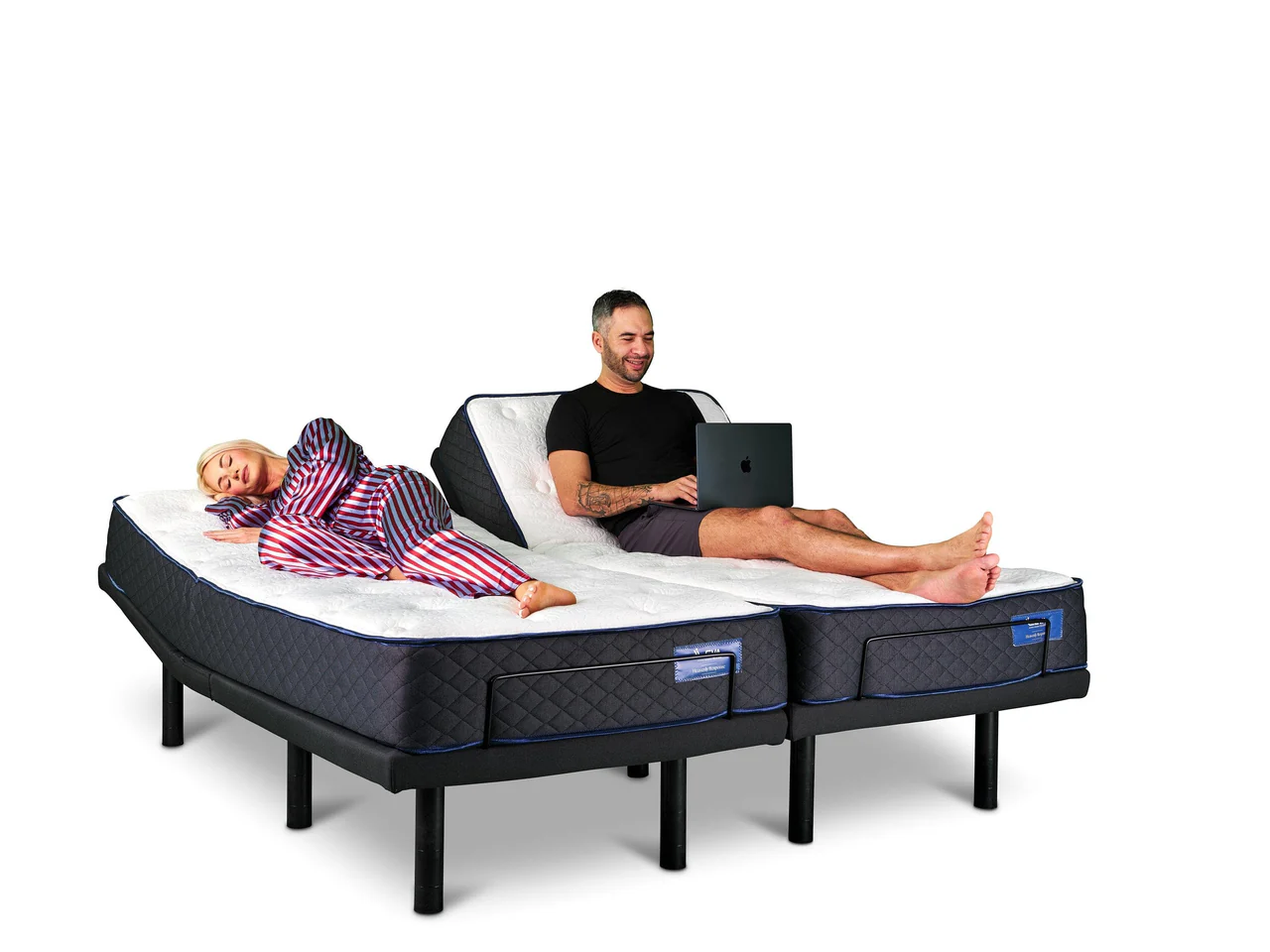
Price is only one dimension of value, and health features help justify the investment. Automatic anti-snore positioning ranks among the most requested features for couples. Tempur-Pedic’s TEMPUR-Ergo Smart Base uses Sleeptracker-AI technology to detect snoring via real-time monitoring of breath rate and bedroom conditions, then automatically raises the head of the bed approximately 12 degrees to reduce snoring without waking the user or partner. Tempur-Pedic states the Snore Response feature is designed for otherwise healthy individuals whose snoring is caused by body positioning. Verified customer accounts describe the adjustment as smooth and quiet, with snoring stopping quickly after the head elevation activates.
A 2026 Yahoo Health review of the Sleep Number Climate360 found that its preset “no snore” function raises neck position to help open the airway; reviewer Annie Villacis reported that activating it stopped her partner’s snoring and improved breathing without waking either sleeper. Many couples report that a partner’s snoring often keeps them up at night, with many adults reporting they sleep better alone, which highlights the practical value of reliable anti-snore automation for couples.
Leva Sleep’s anti-snore mode, launching spring 2026, detects snoring and makes micro-adjustments to the head of the bed through its app-connected system. The feature uses whisper-quiet German motors designed to avoid waking the non-snoring partner during adjustment. Lumbar control and pillow-tilt motors are available across multiple Leva models, allowing precise lower-back support and head-position tuning that mass-market bases do not offer at comparable price points.
Active temperature control further improves sleep quality for couples with different thermal preferences. On temperature control, the Sleep Number Climate360 allows independent temperature adjustment on each side by up to 15 degrees warmer or cooler; reviewer Annie Villacis, who runs cold while her partner runs hot, reported that simultaneous use of heating and cooling functions made a noticeable difference in comfort and sleep quality. Tempur-Pedic’s Tempur-ActiveBreeze uses fans built into the adjustable base with three airflow speeds and perforated foam layers to regulate temperature, though a WIRED review noted that the marketed 30-degree difference was a stretch in tests, with real-world cooling effectiveness varying with season, clothing, and individual physiology. Leva Sleep integrates a heating and cooling pad as part of its complete sleep system, allowing each partner to regulate temperature independently on a split base.
The physiological rationale for active temperature management is supported by peer-reviewed data. A 2026 study published in Building and Environment (n=17 healthy adults) found that a water-based cooling mattress topper in overheated bedrooms increased mean total sleep time by 19 minutes, reduced mean sleep onset latency by 10 minutes, and improved self-rated sleep quality from 2.8 to 3.7 on a 1–5 scale, with statistically significant improvements in thermal comfort and large effect sizes (r=0.71–0.93). Harvard Medical School instructor and Massachusetts General Hospital researcher Shahab Haghayegh, PhD, explains that optimal sleep onset requires an initial period of mild skin-surface warming to trigger the drop in core body temperature needed to fall asleep, and that active systems can facilitate this warming-then-cooling cycle in a way passive mattress materials cannot.
Best Value Smart Adjustable Base for Couples
Comfort and pain relief: Buyers evaluating comfort should look for independent head, lumbar, and leg elevation on each side of the bed, a dedicated lumbar motor, and mattress compatibility with significant elevation angles. Sleep Number’s P6 smart bed features Responsive Air technology that uses sensors to automatically inflate or deflate air chambers during sleep to relieve pressure on joints and high-pressure areas such as hips and shoulders. Leva Sleep takes a different approach. Its adjustable bases allow head and leg elevation to reduce joint pressure and improve spinal alignment, with lumbar control available across multiple models and mattresses designed specifically to flex with the base rather than resist it.
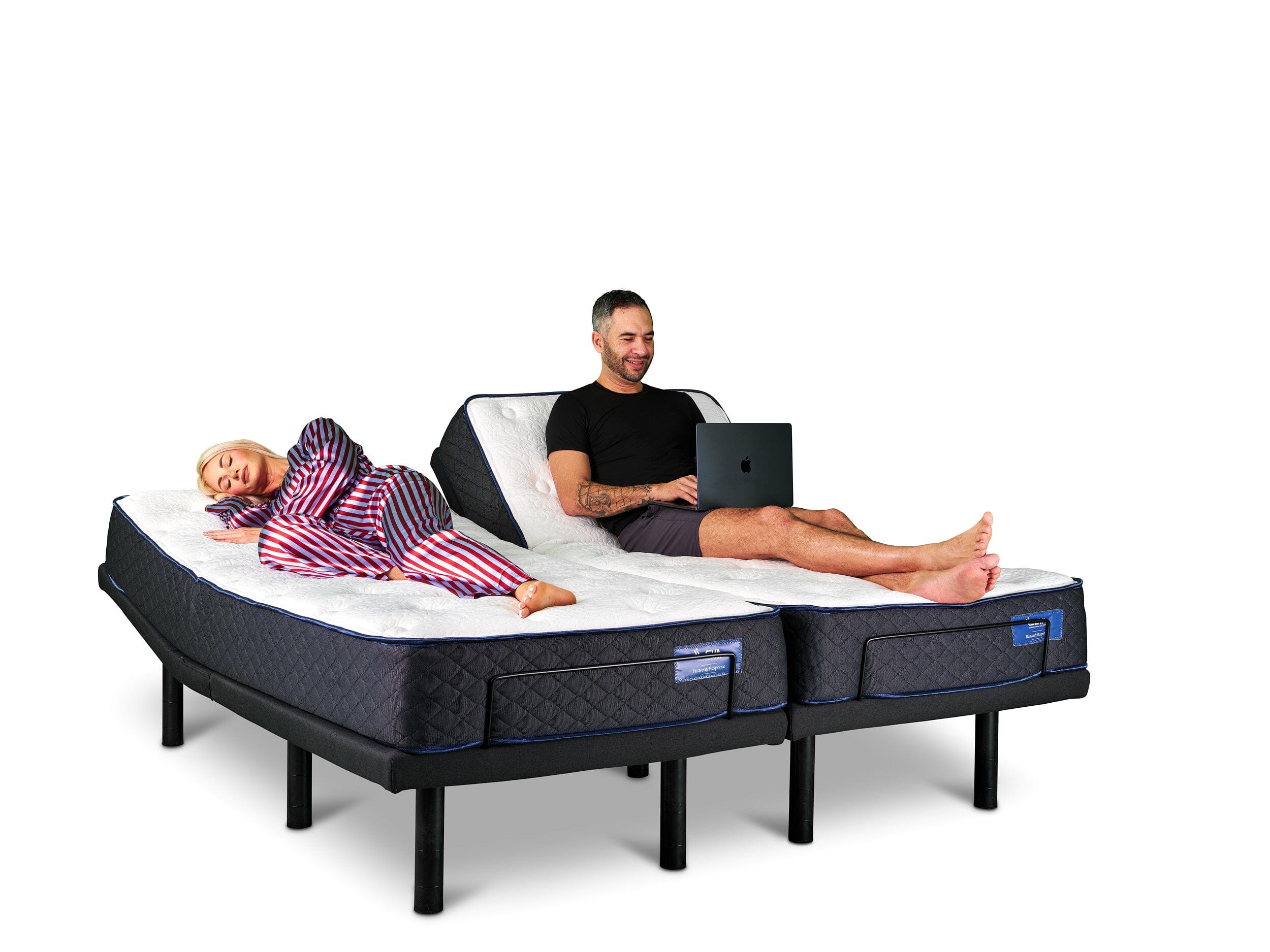
Partner compatibility: A split configuration is the single most important structural feature for couples with differing needs. Split King, which uses two twin XL bases, is the most widely available format. Leva Sleep’s Split Queen is a built-to-specification option that serves couples in queen-size rooms who would otherwise have to choose between split functionality and room space. Independent app control on each side means one partner can activate anti-snore mode, adjust lumbar support, or run a massage cycle without affecting the other side.
Visit the La Jolla showroom or shop online to see how split configurations solve the partner-compatibility challenge.
Technology and Health Features, Setup, and Everyday Use
Beyond core comfort and partner compatibility, the technology layer and setup experience determine how well a smart bed works in daily life. App reliability is a practical differentiator that is difficult to assess from specifications alone. Buyers should check whether the app requires a persistent Wi-Fi or Bluetooth connection, whether custom positions can be saved and recalled with a single tap, and whether the app integrates with wearable health platforms. Leva Sleep’s app provides full control over elevation, massage, vibrating alarms, and anti-snore micro-adjustments via Bluetooth, with AI-powered sleep tracking for real-time position optimization.
Motor noise is a critical factor for couples because one partner’s adjustment should not wake the other. Leva Sleep addresses this with whisper-quiet German motors across its lineup, which keep adjustments discreet during sleep. Buyers evaluating other brands should request decibel specifications or read verified owner reviews that describe nighttime adjustment noise specifically, not just daytime demonstration noise, because showroom environments often mask real-world sound levels.
Delivery and setup experience separates specialist brands from mass-market options. Leva Sleep’s white-glove delivery service, available for a fee, sends trained professionals to the bedroom, assembles the base and mattress, adjusts leg heights, provides a product tutorial, and removes the old bed for donation or recycling. Bed-in-a-box brands and large retail chains typically deliver to the door or curb, leaving assembly and old-bed disposal to the customer.
Long-Term Reliability and Cost
Total ownership cost for a smart adjustable bed extends beyond the purchase price. Buyers should consider motor warranty coverage, mattress replacement cycles, app subscription fees where applicable, and the cost of compatible bedding. They should confirm whether the motor warranty covers the full adjustment mechanism or only specific components, and whether the brand offers in-home service or requires the base to be shipped for repair.
Leva Sleep designs and assembles its systems locally, which supports faster service response and consistent quality control without passing a manufacturing markup to the customer. Its mattresses are made in the United States. Bedding accessories such as fitted sheets with deep pockets and extra elastic, duvet clips, and mattress protectors are designed specifically for adjustable bases to prevent the sheet slippage and bunching that standard bedding produces under significant elevation.
Real-World Use Cases
Chronic back pain: Head and leg elevation to a zero-gravity position reduces lumbar compression. A dedicated lumbar motor allows fine-tuning of lower-back support independent of overall incline. Leva Sleep’s all-foam and hybrid pocket-coil mattresses are engineered to flex with the base rather than create pressure points at bend zones.
Snoring partner: Automatic anti-snore positioning that raises the head 10–12 degrees without waking either sleeper is one of the most effective positional interventions available in a consumer bed. Both Tempur-Ergo and Sleep Number Climate360 offer this feature at higher price points. The anti-snore mode described earlier delivers comparable automation at a fraction of those costs.
Differing firmness preferences: A split base paired with two separate mattresses, one firm and one soft, is the only configuration that fully resolves this conflict. Leva Sleep’s Split King and Split Queen both support independent mattress selection on each side.
Post-surgery recovery: Sustained head or leg elevation prescribed after hip, knee, or abdominal surgery requires a base that holds a precise angle reliably for weeks. Leva Sleep’s precision-fabricated bases and white-glove setup ensure the correct elevation is calibrated at installation rather than estimated by the patient.
Total Value and Practical Considerations
The learning curve for a smart adjustable base is typically short, and most users establish preferred positions within the first week and save them as app presets. Maintenance remains minimal, since motor mechanisms require no lubrication or user servicing under normal use, and mattress rotation schedules apply to the mattress, not the base. Delivery logistics are the most commonly underestimated factor. A split king base consists of two heavy independent frames that require coordinated placement, and professional setup eliminates the risk of incorrect assembly or misaligned components.
Leva Sleep’s 15–20 adjustable models give buyers a meaningful selection across price points and feature sets, compared to the three to five models typically available at a general mattress retailer.
Decision Checklist
- Budget under $2,000 (base only): Ghostbed or Leva Sleep entry models; confirm anti-snore and lumbar features are included at the chosen tier.
- Budget $2,000–$4,000 (base only): Leva Sleep mid-to-upper models with full health-feature suite, delivering the pricing advantage noted earlier while offering the same automation and control as higher-priced systems.
- Budget $4,000+ (base + mattress bundle): Tempur-Ergo ProSmart or Sleep Number Climate360; expect proprietary ecosystem lock-in and standard retail delivery.
- Snoring is the primary concern: Confirm automatic anti-snore mode, not manual preset only, is included. Tempur-Ergo, Sleep Number Climate360, and Leva Sleep spring 2026 models all qualify.
- Queen-size room, split functionality needed: Leva Sleep Split Queen is the only widely available built-to-spec option in this category.
- Medicare eligibility being evaluated: Consult a physician for a Letter of Medical Necessity, confirm the specific model is DME-classified before purchase, and remember that consumer smart bases do not qualify.
- White-glove setup required: Leva Sleep (fee-based), or confirm in-room setup is included, not just threshold delivery, with any other brand.
- Temperature regulation is a priority: Sleep Number Climate360, with active heating and cooling independent per side, or Leva Sleep heating and cooling pad integration. Verify real-world performance data, not only marketed temperature ranges.
Frequently Asked Questions
What is the difference between a Split King and a Split Queen adjustable bed?
A Split King consists of two twin XL bases placed side by side, each independently adjustable, fitting a standard king-size bed frame. A Split Queen uses two narrower bases to fit a queen-size footprint. Split Queen configurations are rare in the mass market because the narrower width creates engineering challenges for independent adjustment mechanisms. Leva Sleep builds Split Queen bases to customer specifications, making it one of the only U.S. providers offering this format. Both configurations allow each partner to control elevation, massage, and other features independently without affecting the other side.
Does Medicare cover smart adjustable beds in 2026?
Medicare Part B covers only hospital-grade semi-electric beds classified as Durable Medical Equipment when a physician certifies medical necessity for a qualifying condition. Consumer smart adjustable bases, including models with anti-snore automation, sleep tracking, or lumbar motors, are not classified as DME and are not reimbursable under Medicare regardless of the health features they include. Buyers with qualifying conditions should obtain a Letter of Medical Necessity from their physician, verify the supplier is Medicare-enrolled, and confirm the specific model appears on the Medicare HCPCS fee schedule before assuming any coverage applies.
How does automatic anti-snore positioning work, and is it effective?
Automatic anti-snore positioning uses sensors embedded in the base or mattress to detect snoring through changes in breath rate, vibration, or sound. When snoring is detected, the system raises the head of the bed, typically 10–12 degrees, to open the airway without waking the sleeper or partner. Tempur-Pedic’s Sleeptracker-AI system and Sleep Number’s no-snore preset both operate on this principle. Leva Sleep’s spring 2026 anti-snore mode uses app-connected micro-adjustments through its German motor system. The feature is most effective for positional snoring caused by airway collapse during supine sleep. It does not replace CPAP therapy in cases of diagnosed obstructive sleep apnea, though head elevation can reduce the frequency and severity of apnea events for some users.
Why does a split adjustable base cost more than a single adjustable base?
A split configuration requires two independent motor assemblies, two separate control systems, two sets of adjustment mechanisms, and in most cases two separate mattresses. Each side must operate without transmitting motion or noise to the other, which demands higher-precision engineering and more robust motor isolation. The total component count is roughly double that of a single base. Leva Sleep’s direct-to-consumer, locally assembled model reduces the retail markup on this additional complexity, which is why its split configurations are priced 30–50% below comparable mass-market split systems.
What should couples look for in white-glove delivery for a smart adjustable bed?
White-glove delivery for a smart adjustable bed should include in-room delivery to the bedroom, not threshold or garage only, full assembly of the base and mattress, calibration of leg height to the customer’s preference, a product tutorial covering app setup and position programming, and removal of the old bed. Buyers should confirm in writing whether old-bed removal is included or costs extra, whether the delivery team is employed by the brand or a third-party logistics contractor, and whether the team can perform real-time adjustments such as repositioning the base or troubleshooting app connectivity before leaving. Leva Sleep’s in-house white-glove service covers all of these elements for a stated fee, with trained professionals rather than contracted freight handlers.
Conclusion
Smart adjustable beds with health features in 2026 range from basic incline bases to AI-driven split systems with automatic anti-snore positioning, active temperature regulation, lumbar motors, and app-controlled personalization. The evaluation criteria that matter most, including independent adjustability, anti-snore reliability, motor noise, app stability, and total cost, reveal meaningful differences between mass-market integrated systems and specialist brands. Leva Sleep’s extensive model range delivers the full health-feature suite at 30–50% below Sleep Number 360 and Tempur-Ergo price points, with a Split Queen option unavailable elsewhere, whisper-quiet German motors, and in-house white-glove delivery that ensures the system is calibrated correctly from the first night.
Explore Leva Sleep’s U.S.-assembled adjustable bases at the La Jolla showroom or online.