Written by: Matthew Timmins, Founder and Managing Director, Leva Sleep
Key Takeaways
- Adjustable bases disrupt passive cooling foams by reducing body contact and accelerating heat buildup, while active cooling pads maintain temperature reduction at any elevation angle.
- Independent per-side temperature and position control is essential for couples with different needs; single-zone systems force unwanted compromises.
- Leva Sleep’s split adjustable bases use whisper-quiet German motors and purpose-built bedding to reduce noise and sheet slippage during articulation.
- Climate-controlled luxury mattresses often exceed $10,000 for split-king setups, while Leva Sleep delivers similar performance at 30–50% lower total cost through vertical integration and local assembly.
- Experience independent cooling and adjustability by visiting Leva Sleep online or at the La Jolla showroom.
The Five Criteria That Matter for Couples
Every option in this guide is measured against five clear standards.
- Cooling performance when elevated, meaning the system maintains meaningful temperature reduction once the head or foot section rises.
- Independent temperature control, meaning each partner can set a different temperature without affecting the other side.
- Noise during articulation, meaning motors or pumps stay quiet enough not to disrupt sleep when the base moves.
- Sheet retention, meaning bedding stays in place at full elevation.
- Total cost of ownership, meaning the combined price of purchase, delivery, maintenance, and longevity.
These five criteria provide the framework for evaluating the three product categories that dominate the market for couples seeking cooling on an adjustable base.
How Today’s Cooling Systems Fit Adjustable Bases
Three main product categories serve couples who want cooling on an adjustable base.
Active cooling pads sit on top of a compatible mattress and use a pump to circulate temperature-controlled water or air through a thin hydrolayer. Active cooling pads can produce a surface temperature drop that continues as long as the unit runs. This continuous operation requires a bedside pump unit that needs occasional refilling, and because the pad sits between your mattress and sheets, you must confirm that it works with your specific adjustable base model.
Climate-controlled mattresses such as Sleep Number's Climate360 integrate the cooling mechanism directly into the mattress structure. Climate360 enables independent temperature control on each side, allowing users to sleep up to 30 degrees cooler or warmer independently. These systems are proprietary and remain permanently tied to the mattress.
Passive hybrid foams use gel-infused layers, copper, graphite, or phase-change materials to absorb body heat. Sleep Reviews noted that gel-infused foam provides initial cooling but loses its advantage within 60–90 minutes as the gel saturates with body heat. These mattresses require no power but offer no user-adjustable temperature setting.
Cooling Performance When the Base Is Elevated
Cooling effectiveness often drops once the base articulates. Articulation changes the geometry of the sleep surface. Passive foams rely on gravity-assisted airflow and conductive material contact, and both mechanisms weaken when the head or foot section rises.
Independent testing by MattressNut, a mattress review laboratory, measured surface temperatures for active and passive cooling mattresses under controlled conditions. Their findings show that when the base elevates, passive systems lose additional contact area with the sleeper's body, which accelerates heat buildup.
Active cooling pads circulate fluid regardless of surface angle, so they maintain consistent temperature reduction even at full elevation. Passive cooling approaches, by contrast, provide only brief temperature reduction before the materials saturate, and this limitation worsens when the mattress bends because contact area decreases. Climate-controlled mattresses fall between these extremes. They maintain performance at elevation like active pads, but only when their internal airflow channels are engineered to flex with the base rather than kink or compress.
Shoppers should request documented surface temperature data at 30° and 45° head elevation, not just flat measurements.
Split-Base Independence for Couples
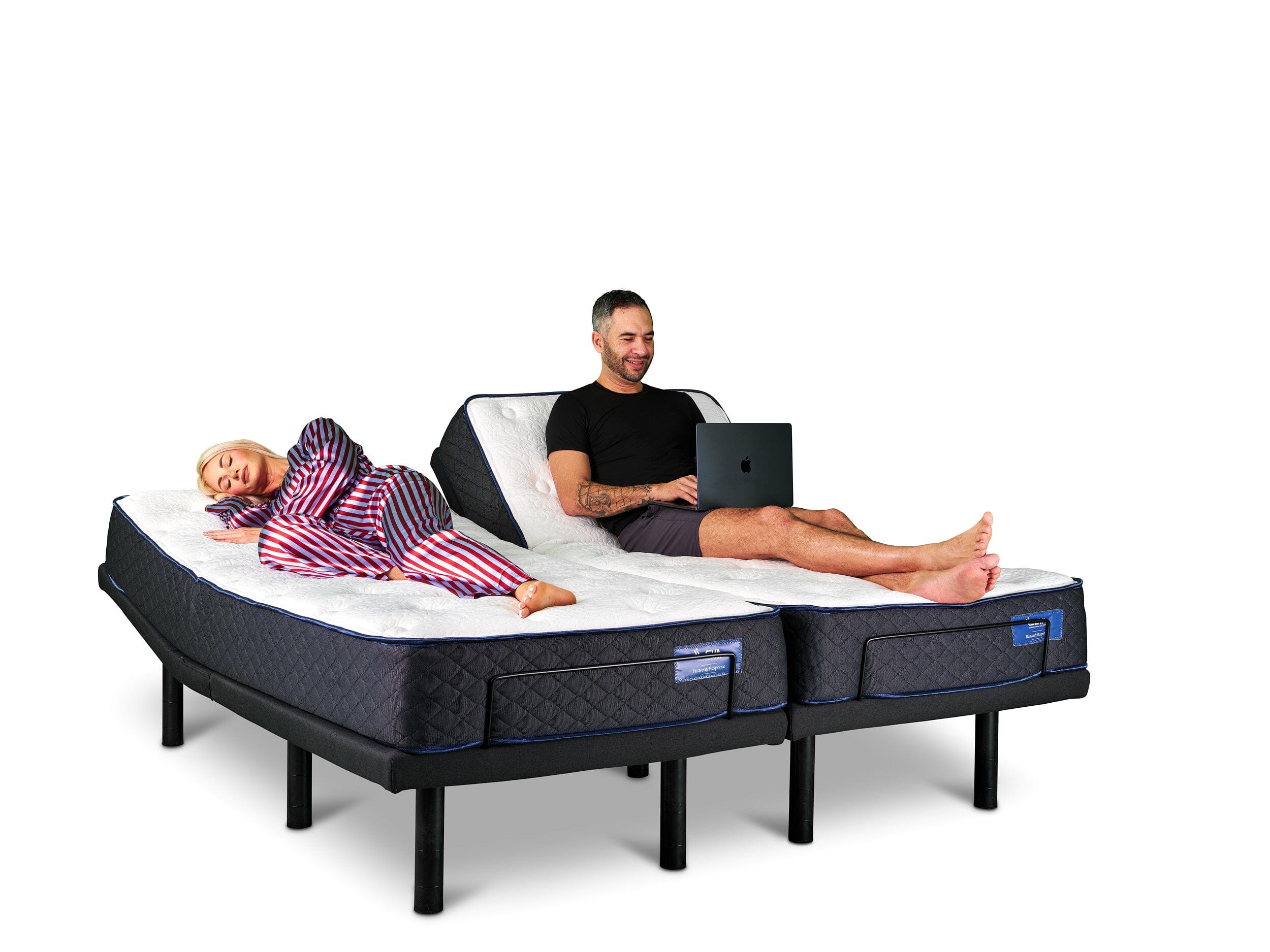
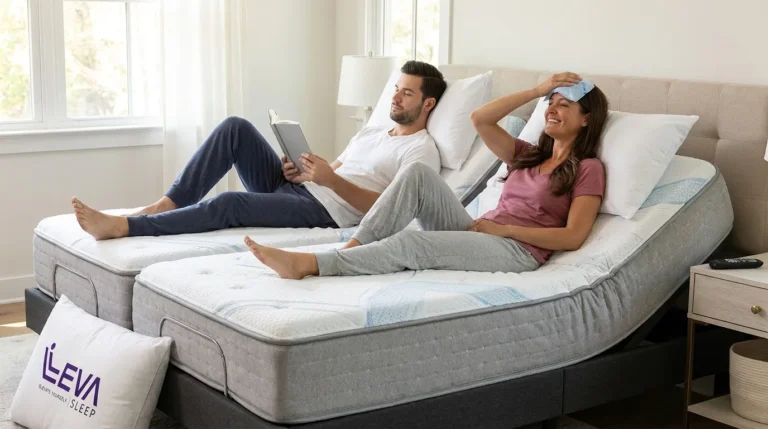
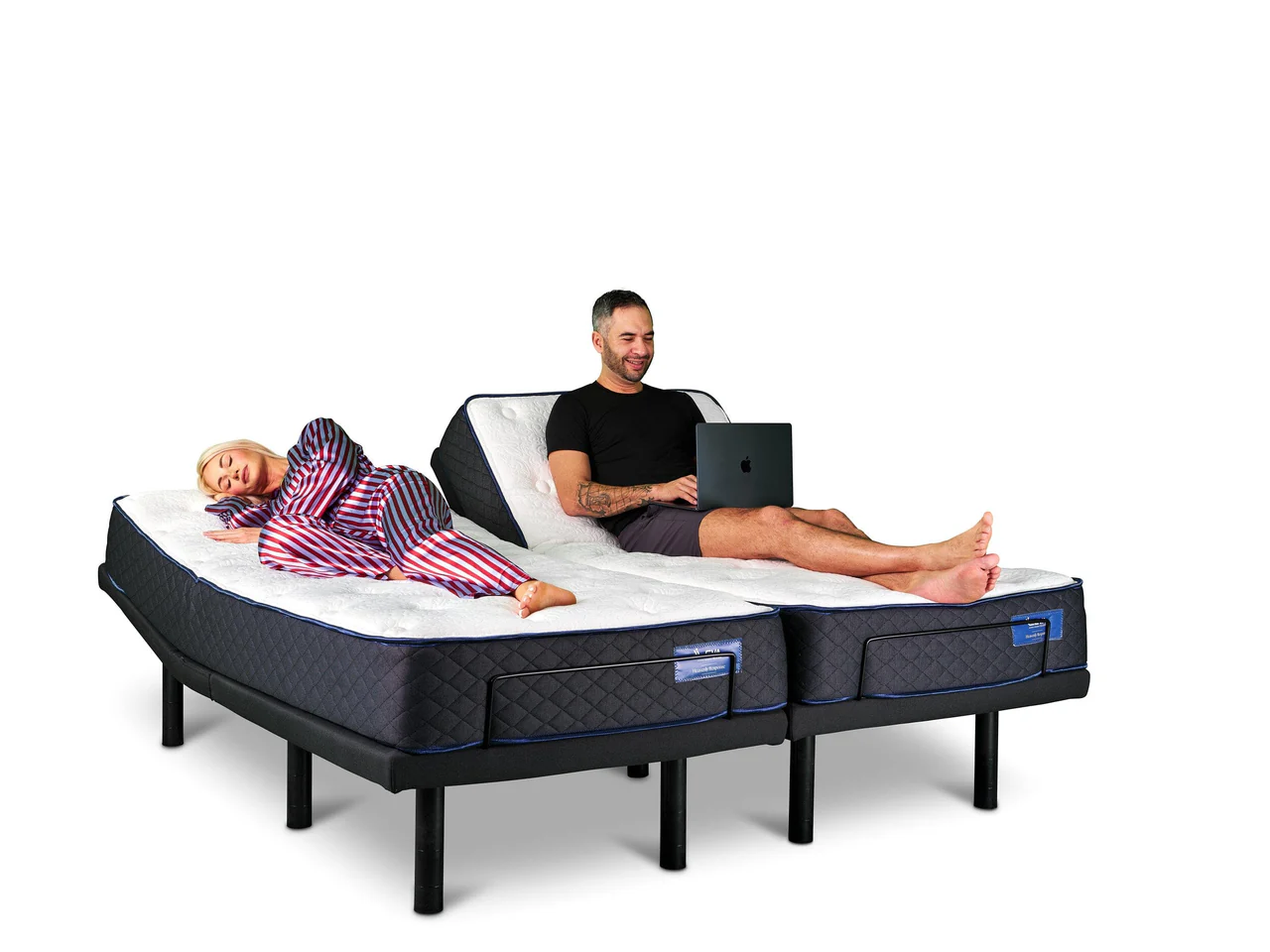
True per-side control allows Partner A to set 65°F and 30° head elevation while Partner B sets 72°F and a flat position, with no thermal or mechanical crossover. Most passive hybrids offer no electronic adjustment at all. Single-zone active systems cool the entire mattress surface uniformly, so the cooler-sleeping partner must accept the same temperature as the hot sleeper.
Passive cooling technologies can slow heat buildup but cannot actively regulate temperature in a precise way. For couples with divergent preferences, that limitation often becomes the deciding factor.
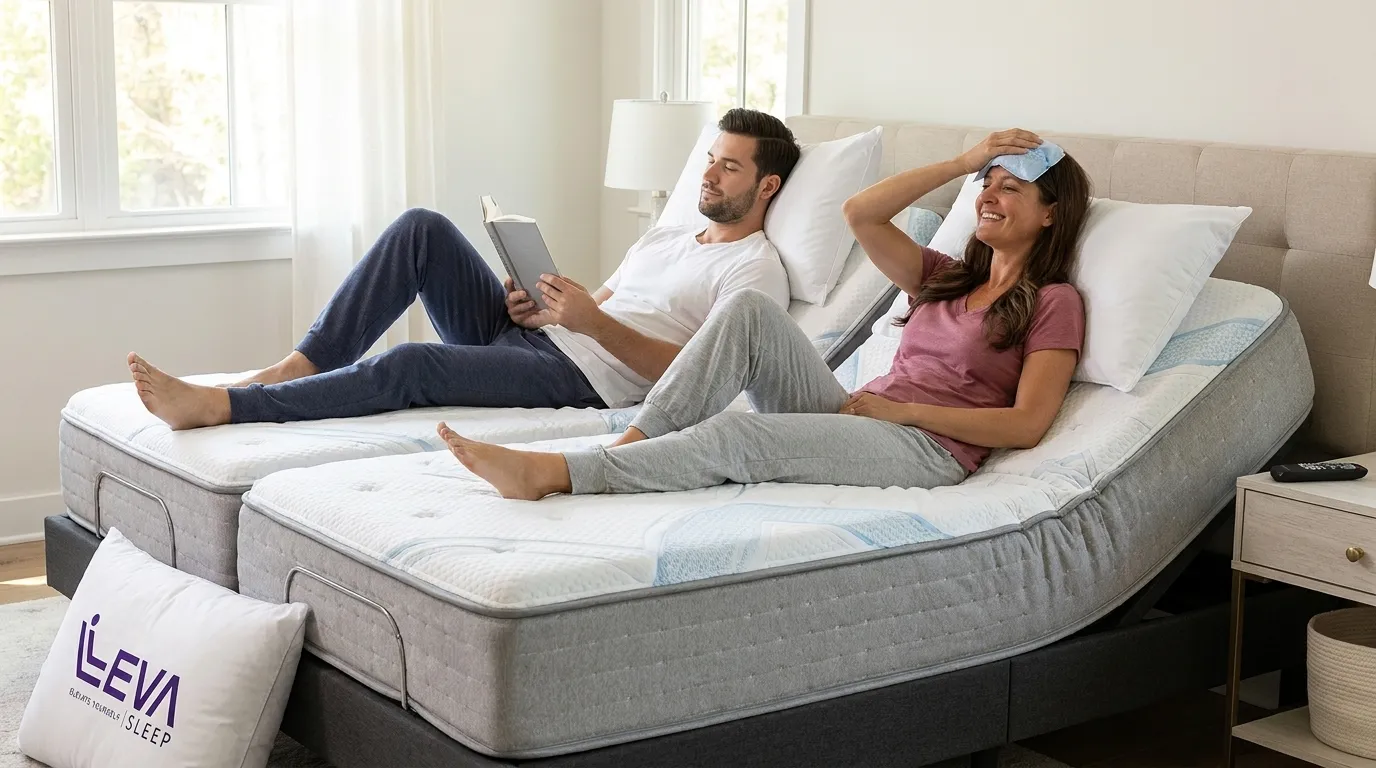
Leva Sleep's split adjustable bases pair each side with an independent motor and an integrated cooling pad, delivering separate temperature and position control through the Leva Sleep app. This architecture addresses a major gap in current options. No top-ranked competitor fully combines split-base mechanical independence with per-side active thermal control at a price point 30–50% below luxury alternatives.
Experience true per-side independence with Leva Sleep's split adjustable bases
Noise and Motion During the Night
Noise control determines whether one partner's movement disturbs the other. Motor noise during articulation is a documented pain point for couples. A partner adjusting position at 2 a.m. should not wake the other.
Leva Sleep's bases use whisper-quiet German motors engineered for low acoustic output during movement. Basic adjustable bases sold as add-ons at general mattress retailers often use lower-grade motors that produce audible grinding or clicking during elevation changes.
Active cooling pads introduce a second noise source: the pump or fan unit that circulates fluid. Pump volume varies significantly by brand and should be evaluated in person or through verified owner reviews. Climate-controlled mattresses with internal airflow systems also generate fan noise, usually housed within the base or a bedside unit.
Shoppers should request a live demonstration at elevation with the cooling system running at the same time. A system that is quiet at rest but loud during articulation fails the real-world test for light sleepers.
Hear the difference whisper-quiet motors make — visit Leva Sleep's La Jolla showroom
Sheet Slippage and Purpose-Built Accessories
Sheet design affects comfort as much as the base itself. Standard fitted sheets are built for flat mattresses. At 30–45° head elevation, the mattress surface stretches and the sheet corners pull free, creating a bunched fabric layer that disrupts sleep. Split configurations magnify this problem because each side moves independently.
Leva Sleep designs fitted sheets with deep pockets and reinforced elastic specifically for adjustable bases, along with duvet clips that maintain separation when the two sides sit at different angles. The Slumber Cloud Performance Mattress Pad is offered in a split-king configuration specifically suited for couples using adjustable beds, and Saatva's Organic Mattress Pad offers an Upper-Flex split-top option for queen and king sizes that aligns with split adjustable mattresses, both examples of accessory engineering that supports cooling on an articulating base.
Passive hybrid mattresses sold without purpose-built bedding leave this challenge entirely to the consumer. Active cooling pads add a layer of tubing beneath the sheet, which can shift at elevation if the pad is not secured with compatible anchors.
Explore Leva Sleep's purpose-built bedding designed for adjustable bases
Long-Term Value and Total Cost of Ownership
Total value depends on more than sticker price. Climate-controlled mattresses from Sleep Number or Eight Sleep often exceed $10,000 for a split king with active cooling on both sides before delivery. Passive hybrids from Bear or Helix cost less at purchase but usually require a separate active cooling pad and a compatible adjustable base to manage temperature, which adds roughly $500–$2,000 to the total.
Leva Sleep's vertically integrated model, which combines in-house design with local assembly, removes distributor and retail markups. This structure delivers premium engineering at 30–50% below comparable luxury competitors. White-glove delivery, available for a fee, includes setup, leg-height adjustment, a product tutorial, and removal of the old bed, which reduces the hidden labor costs that come with box-delivery brands.
The global sleep aid technology market stood at roughly $103.5 billion in 2025 and is projected to reach $136 billion by 2030, with the global smart mattress market projected to grow at a CAGR of 8.2% from 2025 to 2033. As the smart mattress market expands, manufacturers are consolidating features into integrated systems rather than separate components. This shift means buying a complete system now can protect you from future compatibility issues as standalone cooling pads and adjustable bases become harder to match across brands.
See how Leva Sleep delivers luxury performance at 30–50% lower cost
Real-World Use Cases for Couples
The snoring partner who overheats. Sleep experts recommend elevating the head using an adjustable base to reduce airway obstruction associated with snoring. When that partner also sleeps hot, elevation alone does not solve the problem. The cooling system must maintain performance at the elevated angle. A split base with per-side active cooling addresses both issues without forcing the non-snoring partner into the same elevated position or temperature.
The side-sleeper with hip pain. Higher ambient temperatures have been linked to more severe obstructive sleep apnea symptoms, so people with obstructive sleep apnea may find a cooler mattress better for restful sleep. A side-sleeper managing hip pain needs a mattress that flexes with the base while preserving pressure relief. Passive foams that saturate thermally also tend to soften unevenly under repeated articulation, which reduces long-term support.
The couple with opposite temperature preferences. One partner runs cold and the other wakes overheated. A single-zone system forces a compromise temperature that satisfies neither. A 2024 three-center study found that conductive body cooling via a high-heat-capacity mattress increased slow-wave sleep (N3) by 7.5 minutes per 7.5-hour night. That benefit disappears if the cooler-sleeping partner becomes overcooled by a shared zone, so independent control preserves the full gain for both sleepers.
Total Value and Practical Considerations
Daily use and upkeep should feel manageable for both partners. A split adjustable system with integrated cooling requires a short learning curve. Both partners need to configure their preferred positions and temperatures in the app, and the cooling pad needs periodic maintenance such as fluid refills.
These tasks usually take only minutes per month, a minor investment compared to the nightly benefit of uninterrupted sleep at your ideal temperature and position. Still, couples who prefer zero-maintenance solutions should factor this into the purchase decision.
Future health changes, such as a new diagnosis of sleep apnea, post-surgical recovery, or changing temperature sensitivity with age, are easier to accommodate in a modular system than in a fixed climate mattress. Leva Sleep offers a broad range of adjustable base models, which creates upgrade paths without requiring a full system replacement.
A practical decision checklist for couples evaluating this category:
- Do both partners need independent temperature control, or only one?
- Does either partner require head or foot elevation for a medical condition?
- Is noise sensitivity a factor for either partner?
- What is the realistic total budget including delivery, bedding, and accessories?
- Is white-glove setup important given the complexity of the system?
Frequently Asked Questions
Why do passive cooling foams stop working when an adjustable base is elevated?
Passive cooling materials such as gel, copper, graphite, and phase-change compounds work by absorbing body heat through direct contact and conducting it away from the skin. When an adjustable base raises the head or foot section, the mattress surface bends and the contact geometry between the sleeper and the foam changes. Less surface area stays in direct contact, which reduces conductive transfer.
Passive materials also have a finite absorption capacity. Once the gel or phase-change layer reaches thermal equilibrium with the body, it stops absorbing heat and begins trapping it. As noted earlier, this saturation typically occurs within the first 90 minutes on a flat surface and can occur faster at elevation because the reduced contact area concentrates heat in a smaller zone. Active cooling systems avoid this problem because they continuously remove heat via circulating fluid or air, regardless of the surface angle.
Can a standard active cooling pad be added to any adjustable base?
Most active cooling pads need compatibility checks before use on an adjustable base. These pads require a flat, stable surface beneath them to prevent the tubing from kinking or the pad from shifting during articulation. Some pads include anchor straps or corner clips designed for adjustable bases, while others do not.
The bedside pump unit also needs a position where the base's movement does not strain the connecting hoses. Split configurations require two separate pad units, one per side, and each must be compatible with the specific base model. Leva Sleep's integrated approach resolves this by engineering the cooling pad and the base together, which removes compatibility guesswork and helps the system perform as designed at every elevation angle.
How much does independent temperature control actually improve sleep for couples?
Independent temperature control consistently improves sleep quality in research settings. Sleep Number's analysis of Climate360 users has shown that adjusting mattress temperature can increase sleep duration. A Loughborough University 2026 study of 17 adults found that a cooling mattress topper increased average total sleep time by 19 minutes and reduced sleep onset time by 10 minutes in an overheated 30°C bedroom.
A 14-night controlled study found that sleepers using temperature-controlled bedding reported waking up more refreshed and experienced higher overall sleep satisfaction than those sleeping without it. For couples, independent zones add another benefit. Neither partner must accept a compromise temperature, so the cooler-sleeping partner avoids overcooling and the hot sleeper receives full active cooling throughout the night.
What should couples look for in bedding designed for split adjustable bases?
Couples should choose bedding that stays anchored when each side moves independently. Standard fitted sheets are engineered for flat mattresses and often pull free at the corners when either side of a split base elevates. Purpose-built bedding for adjustable bases includes deeper pockets, typically 18–21 inches, and reinforced elastic that wraps further under the mattress. Some designs add anchor bands that run beneath the mattress to prevent movement.
For split configurations, the top sheet and duvet also need to accommodate two independently moving surfaces. Duvet clips or separate duvet panels prevent the cover from bunching between the two sides when they sit at different angles. Leva Sleep designs its full bedding suite, including fitted sheets, duvets, mattress protectors, and pillows, specifically for adjustable bases so every component works together rather than being adapted from flat-bed designs.
Is a split queen adjustable base a viable option for smaller bedrooms?
A split queen can deliver full per-side independence in a smaller footprint. It provides the same separate elevation, temperature, and massage controls as a split king while fitting standard queen-size bedroom furniture. Most adjustable base manufacturers focus on split king configurations because they are mechanically simpler, using two twin XL bases placed side by side.
A true split queen requires custom engineering to maintain the narrower width while preserving full independent articulation on each side. Leva Sleep is one of the few providers that builds split queen adjustable bases to customer specifications, which makes independent sleep customization accessible in rooms where a split king would not fit.
Conclusion
Passive foams often saturate within the first hour of sleep and lose their cooling advantage once the base articulates. Single-zone active systems solve the thermal problem but force couples into a shared temperature that rarely satisfies both partners. Climate-controlled mattresses from luxury brands address both issues but at price points that exclude many buyers and with proprietary designs that limit future flexibility.
Leva Sleep's split adjustable bases with integrated cooling pads meet all five criteria: sustained cooling at elevation, true per-side temperature independence, whisper-quiet German motors, purpose-built sheet retention accessories, and the cost advantage detailed earlier, all within a single vertically integrated system that includes optional white-glove delivery and setup.