Written by: Matthew Timmins, Founder and Managing Director, Leva Sleep
Key Takeaways for Couples Choosing Adjustable Beds
- Dual-zone adjustable firmness systems let each partner independently control firmness, head elevation, and foot elevation on their side of the bed, so neither person has to compromise on comfort.
- Split-king configurations give each partner more sleeping width, while split-queen options fit smaller bedrooms. Leva Sleep uniquely offers custom-built split-queen systems.
- Head-of-bed elevation on adjustable bases can reduce snoring and mild sleep apnea symptoms by helping keep the airway open. Leva Sleep’s anti-snore mode adds automated micro-adjustments during sleep.
- Split configurations improve motion isolation but introduce a 2–4 inch gap between mattresses. Couples should weigh intimacy needs and consider Leva Sleep’s bedding solutions that help bridge this gap.
- Professional white-glove delivery and setup support long-term performance of adjustable systems, and couples can explore Leva Sleep’s full range of customizable options on Leva Sleep’s website to find a system that fits their needs.
1. How Independent Firmness Systems Work for Each Partner
Separate Controls for Comfort and Elevation
In a dual-zone adjustable system, each side of the bed uses its own comfort layer, such as air chambers, individually pocketed coils, or zoned foam, controlled by a dedicated motor and app interface. When one partner adjusts firmness, the change stays on their mattress half and the other side remains unchanged. This directly addresses the reality that 65% of engaged couples want a bigger bed, according to a Mattress Firm survey, with sleep position driving much of the difference in preferred feel.
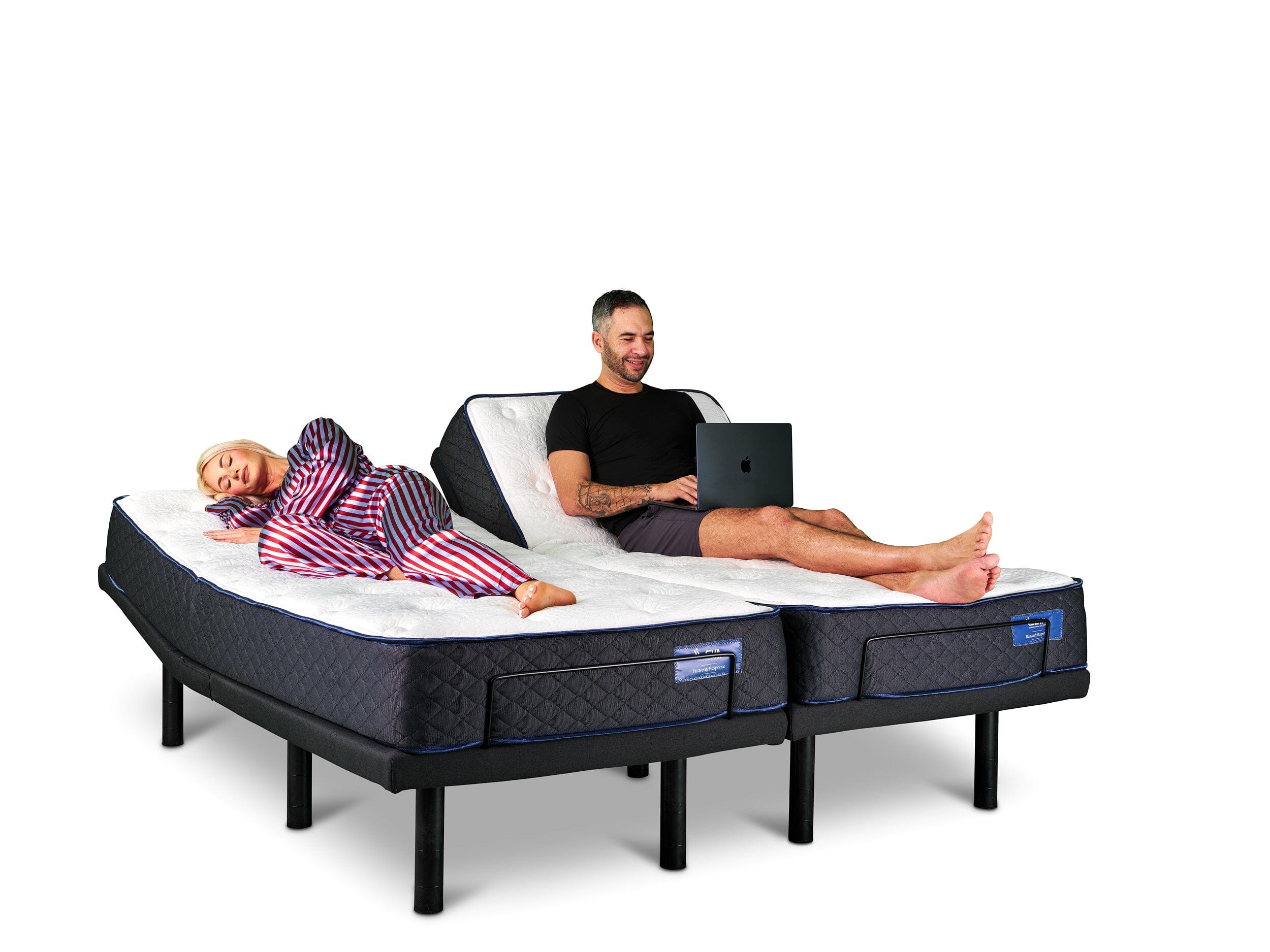
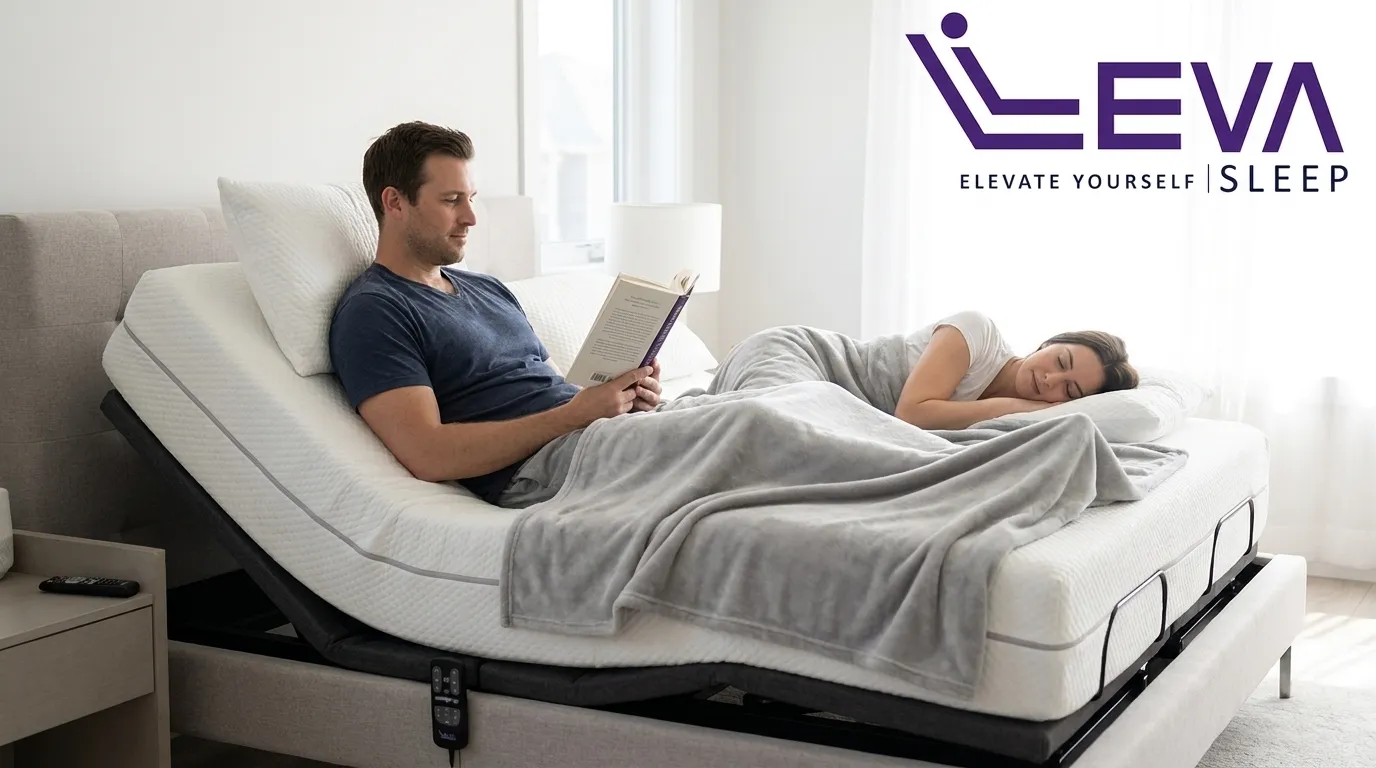
The elevation component works alongside firmness control. Each adjustable base raises or lowers the head and foot sections independently using motorized articulation. Leva Sleep’s bases use whisper-quiet German motors and full app control, so partners can save custom positions, set vibrating alarms, and make micro-adjustments without waking the other person. Industry professionals summarize the benefit clearly: “We often have couples who cannot agree on feel. Our system allows customization for the left and right side of the mattress to give each individual what they want.”
Couples should verify that each side truly operates independently by testing the full range of adjustments on their own side while the other partner remains still. This means checking:
- Firmness range from softest to firmest setting
- Head elevation from flat to maximum incline
- Foot elevation and the zero-gravity preset
- App responsiveness and motor noise at night
If any adjustment on one side causes movement or noise that disturbs the other side, the system does not provide full independence. The primary trade-off in independent firmness systems is mattress compatibility with articulation. Not every mattress flexes safely on an adjustable base.
Leva Sleep designs its all-foam and hybrid pocket-coil mattresses specifically for adjustable bases, and its curated partner lineup, including Helix Sleep and Airloom, carries the same compatibility guarantee. Couples who already own a mattress should confirm flex compatibility before purchasing a base separately. If either partner has a diagnosed spinal condition, a physiotherapist or orthopedic specialist should review firmness needs, because therapeutic positioning can narrow the appropriate options.
2. Split-Queen Versus Split-King: Space, Width, and Gap
Matching Bed Size to Room Size and Body Size
A split king uses two Twin XL mattresses, each 38 inches wide, placed side by side on two independent adjustable bases for a combined width of 76 inches, which matches a standard king. Each partner adjusts their side’s head and foot elevation separately, so one person can sit up to read or watch TV while the other side remains flat. A split queen uses two narrower mattresses, each 30 inches wide, for a combined 60-inch width that matches a standard queen.
Leva Sleep is one of the few providers offering a true split-queen configuration built to customer specifications. This option works well for smaller master bedrooms or guest rooms where a king footprint will not fit. The split king’s extra 8 inches of total width translates to 4 additional inches per partner, which matters for broad-shouldered sleepers or frequent position changers.
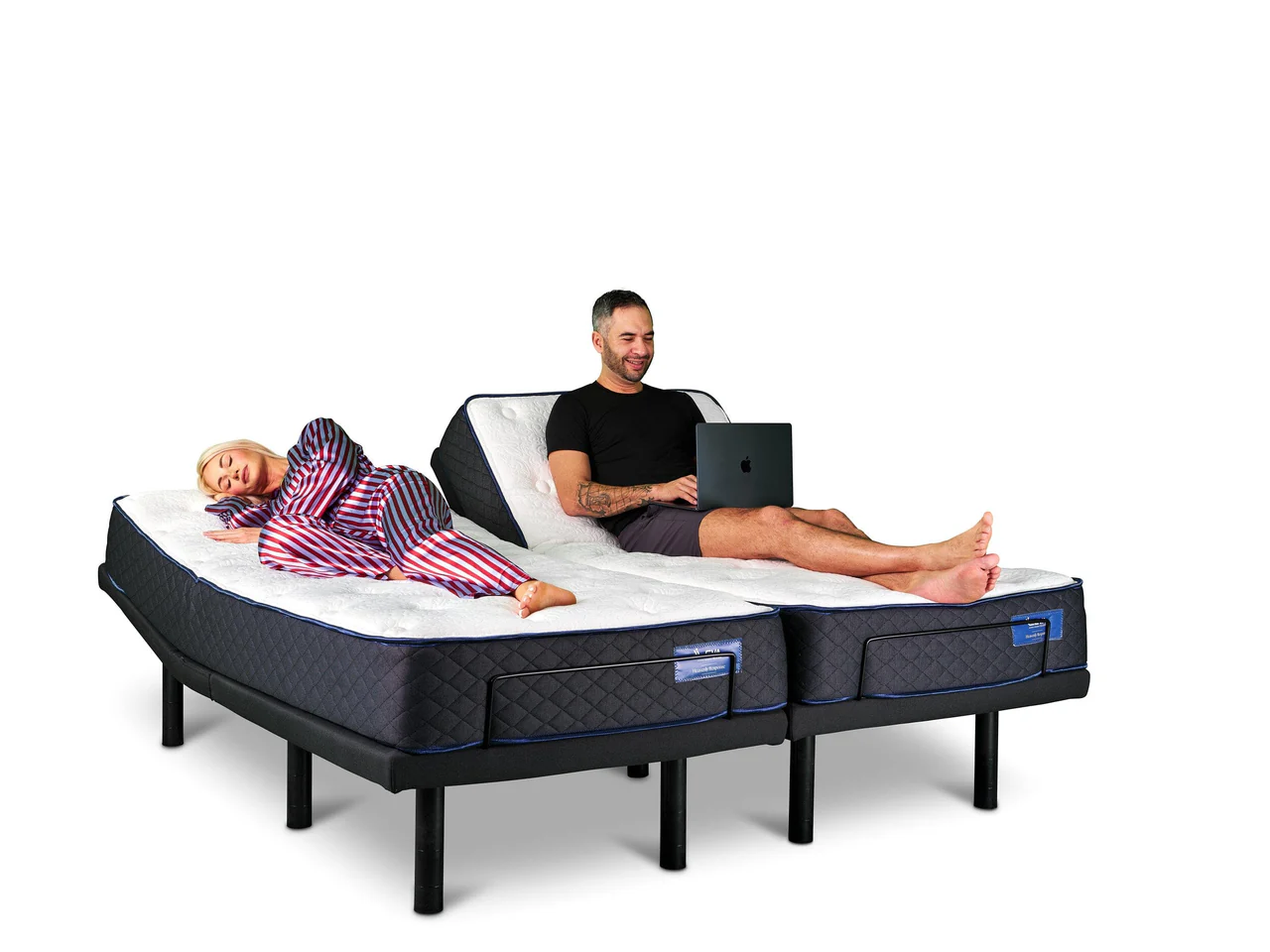
The split queen fits better in rooms under 12 feet wide or in spaces where a compact footprint matters more than maximum width. Both configurations deliver the same core benefit: fully independent firmness and elevation control for each side.
Couples should measure the bedroom and account for clearance on all three open sides of the bed, typically 24–36 inches per side for comfortable movement. Then they can evaluate:
- Whether the room accommodates a 76-inch king width or requires the 60-inch queen width
- Each partner’s shoulder width and preferred sleeping position
- Whether the bed will likely be moved in the future, since split configurations disassemble more easily than single-piece kings
The central trade-off in any split configuration is the gap between the two mattresses. Industry professionals describe the 2–4 inch gap as “the biggest complaint,” with 60% of couples finding it intolerable for maintaining physical closeness. Leva Sleep addresses this with purpose-designed bedding, including fitted sheets with deep pockets and extra elastic plus duvet clips, that visually and functionally unify the two sides.
Couples who place a high premium on an uninterrupted sleeping surface should discuss gap-bridging solutions with a Leva Sleep specialist before purchasing. Later sections in this guide revisit how the gap affects intimacy and how some couples adapt.
3. Positioning Strategies for Snoring and Mild Apnea
Head Elevation and Mattress Firmness for Airway Support
Head-of-bed elevation is a clinically studied intervention for positional sleep apnea and snoring. A 2017 study by Souza et al. published in Sleep and Breathing found that elevating the head of the bed by 7.5 degrees in 52 patients with OSA reduced the Apnea-Hypopnea Index and improved minimum oxygen saturation. An adjustable base delivers this elevation consistently across the entire torso, unlike stacked pillows that flex the neck and can worsen cervical alignment. An adjustable base may help reduce airway collapse in some people, particularly those with positional sleep apnea, by allowing elevation of the upper body and head to keep the airway clear.
Mattress firmness interacts directly with airway outcomes. Medium-firm mattresses, around 6–7 on a 10-point scale, are often recommended for sleep apnea management because they prevent excessive torso sinking that causes cervical flexion while still contouring enough for comfortable side sleeping. Some mattresses can be too soft, allowing poor spinal alignment that may worsen sleep apnea symptoms, according to sleep medical director Kendra Becker, MD, at Kaiser Permanente in Fontana, California. Leva Sleep’s hybrid pocket-coil mattresses are available in medium-firm configurations and are engineered to maintain spinal alignment at elevated angles.
Couples where one partner snores should configure the snoring partner’s side first, then adjust the other side independently. A practical sequence looks like this:
- Set the snoring partner’s head elevation to 7–10 degrees and trial that position for two weeks.
- Confirm the mattress firmness keeps the torso from sinking excessively at that angle.
- Once a helpful baseline elevation is established, enable Leva Sleep’s anti-snore mode to automate further refinement. The system detects snoring acoustically and makes micro-adjustments to head elevation throughout the night.
- Adjust the non-snoring partner’s side to their preferred flat or slightly elevated position without affecting the first side.
Positional therapy supports positional obstructive sleep apnea but does not replace CPAP or other prescribed interventions for moderate-to-severe OSA. A mattress alone cannot cure obstructive sleep apnea, but it can meaningfully reduce symptoms by supporting side sleeping and proper spinal alignment as part of a broader treatment plan that includes medical interventions such as CPAP. Any couple where one partner has a diagnosed sleep disorder should consult their physician before relying on positional adjustment as a primary treatment. Leva Sleep’s systems are designed to complement medical care rather than replace it.
Couples dealing with snoring or sleep apnea benefit from a system that actively supports their efforts. Transform your sleep with Leva Sleep by visiting the La Jolla showroom or shopping online today.
4. Motion Isolation, Mattress Gap, and Intimacy
Protecting Sleep While Preserving Closeness
When one partner turns over, sits up, or adjusts their elevation, the movement does not transfer through a shared foam or coil layer to the other side. For couples where one partner moves frequently or follows a different sleep schedule, this isolation level often becomes the main functional reason to choose a split configuration instead of a single-mattress dual-zone system.
The intimacy question is real and documented, and it affects many couples rather than a small minority. Forum discussions reflect genuine frustration: one Reddit user described the gap in a split king as making “intimacy nonexistent” after two months, while another wrote that “snuggling pretty much never happens” despite feeling otherwise satisfied with the system. The gap problem affects the majority of couples, as noted earlier, and represents a structural characteristic of split configurations that every couple should evaluate before purchasing.
Couples can assess intimacy compatibility with a split system by considering:
- Whether cuddling usually happens only at the start of the night or continues throughout the night
- Whether a gap-bridging mattress topper or connector pad would provide enough closeness
- Whether the motion isolation benefit outweighs the gap trade-off given each partner’s movement patterns
Leva Sleep’s purpose-designed bedding, including fitted sheets with extra elastic and duvet clips, creates a unified visual surface that reduces the psychological impact of the gap. For couples where intimacy is the primary concern, Leva Sleep specialists can discuss hybrid configurations that maximize closeness while preserving as much independent adjustment as possible.
The split queen’s narrower individual mattresses, 30 inches each, place partners closer to the center line than in a split king. Some couples find that this closer proximity reduces the perceived gap during sleep and makes cuddling feel more natural.
5. White-Glove Delivery and Setup for Adjustable Systems
What Professional Installation Prevents and Protects
A split adjustable system involves more components than a standard mattress purchase. The setup includes two independent bases, two mattresses, a unified headboard connection, app pairing for both sides, leg height calibration, and compatible bedding. “Bed in a box” delivery models drop components at the door and leave assembly to the customer, which increases the risk of incorrect setup, voided warranties, and early dissatisfaction.
Leva Sleep’s white-glove delivery service, available for a fee, sends trained professionals to the bedroom to assemble every component. The team calibrates leg heights, pairs the app, provides a full product tutorial, and removes the old bed through donation or recycling. Setup quality directly affects long-term performance and comfort.
A base installed at the wrong height strains the frame during articulation. Misaligned mattresses accelerate wear at the flex points. Incorrectly paired app controls create confusion that can lead couples to abandon personalization features entirely. Leva Sleep’s in-house delivery team, not a third-party logistics contractor, handles every installation, so the same expertise that designed the system oversees its setup.
When evaluating any adjustable system’s delivery offering, couples should confirm:
- Whether delivery includes in-room setup or only threshold drop-off
- Whether the delivery team is employed by the brand or subcontracted
- Whether old bed removal is included or requires separate scheduling
- Whether a product tutorial and test adjustment are part of the service
- Whether the delivery team can make real-time height and alignment adjustments
White-glove delivery adds cost, but for a system priced at $5,000–$12,000, the fee represents a small percentage of the total investment and removes the most common sources of early frustration. Couples with limited physical ability to manage heavy components, or those in multi-story homes with narrow stairwells, should treat white-glove service as a requirement. If either partner has post-surgical restrictions or mobility limitations, professional setup removes the physical burden from the installation process.
A premium sleep system benefits from a premium setup experience. Transform your sleep with Leva Sleep by visiting the La Jolla showroom or shopping online today.
6. Budget Tiers and Total Cost of a Dual-Zone System
Breaking Down Price, Features, and Long-Term Value
Total system cost for a split adjustable setup includes two mattresses, two bases, compatible bedding, and optional delivery. Split king adjustable bed setups typically range from $1,400–$5,500 depending on features and location. The split queen configuration usually costs less than the split king because Twin XL mattresses carry a slight premium over the narrower split-queen dimensions, and the smaller footprint reduces material costs. Leva Sleep’s direct-to-consumer model and local assembly remove retail markup, providing comparable systems at 30–50% less than traditional luxury competitors.
Budget tiers for dual-zone adjustable systems generally fall into three categories. Entry-level systems, around $3,000–$5,500, include basic independent elevation with limited app features and standard foam mattresses. Mid-range systems, around $5,500–$9,000, add whisper-quiet motors, zero-gravity presets, massage functions, and hybrid mattress options. Premium systems, around $9,000–$14,000 and above, include AI-assisted sleep tracking, anti-snore detection, lumbar control, pillow tilt, heating and cooling integration, and luxury mattress pairings. Leva Sleep operates primarily in the mid-range and premium tiers, with white-glove delivery and specialized bedding integrated into the system design.
Couples can evaluate budget fit by calculating cost per night over the expected system lifespan:
- Estimate the realistic lifespan of the base, typically 10–15 years for quality motorized systems.
- Divide total system cost by the number of nights in that period.
- Compare that figure against the cost of sleep disruption, including reduced productivity, health interventions, or separate sleeping arrangements.
- Include the cost of accessories such as bedding and mattress protectors designed for adjustable bases, since standard bedding often fails to stay in place.
The primary trade-off at each tier is feature depth versus upfront cost. Couples who mainly need independent elevation and basic firmness adjustment can see meaningful improvement at the entry level. Couples managing snoring, mild apnea, chronic back pain, or significant temperature differences usually gain more value from mid-range and premium systems, where therapeutic features justify the higher investment. Leva Sleep’s La Jolla showroom lets couples test multiple configurations before committing, which remains the most reliable way to match budget tier to real comfort needs.
Side-by-Side Comparison of Leading Adjustable Systems
| Brand | Split Configuration | Price Range (Full System) | White-Glove Delivery Included? | Old Bed Removal? | Physical Showroom? | Subscription Required for Full App? |
|---|---|---|---|---|---|---|
| Leva Sleep | Split King and Split Queen (built to spec); independent elevation, firmness, anti-snore mode, app control, whisper-quiet German motors | Mid-range to premium; 30–50% below comparable luxury competitors per company pricing | Available for a fee | Yes | Yes, La Jolla showroom with 15–20 adjustable base models | No |
| Saatva Solaire | Split King available; 50 air-pressure firmness settings per side | Split king adjustable bed setups typically range from $1,400–$5,500 depending on features and location; Saatva Solaire Split King listed at approximately $4,795–$5,995 for mattress only | Yes, included in price | Varies by program | Yes, through retail partners and brand showrooms | No |
| Sleep Number i8 | Split King (FlexFit base sold separately); dual air-chamber firmness; SleepIQ tracking per side | Mattress approximately $3,499–$4,499 (King); FlexFit 3 base adds $1,999–$2,999 per side; total system around $7,000–$10,000+ | Yes, available | Often included or available for a fee | Yes, Sleep Number stores | Yes, for full app features |
| GhostBed | Split King available with GhostBase adjustable; limited model selection compared to specialists | GhostBed Luxe King approximately $2,495; adjustable base approximately $1,299–$1,999 per side; total system around $5,000–$6,500 | Usually no, threshold or standard delivery common | Varies by retailer | Yes, through partners such as Costco | No |
| Tempur-Pedic | Split King with TEMPUR-Ergo base; independent head and foot elevation; no independent firmness zones because each side uses a single-density mattress | TEMPUR-LuxeAdapt King approximately $5,699; Ergo base approximately $2,499–$3,499 per side; total system around $10,000–$13,000+ | Yes, available at a premium | Often included with white-glove service | Yes, through retail partners and direct showrooms | No |
Real Couples on Split Adjustable Beds
Forum discussions across Reddit’s r/Mattress and r/nectarsleep communities show a consistent pattern. Couples who purchase split adjustable systems often report high satisfaction with independent adjustment features and significant frustration with the physical gap between mattresses.
“My husband got us a dual mattress back in mid September as an anniversary gift and overall like it but there is one big big issue that I haven’t been able to figure out. How can a couple cuddle on this? The split between the beds creates a gap that prevents us from getting close at all. It’s only been 2 months and it’s negatively affecting our marriage. Intimacy is nonexistent.” — Reddit user, r/nectarsleep
“We spent 10k on an adjustable base split king. I loathe it. So so much. My husband loves it. Intimacy hasn’t been an issue, but snuggling pretty much never happens, and I always end up sleeping on the edge of my mattress, because I can’t stand the gap between beds. I HATE our split king. I would have gotten [a] king mattress.” — Reddit user, r/Mattress
These accounts reflect the gap problem documented across the industry and highlight how strongly it can affect relationship satisfaction. The pattern also reveals a purchasing process failure. Couples who test systems in-store and discuss the gap trade-off with a specialist before buying report fewer post-purchase regrets than those who purchase online without a physical trial.
Leva Sleep’s La Jolla showroom exists specifically to close that gap in the buying process. Couples can lie on both sides simultaneously, test the gap with their own bedding preferences, and make an informed decision before committing. Couples with customizable firmness options often rate their sleep quality as good or excellent compared to those without such options, which reflects the real-world impact of independent adjustment when the right system matches the right couple.
Frequently Asked Questions
What is the difference between a split queen and a split king adjustable bed?
A split queen consists of two 30-inch-wide mattresses on two independent adjustable bases, producing a combined 60-inch width that matches a standard queen. A split king uses two Twin XL mattresses for a combined 76-inch width, the same as a standard king. Both configurations allow each partner to control their side’s firmness and elevation independently. The split queen suits smaller bedrooms or couples who want independent adjustment without a larger footprint, while the split king provides more individual sleeping width per partner. Leva Sleep offers both configurations, including a custom-built split queen that most general retailers do not carry.
Can an adjustable base actually reduce snoring or sleep apnea symptoms?
Head-of-bed elevation on an adjustable base can meaningfully reduce snoring and mild obstructive sleep apnea symptoms by using gravity to keep the airway more open during sleep. Clinical research shows that head elevation can reduce the Apnea-Hypopnea Index and improve oxygen saturation in patients with OSA. An adjustable base delivers this elevation more consistently than stacked pillows because it raises the entire torso rather than flexing the neck. Positional therapy does not replace CPAP or other prescribed treatments for moderate-to-severe sleep apnea, so couples where one partner has a diagnosed sleep disorder should consult their physician before relying on elevation as a primary intervention. Leva Sleep’s anti-snore mode adds an automated layer by detecting snoring acoustically and making micro-adjustments to head elevation in real time.
How do I know if a mattress is compatible with an adjustable base?
A mattress is compatible with an adjustable base if it can flex repeatedly at the head and foot sections without damaging its internal structure. All-foam mattresses and hybrid pocket-coil mattresses with individually wrapped coils are generally compatible. Innerspring mattresses with interconnected coils, pillow-top mattresses with rigid foam borders, and waterbeds are not compatible. The safest approach is to purchase a mattress and base from the same specialist, as Leva Sleep does, because every mattress in the Leva lineup is engineered and tested for use on an articulating base. Couples who own an existing mattress should check the manufacturer’s warranty terms, since using an incompatible mattress on an adjustable base typically voids the mattress warranty.
What should couples look for when testing a split adjustable system in a showroom?
Each partner should lie on their own side and adjust firmness and elevation independently while the other partner remains still. Key things to evaluate include whether the motor noise is audible from the other side, how the gap between mattresses feels when both partners lie close to the center, whether the app controls respond quickly and intuitively, and whether the zero-gravity preset relieves pressure in the lower back and hips for both partners. Couples should also test the anti-snore elevation angle to confirm it feels comfortable for the partner who will use it nightly. Bringing personal pillows to the showroom provides a more accurate simulation of the home sleep environment. Leva Sleep’s La Jolla showroom is staffed by adjustable bed specialists who can guide this evaluation process.
Is white-glove delivery worth the additional cost for an adjustable bed system?
For a split adjustable system, professional setup is strongly advisable. The installation involves two independent bases, two mattresses, app pairing for both sides, leg height calibration, headboard alignment, and bedding configuration. Incorrect assembly, particularly misaligned bases or improperly calibrated leg heights, can cause premature motor wear, mattress damage at flex points, and voided warranties. White-glove delivery also includes old bed removal, which is logistically complex for large items. The incremental cost of professional setup represents a small percentage of the total system investment and removes the most common sources of early dissatisfaction. Leva Sleep’s white-glove service uses in-house trained professionals rather than subcontracted logistics teams, so the same expertise that designed the system oversees its installation.
Conclusion: Building a Shared Sleep System That Works
Dual-zone adjustable firmness systems address a core problem that often drives sleep divorce: two people with different bodies, health needs, and comfort preferences sharing a single, inflexible sleep surface. The six areas covered in this guide, including independent firmness mechanics, split configuration trade-offs, snoring and apnea positioning, motion isolation, delivery quality, and total system cost, form a complete decision framework for couples evaluating this category.
Evidence across sources remains consistent. Couples with customizable firmness options often rate their sleep quality higher than those without. The global sleep aid technology market is projected to grow from $103.5 billion in 2025 to $136 billion by 2030, which reflects accelerating adoption of personalized sleep systems. Couples who benefit most usually approach the purchase as a health investment, test systems in person, and work with a specialist who understands both the mechanical and relational dimensions of shared sleep.
The most manageable first step is a showroom visit where both partners can test independent adjustment simultaneously. That single experience, with each partner controlling their own side while lying together, resolves more uncertainty than extensive online research.
Transform your sleep with Leva Sleep by visiting the La Jolla showroom or shopping online today.