Written by: Matthew Timmins, Founder and Managing Director, Leva Sleep
Key Takeaways
- Active lumbar support and zero-gravity positioning separate clinically useful adjustable bases from basic models for chronic back pain relief.
- Independent lumbar articulation targets the lower spine without moving the whole surface, which creates measurable spinal decompression.
- Programmable zero-gravity presets and split configurations let each partner set head, lumbar, and leg angles for personal relief.
- App-controlled micro-adjustments and quiet, precision motors keep overnight position changes smooth and sleep-friendly.
- Leva Sleep combines premium engineering, Split Queen options, and white-glove service at 30–50% below major competitors, so you can shop online or visit the La Jolla showroom today.
1. Independent Lumbar Articulation for Lower Back Support
The lower spine carries the most mechanical stress during sleep on a flat surface. This stress occurs because gravity pulls the torso downward and can exaggerate the natural curve of the lumbar region. Elevating the legs tilts the pelvis slightly, which flattens and relaxes the lower back against the mattress and produces spinal decompression. A base with independent lumbar articulation builds on this principle by using a motorized lumbar zone that raises or lowers separately from the head and foot sections, filling the gap between the mattress and the inward curve of the lower back.
When evaluating any base for this feature, confirm three checkpoints. First, the base needs a dedicated lumbar motor zone that moves independently of the head and foot sections, which confirms the feature exists at all. Second, the lumbar range of motion should be measurable in degrees or inches and listed in the product specification sheet, so you can judge whether the travel matches your body. Third, the control interface, remote or app, must allow real-time lumbar adjustment without moving the rest of the sleeping surface, so you can fine-tune support after you lie down.
2. Programmable Zero-Gravity Angles for Disc-Pressure Relief
The Zero Gravity preset was originally developed by NASA to distribute pressure evenly across the body during liftoff, and in a sleep context it elevates the head 30–45 degrees and raises the knees above heart level, placing the spine under minimal compression. This position reduces load on the lumbar discs by shifting weight away from the lower back and into the larger surface area of the torso and thighs. Spinal decompression from leg elevation allows the intervertebral discs to recover from daytime stress more effectively. For chronic back pain, the ability to save and recall this position without manual trial and error each night becomes a daily quality-of-life factor.
Evaluate any base against three checkpoints. First, the zero-gravity preset should be factory-programmed and user-adjustable, not locked at a single angle, so you can refine it to your body. Second, the base should store at least two custom positions per side, which lets each partner recall a personal decompression angle. Third, the transition from flat to zero-gravity needs to be smooth and continuous rather than stepped, because abrupt shifts can jar the spine during adjustment.
3. Split-King and Split-Queen Independence for Couples
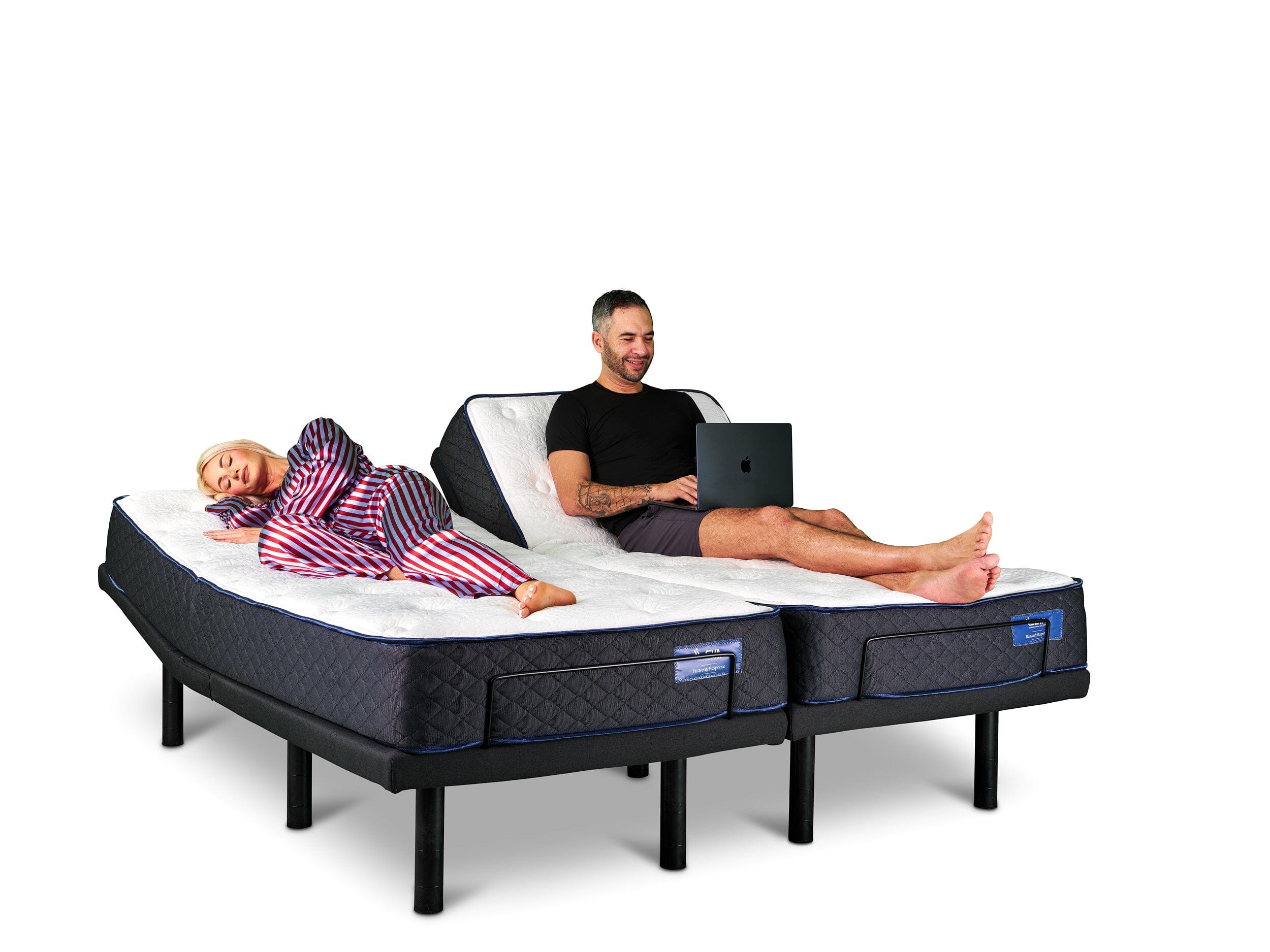
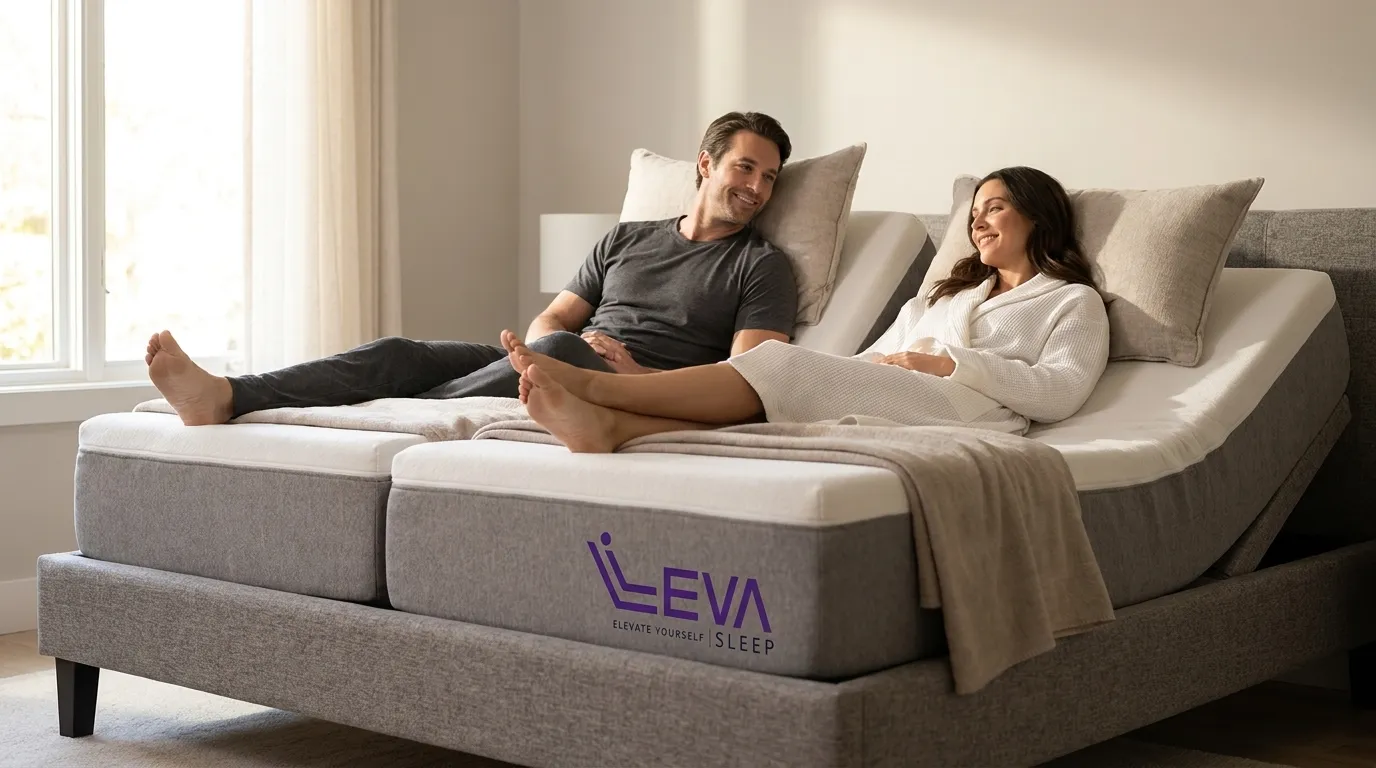
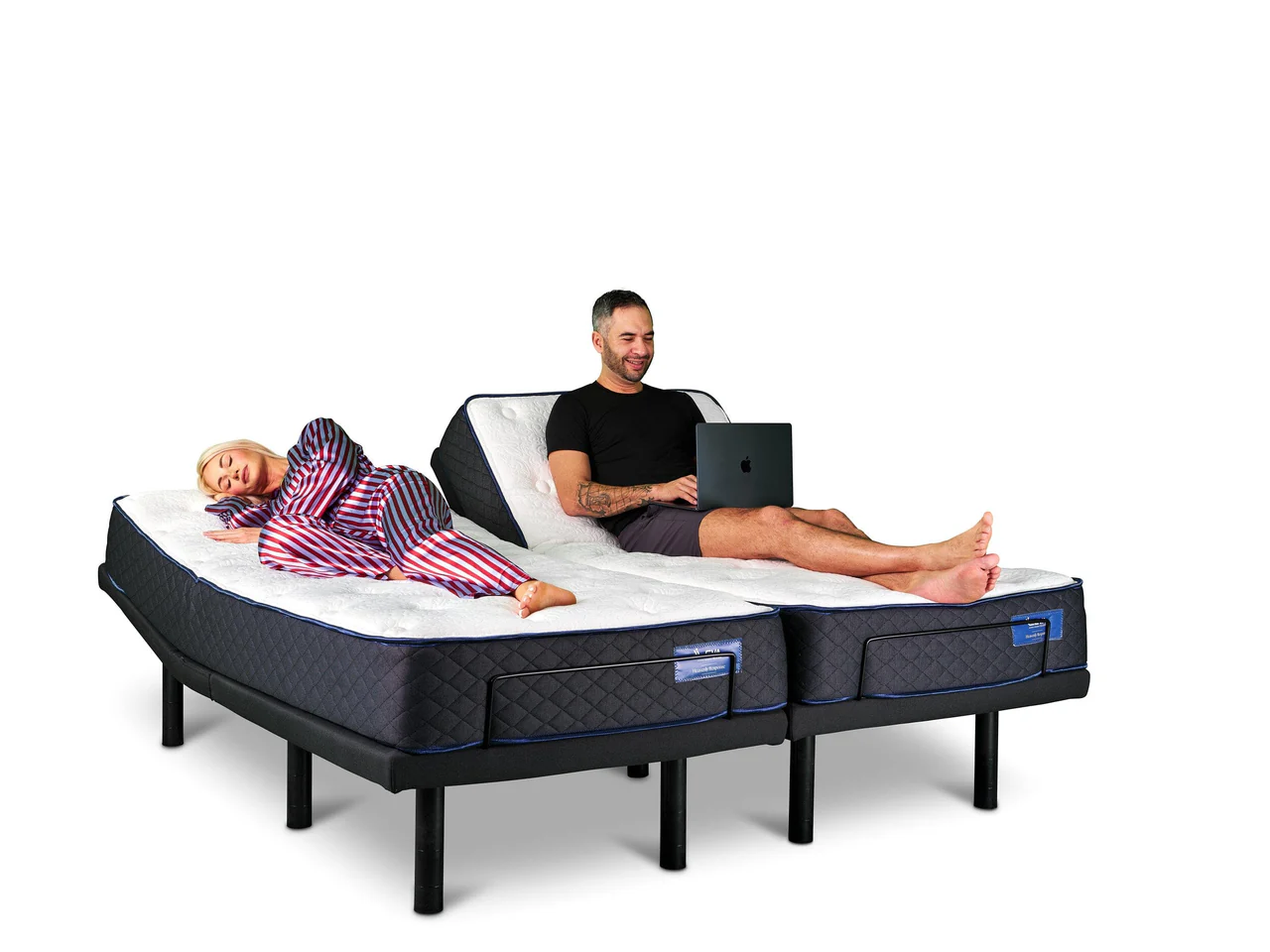
The lumbar and zero-gravity features above focus on a single sleeper, yet most couples have different pain patterns. Chronic back pain rarely presents identically in both partners. One sleeper may need strong lumbar elevation while the other prefers a flatter surface for hip alignment. A split configuration, two independent bases sharing one bed frame, lets each partner program head angle, lumbar position, and zero-gravity preset without changing the other side.
Slight elevation of the head and legs eases strain on the lower spine and supports a more comfortable sleeping posture for people with chronic lower back pain and sciatica, and a split system preserves that relief without sacrificing the other partner’s comfort. Evaluate split bases against three checkpoints. First, each side should have its own motor controller and app profile, which keeps adjustments fully independent. Second, the gap between the two mattresses should be minimized by a center fill or bridge accessory, which maintains a unified sleep surface. Third, the base should be available in Split Queen as well as Split King, since many bedrooms cannot fit a king footprint. Leva Sleep offers 15–20 adjustable models including Split Queen configurations, a selection that general retailers, who typically stock 3–5 models, cannot match.
4. App-Controlled Overnight Micro-Adjustments and Anti-Snore Support
Back support needs change across the night as muscles relax and sleep stages shift. A base that only adjusts manually before bed cannot respond to these changes once you fall asleep. App-controlled systems with programmable schedules or sensor-triggered micro-adjustments solve this by making small position changes, often in fractions of a degree, while you remain asleep.
When you compare app-controlled bases, look for several capabilities. The companion app should support scheduled position changes tied to a sleep timer or alarm, so the base can ease you into or out of zero-gravity automatically. Connectivity, through Bluetooth or Wi-Fi, needs to remain stable enough to execute adjustments without constant manual overrides. The app should also store independent profiles for each partner on a split base, which prevents one partner’s schedule from moving the other side. Leva Sleep’s anti-snore mode detects snoring and raises the head section to open the airway, and this function runs automatically once configured.
5. Motor Noise and Motion Smoothness During Nighttime Adjustments
App-controlled micro-adjustments only help when they happen quietly. A base that relieves back pain but wakes a partner during movement undermines its own benefit. Motor noise is measured in decibels, and the threshold for sleep disruption in a quiet bedroom sits around 40 dB, which matches a quiet library. Jerky, stepped motion can also create micro-vibrations that travel across a shared mattress, even on split configurations.
When you evaluate any base, check three areas. First, see whether the manufacturer publishes a decibel rating for motor operation or whether you can test the base in a showroom with a smartphone decibel meter at mattress height. Second, watch whether the transition between positions stays continuous and linear instead of stepped or pulsed, which keeps the spine from sudden shifts. Third, on a split base, place a hand flat on the stationary mattress while the other side moves and confirm that motor operation on one side produces no noticeable vibration on the other. Leva Sleep’s bases use whisper-quiet German motors, and this breadth of choice across models means there is a motor specification suited to nearly every sensitivity level.
6. Delivery, Setup Quality, and Long-Term Cost
Beyond mechanical features, delivery quality and long-term cost determine whether an adjustable base continues to perform over years of use. An adjustable base functions as a multi-component system made up of frame, motor assembly, mattress, and bedding, and its performance depends on correct installation. Because these components must align precisely, a base delivered in a box and self-assembled by the customer can introduce alignment errors that reduce lumbar articulation range and increase motor strain over time.
White-glove delivery removes this risk. Trained professionals bring the system to the bedroom, assemble the full base and mattress, calibrate leg height, and provide a product tutorial, which ensures every motor zone articulates correctly from day one. Leva Sleep’s in-house white-glove service also includes removal and donation or recycling of the old bed, so you avoid managing disposal alone.
Total cost of ownership depends on both purchase price and service quality. Leva’s direct-to-consumer model and local assembly remove retail markup, delivering premium engineering at 30–50% below comparable competitors such as Tempur-Pedic and Saatva. When you evaluate any delivery offering, confirm three points. First, the delivery team should be employed or trained directly by the brand rather than a generic freight carrier. Second, the service should include in-room assembly and a live product demonstration. Third, the brand needs a clear policy on old-bed removal so you are not left arranging disposal.
Independent Lumbar Control on Split Bases
On a properly configured split base, each partner can adjust lumbar support independently. Each half of the base contains its own motor assembly, including a dedicated lumbar motor when that feature is present. The two halves share a bed frame and may use a center-fill accessory to reduce the gap between mattresses, yet their control systems remain fully separate.
One partner can raise the lumbar zone to address lower back pain while the other keeps their side flat for hip alignment, and neither adjustment changes the other side. This independence also covers zero-gravity presets, head elevation, foot elevation, and, on Leva Sleep’s systems, app-controlled anti-snore micro-adjustments. The mattress must be flexible enough to articulate at the lumbar zone, because a rigid mattress will restrict the lumbar motor’s range regardless of the base specification. Leva Sleep offers mattresses designed to pair with its adjustable bases.
Motor Noise Levels During Night Use
Motor noise in adjustable bases ranges from clearly audible mechanical whirring in entry-level models to near-inaudible operation in bases using precision-engineered motors. The most practical test involves operating the base in a quiet room at night and measuring sound with a smartphone decibel meter at mattress height. As noted in the motor noise section above, Leva’s precision motors operate near-silently.
The distinction matters most for couples on split bases. Even when one partner’s motor does not wake the other through sound, vibration transfer through the frame can cause micro-arousals. Leva’s split configurations are built to minimize cross-frame vibration, and the La Jolla showroom lets buyers operate both sides at once and judge noise and vibration transfer before purchase.
Frequently Asked Questions
What lumbar adjustment range works for chronic back pain?
A useful lumbar adjustment range moves independently of the head and foot sections and travels far enough to fill the inward curve of the lower back when the legs are elevated. Look for a dedicated lumbar motor zone with a published range of motion in the product specification. Leva Sleep offers multiple models with independent lumbar articulation, and the La Jolla showroom lets you test the full range of motion before purchasing.
Is Split Queen available, or only Split King?
Most general retailers primarily stock split configurations in King size, and Split Queen options can be difficult to find. Leva Sleep is one of the few specialists that offers Split Queen adjustable bases built to customer specifications, which makes independent lumbar and elevation control possible in bedrooms that cannot fit a king footprint.
What does white-glove delivery include, and is it worth it?
Leva Sleep’s white-glove delivery service covers in-room delivery, full assembly of the base and mattress, leg-height calibration, a live product tutorial, and removal of the old bed for donation or recycling. For a multi-component adjustable sleep system, professional installation helps ensure every motor zone articulates correctly and that the mattress pairs properly with the base, which self-assembly often fails to guarantee.
How does Leva Sleep’s pricing compare to Tempur-Pedic and Saatva?
Leva Sleep’s direct-to-consumer model and local assembly remove the retail markup that many premium brands pass to the customer. As detailed in the delivery and cost section, this structure produces significant savings versus traditional premium brands while still providing a broad model selection and available white-glove delivery.
Conclusion
Chronic back pain relief during sleep depends on three core mechanics. Independent lumbar articulation supports the lower spine, programmable zero-gravity positioning reduces disc pressure, and split-side independence lets couples address different spinal needs without compromise. Many general retailers offer too few models and limited delivery support to match every pain profile.
Leva Sleep focuses on adjustable sleep systems as its primary product, with a wide model range, quiet German motors, Split Queen availability, and in-house white-glove service at a fraction of major competitors’ pricing. Start with Leva’s online tools to match your pain profile to a base, or schedule a La Jolla showroom visit for hands-on testing.