
Written by: Matthew Timmins, Founder and Managing Director, Leva Sleep
Key Takeaways
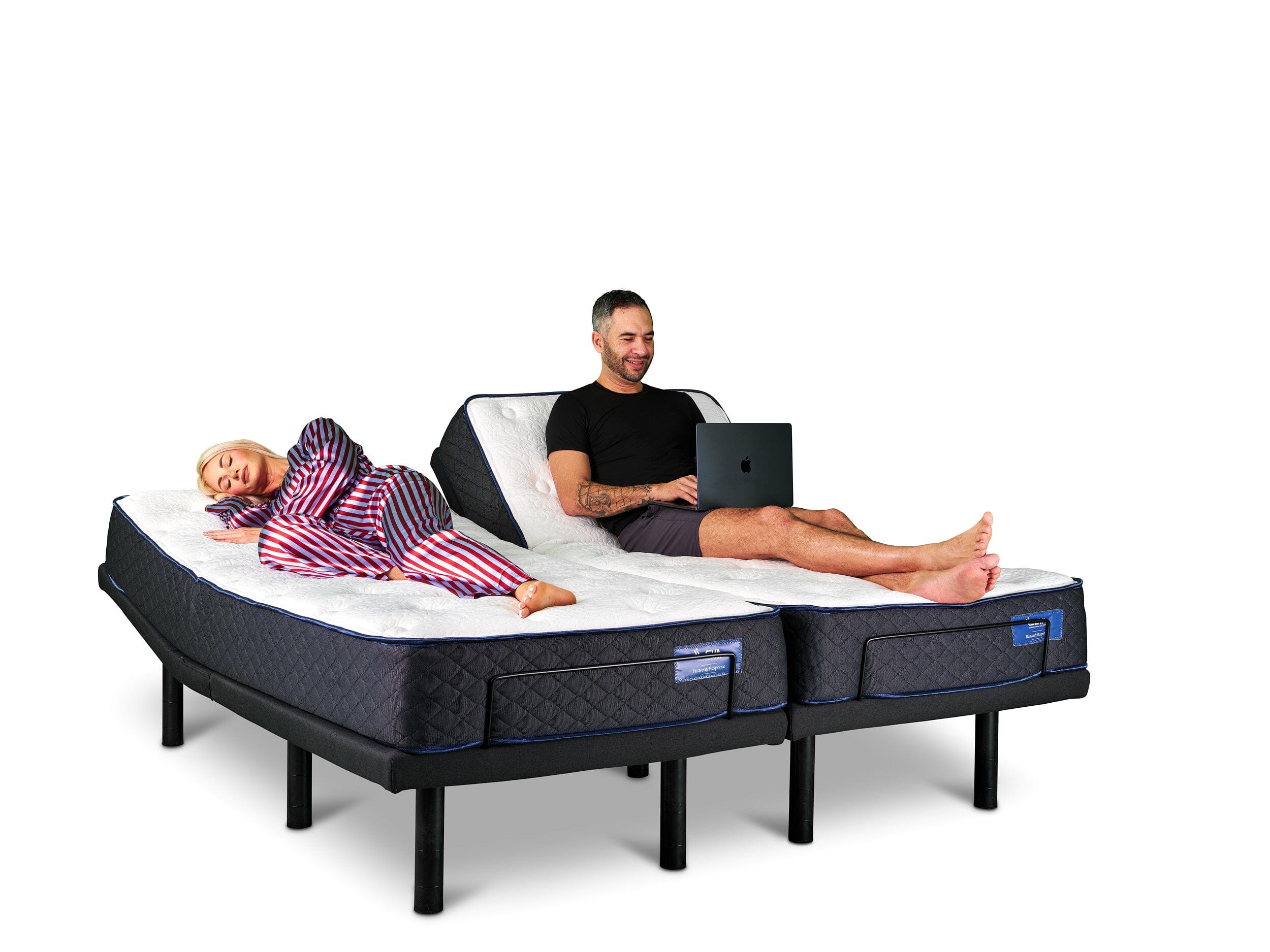
- Split king adjustable beds support individual comfort needs but often create a center gap that disrupts cuddling and intimacy.
- A five-step nightly routine – flatten, bridge, top, secure, and restore – closes the gap temporarily without sacrificing either side’s settings.
- An adjustable-rated foam bridge, thin flexible topper, and deep-pocket sheets create a unified, stable surface for couples.
- Memory presets and independent base controls let each partner return to medically or personally tuned sleep positions after cuddling.
- Experience the benefits of a split king adjustable bed with Leva Sleep by visiting the La Jolla showroom or shopping online today.
Before You Start: Comfort Settings and Medical Needs
Each partner should know their preferred firmness and any elevation settings prescribed or recommended for conditions such as sleep apnea, acid reflux, or post-surgical recovery. Consult a physician before temporarily flattening a medically prescribed position, because the routine described here is designed for brief nightly use rather than permanent reconfiguration. The goal of every step below is temporary flattening for intimacy, followed by a full return to individual settings, not a permanent compromise of either side.
Step 1: Flatten Both Sides for a Level Surface
Step 1: Flatten both sides to create a level surface. Use each side’s remote or app to lower the head and foot of both bases to the fully flat position so the two Twin XL mattresses sit at the same height and angle.
The tactile change feels immediate. Both mattresses sit flush, which removes the height difference that makes the center seam feel like a ridge. Strapping the bases together before flattening adds lateral stability and keeps the frames from shifting apart under body weight. If the bases have not been strapped, do that now to prevent separation when you move toward the middle.
Tighten the straps until the frames cannot slide apart during normal movement. Check that all legs rest on a level floor, because uneven legs cause drift even when the bases are strapped. Lubricate any pivot points according to the manufacturer’s manual so articulation stays smooth when you return to individual positions later. Once both sides feel flat and stable, move on to closing the physical gap between them.
Step 2: Add a Split King Gap Filler
Step 2: Select and position an adjustable-compatible bed bridge sized for the gap width. Measure the gap at mattress-top level, not frame level, then place a medium-firm or firm foam bridge wedge that matches that measurement into the seam.
Most standard split king gap fillers are sized for gaps between zero and three inches, and a gap filler kit that includes a bridging sheet smooths the transition better when the two mattresses differ noticeably in thickness. When you compare bridges, confirm that the product is clearly rated for motorized adjustable bases, because some bed bridges are built only for non-adjustable setups and create movement boundaries between beds.
Reinforced foam wedges with sturdy strap systems tolerate head and foot articulation without shifting or bunching. If the filler feels too soft or sits higher than the mattress surface, it recreates a dip or forms a ridge under the sheets. A correctly fitted bridge produces a surface that feels continuous from edge to edge with no noticeable valley at the center seam. The bridge closes the gap vertically, and the next step unifies the surface horizontally and limits lateral separation.
Step 3: Use a Flexible Topper to Keep Mattresses Together
Step 3: Layer a thin, flexible topper that spans both mattresses without restricting future independent movement. Lay a king-size topper, two to three inches thick and rated as adjustable-bed-compatible, across both Twin XL mattresses and the bridge, then secure it with full-perimeter elastic or corner straps.
Thinner mattress toppers flex more reliably on adjustable bases; two to three inches usually balances flex and cushioning, while anything thicker than four inches increases the risk of creasing at steep incline angles. Latex toppers respond and flex quickly when an adjustable base moves, with less lag than memory foam, which helps sleepers who change incline positions often.
A topper marketed as adjustable-bed-compatible works better than a standard flat-bed topper, which can crease or fold stiffly at hinge points. The visual and tactile result is a unified sleeping surface. The center seam disappears, and both partners can move toward the middle without sliding into a gap. If you notice problems at this stage, such as drifting bases or noisy motors, the following tips address the most common issues.
Troubleshooting common issues at Step 3:
- Drifting bases: Re-tighten the base straps and verify that all legs rest on a level, non-carpeted surface or have felt pads underneath. Engage any locking brackets if your base includes them.
- Noisy motors: A grinding or clicking sound during articulation usually means a pivot point needs lubrication. Apply the lubricant specified in the base manual and run the base through a full cycle.
- Sheet pop-off: The topper likely adds height beyond the sheet’s pocket depth. Switch to a deep-pocket or extra-deep-pocket sheet (see Step 4) and confirm that corner straps anchor under the mattress, not just the topper.
Explore adjustable-bed-compatible toppers and complete split king systems at Leva Sleep.
Step 4: Secure Linens and Prevent Slippage
Use deep-pocket sheets, duvet clips, and mattress straps designed for adjustable bases. Fit two separate Twin XL fitted sheets, one per side, with pocket depths of at least 15 to 18 inches, then add a single king duvet secured with duvet clips across the top.
Good Housekeeping Institute Textiles Lab experts recommend sheets specifically designed for adjustable beds because standard sheets loosen when the base moves during position changes. When you choose sheets, look for full-around elastic, thicker elastic bands, and elastic corner straps. Split king sheet sets reduce slippage on dual adjustable bases by using two separate Twin XL fitted sheets instead of one king fitted sheet, so each side can articulate independently without dragging, bunching, or popping off.
Extra-deep-pocket sheets typically accommodate mattresses up to 17–22 inches or 18–25 inches thick, depending on the brand and whether a topper is used. This range matters when a topper sits on top of a hybrid mattress. A well-fitted sheet and secured duvet keep the bed neat through the cuddle phase and maintain a tidy look when each side returns to its independent position.
Step 5: Restore Individual Positions After Cuddling
Return each side to its original settings via app or remote after cuddling. When both partners feel ready to sleep, each person presses their saved memory preset or uses the app to restore their preferred head elevation, foot elevation, and any lumbar or anti-snore positioning.
Couples using split king adjustable beds should program individual memory presets on day one so each partner can reach a preferred sleep position with one button press instead of adjusting manually every night. The topper and bridge stay in place while only the base angles change. Each side rises independently, the topper flexes at its hinge points, and both partners return to their medically or personally tuned positions. This routine repeats every night without removing any hardware.
Experience split king adjustable beds with programmable memory presets at Leva Sleep.
Measuring Success of Your Split King Setup
The five-step routine should create noticeable improvements in sleep quality and setup stability. To confirm that your configuration works, track two metrics over a two-week period: the number of times either partner wakes because of a gap-related disturbance, such as falling into the center seam, sheet pop-off, or base drift, and a morning comfort rating on a simple 1–10 scale for each partner.
A successful setup should show fewer disturbances by the end of week one and stable or improving comfort ratings by week two. If your metrics show no improvement or if specific problems keep returning, use the following checks to diagnose the cause. If gap reformation persists, re-measure the gap at mattress-top level and verify that the bridge density matches the mattress firmness. If sheet slippage continues, compare pocket depth to the combined mattress-plus-topper height and upgrade to an extra-deep-pocket set if the total exceeds 16 inches.
Find the right split king setup for your needs at Leva Sleep’s La Jolla showroom.
Advanced Comfort Tweaks for Couples
Once the five-step routine feels natural, a few refinements can improve comfort even more. Diagonal body positioning, where one partner angles slightly toward the center instead of lying perfectly parallel to the seam, spreads weight more evenly across the bridge and lowers the chance of the gap filler shifting.
Pillow placement for spinal alignment should match each partner’s incline angle when the bases return to sleep positions. Each person should test pillow thickness that fits their own incline rather than using identical pillows. A thinner pillow usually works better at higher head elevations to keep the cervical spine neutral.
Temperature-regulating pads placed on each side independently let partners with different thermal preferences maintain their own sleep environment without affecting the other side. This approach extends the same independent-control philosophy that makes the split king configuration appealing in the first place.
Frequently Asked Questions
Is it safe to temporarily flatten a medically prescribed elevation setting for cuddling?
For most people, briefly returning a base to the flat position for a short period before sleep does not create major risk. The concern increases when a physician has prescribed a specific elevation to manage an active condition, such as severe acid reflux, post-surgical recovery, or a respiratory condition that requires continuous positional therapy.
In those cases, the length of time spent flat matters. The routine in this guide assumes a short window: flatten, cuddle, then restore. Anyone managing a condition with a prescribed elevation should confirm with their physician that a short nightly flat period is acceptable before adopting this routine.
Will a topper interfere with sleep-apnea positioning on a split king adjustable base?
A two-to-three-inch adjustable-bed-compatible topper does not meaningfully change the effective head elevation angle when the base articulates, because the topper flexes with the base instead of holding a rigid shape. The net elevation at the head remains functionally similar to the base angle.
Risk increases with toppers thicker than four inches, which can crease at hinge points and slightly reduce articulation smoothness. If one partner uses a specific head elevation for sleep apnea management, they should confirm that their topper flexes cleanly at that angle before using it nightly. Latex toppers usually respond fastest for frequent elevation changes.
How long does it typically take couples to adapt to the cuddle-then-separate routine?
Many couples find that the physical steps of the routine, such as flattening, bridging, topping, and restoring, feel automatic within the first week. The bigger shift is behavioral, because partners must remember to restore individual settings before falling asleep instead of drifting off in the flat position.
Programming memory presets from the first night removes the friction of manual adjustment and shortens the adaptation period. Couples who use a shared app or sync feature to mirror positions during the cuddle phase and then switch to independent mode for sleep often adapt faster, because the transition becomes a single button press instead of a multi-step process.
Conclusion: Turning a Split King into a Shared Space
The gap between two Twin XL mattresses on independent bases is a practical engineering challenge that couples can solve with the right setup. A five-step nightly routine, flatten, bridge, top, secure, and restore, closes the gap for intimacy and reopens it for independent sleep without sacrificing either partner’s medical or comfort positioning.
The routine depends on compatible hardware at each step, including an adjustable-rated bridge, a flexible thin topper, and deep-pocket sheets built for moving bases. When you choose components that meet those criteria, the setup becomes repeatable, reversible, and adaptable to any split king configuration.
Shop split king adjustable bed systems and accessories at Leva Sleep.