Written by: Matthew Timmins, Founder and Managing Director, Leva Sleep
Key Takeaways for Couples Managing Snoring
- A split adjustable base with independent head elevation lets the snoring partner raise their head 10–30° while the other side stays flat.
- Quiet brushless motors and stable, compatible mattresses help prevent nighttime disturbances for the non-snoring partner.
- Leva Sleep offers both Split King and the rare Split Queen configuration, so couples can match the system to their room size.
- App-controlled presets and upcoming automatic snore detection create consistent, convenient positioning without repeated manual adjustments.
- Leva Sleep provides integrated mattresses, bedding, and white-glove delivery that are designed to work together at Leva Sleep.
Why Split Adjustable Bases Work Better for Couples
A standard queen adjustable base raises both sides at the same time. When the snoring partner elevates their head, the non-snoring partner is forced into the same incline. Over time, that partner either tolerates an unwanted position or the base goes unused. Neither outcome solves the snoring problem.
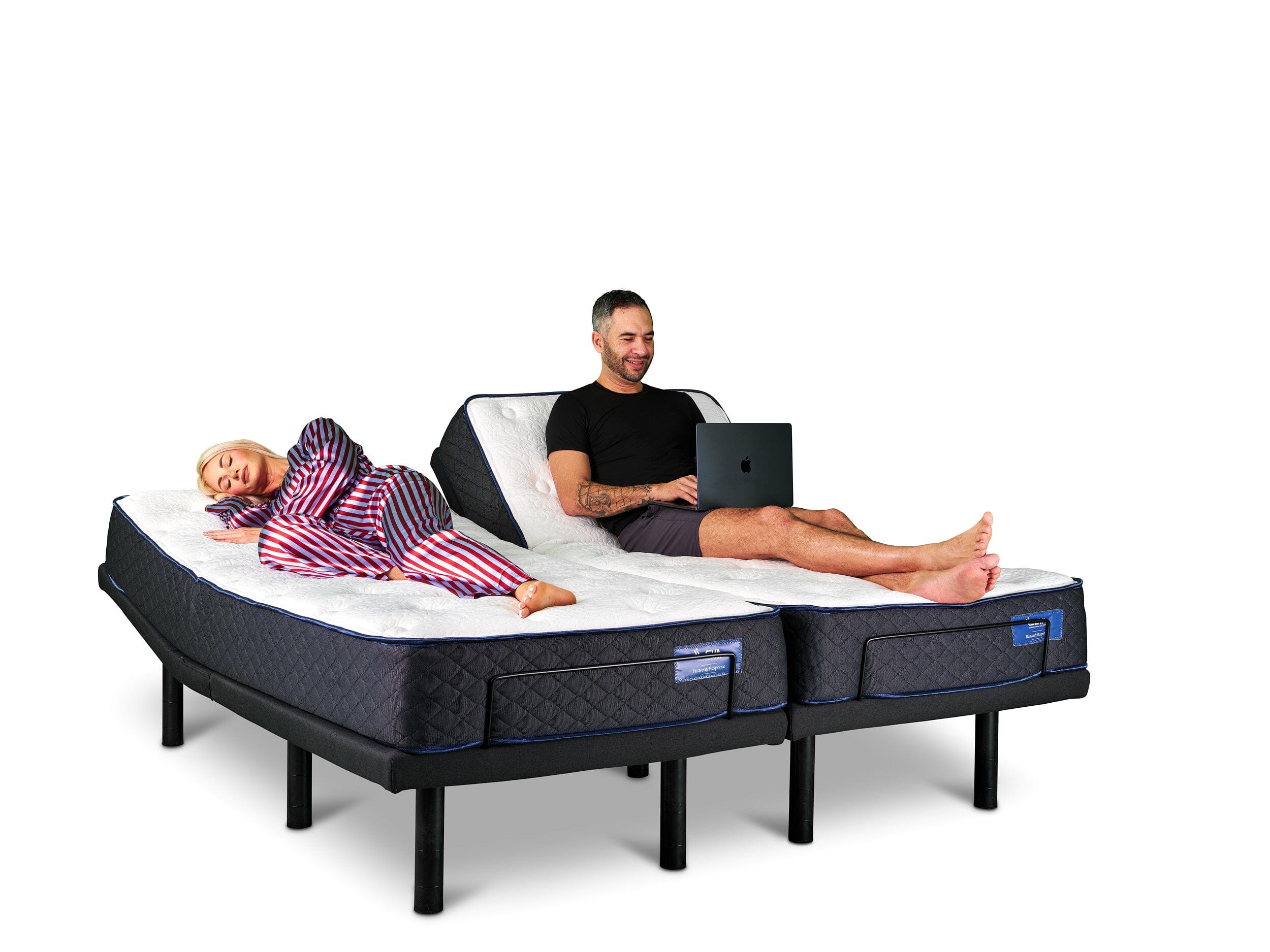
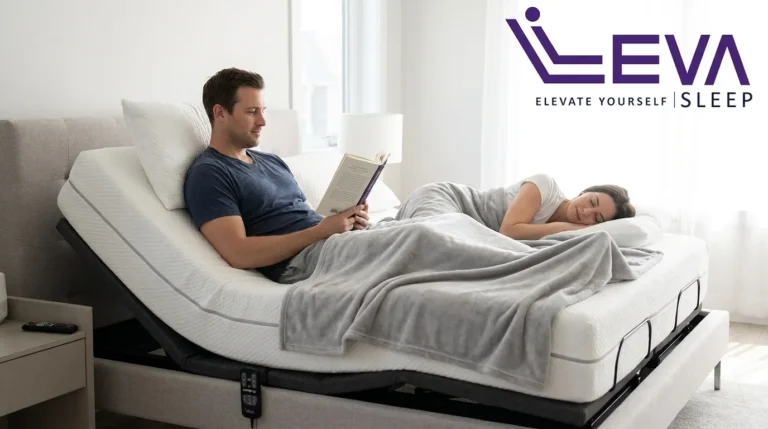
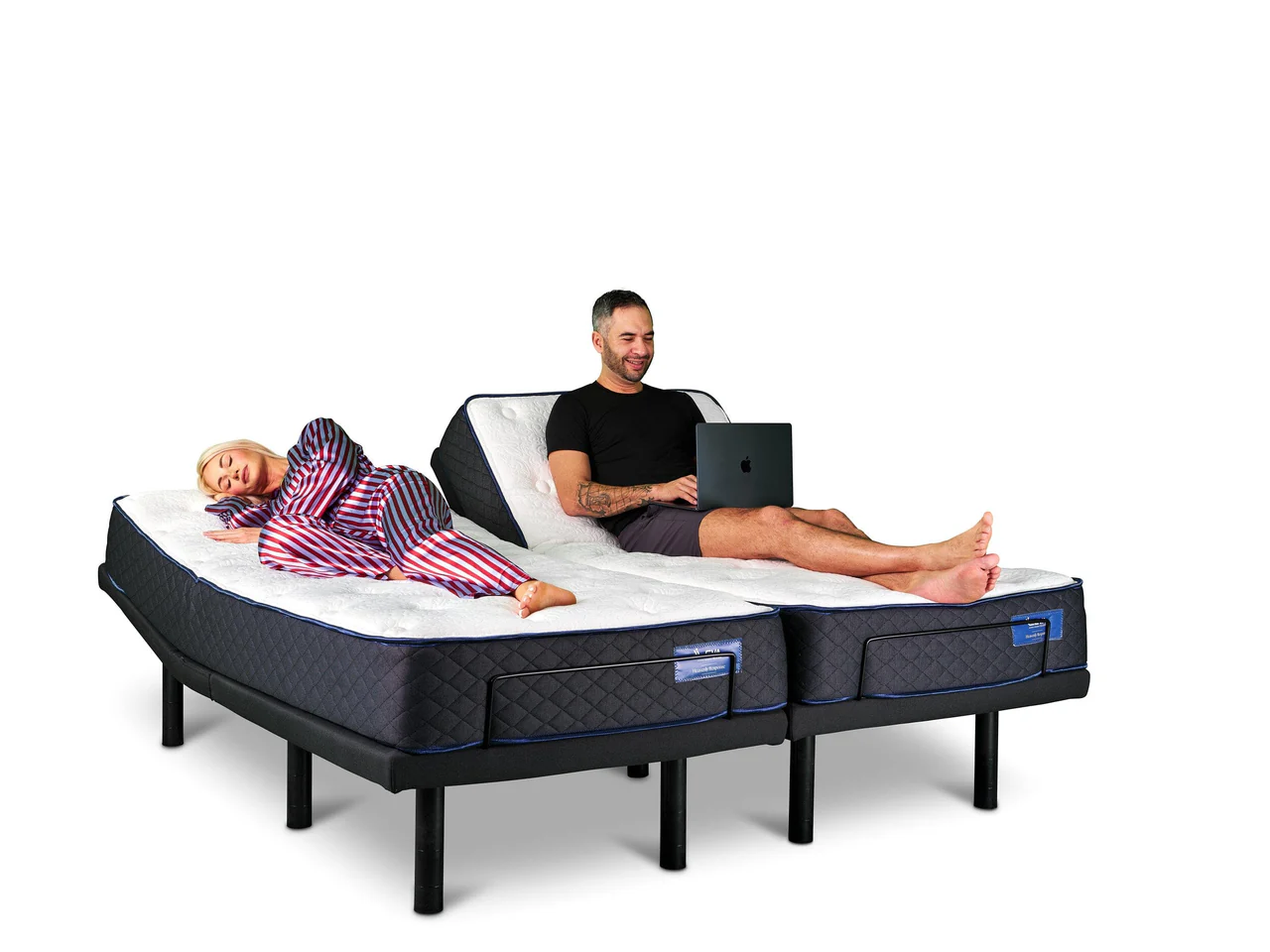
A split configuration assigns each half of the bed its own motor, controller, and elevation range. The snoring partner can raise their head to 20° while the other side stays flat. Both partners sleep in their preferred position, in the same bed, without constant negotiation.
- Flat bed: No elevation capability; the snoring partner has no positional option beyond pillows.
- Single-unit adjustable base: Elevation affects both sides equally, so one partner’s adjustment disrupts the other.
- Split adjustable base: Fully independent elevation per side; each partner controls their own position with an app or remote.
Leva Sleep offers both Split King and Split Queen configurations. Split Queen is rare in the market and built to customer specifications. It gives couples in smaller rooms a practical way to keep full independent control.
Head Elevation Angles That Actually Reduce Snoring
Snoring occurs when soft tissue in the throat relaxes and partially blocks the airway during sleep. Head elevation shifts the jaw and tongue forward, which reduces that obstruction. Most snorers respond to 10–30° of head elevation. That range opens the airway without creating neck strain or causing the sleeper to slide down the mattress.
Leva Sleep’s adjustable bases cover this full range with precise motor control. The Leva Sleep app lets users save a preferred anti-snore position as a preset. The snoring partner can then activate it with a single tap instead of cycling through angles in the middle of the night.
- 0° (flat): No airway benefit; standard flat-bed position.
- 10–15°: Mild elevation that suits light snorers or people new to adjustable positioning.
- 20–30°: Clinically relevant range for moderate snoring and mild sleep apnea, also used for acid reflux management.
Some couples face medical requirements as well as snoring. When a physician recommends elevation for sleep apnea, acid reflux, or post-surgery recovery, a split base lets that partner sleep elevated. The other partner can remain flat instead of sharing a therapeutic position they do not need. However, achieving independent elevation is only half the solution. The base must also operate quietly enough that nighttime adjustments do not wake the non-elevated partner.
Quiet Motors and Motion Control for Restful Nights
Motor noise often becomes the hidden deal-breaker for couples choosing an adjustable base. An adjustment made at 2 a.m. that wakes the non-snoring partner cancels out the benefit of independent elevation.
Brushless DC motors usually operate around 45 decibels, which is close to a whisper. They produce less vibration transferred to the bed frame and last longer than brushed motors because they have no physical brushes that wear out. Brushed DC motors can reach noise levels of about 65 decibels and often grow louder over time as carbon brushes wear. AC motors can be even noisier, with more vibration and less precise speed control.
A 2012 study in the Journal of Physiological Anthropology examined whether sounds as low as 40 dB disturb sleep. An adjustable base that operates above that level during nighttime adjustments can disturb a sleeping partner, especially in a quiet bedroom.
Leva Sleep’s bases use whisper-quiet German motors. Creaks, clicks, or humming in adjustable beds often come from loose bolts, a shifting frame, worn motor parts, or friction between moving components. Leva’s white-glove setup process addresses these issues at installation, not after the first sleepless night.
Experience whisper-quiet German motors in person at Leva Sleep’s La Jolla showroom or explore the full range of split bases online.
Split Queen vs. Split King: Space and Comfort Trade-Offs
The choice between Split Queen and Split King depends on room dimensions, budget, and how much independent surface area each partner wants.
| Attribute | Split Queen | Split King |
|---|---|---|
| Total width | 60 inches | 76 inches |
| Per-partner width | 30 inches | 38 inches |
| Room size requirement | Smaller footprint; suits standard bedrooms | Requires larger room |
| Independent elevation | Yes, per side | Yes, per side |
| Market availability | Rare; Leva builds to specification | More widely available |
Most retailers stock Split King only. Leva Sleep’s Split Queen fills a real gap for couples who share a smaller master bedroom but still want independent control. Both configurations use the same quiet German motors and full app integration, so the main differences are width and footprint.
Anti-Snore Technology: From Presets to Automatic Detection
Two main approaches now exist for managing snoring with an adjustable base. One uses automatic detection with real-time micro-adjustments. The other relies on app-controlled presets that the snoring partner activates manually.
Leva Sleep’s anti-snore mode, arriving in 2026, will detect snoring and make subtle micro-adjustments to the head of the bed automatically. The snoring partner will not need to wake up or touch a remote. This feature moves beyond manual presets because the system responds directly to the snoring event.
Couples shopping today can use Leva’s current app-controlled preset system. The snoring partner saves a preferred elevation angle and activates it instantly through a smartphone or remote. The Leva Sleep app also supports custom sleep positions, vibrating alarms, and scheduled position changes through Bluetooth.
- Manual pillow stacking: Inconsistent angle that shifts during sleep and offers no app integration.
- App-controlled preset: Consistent, repeatable angle that requires the partner to activate it and is available now on Leva bases.
- Automatic snore detection: Real-time response to snoring without waking the partner, scheduled to arrive on Leva systems in 2026.
Mattress and Bedding That Stay Put on a Split Base
A mattress that slips, gaps, or refuses to bend at the hinge point undermines every other feature on an adjustable base. Compatibility is not guaranteed, even for mattresses marketed as adjustable-base friendly.
Many mattresses advertised as adjustable-base compatible still slip or slide off the frame in real use. Foam mattresses are usually the most flexible option and allow maximum head and foot elevation, including zero-gravity positioning. Hybrid mattresses with individually pocketed coils are more flexible than standard innerspring models and can move with an adjustable base without excessive shifting.
When you evaluate a mattress for adjustable base use, check for smooth bending at hinge points across the full elevation range. Watch for gapping between mattress and base at maximum incline and for lateral sliding during repeated position changes. Mattress brands often publish specific compatibility lists and height restrictions for their adjustable bases, so verify these details before purchase.
Leva Sleep designs its all-foam and hybrid pocket-coil mattresses to work specifically with its adjustable bases. Both components are engineered together rather than sold as independent products that simply coexist. Leva also manufactures purpose-built bedding, including fitted sheets with deep pockets and extra elastic that stay anchored at 30° elevation, duvet clips that maintain separation when partners are at different angles, and remote pockets integrated into the bedding system.
Explore Leva’s integrated mattress and bedding systems designed to work seamlessly with split adjustable bases.
Real Cost of a Split Adjustable Base for Couples
The sticker price of a split adjustable base tells only part of the story. Delivery, setup, mattress compatibility, and replacement bedding all affect what a couple actually spends to sleep better.
When calculating total cost, start with the base price and consider motor quality and warranty length. Premium bases with brushless motors usually cost more upfront than brushed or AC motor models, yet they often carry longer motor warranties and deliver better long-term value. Leva Sleep’s pricing runs 30–50% below comparable premium competitors such as Tempur-Pedic by removing retail middlemen and assembling systems locally in the regions it serves.
Beyond the base itself, white-glove delivery adds predictable setup costs but removes hidden labor and frustration. This service includes bedroom delivery, full assembly, leg-height adjustment, a product tutorial, and removal of the old bed. Professional setup also reduces the risk of improper installation that can create noise and frame issues over time.
Integrated bedding purchased with the system avoids the trial-and-error cost of standard sheets that pop off at elevation. Couples who plan for these factors upfront get a clearer picture of total cost of ownership.
How Couples Share a Bed When One Partner Snores
The most effective approach combines independent head elevation on the snoring partner’s side with a mattress and bedding system that limits motion transfer. A split base with quiet motors handles the mechanical side. The non-snoring partner remains undisturbed, with no elevation, minimal noise, and reduced motion transfer.
Some couples already sleep in separate rooms, often called a “sleep divorce.” A split adjustable base offers a direct path back to a shared bed. Each partner keeps full control of their sleep environment. The shared element is the frame, while elevation, mattress feel, and bedding remain individualized.
Best Bed Setup for Couples Managing Snoring
The most effective setup for couples who snore uses a split adjustable base paired with a compatible all-foam or hybrid pocket-coil mattress, purpose-built bedding, and app-controlled elevation presets. As established earlier, the split configuration is non-negotiable. Without independent elevation per side, one partner’s snoring solution becomes the other partner’s sleep disruption.
Motor type then determines whether middle-of-the-night adjustments wake the non-snoring partner. The mattress determines whether the elevation angle is achievable and stable. The bedding determines whether the system stays functional at incline.
Leva Sleep is one of the few companies that engineers all four elements as an integrated system rather than selling them as separate products.
Decision Guide: Matching Your Needs to a Leva System
Use the following criteria to identify which configuration fits your situation. When several apply, prioritize room size and medical needs first, then noise sensitivity and budget.
- Room size under 12 feet wide: Choose Split Queen to preserve floor space while keeping independent control.
- Room size 12 feet or wider: Choose Split King for maximum per-partner surface area.
- One partner snores, one does not: Choose a split base. A single-unit base does not provide a viable long-term solution.
- Partners prefer different firmness levels: Choose a split base with independently selectable mattress firmness per side.
- Physician-recommended elevation: Choose a split base so only the partner with sleep apnea, acid reflux, or post-surgery needs sleeps elevated.
- High noise sensitivity: Choose a model with a brushless DC motor and confirm motor type before purchase.
- Previous dissatisfaction with an adjustable base: Reevaluate motor type, mattress compatibility, and whether the prior base was part of an integrated system.
- Budget constraints: Compare total cost, including delivery, setup, compatible mattress, and bedding, not base price alone.
Leva Sleep’s showroom in La Jolla lets couples test positions, evaluate motor noise in person, and work with specialists across 15–20 adjustable base models. This selection far exceeds the 3–5 models typically found at general mattress retailers.
Test 15–20 adjustable base models in person at Leva’s La Jolla showroom to find the right fit for your specific needs.
Frequently Asked Questions
Will a split adjustable base make noise when one partner adjusts their position at night?
Motor type largely determines noise level. Leva Sleep bases use quiet motors that produce minimal vibration. Brushed or AC motors are louder and often worsen over time. If noise is a concern, confirm the motor type before purchasing any base and ask whether the frame has been tested for creaks and friction points. Leva’s white-glove setup process also addresses frame stability during installation.
Is a Split Queen actually viable, or is Split King the only real option?
Split Queen is a fully viable configuration for couples in standard-sized bedrooms. Each partner gets the same independent surface area noted in the comparison table above, comparable to a twin, with full independent elevation, motor, and app control. The main challenge is availability because most retailers do not stock Split Queen. Leva Sleep builds Split Queen bases to customer specifications, which makes it one of the few sources for this configuration in the US market.
What mattresses work with a split adjustable base?
All-foam and hybrid pocket-coil mattresses are usually the most compatible options. All-foam mattresses flex easily and allow the full elevation range. Hybrid models with individually pocketed coils move with the base without excessive shifting. Standard innerspring mattresses are generally not compatible. Leva Sleep designs its mattresses specifically to pair with its adjustable bases, which removes most compatibility guesswork. If you purchase a third-party mattress, verify the manufacturer’s adjustable-base compatibility list and height restrictions before buying.
What does white-glove delivery actually include, and is it worth the cost?
Leva Sleep’s white-glove delivery includes transport to the bedroom, full assembly of the base and mattress, leg-height adjustment to match your preferred bed height, a complete product tutorial covering app setup and preset positions, and removal of the old bed, which is donated or recycled where possible. For a split adjustable base that involves two independent bases, two mattresses, coordinated bedding, and app pairing, professional setup reduces the risk of noise, frame issues, and compatibility problems over time.
How long do adjustable base motors last, and what should couples look for in a warranty?
Brushless DC motors usually last longer than brushed motors because they have no physical brushes that wear down. Premium bases typically carry longer motor warranties than budget models with brushed or AC motors. For couples who use independent elevation adjustments nightly, and possibly multiple times per night for snoring management, motor longevity becomes a meaningful factor in total cost of ownership. The whisper-quiet German motors discussed earlier are covered under a warranty that reflects their long-term engineering standard.