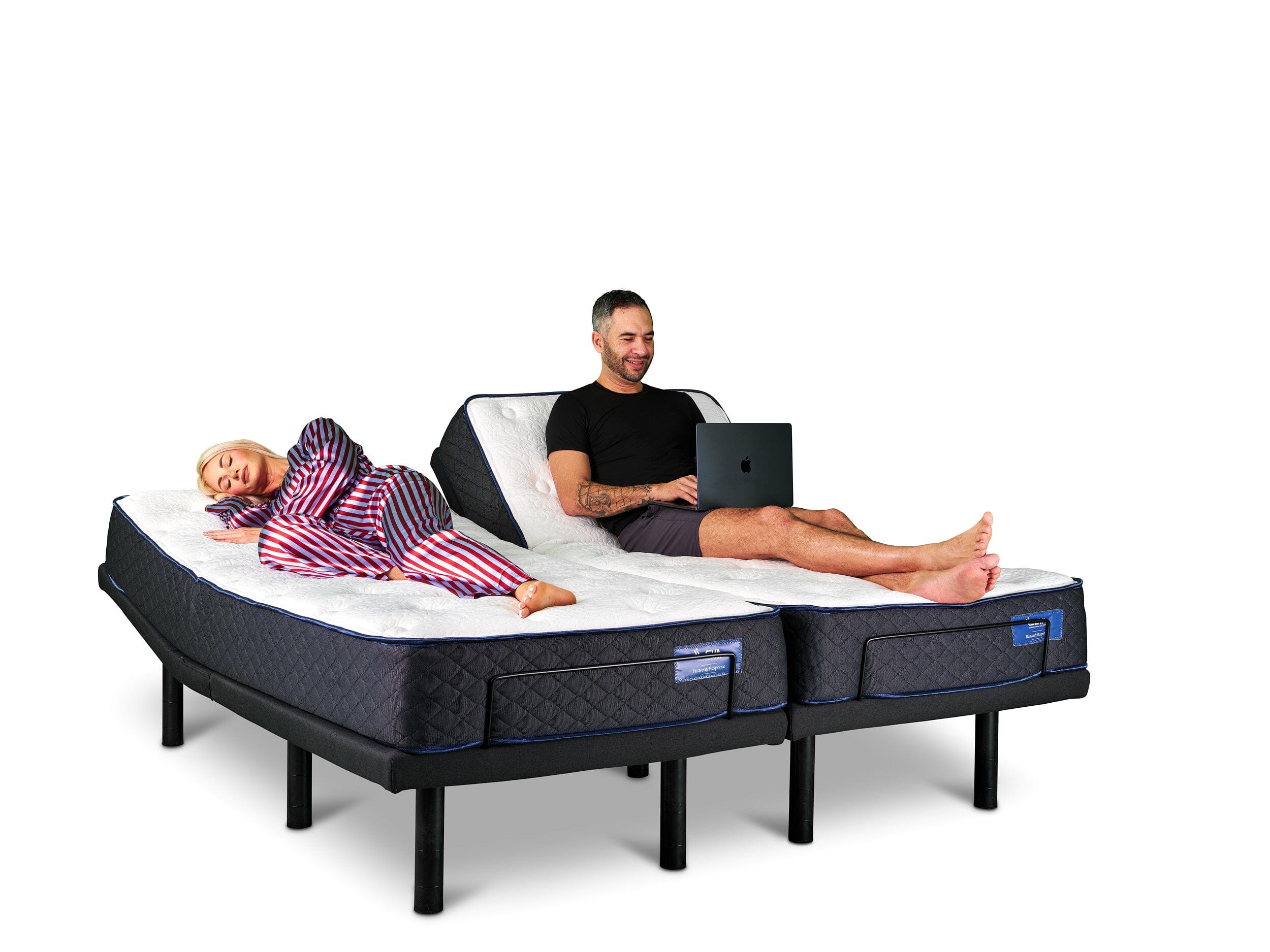

Written by: Matthew Timmins, Founder and Managing Director, Leva Sleep
How Long Your Adjustable Base Can Realistically Last
- Quality adjustable bed frames usually last 10–15 years, and well-maintained units can reach 20 years depending on build, use, and care.
- Motors, actuators, and control electronics typically fail first, while the steel frame remains the most durable part of the base.
- Warranty coverage varies widely by brand. Motors and electronics usually receive fewer years of protection than the structural frame, so buyers should favor tiered coverage that protects electrical components for at least 2–3 years.
- Motor grinding, uneven movement, or repeated wiring faults often signal that repair costs are approaching or exceeding replacement value, especially on split bases.
- Leva Sleep offers durable adjustable bases with whisper-quiet motors and white-glove delivery—shop online or visit the La Jolla showroom today to upgrade your sleep experience.
Which Adjustable Bed Parts Wear Out First
The structural frame is the most durable part of an adjustable base, and its steel construction is designed to outlast the electronics. Quality adjustable bed frames and bases typically last 8–15 years with proper care, with some models reaching up to 20 years. That lifespan matters because frames are rarely sold as individual replacement components. The steel frame of an adjustable base is expected to last 10–20 years with proper care, and a failed frame usually means replacing the entire base.
Motors and actuators are usually the first parts that need attention. With regular maintenance, motors often last 10–15 years. Without that care, their lifespan shortens, with replacement costs for adjustable beds varying widely from about $30 to over $500 per motor depending on model and seller.
Control electronics experience the same maintenance-dependent lifespan variation, although they fail through circuit board degradation rather than mechanical wear. Control boxes can run for many years when kept clean and dry, with adjustable-bed control-box replacement costs typically ranging from $88 to $249 depending on brand and model. Remote controls are usually the shortest-lived electronic component. They can last for years with care, with replacement adjustable bed remote costs varying by brand and model, ranging from $45 to $250.
Wiring and connections often receive the least attention yet cause many “mystery” failures. They can last many years when kept clear of pinch points and dust, and professional minor electrical wiring repair typically costs $100–$300. Before assuming a major failure, check the basics. In most cases, a base that “stopped working” has dead remote batteries, a loose power cord, or dust buildup on the motor.
If troubleshooting reveals a genuine component failure, explore Leva Sleep’s durable adjustable bases with extended motor warranties at the La Jolla showroom or online.
How Adjustable Bed Warranties Really Work
Warranty tiers vary significantly across brands and product lines, and the imbalance between frame and motor coverage is consistent. The table below highlights a key pattern: even premium brands protect motors and electronics for only a few years while extending frame coverage to 10–20 years or more. This means the parts most likely to fail receive the shortest protection.
| Brand / Model | Frame Coverage | Motors & Electronics | Labor Coverage |
|---|---|---|---|
| Tempur-Pedic TEMPUR-Ergo | Tempur-Pedic TEMPUR-Ergo models receive a lifetime frame warranty | Motors and electronics on TEMPUR-Ergo bases receive 1 year of full parts-and-labor coverage (or up to 2–3 years on certain models), with no coverage specified beyond that period | Tempur-Pedic TEMPUR-Ergo provides full parts-and-labor coverage for years 1–3 only, under a 3-year limited warranty |
| Tempur-Pedic TEMPUR-Ergo System (floor models) | 20-year limited, prorated after year 1 | Full coverage year 1, excluded years 2–20 | Included year 1 only |
| Avocado Eco / Eco-Plus | 20-year limited on steel frame | Limited coverage for motors and electronics | Limited labor coverage |
| Saatva Adjustable Base | 10-year limited | Covered under the 10-year limited warranty | Varies by claim type |
A consistent pattern across all tiers is shorter warranty periods for motors and electronics than for structural frames. Buyers should look for tiered coverage that protects electrical components for at least 2–3 years and the frame for 10 years or more. All warranties reviewed void coverage when rated weight limits are exceeded.
Clear Signs Your Adjustable Base Is Near the End
Several failure indicators show that repair costs are approaching or exceeding replacement value:
- Motor grinding or stalling during routine head or foot elevation, which becomes common after year 10 in high-use households.
- Uneven movement where one side of a split base rises faster or stops mid-position, disrupting a partner’s sleep.
- Control box failures that leave the base unresponsive to both remote and app commands.
- Frame flex or audible creaking under normal body weight, which points to joint fatigue in the mechanical structure.
- Repeated wiring faults that require professional repair more than once within 12 months.
- Discontinued parts when a manufacturer no longer stocks replacement motors or control boards for a model, making repair impossible regardless of cost.
For couples using a split configuration, a motor failure on one side effectively removes that partner’s independent positioning. That disruption often pushes households toward replacement sooner.
How Daily Adjustments and Split Bases Change Lifespan
Mechanical components in adjustable bases may eventually require repair even with normal use, and usage frequency directly affects that timeline. A couple making four to six independent adjustments per night, with each partner raising or lowering head and foot positions, places roughly twice the motor cycle load of a single sleeper making one or two adjustments.
Exceeding rated weight capacity accelerates wear on the frame and motors. Standard bases have specific weight capacities, while heavy-duty models provide higher limits. Couples near the upper end of those limits should favor heavy-duty frames and confirm per-side weight ratings on split configurations.
AI-enabled bases that monitor snoring and make automatic micro-adjustments can reduce the number of large manual repositioning events. That reduction may lower cumulative mechanical stress over time. Whisper-quiet German motors, like those used in Leva Sleep’s split bases, are engineered for high-cycle durability and suit couples with frequent nightly adjustments.
Simple Maintenance Habits That Extend Bed Frame Life
A consistent maintenance routine gives motors and electronics the best chance of reaching the upper end of the 15–20-year range.
- Vacuum the motor housing monthly. Dust buildup on the motor is one of the most common causes of premature failure, and preventing it only requires a low-suction attachment around vents and actuator housings.
- Check all power connections every 90 days. Confirm the main power cord is fully seated and that under-bed movement has not loosened secondary connectors, which can cause sudden failures that resemble motor problems.
- Inspect the frame and joints twice a year. Look for bent slats, loose bolts, or cracked welds. Tighten hardware with the manufacturer-specified torque to avoid stripping and to keep the structure stable.
- Replace remote batteries proactively. Low battery voltage causes erratic motor behavior that many owners misread as motor failure, so fresh batteries prevent unnecessary service calls.
- Stay within rated weight limits at all times. Post the capacity rating inside a drawer or nightstand so both partners can check it when adding weighted blankets or other bedding.
What Adjustable Bed Motor Replacement Really Costs
Motor replacement costs vary widely from about $30 to over $500 per motor depending on model and seller, and a split king base uses two independent motor assemblies. The wide cost range noted earlier becomes especially significant on split bases because full motor replacement on both sides can be expensive before labor. Control box replacement typically ranges from $88 to $249 depending on brand and model, and adding the control box cost to dual motor replacement can push total repair costs above $1,000. Professional wiring repair typically costs $100–$300, and even that modest amount contributes to the cumulative total.
On a base purchased for $1,500–$2,500, a few post-warranty service events can quickly add up. At that threshold, replacement with a current-generation system, which includes updated motor technology, a fresh warranty, and compatibility with modern app controls, usually delivers better long-term value than continued repair. Compare Leva Sleep’s current-generation bases and warranty coverage at the La Jolla showroom or online.
Decision Guide: When to Repair and When to Replace
The cost thresholds above provide the raw numbers, but the repair-or-replace decision also depends on the base’s age, parts availability, and feature gaps. Use the following criteria to decide whether repair or replacement makes financial sense after warranty expiration:
- Repair is the better choice when the base is under 8 years old, the frame is structurally sound, replacement parts are still available from the manufacturer, and the total repair cost is below 30% of a comparable new base.
- Replace is the better choice when the base is over 10 years old, multiple components have failed within 12 months, parts are discontinued, or cumulative repair costs have exceeded 40% of replacement value.
- Upgrade is worth considering when the existing base lacks features such as independent split control, app integration, anti-snore positioning, or whisper-quiet motors that would clearly improve sleep quality for both partners.
Buyers replacing an aging base gain the most from integrated systems that pair the adjustable frame with a compatible mattress and purpose-built bedding from a single source. This approach removes compatibility guesswork and ensures every component is engineered to work together from the first night. Leva Sleep’s white-glove delivery service handles old bed removal, full assembly, and a product walkthrough, which removes the friction that often delays a replacement decision.
Conclusion
A quality adjustable bed frame is a long-term investment that can deliver many years of comfortable use. The steel frame of an adjustable base is expected to last 10-20 years with proper care, and the structure reaches the 20-year upper limit more consistently than electrical components. Motors and electronics determine real-world usability and require consistent maintenance to avoid early failure. Warranty coverage, usage patterns, and weight compliance are the three variables most within a buyer’s control. For couples making multiple nightly adjustments on a split configuration, choosing a base with heavy-duty motors, a tiered warranty, and readily available replacement parts offers the most reliable path to reaching the upper end of that lifespan range. Explore Leva Sleep’s heavy-duty split bases with German motors and tiered warranty coverage at the La Jolla showroom or online.
Frequently Asked Questions
How long do adjustable bed frames usually last for couples using a split configuration?
A split king or split queen adjustable base used by two partners making independent nightly adjustments will typically last 10–15 years with regular maintenance, and up to 20 years with diligent care. The higher adjustment frequency places more cumulative load on each side’s motor assembly compared to a single-sleeper setup. Choosing a base with heavy-duty, whisper-quiet motors rated for high-cycle use, and staying within the per-side weight limits, is the most effective way to reach the upper end of that range. The steel frame itself is unlikely to be the limiting factor, so motors and control electronics usually determine when the base needs attention.
What is the difference between a frame warranty and a motor warranty on an adjustable base?
Frame warranties and motor warranties cover different components and usually last for very different periods. A frame warranty protects the steel structure, including welded joints, slats, and mechanical hinges, and often runs for 10 years or more depending on the brand. A motor or electronics warranty covers the actuators, control box, remote, and wiring, and is almost always shorter, commonly providing full parts-and-labor coverage for only a few years. After the motor warranty expires, repair costs fall entirely on the owner. When evaluating a purchase, buyers should read both warranty documents separately and confirm exactly which components are excluded after each coverage period ends.
Is it worth repairing an adjustable bed motor, or should I replace the entire base?
The repair-versus-replace decision depends on the base’s age, the availability of manufacturer parts, and the cumulative cost of repairs relative to a new system. Repair makes financial sense when the base is under 8 years old, the frame is structurally intact, parts are still in production, and the repair cost is below 30% of a comparable replacement. Replacement becomes the better option when the base is over 10 years old, multiple components have failed within a short period, or parts are discontinued. An upgrade is worth considering when the existing base lacks features such as independent split control, app integration, or anti-snore positioning that would meaningfully improve sleep quality for both partners. Motor replacement alone costs vary widely from about $30 to over $500 per unit, and a split base has two motors, so costs can accumulate quickly after the warranty period ends.
Does exceeding the weight limit on an adjustable base void the warranty?
Yes. Every major manufacturer reviewed voids warranty coverage when the total weight on the base, including sleepers, mattress, and bedding, exceeds the rated capacity. Standard adjustable bases support specific weight limits, while heavy-duty models offer higher capacities. Exceeding those limits not only voids the warranty but also accelerates wear on the frame, motors, and actuators, which shortens the base’s practical lifespan. Couples should verify both the total weight rating and, on split configurations, the per-side rating before purchase. If combined body weight plus mattress weight approaches the rated limit, selecting a heavy-duty model is the appropriate choice.
What maintenance steps have the greatest impact on adjustable bed frame longevity?
Monthly vacuuming of the motor housing to remove dust buildup is the single highest-impact maintenance task, because dust accumulation is one of the most common causes of premature motor failure. Beyond that, checking all power connections every 90 days prevents the loose-cord failures that are frequently misdiagnosed as motor problems. Replacing remote batteries proactively, before they are fully depleted, avoids erratic motor behavior caused by low voltage. Inspecting the frame and tightening hardware twice a year prevents joint fatigue from progressing into structural damage. Finally, consistently staying within the manufacturer’s rated weight limit protects every component at once and keeps the warranty valid for the full coverage period.