Written by: Matthew Timmins, Founder and Managing Director, Leva Sleep
Key Takeaways for Couples with Back Pain
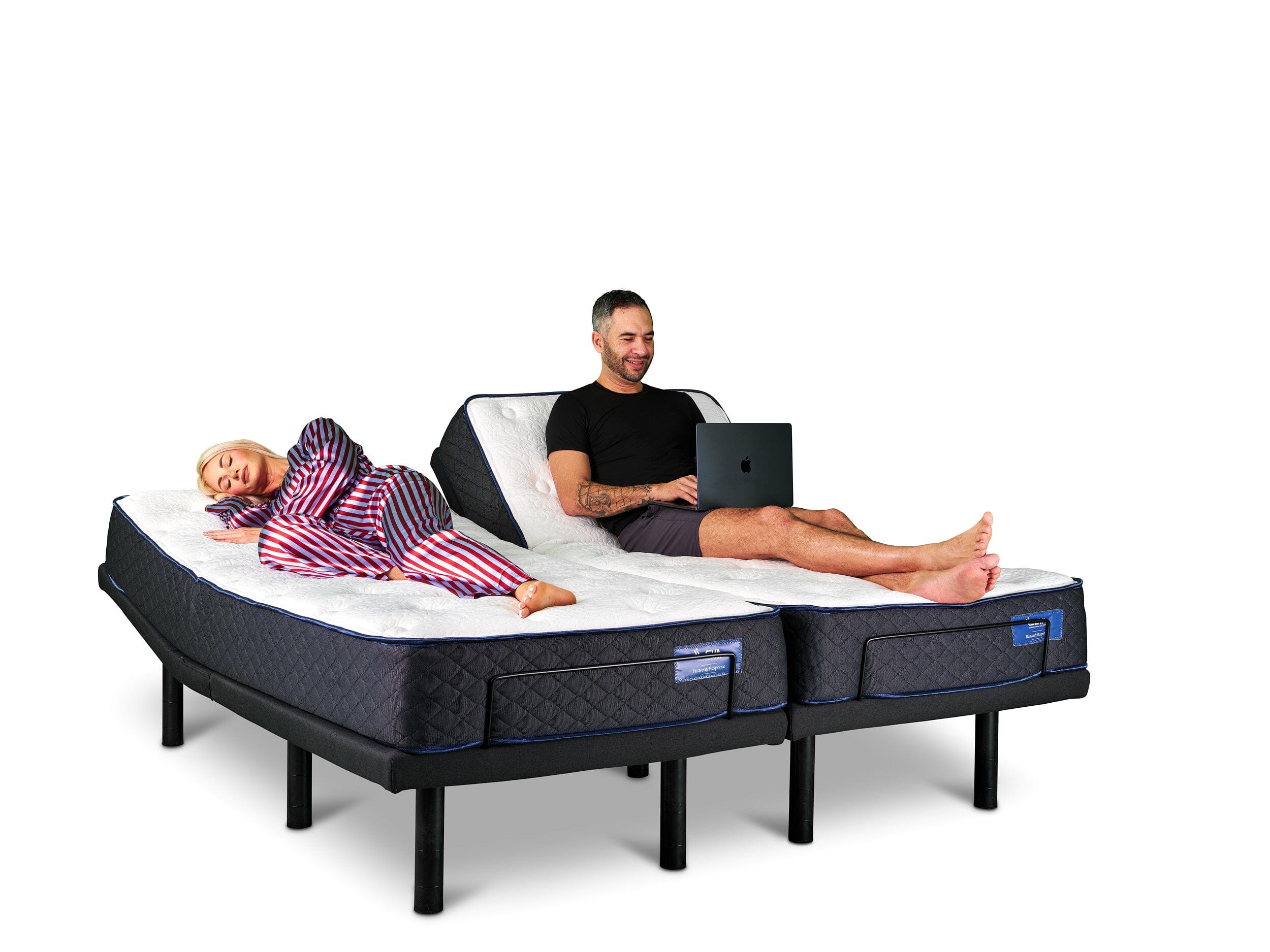
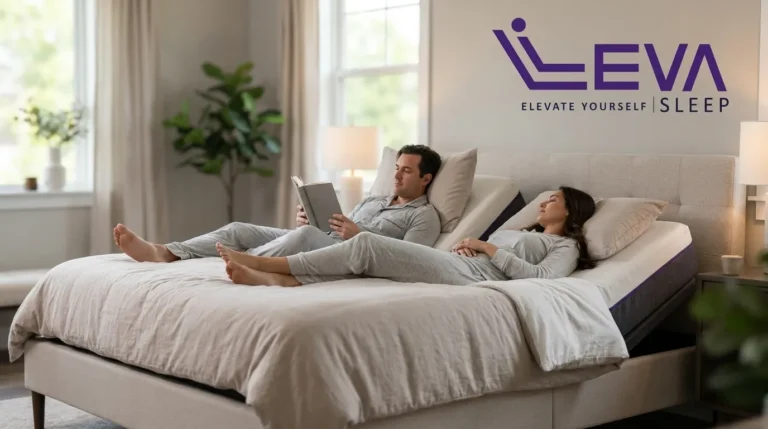
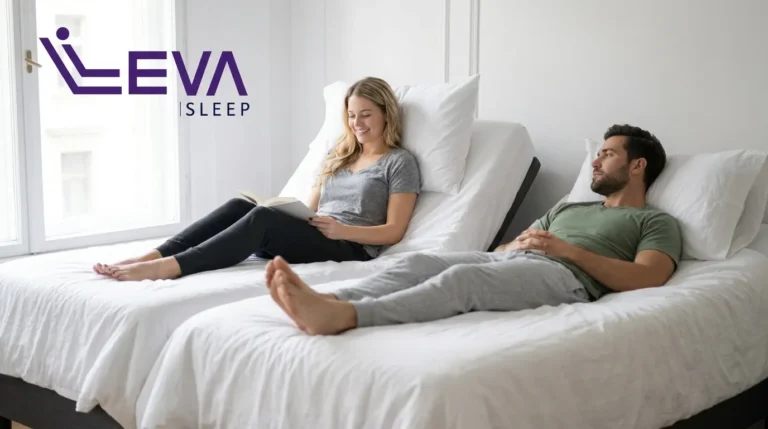
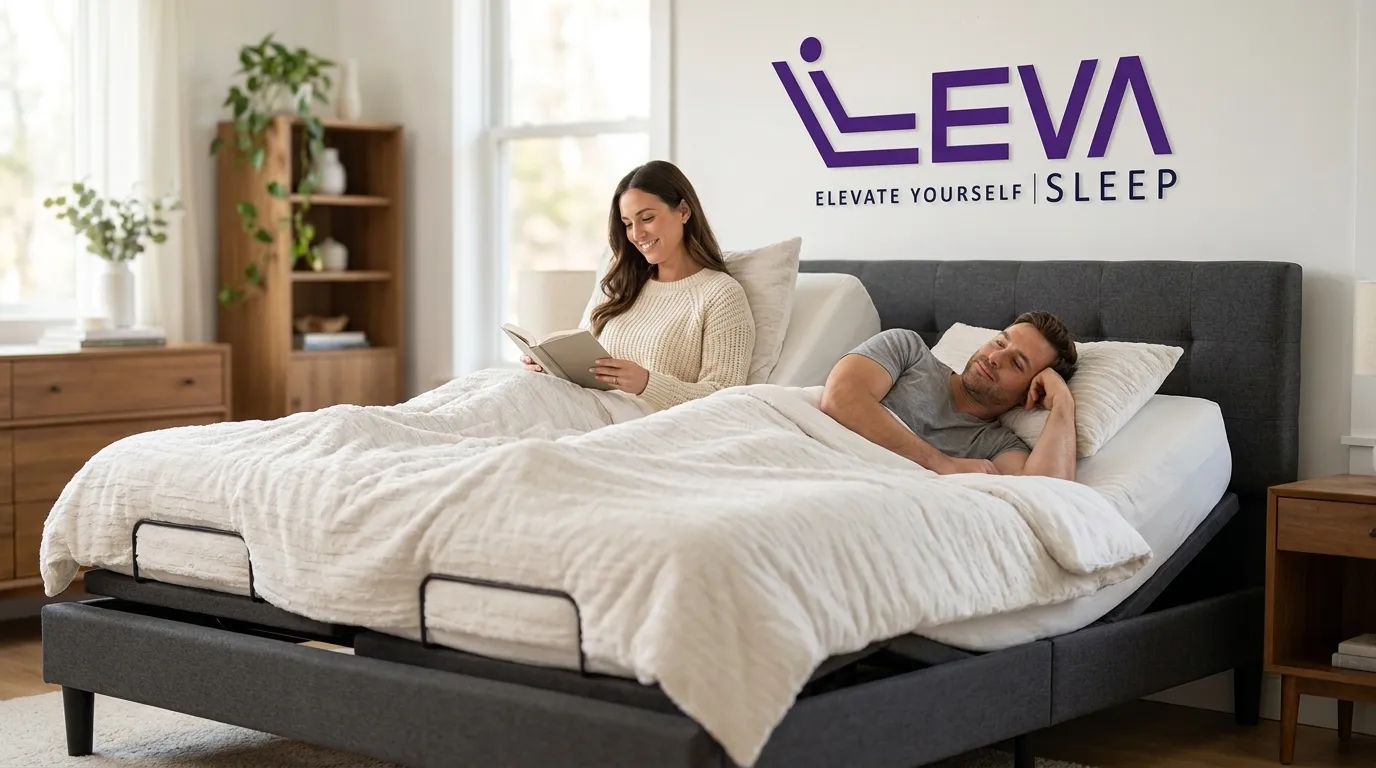
- Split adjustable beds let each partner control head, foot, and lumbar settings independently, so no one has to compromise on comfort.
- Zero-gravity positioning and targeted lumbar support ease back pain by decompressing the spine and reducing pressure on lumbar discs.
- Among the five brands reviewed, Leva Sleep stands out for deep split configuration options, including split queen, quiet German motors, and adjustable-bed expertise.
- Key buying factors for couples include true split-base independence, mattress compatibility, quiet motors, and white-glove delivery with setup support.
- Explore Leva Sleep’s adjustable beds to find personalized solutions for back pain relief.
How the Top 5 Adjustable Bed Brands Compare for Couples
Each of the five brands fills a different niche. Tempur-Pedic focuses on mattress prestige. Sleep Number focuses on biometric integration. Reverie focuses on modular customization. Ghostbed focuses on accessible price points through broad retail distribution. Leva Sleep focuses on split-configuration depth, specialist expertise, and cost efficiency at a premium quality level.
Tempur-Pedic Adjustable Bases for Back Pain
Tempur-Pedic’s TEMPUR-Ergo bases pair with the brand’s proprietary pressure-absorbing foam mattresses, which conform closely to the body and reduce peak pressure at the hips and shoulders. The Ergo Smart base adds an anti-snore feature and app control. For couples, Tempur-Pedic offers split king configurations that allow independent head and foot adjustment on each side. The ownership experience feels premium, with white-glove delivery available through authorized retailers and strong warranty backing. The main drawback is cost, since Tempur-Pedic systems sit at the high end of the price spectrum and the adjustable base lineup includes only a few models, with no split queen option for couples who want that format.
Sleep Number Smart Beds and FlexFit Bases
Sleep Number’s 360 Smart Beds use air-chamber technology to adjust firmness digitally, and the brand’s FlexFit adjustable bases add head and foot articulation. The system integrates biometric sleep tracking and can make automatic adjustments based on detected snoring or movement. Split configurations are available, so each partner can control firmness and elevation independently. For couples managing back pain, this combination of adjustable firmness and positioning can be helpful. The trade-offs include a proprietary ecosystem that requires Sleep Number mattresses exclusively, and a subscription model for advanced tracking features that adds ongoing cost beyond the initial purchase.
Reverie Modular Adjustable Systems
Reverie builds adjustable bases with a modular philosophy, offering multiple base tiers with features such as independent lumbar support, head and foot articulation, and a Dream Cell mattress system that allows firmness to be adjusted zone by zone. For couples with back pain, the mix of per-side elevation and per-zone firmness provides very granular control. Split king configurations are supported. Reverie’s ownership experience is generally positive, although the retail footprint is smaller than Tempur-Pedic or Sleep Number, which makes in-person evaluation harder in many areas. Pricing sits in the upper-mid range, and the system’s complexity means setup guidance matters, yet Reverie’s distribution model can deliver less consistent support than a vertically integrated specialist.
Ghostbed Adjustable Bases on a Budget
Ghostbed offers adjustable bases at accessible price points and distributes widely, including through Costco. The bases include zero-gravity presets, massage functions, and USB charging. For couples on a tighter budget who want basic split adjustability and back-pain-friendly positioning, Ghostbed provides a practical entry point. The trade-offs are significant for couples with serious or chronic back pain. The base lineup includes only a few models, lumbar support is not standard across the range, and the wholesale-heavy distribution model means setup and post-purchase support vary by retailer. Couples who need specialist guidance on positioning or mattress pairing will usually not find that expertise at the point of sale.
Leva Sleep Split Adjustable Beds for Couples
Leva Sleep builds its business around adjustable beds as the primary product, not a secondary add-on. The company offers roughly 15–20 adjustable base models, compared with the 3–5 models typically found at general mattress retailers. Options include split king and the less common split queen configuration, which Leva builds to customer specifications for couples in smaller rooms. Each side of a split base operates independently, with whisper-quiet German motors controlling head elevation, foot elevation, and lumbar support.
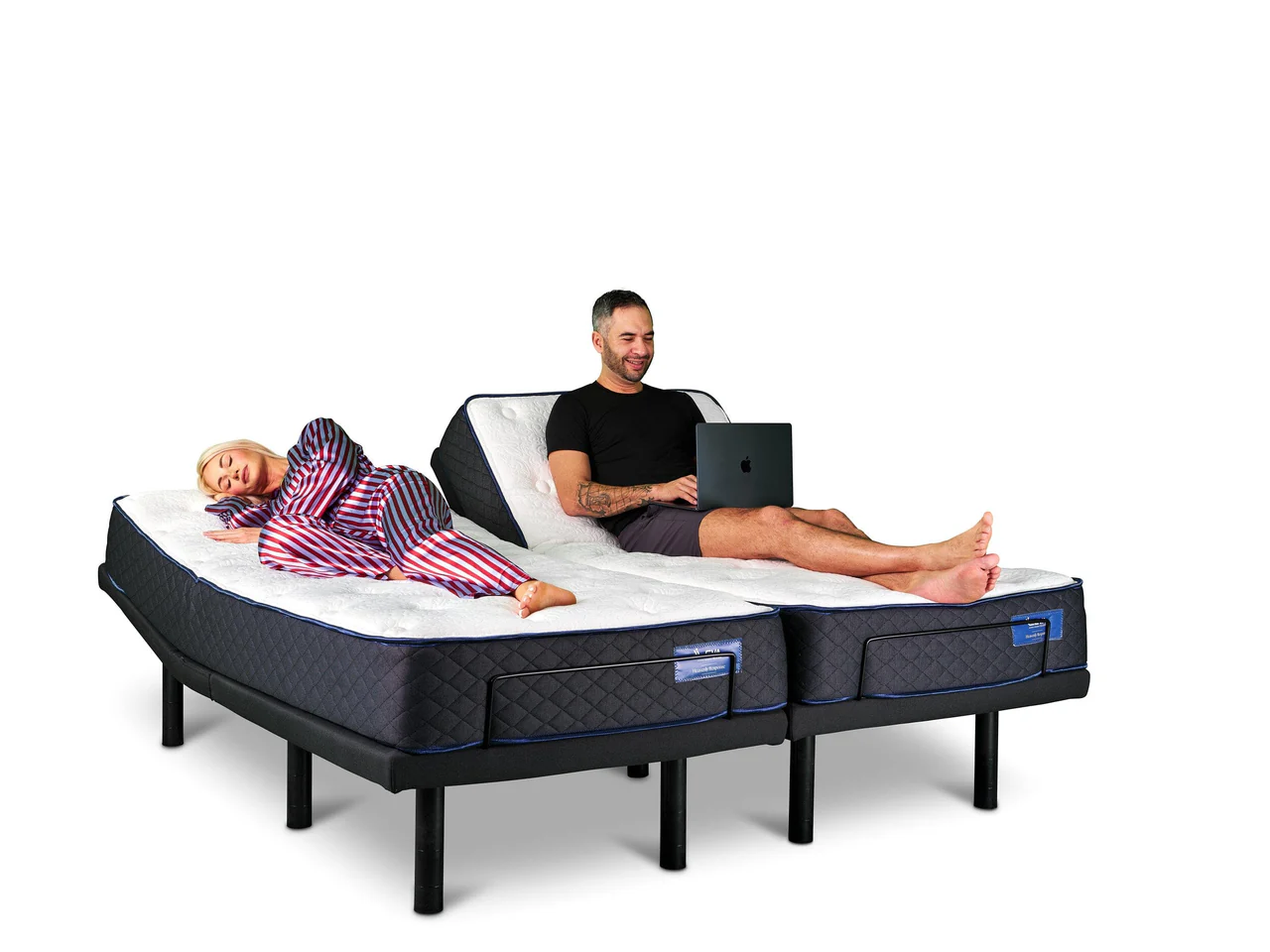
The Leva Sleep app supports full Bluetooth control, custom position memory, vibrating alarms, and anti-snore micro-adjustment. A heating and cooling pad helps couples who prefer different sleep temperatures share the same bed comfortably.
Mattress compatibility comes from Leva’s curated lineup of foam and hybrid pocket-coil mattresses, all designed to articulate without bridging or motor strain, including California-made brands such as Airloom and Diamond Mattress. Purchasing a base and mattress as a bundle from a single vendor guarantees compatibility, extends product lifespan under repeated bending stress, and simplifies warranty claims. Leva’s vertically integrated model, which includes design, local assembly, and direct delivery, removes retail markup and places its systems at 30–50% below comparable premium competitors. White-glove delivery includes bedroom setup, leg-height adjustment, a product tutorial, and removal of the old bed. For couples in the San Diego region, the La Jolla showroom offers in-person evaluation of multiple configurations before purchase.
Doctor-Recommended Sleep Positions for Back Pain Relief
The clinical rationale for adjustable beds in back pain management centers on spinal decompression during sleep. A flat surface maintains the tension the spine carries from daytime compression. Elevation changes that angle the body redistribute that load and can reduce strain on sensitive structures.
Zero-gravity positioning, with the head raised to about 30–45 degrees and the knees slightly elevated, is considered the gold standard for back pain relief because it decompresses the spine and reduces pressure on lumbar discs. For people who find full zero-gravity uncomfortable, a gentler 10–20 degree head elevation can still provide meaningful lumbar relief.
Specific positioning protocols vary by pain type. For lower back pain, 15–20 degrees of foot elevation combined with 10–15 degrees of head elevation creates a slight hip pocket that reduces tension on the psoas muscles and lower lumbar discs. For upper back and neck pain, about 30 degrees of head elevation with feet relatively flat reduces pull on the trapezius and maintains neutral cervical alignment. For sciatica, the zero-gravity position with the head at about 15 degrees and feet elevated above heart level opens space in the lower vertebral foramina and can reduce pressure on the sciatic nerve.
Which adjustable bed is best for back pain?
The most effective adjustable bed for back pain relief combines independent lumbar support, precise head and foot articulation, and a compatible conforming mattress. Key criteria to evaluate include whether the base offers the zero-gravity preset discussed earlier with adjustable angles, whether there is a dedicated lumbar zone that moves independently, and whether the paired mattress is flexible enough to articulate without bridging, ideally memory foam or individually pocketed hybrid coils. Specialist guidance on positioning protocols for your specific pain pattern also adds value.
Do doctors recommend adjustable beds for back pain?
Orthopedic and sleep specialists often recommend adjustable positioning for conditions such as lower back pain, sciatica, herniated discs, and poor spinal alignment during sleep. The mechanism is spinal decompression. Slightly elevating the knees slackens the hamstrings and hip flexors, allowing the pelvis to rotate into a neutral position that offloads pressure on the lower lumbar vertebrae and intervertebral discs. Adjustable beds also support treatment plans for sleep apnea, acid reflux, and post-surgical recovery when elevation is clinically indicated.
What is the best adjustable bed for couples?
For couples, the essential feature is independent per-side control. Evaluate brands on whether true split configurations such as split king or split queen are available, whether each side can hold different elevation angles simultaneously without mechanical interference, whether motors are quiet enough that one partner’s adjustment does not wake the other, and whether the mattress pairing minimizes motion transfer between sides.
Buying Checklist for Couples Managing Back Pain
Split configuration availability: Start by confirming the brand offers a true split base, not a shared base with a split-top mattress only, so each partner has fully independent head and foot articulation.
Mattress compatibility: Once you confirm split functionality, review mattress options. Verify the mattress can bend about 45 degrees without damage, falls within 8–12 inches of thickness, and carries a warranty that explicitly covers adjustable-base use. Memory foam and individually pocketed hybrids usually perform best.
Motor noise: Request a live demonstration or ask specifically about decibel ratings. Quiet motors matter when one partner adjusts position during the night and the other partner is sleeping.
Lumbar support: Check whether lumbar adjustment is a standard feature or a premium add-on, and confirm that it operates independently of the head and foot sections.
Delivery and setup: Review whether white-glove delivery is available, what it includes such as room placement, assembly, old-bed removal, and tutorial, and whether trained brand employees or third-party contractors perform the service.
Warranty and total cost of ownership: Compare base and mattress warranties and confirm whether a single vendor covers both. Include any subscription fees for app features or sleep tracking when you calculate long-term cost.
Showroom access: Whenever possible, test the system in person to evaluate motor noise, articulation range, and mattress feel before purchasing.
Frequently Asked Questions
Can an adjustable bed replace other back pain treatments?
An adjustable bed functions as a sleep positioning tool, not a stand-alone medical treatment. It can reduce nighttime spinal compression and morning stiffness by allowing the body to rest in a decompressed position. It works best as part of a broader plan that may include physical therapy, exercise, and medical care. Many people find that better sleep positioning reduces daytime pain by improving overnight recovery, although results depend on the underlying cause of the back pain.
Is a split queen a real option, or do most brands only offer split king?
Split king is the most widely available configuration among major brands, while split queen options remain far less common. Split queen configurations provide the same independent-control benefits in a smaller footprint. Leva Sleep specializes in split queen adjustable bases built to customer specifications, which makes it one of the few sources for this configuration in the US market.
How long does it take to adjust to sleeping on an adjustable base?
Most new users adapt more easily with a gradual approach. Start with a modest 5–10 degree elevation and increase over several nights instead of jumping straight to full zero-gravity. Using the zero-gravity preset for about 20 minutes before sleep can help muscles relax into the position. Most users find a comfortable baseline within one to two weeks of nightly use.
What mattress type works best with a split adjustable base for back pain?
Memory foam usually works best with adjustable bases because it returns to shape quickly and has no rigid internal structures that can be damaged by repeated articulation. Individually pocketed hybrid coils offer the next best balance of contouring and support. Traditional interconnected innerspring mattresses generally do not pair well with adjustable bases and can damage both the mattress and the base motor over time. For back pain specifically, a conforming memory foam mattress paired with the zero-gravity positioning described earlier helps flatten the lumbar spine and fill gaps to support the lower back.
Why is Leva Sleep significantly less expensive than brands like Tempur-Pedic if the quality is comparable?
Leva Sleep’s pricing advantage comes from vertical integration. By designing systems in-house, assembling locally, and selling direct-to-consumer without traditional retail markup, Leva removes intermediary costs that inflate prices at general mattress retailers and department stores. The result is a 30–50% cost reduction relative to comparable premium competitors without lowering materials quality or engineering standards.
Conclusion: Choosing the Right Adjustable Bed as a Couple
Across the five brands evaluated, a clear pattern appears. The features that matter most for couples with back pain, such as independent per-side elevation, dedicated lumbar support, quiet motors, and compatible mattress pairing, show up in different combinations. The ownership experience, including delivery, setup, and specialist guidance, often differentiates brands as much as the hardware itself. Tempur-Pedic and Sleep Number provide strong brand prestige but limited configuration depth and higher total cost. Reverie offers granular customization with less consistent retail support. Ghostbed delivers accessible entry-level adjustability without specialist depth. Leva Sleep combines the widest adjustable base selection, split queen availability, specialist expertise, white-glove delivery, and the cost efficiency described earlier through its direct-to-consumer model.
For couples beginning this evaluation, an in-person demonstration usually provides the most productive starting point. Both partners can test independent elevation at the same time, assess motor noise at night-use volumes, and verify mattress articulation without bridging. This hands-on experience helps clarify which features matter most for your specific needs, which makes it easier to use the buying checklist above as a structured framework for comparing final candidates on the factors that shape long-term satisfaction.