
Written by: Matthew Timmins, Founder and Managing Director, Leva Sleep
Key Takeaways for Couples Who Snore
- Split adjustable bases with snore detection raise only the snoring partner’s head while the other side stays flat, which helps couples avoid “sleep divorce.”
- Only split configurations (Split King or Split Queen) provide true side-specific adjustment, since single-piece bases lift both partners at once.
- Leading 2026 options mainly differ in motor quietness, mattress compatibility, Split Queen availability, and total ownership cost, not in how they detect snoring.
- Leva Sleep’s spring 2026 anti-snore mode uses whisper-quiet German motors and app-controlled micro-elevations on Split King and Split Queen sizes at 30–50% lower cost than many premium competitors.
- Couples ready to reduce snoring disruption can review Leva Sleep’s Split Queen and Split King setups at Leva Sleep to match their room and budget.
How Adjustable Beds Detect and Respond to Snoring
Automatic snore-response technology monitors a sleeper’s breathing in real time. When snoring is detected, the base raises the head of the bed by about 12 degrees to reposition the airway and reduce or stop the snoring episode. The adjustment occurs quietly without an alarm, a nudge, or a manual remote press.
Tempur-Pedic’s TEMPUR-Ergo Smart Base uses the Sleeptracker-AI platform to detect snoring via micro-vibrations and then automatically raises the head 12 degrees. The system aims to adjust without waking the snoring sleeper or their partner. One verified owner described the experience: “When he starts snoring, the bed raises smoothly and quietly without disruption and magically his snoring either stops completely or decreases significantly.”
Ergomotion’s ErgoSportive base also integrates snore-detection sensors with automatic head elevation. Leva Sleep’s anti-snore mode, arriving spring 2026, uses app-controlled micro-elevations powered by whisper-quiet German motors to perform the same function with side-specific precision on Split Queen and Split King configurations.
Regardless of which system you choose, split configurations are essential for couples. A single-piece adjustable base with snore detection raises both sides at the same time, which means the non-snoring partner is also elevated and may be disturbed. Only a split base allows the snoring side to adjust independently.
See how Leva’s split bases deliver independent snore control for both partners.
Best Bed Types for Couples When One Partner Snores
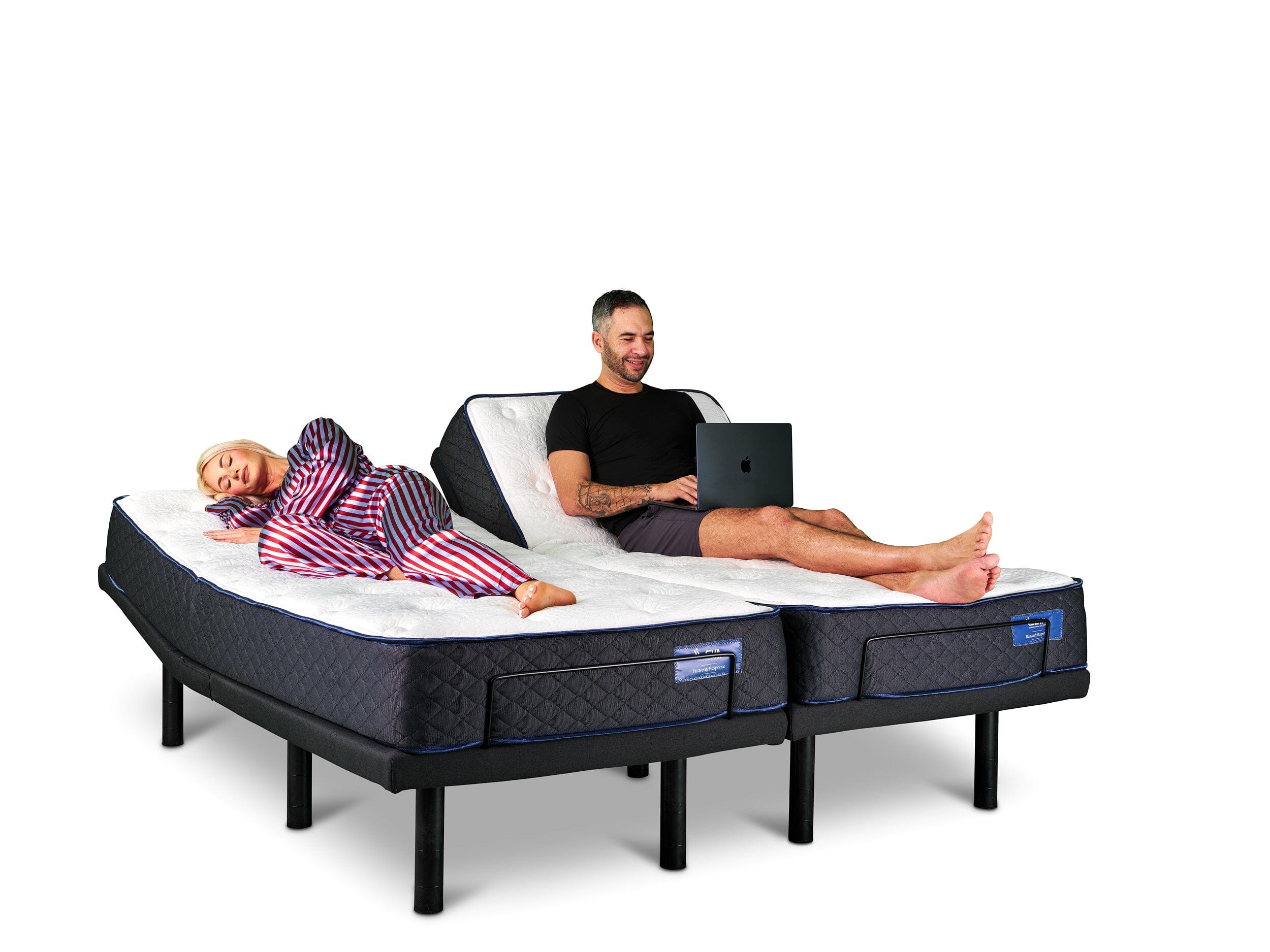
A split adjustable base offers the most practical setup for couples where one partner snores. Traditional flat beds provide no positional help. Single-piece adjustable bases move both sides together. Split King and Split Queen bases stand out because they deliver independent, side-specific elevation.
Split King consists of two Twin XL mattresses, each 38 inches wide by 80 inches long, for a combined footprint of 76 by 80 inches, which matches a standard Eastern King. Each side operates on its own adjustable frame and removes motion transfer. Each sleeper can independently elevate their head and legs without affecting their partner. The trade-off is a center seam between the two mattresses, which some couples soften with a foam gap filler or a non-split mattress pad.
Split Queen applies the same independent-control concept to a smaller footprint, which suits bedrooms that cannot accommodate a King. Leva Sleep is one of the few specialists offering a Split Queen adjustable base built to customer specifications, a configuration that most general mattress retailers do not stock.
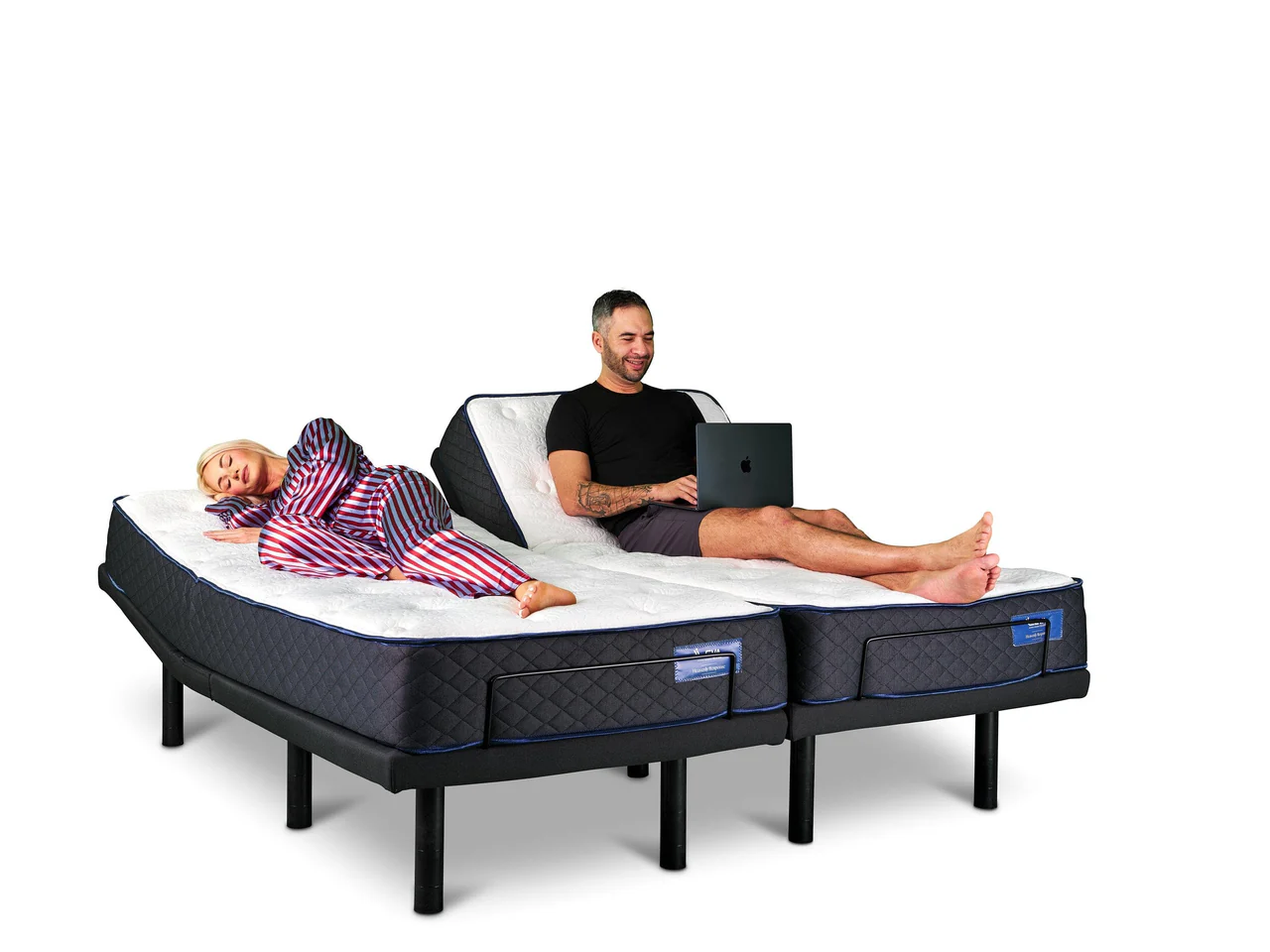
Both configurations require split-compatible sheet sets. Split King sheet sets typically include two fitted sheets and one king flat sheet. Leva Sleep designs its own bedding accessories with extra elastic and side remote pockets for adjustable bases, which helps prevent the fitted-sheet slippage that frustrates owners of standard bedding.
Find the split-base setup that fits your bedroom and budget.
Side-by-Side Comparison of Split Adjustable Beds with Snore Detection
The table below compares five models on four criteria. Motor noise figures and ownership cost ranges reflect manufacturer specifications and publicly available pricing. When independent decibel testing data is not available from a verifiable source, the comparison appears in prose rather than as a specific number.
| Model | Independent Adjustability | Motor Noise (Auto Snore Response) | Total Ownership Cost (Split King) |
|---|---|---|---|
| Tempur-Pedic Ergo ProSmart | Yes, Split King only, each side controlled independently via app or remote | Described by owners as smooth and quiet during automatic 12-degree elevation, no published dB rating | Premium tier, base price plus proprietary TEMPUR mattress required, among the highest total costs in this category |
| Ergomotion ErgoSportive | Yes, Split King configurations available with independent controls | No published independent dB rating, manufacturer markets quiet operation | Mid-to-upper tier, compatible with a wider range of third-party mattresses, which can reduce total cost |
| Ghostbed Adjustable | Split King available, independent controls per side | No published independent dB rating available | Mid tier, sold through broad distribution including wholesale channels |
| Saatva Adjustable | Split configurations available, independent controls per side | No published independent dB rating available | Mid-to-upper tier, white-glove delivery included in base price |
| Leva Sleep (Spring 2026) | Yes, Split King and Split Queen, fully independent app-controlled elevation per side | Whisper-quiet German motors, no published dB rating, designed for micro-adjustment without partner disturbance | Lower than top comparable competitors, white-glove delivery available, Split Queen option reduces base cost further |
The most meaningful differences across these models relate to motor quietness, split-size flexibility, and total cost rather than the snore-detection mechanism itself. Most systems use sensor-based breath monitoring with automatic head elevation. Tempur-Pedic’s system is well-documented and owner-reviewed but requires a proprietary TEMPUR mattress, which locks buyers into a single mattress ecosystem and raises total ownership cost. Ergomotion offers broader mattress compatibility. Leva Sleep’s spring 2026 anti-snore mode adds Split Queen availability and German-motor engineering at a lower price point, with white-glove delivery handled in-house instead of outsourced.
Compare Leva’s pricing and motor specs against the models above.
Scenario: Chronic Snoring in One Partner
Couples dealing with nightly snoring need automatic head elevation on one side as the primary feature. The snore-detection sensor should respond quickly enough to prevent long disruptions, and the motor should complete the elevation quietly so the non-snoring partner stays asleep.
When you evaluate motor noise in a showroom or during a trial period, focus on the sound at the moment the base begins to move, not just at full elevation. Some motors produce a brief mechanical click or hum at startup that sounds louder than the sustained movement. Ask the retailer to demonstrate the automatic snore-response cycle, not only manual remote adjustment, since the speed and torque profile can differ. Leva Sleep’s La Jolla showroom allows in-person evaluation of motor behavior across multiple configurations.
Scenario: Different Firmness and Comfort Needs
Couples with different firmness needs can solve comfort and snoring issues at the same time with a split base. Independent elevation supports snore control, and independent mattress selection supports comfort. Split King configurations allow each partner to select different firmness levels while sharing one bed frame.
For bedrooms that cannot fit a King, Leva Sleep’s Split Queen delivers the same independent-control benefit in a more space-conscious footprint. This configuration is rare among general mattress retailers, which makes Leva Sleep one of the few specialists able to meet this specific need. Leva’s mattresses, available in all-foam or hybrid pocket coil, are designed to flex with adjustable bases without voiding compatibility.
Scenario: Mild Sleep Apnea or Tight Bedroom Space
Mild sleep apnea and positional snoring both respond to gentle head elevation that opens the airway. This distinction affects engineering. A base designed for subtle, incremental micro-adjustments, rather than a single large elevation event, suits mild apnea management better because the goal is airway maintenance instead of a strong reaction to loud snoring.
Space constraints often push buyers toward Split Queen. A standard Queen measures 60 by 80 inches, while a King measures 76 by 80 inches. In bedrooms where a King-sized footprint does not fit, a Split Queen preserves independent adjustability without a major room reconfiguration. Buyers should confirm that their chosen base manufacturer offers Split Queen as a standard SKU rather than a special order, since lead times and return policies can differ.
Inside Look: Leva Sleep’s Spring 2026 Anti-Snore Mode
Leva Sleep’s spring 2026 anti-snore mode uses app-controlled micro-elevations and whisper-quiet German motors. The system works on both Split King and Split Queen configurations and adjusts only the snoring partner’s side. Full control runs through the Leva Sleep app, which includes custom sleep positions, vibrating alarms, and real-time adjustment settings.
Leva designs and assembles its systems locally, which removes the manufacturing markup common at traditional retailers. This approach delivers premium-tier engineering at 30–50% lower cost than many comparable competitors. White-glove delivery, handled by Leva’s own trained professionals instead of a third-party logistics provider, includes bedroom delivery, full assembly, leg-height adjustment, product tutorial, and removal of the old bed.
Couples in Southern California can visit the La Jolla showroom to test motor behavior, split configurations, and mattress pairings before purchase.
Decision Checklist for Choosing a Split Adjustable Base
Use the following criteria in sequence to match your situation to the right configuration:
- Snoring severity: Start by assessing how often snoring disrupts sleep. Nightly chronic snoring calls for automatic snore detection with a quiet motor response, while occasional snoring may be manageable with manual elevation presets.
- Bedroom size: After you decide on the automation level, measure the room to choose between Split King and Split Queen. A Split Queen fits a standard Queen footprint, and a Split King needs King-sized clearance.
- Mattress compatibility: Once you settle on a size, confirm whether the base requires a proprietary mattress or accepts third-party options, since proprietary requirements raise total ownership cost.
- Motor noise tolerance: Then test the automatic snore-response cycle in a showroom. Listen at motor startup and during movement from the non-adjusting side of the bed.
- Delivery and setup: Check whether white-glove delivery is in-house or outsourced, and whether assembly, height adjustment, and old-bed removal are included.
- Budget: Finally, calculate total ownership cost, including base, mattress, compatible bedding, and delivery, not just the base price.
Frequently Asked Questions
Does an adjustable bed really help with snoring?
Elevating the head of the bed changes the angle of the airway and can reduce or eliminate snoring caused by body positioning. The 10–12 degree elevation mentioned earlier works by using gravity to keep soft tissue from collapsing into the airway during sleep. Adjustable bases with automatic snore detection perform this elevation without requiring the sleeper to wake up or manually adjust the bed. Effectiveness varies by individual and tends to be strongest for positional snoring, which worsens when lying flat, rather than snoring caused by structural airway issues. For mild sleep apnea, positional elevation can reduce episode frequency, although it does not replace medical evaluation or treatment.
How do couples sleep together when one partner snores?
A split adjustable base offers a practical way for couples to stay in the same bed when one partner snores. It allows the snoring partner’s side to elevate automatically while the other side remains flat and undisturbed. Both partners stay close while avoiding the disruption that leads to couch nights or separate rooms. Independent controls let each partner set their own elevation, firmness, and position preferences without affecting the other side. For couples with additional differences, such as temperature or support needs, a split base addresses these through side-specific settings.
What should I listen for when testing motor noise during automatic adjustment?
Motor noise has two phases: the startup sound when the motor engages and the sustained sound during movement. Some bases produce a brief mechanical click or hum at startup that sounds louder than the movement itself. When you test in a showroom, request a demonstration of the automatic snore-response cycle, since the speed and torque profile during automatic adjustment can differ from a manual remote press. Listen from the non-adjusting side of the bed, which matches the position of the partner most likely to be disturbed. A whisper-quiet motor should be inaudible or nearly inaudible from the opposite side of a split base during a slow, incremental elevation.
Is a Split Queen a Good Option for Smaller Bedrooms?
A Split Queen suits bedrooms where a King-sized footprint does not fit. It delivers the same independent-control benefits as a Split King, including separate elevation, separate firmness, and separate snore-response adjustment, within a standard Queen footprint of 60 by 80 inches. The trade-off is that each side is narrower than a Twin XL, which may feel tight for larger sleepers. For couples who want to stay in the same bed with independent controls but cannot accommodate a King, a Split Queen offers the most space-efficient option. As noted earlier, Leva’s Split Queen availability addresses this gap where most retailers offer no equivalent.