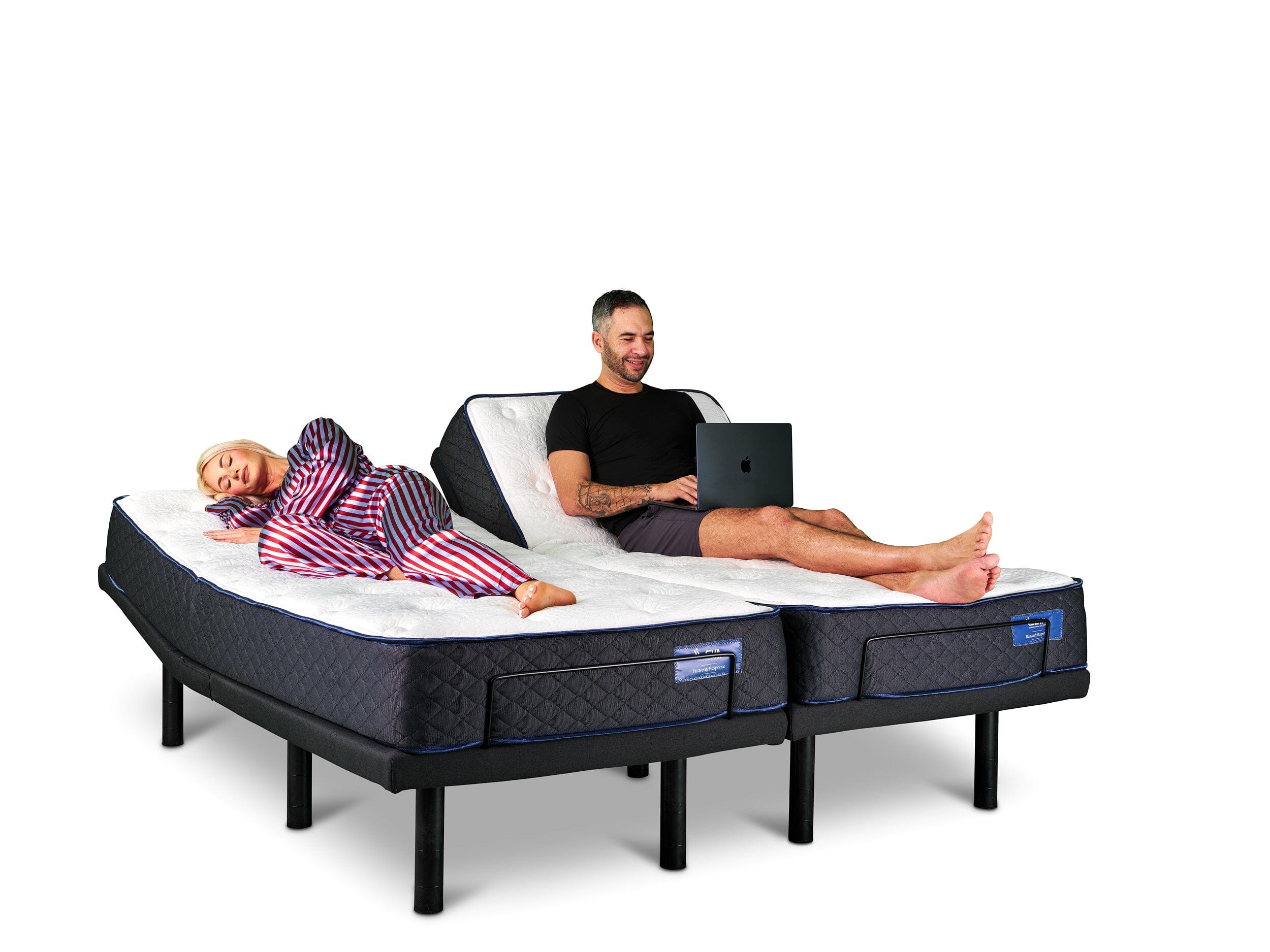

Written by: Matthew Timmins, Founder and Managing Director, Leva Sleep
Key Takeaways for Couples Comparing Split Sizes
- Split adjustable bases give each partner independent head and foot elevation, so no one has to compromise on position.
- Premium bases use brushless German motors that run at 30–40 dB, quiet enough for most sleepers, and place USB ports on each half for easy charging.
- Split king (76″ × 80″) offers the widest space per partner but needs a larger bedroom, while split queen (60″ × 80″) keeps a standard queen footprint.
- Specialty bedding made for adjustable bases and white-glove delivery solve sheet slippage and complex setup for split systems.
- Leva Sleep designs complete split systems with independent controls, quiet motors, and custom bedding—shop the full collection today.
How Split Systems Differ From Flat Beds and Basic Adjustable Bases
Three main bed types shape the market for couples today. Traditional flat beds offer no elevation, no USB access, and no independent movement, so both partners share the same position all night. Basic adjustable bases, often sold as add-ons, introduce head and foot elevation but usually move as a single unit, so one partner’s adjustment always affects the other.
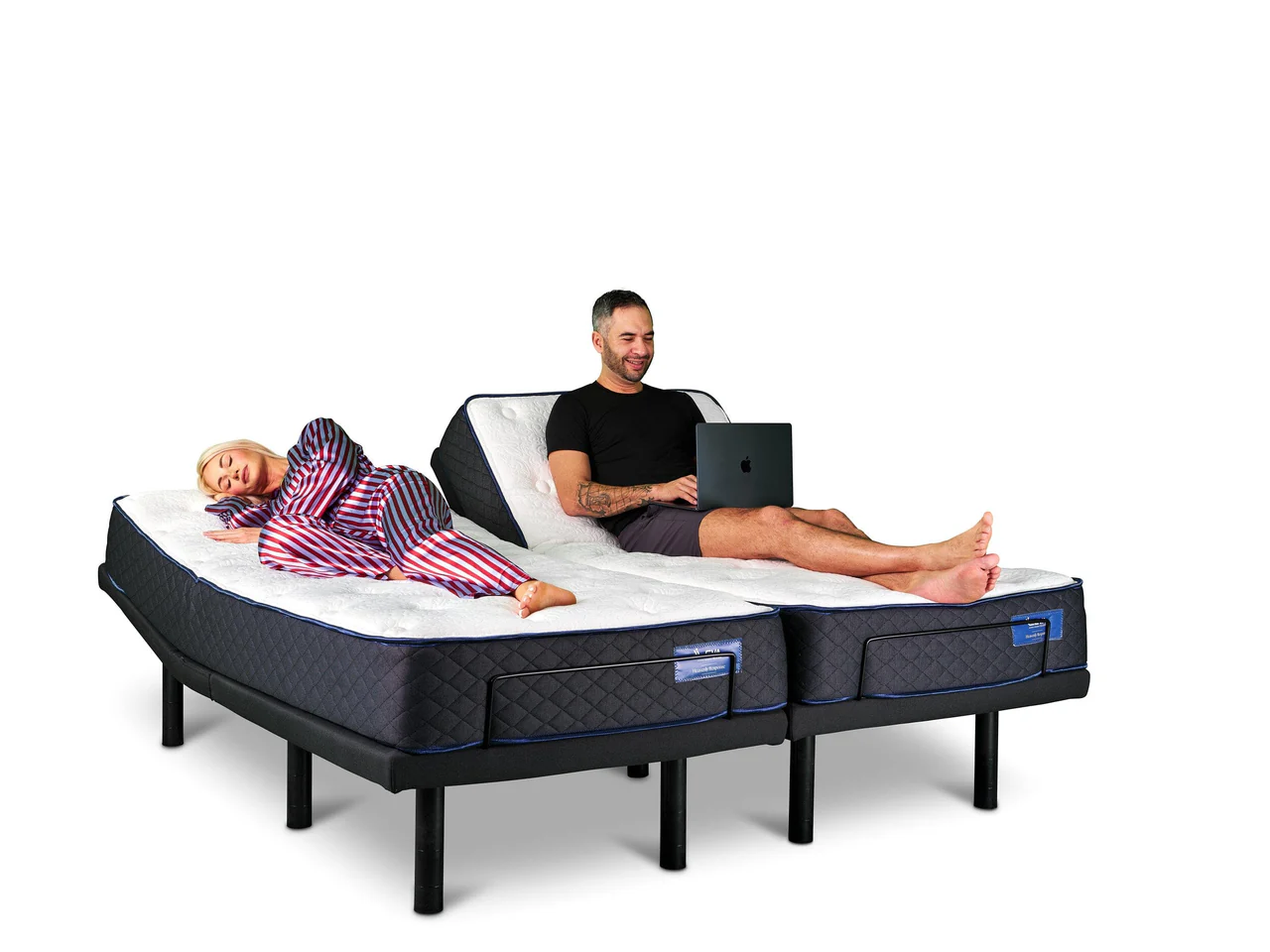
Integrated split systems use two mechanically independent bases inside one shared frame. A split king pairs two Twin XL bases (each 38″ × 80″) for a combined 76″ × 80″ footprint. A split queen pairs two 30″ × 80″ bases inside a standard 60″ × 80″ queen frame, a rare configuration that Leva Sleep builds to specification. Each half has its own motor, its own remote or app, and its own USB ports, so one partner can use zero-gravity while the other sleeps flat.
Comfort, Pain Relief, and Medical Positioning
The zero-gravity preset, with the head raised about 30 degrees and legs slightly elevated, is the most-used position for couples. This position reduces lumbar disc pressure and improves circulation. Lumbar inserts and pillow-tilt motors then fine-tune support for lower-back and neck pain, which helps during post-surgery recovery and with chronic hip or knee issues.
Couples often face a mismatch when one partner needs elevation for a medical reason and the other does not. A single-unit queen or king base moves as one piece, so both partners elevate together even if only one needs it. A true split system removes that link, letting the medical side elevate while the other side stays flat.
Leva Sleep’s adjustable bases include adjustable lumbar support and pillow tilt and pair with foam and hybrid pocket-coil mattresses that flex smoothly through every elevation angle. Explore the complete pain-relief configurations at the La Jolla showroom or online.
Partner Compatibility and Keeping Couples in the Same Bed
A 2024 OnePoll survey found that 82% of people in relationships say their partner’s sleep habits wake them, with 25% blaming tossing and turning. Actigraphy studies show that partner movements can trigger awakenings. Research in Sleep (1994) found that bed partners move together in about one-third of epochs, although that work did not compare flat beds to independent surfaces.
Snoring adds another layer of disruption. A 2024 Sleep Foundation survey reported that 75% of people with a snoring partner say it harms their sleep quality, and 77% say it affects overall well-being. Mayo Clinic data shows that partners of snorers can lose at least an hour of sleep per night. AASM 2023 survey data shows that 35% of Americans occasionally or consistently sleep in another room, and 2025 AASM data reports that 31% of U.S. adults have tried a sleep divorce.
These numbers show how often couples feel forced apart by a shared flat bed. Many choose separate rooms because they must pick between their partner’s presence and their own sleep quality. Split adjustable bases address motion transfer and snoring together by giving each partner independent control, so anti-snore positioning on one side does not disturb the other.
See how Leva Sleep’s split systems keep both partners in the same bed by visiting the La Jolla showroom or exploring configurations online.
Technology That Matters for Couples at Night
Technology features matter most when they solve real nighttime problems for couples. USB port placement affects whether you can charge devices without reaching across your partner. Ports near the side rail by the headboard keep phones and tablets within easy reach, and each half should have its own ports. Check whether a base offers USB-A, USB-C, or both, and confirm that each side has dedicated charging.
Motor noise becomes critical when one partner adjusts after the other falls asleep. Premium brushless DC motors usually run at 30–40 decibels, similar to a whisper, while budget AC motors often reach 50–60 decibels or more. Research shows that sounds as low as 40 decibels can disturb sensitive sleepers, so a louder motor can wake a partner even when the movement feels gentle. Brushed DC motors also grow louder as carbon brushes wear, while brushless motors keep a more consistent sound profile over time.
The broader industry now focuses on quieter, smoother systems. LOGICDATA introduced the first fully brushless adjustable bed system at the Winter Las Vegas Market 2026 and described it as a complete architectural redesign that lowers noise and improves motion control. Leva Sleep’s bases use whisper-quiet German motors built to the same brushless standard.
Anti-snore technology builds on this independent-control foundation. A peer-reviewed PMC study found that sleeping at a 12° incline for four weeks produced a 7% relative reduction in objective snoring duration compared with flat sleep. Studies show that raising the head 5–12 degrees can reduce snoring and mild sleep apnea severity, with trials at 7.5° and 12° inclines. Leva Sleep’s anti-snore mode, arriving spring 2026, will detect snoring and make small head adjustments on the snoring partner’s side only.
Compare the full technology lineup, including quiet motors, USB options, and the upcoming anti-snore mode, at Leva Sleep’s La Jolla showroom or online.
Setup, Bedding, and Everyday Use
Split systems introduce two everyday challenges for couples: bedding fit and delivery complexity. The seam between halves of a split queen can cause sheets to slip or bunch, especially when one side elevates and the other stays flat. Couples can use a mattress connector strap, two separate 30″ × 80″ fitted sheets with a shared flat sheet or duvet, or specialty split-queen sheets.
Split king setups follow a similar pattern. Standard king fitted sheets do not fit because the system uses two Twin XL mattresses. The base needs either Twin XL sheets or split-king bedding, which costs more and is less common. Leva Sleep designs fitted sheets with deep pockets and extra elastic, duvets with clips, and mattress protectors specifically for adjustable bases, so sheet slippage gets solved at the product level.
Delivery also feels different from a standard frame. Bed-in-a-box brands usually leave a split base at the door and expect the buyer to assemble it. Leva Sleep’s white-glove delivery service, available for a fee, sends trained professionals to assemble the system, set leg heights, walk through controls, and remove the old bed through donation or recycling.
Reliability, Medicare, and Long-Term Value
Motor longevity affects total cost of ownership. Brushless DC motors often cost more than brushed or AC motors but run more smoothly, transfer less vibration to the frame, and keep their noise level more stable over time. Brushed motors rely on carbon brushes that wear down, which can increase noise and reduce performance.
Medicare Part B may cover a hospital bed as Durable Medical Equipment when a physician documents a medical need for positioning that a flat bed cannot provide, such as severe congestive heart failure, chronic obstructive pulmonary disease with head elevation needs, or specific post-surgical positioning. Coverage usually applies to a basic semi-electric or full-electric hospital bed, not to consumer adjustable bases with massage, USB ports, or app control. Consumers remain responsible for about 20% of the Medicare-approved amount after the Part B deductible. Adjustable bases bought for comfort, snoring, or preference do not qualify, so anyone exploring coverage should secure written medical-necessity documentation and work with a Medicare-enrolled DME supplier.
Leva Sleep’s direct-to-consumer model, local assembly, and removal of traditional retail markup deliver luxury engineering at roughly 30–50% less than comparable high-end competitors.
Decision Guide: Matching Your Bedroom to the Right Split Size
Start with your room’s physical limits. If your bedroom fits a queen but not a king, a split queen is your only split-adjustable option at the standard 60″ × 80″ footprint. If your room can handle king dimensions, a split king at 76″ × 80″ gives each partner a 38″-wide surface and access to a broader mattress selection.
Once you know which sizes fit, consider your main sleep disruptions. If one partner snores or has sleep apnea, look for a model with an anti-snore preset or active anti-snore mode on that partner’s side. If motion transfer is the primary complaint, choose any true split configuration with independent actuators and confirm that the bases share no mechanical linkage.
Next, match firmness and medical needs. Both split king and split queen allow different mattresses on each half, so check that the retailer offers compatible pairings in both sizes. If only one partner needs medical elevation, a split system becomes essential because a single-unit base cannot raise one side independently.
Finally, weigh noise, charging, and bedding. If motor noise worries you, focus on brushless DC motors rated around 30–40 dB rather than AC motors at 50–60 dB. If USB access matters, confirm port placement and whether USB-C is included on each half. If sheet slippage has frustrated you before, prioritize a retailer that sells bedding engineered for adjustable bases.
What Are the Disadvantages of Split-King Beds?
Split-king setups introduce several trade-offs. A visible gap can form along the center seam, which some couples dislike when sleeping near the middle. Standard king fitted sheets do not work, so you need Twin XL or split-king sheets, which cost more and are less common. The 76″ × 80″ footprint usually requires a room of about 12 × 12 feet, which rules out smaller spaces. Buying two full mattresses instead of one also raises total mattress cost compared with a standard king.
How Do You Connect Two Adjustable Bases Without Wi-Fi?
Most split adjustable bases rely on Bluetooth rather than Wi-Fi for app control. Each half pairs directly with a smartphone or tablet and does not need a home network. Manufacturers usually include a wired or RF remote for each side as a backup that works without any wireless connection.
Some systems also support synchronized movement, where both halves raise or lower together. A wired sync cable under the frame often handles this function and lets one remote move both sides. Always review the model’s documentation to see whether a sync cable comes in the box or as an accessory and whether Bluetooth control uses a dedicated app or a universal remote.
Does Medicare Cover Adjustable Bases?
Medicare Part B treats a hospital bed as Durable Medical Equipment and may cover it when a physician documents a condition that requires special positioning beyond a flat bed. Examples include severe congestive heart failure, chronic obstructive pulmonary disease that needs head elevation, or post-surgical recovery with specific positioning rules. Approved coverage usually applies to a basic semi-electric or full-electric hospital bed, not to consumer adjustable bases with massage, USB ports, or app control.
Patients typically pay 20% of the Medicare-approved amount after meeting the Part B deductible. Consumer adjustable bases bought for comfort, snoring relief, or preference do not qualify. Anyone considering this route should obtain written medical-necessity documentation and work with a Medicare-enrolled DME supplier before buying.
Conclusion: Choosing Between Split King and Split Queen
Split-king systems give couples the widest personal space and the broadest mattress selection but demand king-sized room dimensions and specialty bedding. Split-queen systems keep the standard queen footprint and serve smaller bedrooms, although mattress options are narrower and the configuration is less common. Both formats deliver independent elevation, USB access, and motor control, which flat beds and single-unit bases cannot match.
Motor noise, bedding compatibility, delivery experience, and specialist support then separate one brand from another. Brushless motors around 30–40 dB, bedding tailored to adjustable bases, and white-glove setup remain differentiators rather than standard features.
Visit Leva Sleep’s La Jolla showroom or shop online to compare split-queen and split-king configurations, test whisper-quiet German motor systems, and see how independent sleep can still keep both partners in the same bed.
Frequently Asked Questions
Can a split-queen adjustable base use standard queen bedding?
Split-queen setups often challenge standard bedding. The seam between the two mattresses can cause sheets to slip or bunch, especially when one side elevates. The most reliable options include specialty split-queen fitted sheets with reinforced elastic or two separate 30″ × 80″ fitted sheets under a shared flat sheet or duvet.
Leva Sleep designs bedding specifically for adjustable bases, including deep-pocket fitted sheets with extra elastic and duvets with clips that keep each side in place at different angles. Buying bedding from the same specialist that supplies the base removes much of the trial and error with generic sheets.
How loud are adjustable bed motors, and does it matter for couples?
Motor noise matters because one partner often adjusts position after the other falls asleep. Brushless DC motors, the current premium standard, typically run at 30–40 decibels, similar to a quiet whisper. Budget AC motors can reach 50–60 decibels or higher, which can wake light sleepers.
Research shows that sounds as low as 40 decibels can disturb sensitive sleepers, so a louder motor at 2 a.m. can interrupt rest even if the movement feels smooth. Brushed motors also grow louder as their carbon brushes wear. Brushless motors avoid that wear mechanism and keep a more consistent sound level over the life of the base. Leva Sleep uses whisper-quiet German motors built to brushless standards, and LOGICDATA’s 2026 brushless architecture launch confirms that the industry is moving the same way.
Does elevating the head of an adjustable bed actually reduce snoring?
Head elevation can reduce snoring for people whose snoring is positional, meaning soft tissue falls back into the airway when they lie flat. A gentle incline shifts those tissues forward and helps keep the upper airway open. A peer-reviewed in-home study published in PMC compared four weeks of flat sleep to four weeks at a 12° incline and found a 7% relative reduction in objective snoring duration.
The general recommendation for breathing comfort ranges from 10–20° of upper-body elevation, with 12–15° working well for many sleepers. Elevation does not treat obstructive sleep apnea, which requires medical evaluation. Loud snoring with gasping, choking, or pauses in breathing calls for a sleep study rather than positional changes alone. For positional snorers, a split adjustable base lets the snoring partner elevate independently. Leva Sleep’s anti-snore mode, arriving spring 2026, will automate this by detecting snoring and adjusting only the affected side.
What is the difference between a split-queen and a split-king adjustable base, and which is better for couples?
A split-queen uses two 30″ × 80″ bases inside a standard 60″ × 80″ frame, which suits bedrooms that cannot fit a king. A split-king uses two Twin XL bases at 38″ × 80″ each for a 76″ × 80″ footprint, giving each partner more width but requiring a larger room, usually around 12 × 12 feet.
The better choice depends on room size, preferred width, and mattress availability. Split-king mattresses are widely available because Twin XL is a standard size. Split-queen mattresses are less common and often built to specification, an area where Leva Sleep specializes. Both configurations provide independent head and foot elevation, USB ports, and motor control for each partner.
Is white-glove delivery worth the additional cost for an adjustable base?
Split adjustable bases are more complex to set up than standard frames. A full system includes two bases, two mattresses, a shared frame, sync cables or wireless pairing, leg-height choices, and bedding configuration. Incorrect assembly can leave bases misaligned, legs uneven, or sync features not working.
White-glove delivery from Leva Sleep, available for a fee, sends trained professionals to handle setup, adjust leg heights, explain the app and remotes, and remove the old bed through donation or recycling. For couples treating a split adjustable system as a long-term health investment, this service usually represents a small share of the total cost and helps the bed perform correctly from the first night.