
Written by: Matthew Timmins, Founder and Managing Director, Leva Sleep
Key Takeaways for Couples
- Aireloom offers no brand-level sleep trial, so all return and exchange terms depend on the retailer’s policy, which often includes fees and limits.
- Most couples discover firmness or motion mismatches after the break-in period, so early impressions feel unreliable and returns become expensive.
- Retailer policies like Mattress Firm’s 120-night trial require a 30-night minimum before any exchange and charge a $249.99 fee, which restricts flexibility if partners disagree.
- Split adjustable sleep systems reduce trial risk by letting each partner control firmness, motion isolation, and head or foot elevation on their own side.
- Leva Sleep’s split adjustable systems give couples customizable comfort with less financial exposure to retailer return policies.
How Mattress Firm and Other Retailers Handle Aireloom Trials
Aireloom sets no universal trial, so the policy a couple receives depends entirely on where they buy. The table below reflects Mattress Firm’s published 120-night sleep trial terms. Policies at Bloomingdale’s, Sit ‘n Sleep, Macy’s, and independent luxury retailers differ and should be verified directly with each retailer before purchase, because terms can change without notice.
| Retailer | Trial Length | Exchange Fee | Return / Refund Option |
|---|---|---|---|
| Mattress Firm | 120 nights (30-night minimum before requesting) | $249.99 return processing fee per exchange or return under the 120 Night Sleep Trial | One return after one exchange, fee applies, certain items may be excluded |
| Bloomingdale’s | Verify directly with retailer | Verify directly with retailer | Verify directly with retailer |
| Sit ‘n Sleep | Verify directly with retailer | Verify directly with retailer | Verify directly with retailer |
| Macy’s | Verify directly with retailer | Verify directly with retailer | Verify directly with retailer |
What Happens When One Partner Dislikes the Feel After Two Weeks
At Mattress Firm, the answer is straightforward but restrictive. The 120-night trial requires a minimum 30 nights of use before any exchange request is accepted. A couple who discovers a mismatch at two weeks must continue sleeping on the mattress for at least another two weeks before the policy activates.
After that waiting period, one exchange is permitted for a $249.99 return processing fee. If the replacement also fails to satisfy both partners, a return is available for an additional fee, but only for the replacement mattress’s purchase price minus applicable state use taxes. Certain items may be excluded from the trial entirely, which further limits options.
The 30–60 Day Break-In Reality and Motion Isolation Performance
Most new mattresses need a break-in period before they feel as intended. Industry guidance describes a 30-to-90-day break-in period, with the exact timeline varying by construction. Innerspring models may settle in roughly two to four weeks. Hybrids typically require 30 to 60 days, and memory foam can take up to 90 days to reach its intended feel. Up to 70% of comfort exchanges occur within the first month, often before the mattress has fully softened.
For couples, this timing creates a compounding problem. One partner may form a strong negative impression during the first two weeks, exactly when the mattress is still changing. Body type also affects the timeline, because heavier sleepers break in a mattress faster while lighter sleepers may need more time. When two people with different body weights share the same surface, their individual break-in experiences diverge. Early joint evaluations then feel unreliable for both partners.
Motion isolation adds another variable that couples cannot judge in a single showroom visit. NCOA evaluation of over 130 mattress models found that motion isolation scores vary, with some hybrids allowing enough movement to disturb light sleepers sharing the bed. Couples who prioritize undisturbed sleep only see the real motion performance after both partners have slept on the mattress through their normal movement patterns for several weeks.
Firmness Mismatch and Temperature Differences for Couples
Beyond motion transfer, couples face a more fundamental challenge: agreeing on a single firmness level. Industry testing of hundreds of mattresses shows roughly 80% of people prefer a feel in the 5 to 7 range, but that still leaves meaningful variation within that band. A partner who needs a 5 and a partner who needs a 7 share the same surface, and neither receives ideal support.
A 2015 review in Sleep Health found that body mass significantly affects how a mattress surface is perceived. A 150-pound side sleeper and a 230-pound back sleeper compress the same mattress to different depths. That compression difference translates into different spinal alignment outcomes for each partner, even on the same mattress model.
Temperature regulation creates a parallel challenge. One partner sleeping hot and one sleeping cold cannot resolve that conflict on a single flat mattress surface. Once a mattress is purchased and the trial window has closed, neither firmness nor temperature can be adjusted in any meaningful way. The only options are accessories that partially compensate or an exchange that resets the clock and the fees.
How Split Adjustable Sleep Systems Reduce Couple Sleep Risk
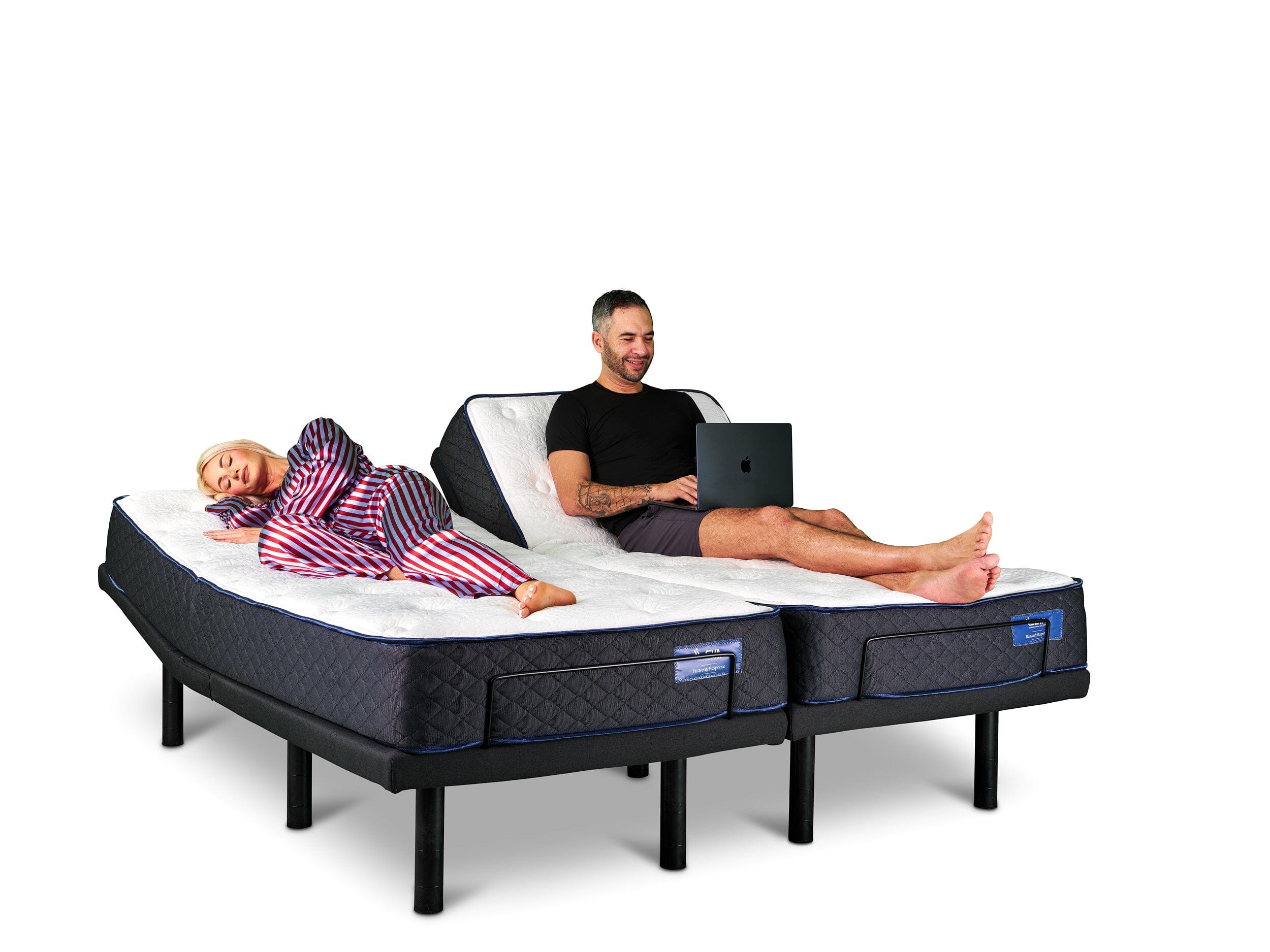
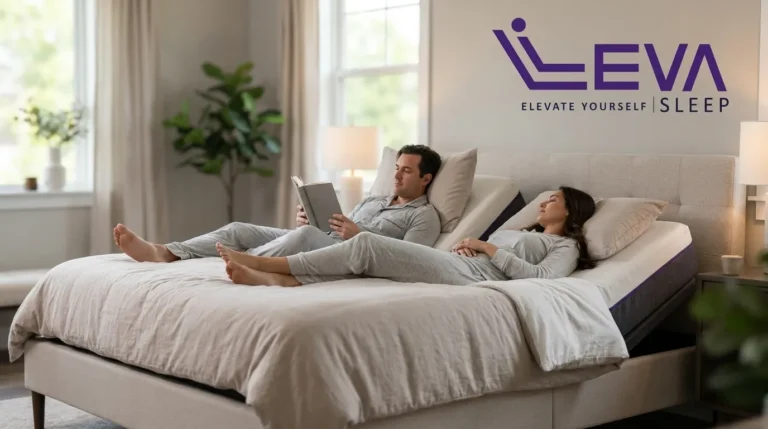
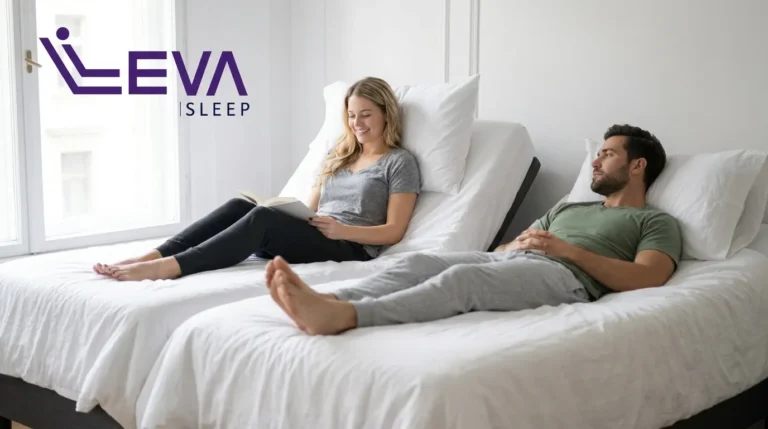
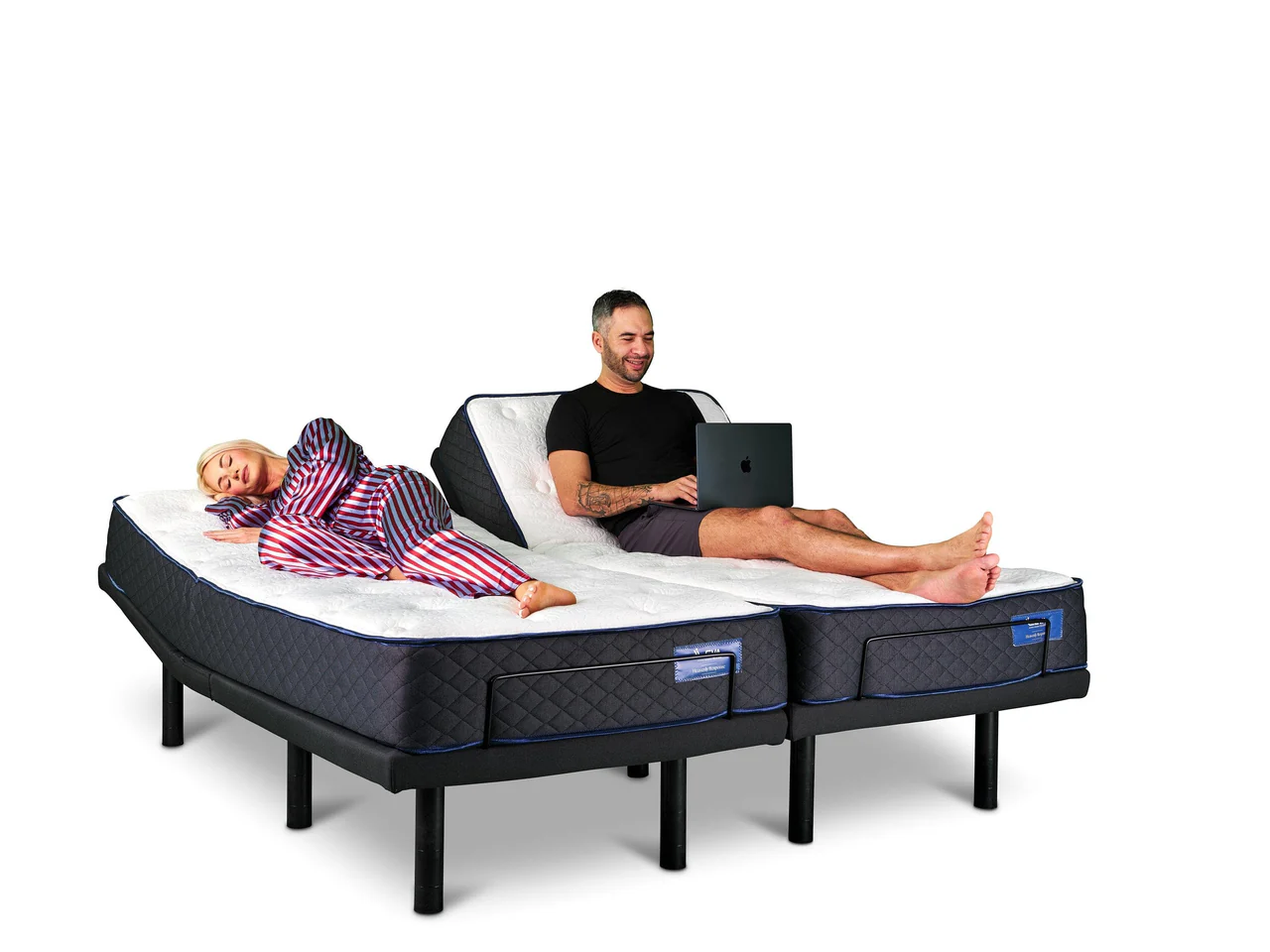
A split adjustable sleep system tackles firmness mismatch, motion transfer, temperature differences, and positional needs at the same time. The system does this without forcing both partners to agree on a single configuration. Each side of the bed operates independently, so comfort decisions stay personal.
A Split King adjustable bed uses two Twin XL mattresses placed side by side on two independent bases, forming a standard King footprint of 76 by 80 inches. Each partner selects their own mattress type and controls head and foot elevation separately. Elevating the head six to eight inches reduces acid reflux symptoms by using gravity to prevent stomach acid from traveling up the esophagus. Raising the head a few degrees can also reduce snoring while the other partner remains flat.
| Factor | Traditional Flat Mattress Trial | Split Adjustable Sleep System |
|---|---|---|
| Firmness customization | One firmness for both partners, exchange required to change | Each partner selects independent firmness on their own mattress |
| Policy risk | Exchange fees apply, for example the $249.99 return processing fee at Mattress Firm, and trials often limit exchanges | Preference mismatch resolved through independent controls, not returns |
| Positional adjustment | Fixed flat surface, no elevation options | Independent head and foot elevation per side, including Zero Gravity preset |
| Long-term adaptability | Fixed, new purchase required if needs change | Position and firmness adjustable as health needs evolve over time |
Leva Sleep offers 15 to 20 adjustable base models, compared to the three to five typically available at general mattress retailers. Every mattress in Leva’s lineup is designed to pair with an adjustable base, and the system ships with white-glove delivery and professional setup available as an option.
Practical Evaluation Guidance for Couples
Couples make better decisions when they evaluate a few practical factors before any premium mattress purchase. Room dimensions come first, because they determine whether a Split King, which measures 76 by 80 inches, or a Split Queen configuration fits the space. That size decision then shapes which mattress and base options stay on the table.
Once size is clear, partner height and weight differences become the next priority. These differences affect mattress compression and break-in timelines, since heavier sleepers compress and soften a mattress faster than lighter ones. Couples then understand that they will experience different comfort curves even on identical mattresses.
Existing medical recommendations for elevated sleeping positions sit alongside these comfort factors. Conditions such as sleep apnea, acid reflux, or post-surgical recovery respond better to an adjustable base than to a flat mattress. For couples with these needs, a split adjustable system shifts from a preference to a functional requirement.
White-glove setup also affects how the first nights feel. Adjustable bases involve base assembly, mattress placement, leg height calibration, app pairing, and accessory fitting. A professional setup ensures every component works correctly from the first night and removes trial-and-error that can distort early comfort impressions.
Research on Spinal Alignment, Pressure Relief, and Partner Dynamics
The Canadian Chiropractic Association identifies improper sleep surface support as a common contributor to morning back pain. For couples sharing a flat mattress, the support compromise is structural. The surface tuned for one partner’s body weight and sleep position rarely suits the other partner equally well.
The Zero Gravity preset on a split adjustable base elevates both the head and legs above the heart, which reduces lower back pressure. This benefit applies independently to each partner without requiring the other to adopt the same position. The Feet Up position uses gravity to improve circulation and reduce leg swelling. Partners with different circulation or mobility needs can share the same bed while using different settings.
The same NCOA evaluation found that motion isolation performance varies substantially across the premium segment, with memory foam constructions generally outperforming hybrids on motion absorption. Couples who care about undisturbed sleep should review motion isolation scores for specific models rather than relying on broad category labels.
Frequently Asked Questions
Does Aireloom offer its own sleep trial directly to consumers?
Aireloom does not publish a brand-level sleep trial or return policy. All trial terms, exchange rights, and return fees are determined by the retailer selling the mattress. Couples purchasing Aireloom through any carrier should request the specific written policy for their mattress model and size before completing the transaction, because terms vary by retailer and can change without notice.
Can a couple get a full refund if both partners dislike an Aireloom mattress?
Refund availability depends entirely on the retailer’s policy. At Mattress Firm, for example, a refund is only available after one exchange has already been completed, with the same processing fee applying to both transactions. Some retailers may offer more flexible terms, while others may limit customers to exchanges only. Couples should confirm refund eligibility, fee structures, and any size or model exclusions before purchase.
How does a split adjustable sleep system compare in price to a premium flat mattress like Aireloom?
Aireloom mattresses sit at the luxury end of the market, with prices that vary by model and retailer. A split adjustable sleep system from Leva Sleep includes both the adjustable bases and compatible mattresses. Leva’s direct-to-consumer model aims to deliver premium quality at 30 to 50% less than comparable high-end competitors by removing retail markups. The total investment covers two independent sleep surfaces, adjustable bases, and optional white-glove setup, which creates a more complete solution than a flat mattress alone.
Will a split adjustable base work with my existing bed frame or bedroom furniture?
Split adjustable bases are self-supporting and do not require a traditional bed frame, though they can pair with compatible platform frames or headboards. The Split King configuration measures 76 by 80 inches, matching a standard King footprint, while a Split Queen fits a standard Queen footprint. Couples should measure their bedroom and confirm headboard attachment compatibility before ordering. Leva Sleep’s white-glove delivery team adjusts leg heights and confirms fit during setup.
When should a couple consult a physician before purchasing an adjustable sleep system?
Couples managing diagnosed conditions such as sleep apnea, acid reflux, post-surgical recovery, deep vein thrombosis, or chronic spinal conditions should consult their physician or physiotherapist before selecting a sleep system. A medical professional can provide specific elevation angle recommendations or identify contraindications for certain positions. Leva Sleep’s adjustable bases accommodate a wide range of medically recommended positions, but the appropriate configuration for a specific condition should be confirmed with a qualified healthcare provider.
Conclusion: Matching Sleep Systems to Both Partners’ Needs
Aireloom mattresses deliver a genuine premium product, yet the absence of a brand-level trial means couples absorb whatever policy risk their retailer imposes. At major carriers, that risk includes mandatory break-in waiting periods, per-transaction exchange fees, and limits on the number of exchanges permitted. For couples whose preferences diverge after delivery, the financial and logistical exposure becomes significant.
A split adjustable sleep system removes the core source of that risk. Independent firmness selection, elevation control, and motion isolation mean that neither partner’s comfort depends on the other’s choices. Preference changes over time can be handled through adjustment instead of replacement. Leva Sleep’s specialization in adjustable sleep systems, with its extensive model selection, American-made mattress options, and professional delivery, offers a direct path from mattress uncertainty to a sleep environment that works for both partners.