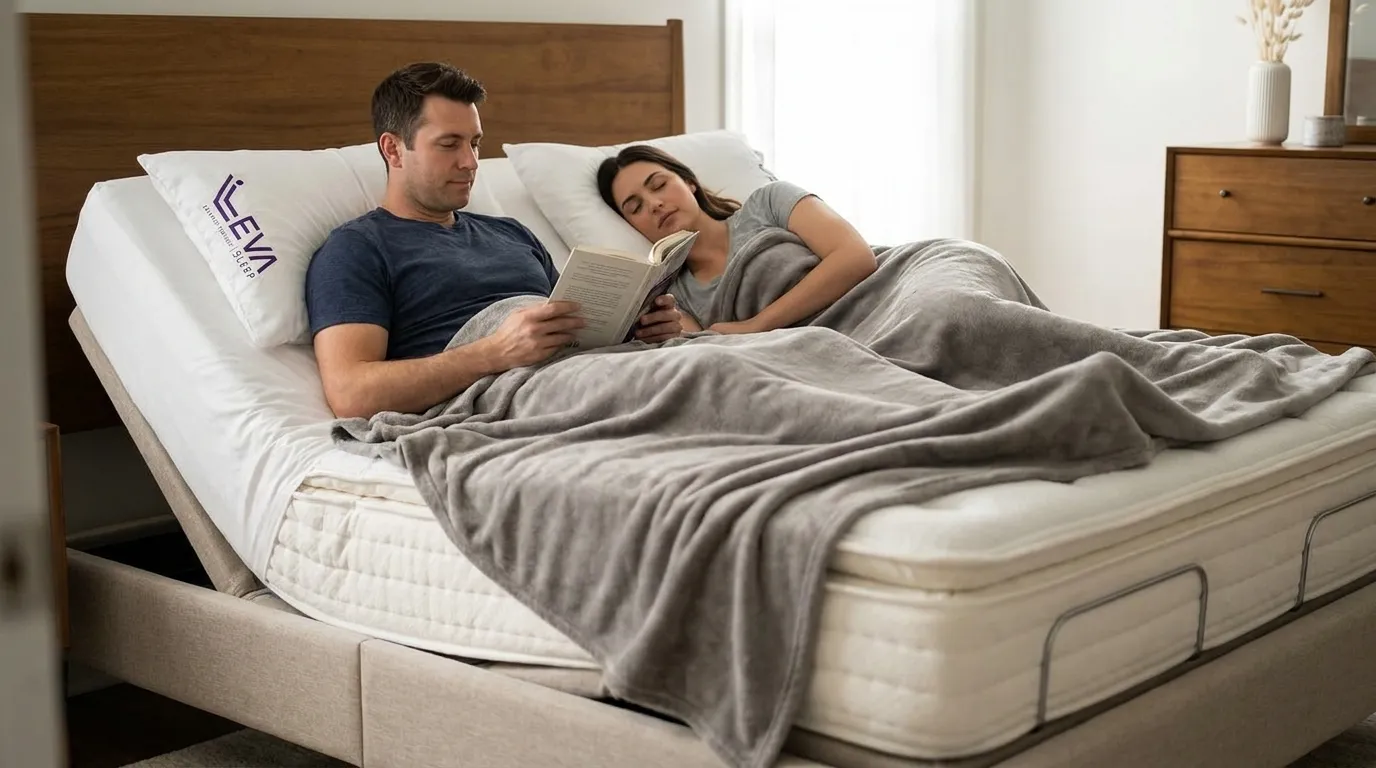
Written by: Matthew Timmins, Founder and Managing Director, Leva Sleep
Key Takeaways
- Passive sleep tracking alone rarely improves sleep quality. Active physical interventions such as temperature regulation and positional adjustments reduce awakenings and snoring.
- Split adjustable bases with independent controls solve core couple issues like snoring, firmness conflicts, and temperature disputes without data fatigue or privacy risks.
- Consumer sleep trackers can reveal patterns but cannot directly improve sleep. Any benefit depends on whether users change physical variables.
- Smart mattresses that collect biometric data raise privacy concerns because HIPAA does not apply. Split adjustable bases collect no biometric data and transmit nothing to corporate servers.
- Leva Sleep’s split adjustable bases deliver independent elevation, temperature, and lumbar support for each partner. Shop online or visit the La Jolla showroom today.
Are Smart Mattresses Worth It?
Smart mattresses fall into two main categories. At one end sit passive trackers that record heart rate, respiration, and movement, then deliver a morning score. At the other end sit active systems that physically change temperature, elevation, or firmness in real time.
A 2026 randomized controlled trial published in Scientific Reports found that a 10-day mindfulness intervention delivered through the Ōura app produced significant improvements in sleep efficiency, total sleep time, and sleep-onset latency relative to wait-list controls. The distinction matters because data visibility alone did not move the needle. Only physical changes to elevation, temperature, or lumbar support reduce awakenings and relieve pain.
For couples weighing a $2,000–$5,000 purchase, the real question is whether a mattress’s active features match their specific pain points, not whether the marketing label calls it “smart.”
See how Leva’s adjustable bases deliver active sleep improvement at the La Jolla showroom.
Hidden Drawbacks of Smart Mattresses
Passive smart mattresses carry three underreported drawbacks. First comes data fatigue. A 2024 American Academy of Sleep Medicine survey found that 81% of adults have lost sleep worrying about sleep problems, a pattern researchers link directly to nightly score-checking.
Second, orthosomnia can develop. Dr. Seema Khosla, medical director of the North Dakota Center for Sleep, warns that fixation on achieving perfect scores can itself cause anxiety-driven insomnia.
Third, engagement often fades. Many users uninstall health apps within the first month, and behavioral benefits disappear without continued active involvement. None of these issues apply to a split adjustable base, which delivers elevation, lumbar support, and temperature changes automatically every night without graphs or habit changes.
Do Sleep Trackers Actually Work?
Consumer sleep trackers can support better habits when paired with coaching or structured programs. Research shows that adults using sleep coaching features can gain additional nightly sleep and fall asleep faster, but the benefit came from coaching, not tracking alone.
Sleep tracker apps cannot directly improve sleep quality. They only reveal patterns, and improvement depends on whether users act on the data. For couples whose core problems are snoring, joint pain, or temperature conflict, acting on data means changing a physical variable, which a split adjustable base handles automatically.
Trackers work best as a diagnostic first step. They do not replace active environmental control.
Explore Leva’s split bases if you are ready to move from tracking to real-time adjustment.
Smart Mattress Privacy Risks in 2026
Sleep Number beds collect more than 8 billion biometric data points every night, and concerns exist around data retention practices. Electronic Frontier Foundation senior staff attorney Lee Tien notes that sleep-tracking data could potentially be interpreted to detect sexual activity.
Even anonymized wearable sensor data can enable re-identification in certain datasets. HIPAA does not apply to consumer smart mattress biometric data, leaving sleep metrics with fewer federal protections than data held by doctors or insurers.
A split adjustable base with independent controls collects no biometric data and sends nothing to a corporate server. This design removes that entire category of privacy risk.
Eight Sleep vs Adjustable Base for Snoring
Eight Sleep’s Pod applies dual-zone temperature changes and can detect snoring to prompt a slight head elevation. That elevation remains limited, and the system is mattress-bound, so couples cannot independently adjust firmness or lumbar support on each side.
Karena Wu, P.T., D.P.T., states that adjustable bases help users with snoring, asthma, gastric reflux, and circulatory issues, and that anti-snore presets work by slightly elevating the head to relieve airway pressure and move the tongue forward. Board-certified sleep medicine physician Lulu Guo, MD, notes that elevating the head by 20 to 45 degrees can significantly alleviate snoring by minimizing throat-tissue collapse and tongue obstruction.
A split adjustable base delivers that elevation independently on each side, pairs with any compatible mattress, and adds lumbar support and zero-gravity positioning that a temperature pod cannot match.
Best Adjustable Bed for Couples in 2026
Couples evaluating adjustable beds in 2026 should focus on independent side control, motor noise, mattress compatibility, and anti-snore capability. Lulu Guo, MD, states that compromising on bed type can mean sacrificing critical elements of sleep health, as a poorly suited mattress may lead to restless nights, chronic pain, or exacerbated posture issues.
Leva Sleep offers a wide selection of adjustable base models compared to those found at general mattress retailers. Features include whisper-quiet German motors, lumbar control, pillow tilt, and an anti-snore mode that detects snoring and makes micro head-elevation adjustments.
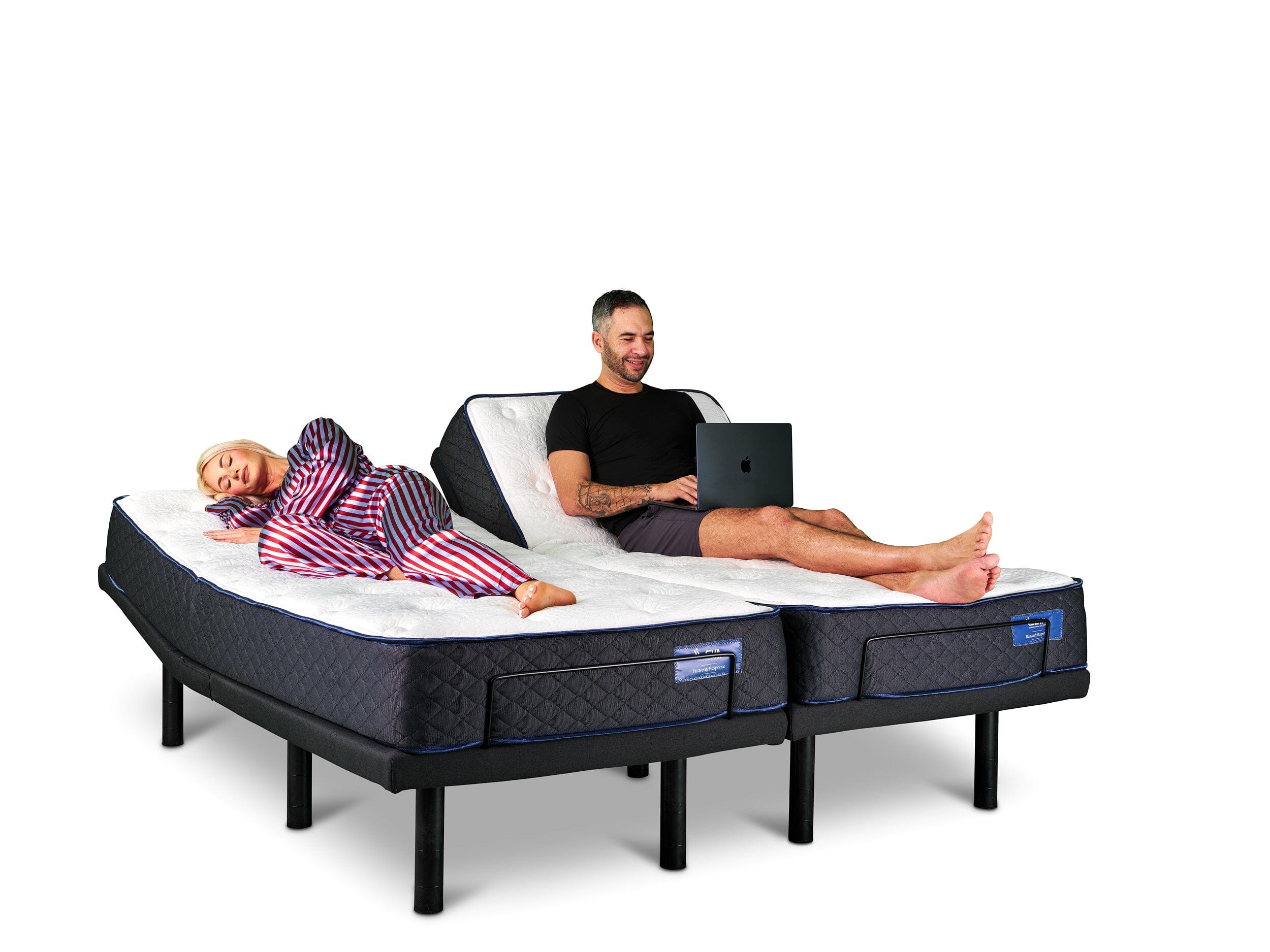
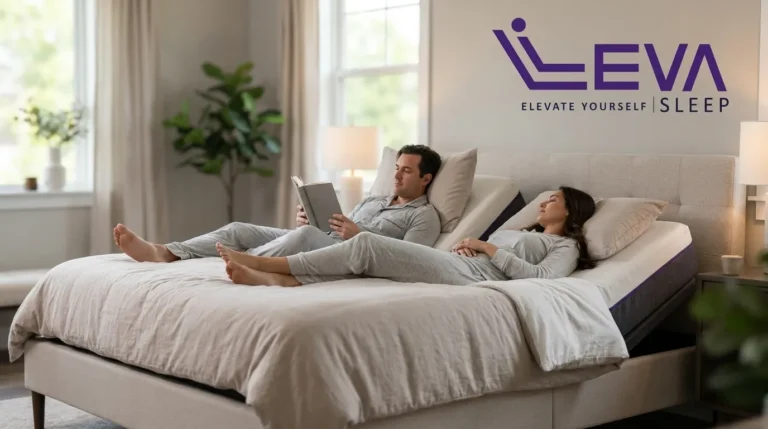
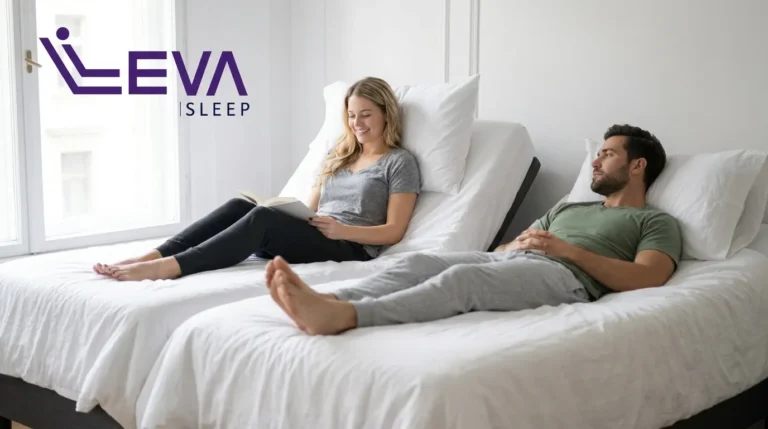
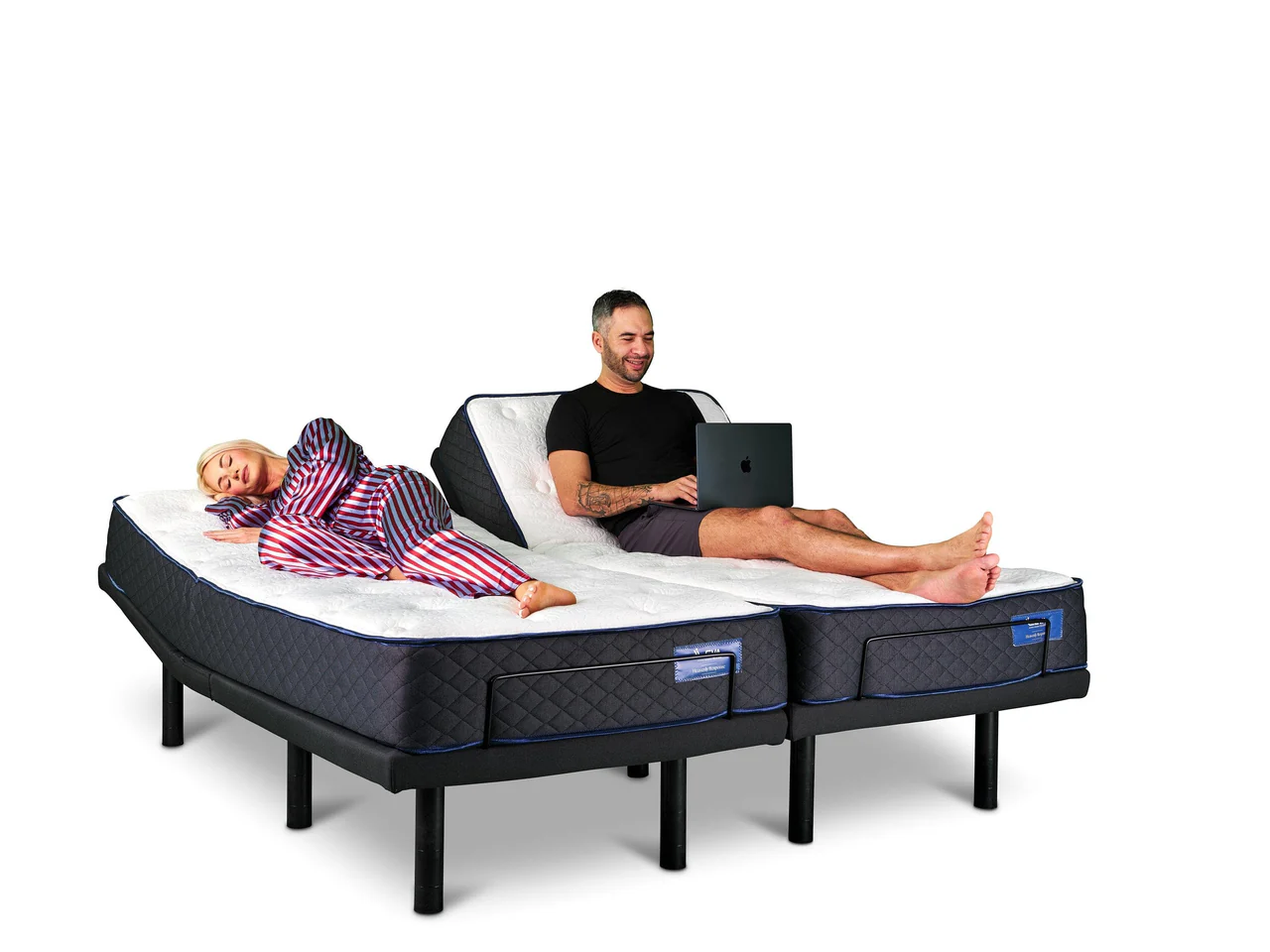
Split Queen and Split King configurations allow each partner to set elevation, massage intensity, and temperature independently without disturbing the other side.
Sleep Tracking vs Adjustable Base
Common sleep disruptors such as temperature instability, partner movement, snoring, and overheating during REM cannot be resolved by passive data collection alone and require active intervention. Users evaluating temperature interventions can test bedroom temperature settings around 64°F to see whether this change increases deep sleep duration.
Sleep tracking identifies what is wrong. An adjustable base fixes it. For couples with snoring, firmness conflicts, or joint pain, the adjustable base addresses root causes directly.
Comfort and Pain Relief
Passive pressure mapping shows where pressure points exist but does not remove them. Active lumbar support and zero-gravity positioning do.
Karena Wu, P.T., D.P.T., recommends the zero-gravity position, a 120-degree angle between thighs and torso, to take pressure off the pelvis and backbone for lower-back pain sufferers. A feasibility study on air-cell-based smart mattresses found that active adjustments reduced pressure-induced discomfort and improved sleep posture, which translated into fewer awakenings.
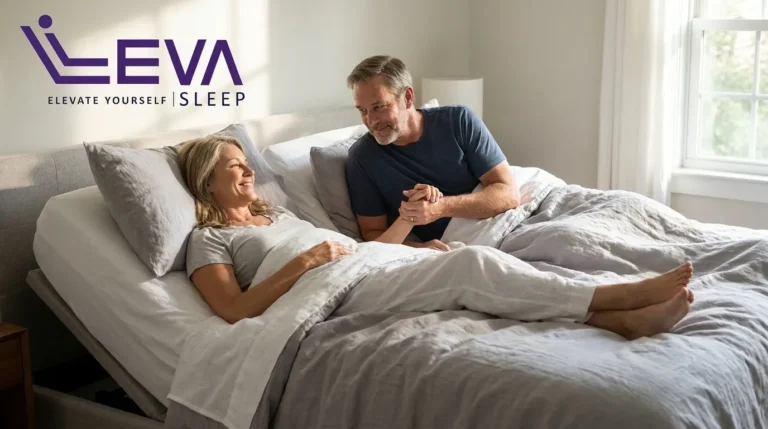
Leva’s adjustable bases include adjustable lumbar support and a pillow tilt motor, so each partner can dial in a position that relieves their specific pain without affecting the other side of the bed.
Partner Independence
Many couples argue about mattress firmness, and AASM data shows that roughly one-third of Americans occasionally or consistently sleep separately, often due to snoring. Shared sleep-score dashboards do not resolve these conflicts. Independent controls do.
Leva’s Split King and Split Queen bases give each partner a separate remote and app profile, controlling elevation, massage, and temperature independently. A 2023 Journal of Sleep Research study examined dyadic sleep hygiene in couples and its links to sleep quality, emotional distress, and conflict frequency, but reported no specific percentages for relationship satisfaction or conflict resolution.
Snoring and Airway Positioning
One of the most common reasons couples need independent controls is snoring. Mayo Clinic research indicates that partners of snorers lose at least one hour of sleep per night, or 365 hours annually, which equals nearly 15 full days of sleep deprivation per year.
Post-sleep snoring graphs confirm the problem but do not stop it. Leva Sleep’s 2026 anti-snore mode detects snoring acoustically and makes micro head-elevation adjustments in real time without waking either partner. As Dr. Guo noted earlier, this elevation keeps airways open by preventing the throat-tissue collapse that causes snoring.
Because the adjustment occurs only on the snoring partner’s side, the other partner’s sleep position stays undisturbed.
Temperature Regulation for Couples
No AASM document directly cites 65–68 °F. Secondary sources associate the range and a 1–2 °F core-temperature drop with NSF and AASM guidance without quoting an official AASM statement.
Dual-zone cooling pods attached to a fixed mattress regulate temperature but cannot change position, firmness, or lumbar support. Leva’s split adjustable systems pair with heating and cooling pads on each side independently, so one partner can sleep warm while the other sleeps cool, without either side affecting the other’s elevation or massage settings.
This combination addresses temperature conflict and positional needs at the same time, which no passive tracker or temperature-only pod can match.
Value and Privacy Comparison
The following table summarizes how passive data collection compares to active adjustment across the features that matter most for couples. It shows why adjustable bases address root causes while trackers only identify problems.
| Feature | Passive Data (e.g., under-mattress sensor) | Active Adjustment (e.g., split adjustable base) |
|---|---|---|
| Snoring response | Records snoring events, user must act manually afterward | Anti-snore preset elevates head automatically during snoring event |
| Temperature control | Some active pods adjust temperature per side, passive sensors only report | Independent heating and cooling pad per side, no biometric data transmitted |
| Pain relief | Pressure mapping identifies pain points, no active repositioning | Zero-gravity and lumbar control actively reduce spinal pressure |
| Biometric data collection | Continuous transmission to company servers, indefinite retention possible | No biometric sensors, no data transmitted to third parties |
| HIPAA protection | Not covered, consumer sleep data falls outside HIPAA | Not applicable, no health data collected |
| Partner independence | Shared dashboard, one score per bed or per side app profile | Fully independent elevation, firmness, and temperature per side |
| Motor noise | Not applicable | Whisper-quiet German motors (Leva Sleep specification) |
Leva Sleep’s direct-to-consumer model removes retail markups, delivering premium engineering at 30–50% less than comparable luxury competitors. White-glove delivery includes setup, height adjustment, product tutorial, and removal of the old bed.
Decision Checklist for Your Next Bed
The comparison above shows what adjustable bases can do. Now use the following checklist to determine which specific features you need. Each pain point maps directly to a feature that solves it.
- Snoring disrupts your partner’s sleep: Require an anti-snore mode with real-time micro head-elevation on the snoring partner’s side only.
- Lower back or hip pain: Require zero-gravity positioning and adjustable lumbar support, independently controllable per side.
- One partner sleeps hot, the other cold: Require split temperature regulation with heating and cooling pads independently controlled per side.
- Different firmness preferences: Require a Split King or Split Queen configuration with separate mattress surfaces and independent elevation.
- Mild sleep apnea or GERD: Require head elevation of 20–45 degrees on one side without affecting the other partner’s position.
- Privacy concerns about biometric data: Avoid systems with continuous biometric transmission and choose bases with no embedded health sensors.
- Noisy or jerky motors from a previous adjustable base: Require whisper-quiet motor certification and an in-person demonstration before purchase.
- Poor delivery experience in the past: Require white-glove in-home setup with trained technicians, not drop-ship assembly.
Frequently Asked Questions
How loud are Leva Sleep adjustable base motors during nighttime adjustments?
Leva Sleep adjustable bases use whisper-quiet German motors engineered to minimize noise during position changes. Basic adjustable bases sold as retail add-ons often use lower-grade motors that produce audible grinding or clicking, but Leva’s motors are selected for acoustic performance.
The anti-snore mode makes micro-adjustments gradually, which further reduces any perceptible sound. Couples who have previously been disturbed by noisy motors on entry-level bases consistently report that Leva’s systems operate without waking the non-adjusting partner.
What is the delivery and setup process, and how long does it take?
Leva Sleep offers white-glove delivery for a fee. Trained professionals deliver directly to the bedroom, assemble the adjustable base and mattress, adjust leg heights to the customer’s preference, connect and configure the app, provide a full product tutorial, and remove and donate or recycle the old bed.
The entire in-home process typically takes one to two hours. Customers do not need to manage curbside drop-off or any assembly themselves. Scheduling is coordinated directly with Leva’s delivery team, and real-time adjustments can be made during the visit.
Which mattresses are compatible with Leva Sleep adjustable bases?
Leva Sleep designs its adjustable bases to work with all-foam and hybrid pocket-coil mattresses. The company curates a lineup of compatible mattresses from premium brands including Airloom, Helix Sleep, Diamond Mattress, Tempur-Pedic, Kingsdown, Serta, and Simmons, all available paired with Leva’s proprietary bases.
Mattresses must be flexible enough to articulate with the base through head and foot elevation. Leva’s sleep specialists can advise on compatibility for mattresses purchased elsewhere. Leva also designs specialized bedding, including fitted sheets with deep pockets and extra elastic, duvet clips, and mattress protectors, to prevent slippage during elevation.
Can a split adjustable base help with sleep apnea, and does insurance cover it?
Elevating the head of the bed is a recognized positional therapy for mild to moderate obstructive sleep apnea and is frequently recommended by physicians as a complement to or alternative to CPAP for positional sleepers. Leva Sleep’s adjustable bases allow head elevation of up to 45 degrees independently on each side.
Insurance reimbursement for adjustable bases as a sleep-apnea intervention varies by plan and requires a physician’s letter of medical necessity. Leva Sleep recommends consulting your physician and insurance provider before purchase if you intend to seek reimbursement. Leva’s team can provide product documentation to support a reimbursement request.
What happens to software and app support over the long term?
Leva Sleep controls its product design and software development in-house, so updates and feature additions do not depend on a third-party platform. The Leva Sleep app, available via Bluetooth, supports custom sleep position presets, vibrating alarms, and anti-snore mode controls.
Because Leva assembles its systems locally and maintains direct customer relationships, software support stays tied to the company rather than a retail intermediary. Customers with questions about app updates or feature availability can contact Leva directly through the website or La Jolla showroom, where specialists provide current information on the product roadmap.
Conclusion
Passive sleep tracking identifies problems, while active positional and temperature adjustment solves them. For couples navigating snoring, firmness conflicts, joint pain, or temperature disputes, a split adjustable base with independent controls delivers measurable nightly relief without generating biometric data, requiring behavioral change, or producing data fatigue.
The 2026 Alyafei et al. meta-analysis confirms that passive-sensing interventions show the greatest utility in cognitively vulnerable populations and calls for further research on long-term real-world outcomes in general adult populations. That gap already exists, while active physical adjustment serves healthy couples with common sleep conflicts today.
Leva Sleep’s Split King and Split Queen systems, whisper-quiet German motors, lumbar control, 2026 anti-snore mode, and white-glove delivery provide a complete, privacy-respecting alternative to tracking-first smart mattresses at 30–50% less than comparable luxury competitors. Experience these features in person at the La Jolla showroom or shop Leva Sleep online.