Written by: Matthew Timmins, Founder and Managing Director, Leva Sleep
Key Takeaways for Snoring Relief With Adjustable Beds
- Adjustable bed bases reduce snoring by elevating the head 10°–30°, which opens the airway and limits soft-tissue collapse during sleep.
- Split configurations give each partner independent control, so one sleeper can use an anti-snore angle while the other remains flat.
- Automatic snore-detection technology, such as Leva Sleep’s 2026 mode, triggers micro-adjustments without manual activation or partner disruption.
- Medium-firm memory-foam or hybrid mattresses flex correctly with adjustable bases and keep the spine aligned at elevated angles.
- Leva Sleep’s split king and split queen systems combine whisper-quiet motors, U.S.-made mattresses, and upcoming automatic anti-snore mode at 30–50% below premium competitors. Shop Leva Sleep today to start reducing snoring together.
How Adjustable Beds Help Reduce Snoring
Snoring occurs when relaxed soft tissue in the throat partially blocks the airway during sleep, which causes turbulent airflow and vibration. Lying flat increases this collapse. Clinical studies show that head elevation can reduce sleep apnea events and snoring.
Adjustable bases do not cure obstructive sleep apnea and do not replace CPAP therapy in diagnosed moderate-to-severe cases. The anti-snore preset is not a substitute for CPAP for diagnosed sleep apnea but helps with milder cases or occasional snoring. Anyone with suspected sleep apnea should consult a physician before relying solely on positional therapy. For the large group of positional snorers, whose snoring worsens when lying flat, controlled head elevation offers a well-supported, non-invasive option.
Best Adjustable Bed Position to Reduce Snoring
Once head elevation is part of your snoring plan, the next step is finding the right angle. Many people find their ideal snoring-reduction angle with an adjustable base that offers precise degree control through a wireless remote or app. At lower angles, the airway opens enough to reduce snoring without placing too much strain on the neck or lower back.
Angles above 25° can increase neck flexion and may cause discomfort over a full night unless the mattress and pillow setup support the elevated position. Elevating the head with an adjustable bed can reduce sleep apnea episodes in positional apnea cases by helping keep airways open during sleep. Most snorers can start at 10°–15°, track comfort and snoring changes for one to two weeks, then increase gradually toward 20° if needed.
Mattress firmness affects this fine-tuning. A mattress that is too soft can cause the hips to sink, misaligning the spine and placing pressure on the neck, which works against neutral spinal alignment during head elevation on an adjustable base.
Best Adjustable Bed Setup for Snoring Couples
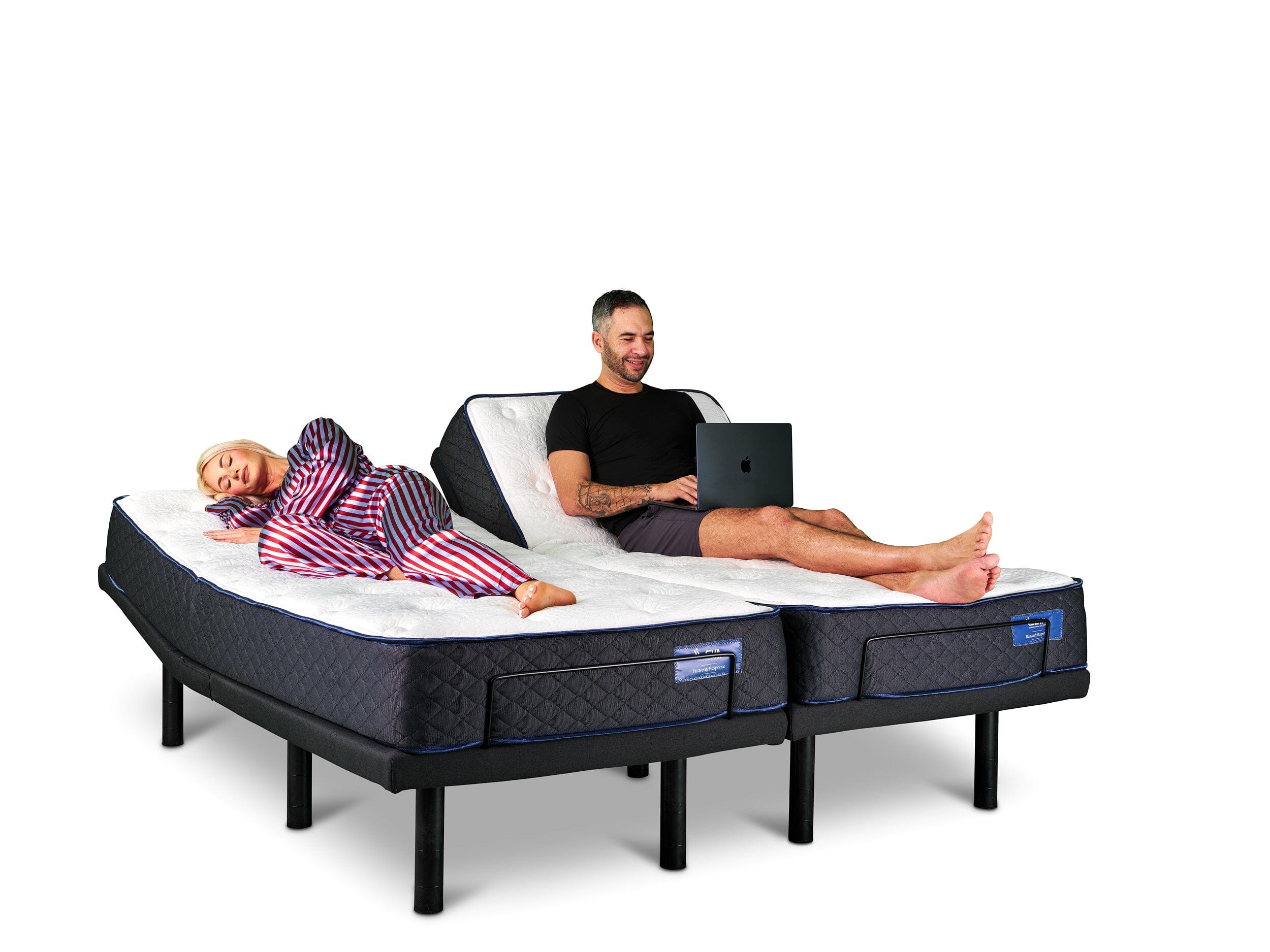
A split king adjustable bed base consists of two independent Twin XL platforms, each measuring 38 × 80 inches, with its own motor system, remote control, and preset memory, so each sleeper can adjust head incline without affecting the other side. This design solves the core couple problem. The snoring partner can elevate to their ideal angle while the non-snoring partner sleeps flat or chooses a different position.
Split queen configurations use the same independent-control concept in a smaller footprint, which works well in bedrooms where a split king is too wide. This size flexibility matters because most manufacturers only offer split configurations in king size, which leaves couples in smaller rooms without independent-control options. Leva Sleep fills this gap by offering split queen adjustable bases built to customer specifications.
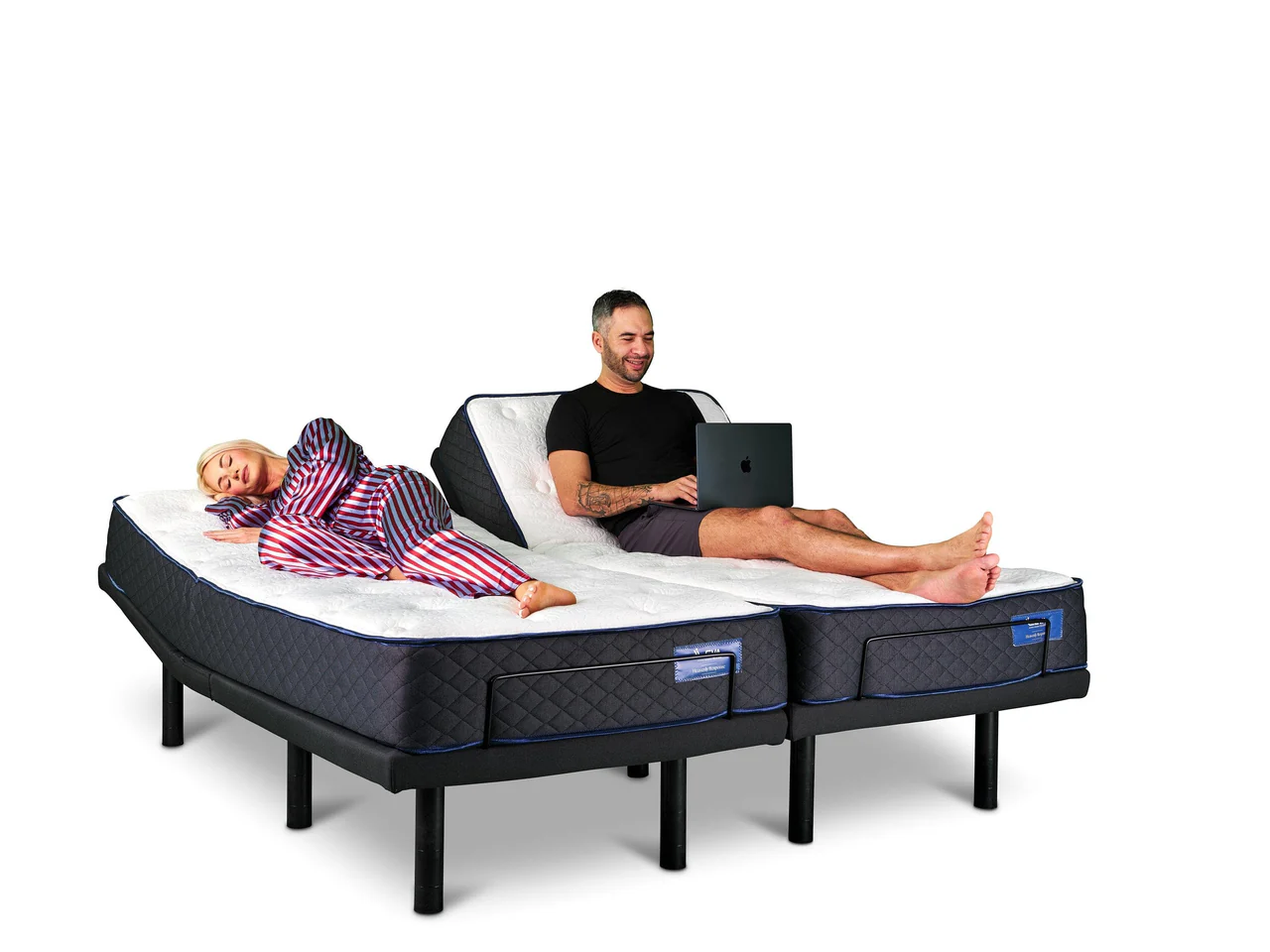
For couples comparing adjustable beds for snoring, features build in a clear order. Basic preset elevation gives manual control. Split configurations add partner independence. Whisper-quiet motors prevent adjustment noise from waking anyone. Automatic snore-detection technology then removes the need for manual activation and responds to snoring in real time.
8 Criteria for Choosing an Adjustable Bed to Reduce Loud Snoring
1. Head Elevation Range and Degree Precision
Effective snoring reduction requires a head elevation range of about 0°–30° with degree-level precision through a remote or app. Bases that offer only simple presets such as flat, low, and high limit your ability to reach the 15°–20° range that often works best. Check whether the base displays the current angle as a number and whether the remote or app allows single-degree adjustments.
Bases with programmable memory positions let you save a preferred snoring-reduction angle and recall it with one touch, which removes nightly guesswork. Wireless remotes or smartphone apps can offer one-touch access to preset positions like zero gravity, anti-snore, and TV recline, with programmable memory positions so preferred angles stay easy to reach.
2. Mattress Compatibility With Adjustable Bases
Traditional innerspring mattresses with rigid border wires and interconnected coils do not work with adjustable bases because they are too stiff to bend correctly and can damage the motor or bed. Memory foam, latex, and hybrid mattresses with individually wrapped pocket coils are the compatible choices. Memory foam mattresses are the most consistently compatible because they flex easily and return to shape.
Firmness level matters as much as material. A medium-firm mattress can work well for many people with sleep apnea by shortening the time it takes to fall asleep and supporting deeper sleep stages while keeping the spine aligned. Leva Sleep’s all-foam and hybrid pocket-coil mattresses, made in the United States, are built to flex with adjustable bases while maintaining spinal support.
Always confirm mattress warranty terms before pairing products. Some manufacturers void coverage when an incompatible mattress is used on a base that elevates the head.
3. Anti-Snore Preset vs. Automatic Detection
Adjustable bases use two main technologies for snoring control. An anti-snore preset stores a fixed elevation angle in the remote or app and requires manual activation before sleep. Presets are common and reliable but depend on the user remembering to turn them on.
Automatic detection technology uses a microphone or other sensors to identify snoring sounds and then raises the head without user action. Tempur-Pedic’s TEMPUR-Ergo ProSmart Base uses Snore Response technology that detects snoring and automatically raises the head of the bed about 12° once without waking the user or partner. Leva Sleep’s anti-snore mode, arriving spring 2026, detects snoring and makes micro-adjustments to the head of the bed automatically. This approach closes the compliance gap that manual presets leave.
| Feature | Anti-Snore Preset | Automatic Detection (e.g., Leva 2026) | Notes |
|---|---|---|---|
| Activation | Manual (remote/app) | Sensor-triggered, no user action | Automatic reduces compliance burden |
| Elevation angle | Fixed preset angle | Micro-adjustments as needed | Automatic adapts to snoring events in real time |
| Partner disruption | None if split base used | None; designed not to wake user or partner | Both require split base for full independence |
| Suitable for | Mild or occasional snoring | Mild to moderate positional snoring | Neither replaces CPAP for diagnosed OSA |
4. Split Configuration Options for Couples
Split king adjustable beds allow one partner to use anti-snore head elevation on their side only while the other sleeper stays flat. When you compare split bases, confirm that each side has its own motor, remote, and preset memory. Avoid models that rely only on a shared controller with a sync mode. Adjustable beds with a split base offer dual-sided controls so one partner can adjust their side without affecting the other person’s side.
Leva Sleep offers both split king and split queen configurations with independent app control for each side. The split queen works especially well for couples in smaller bedrooms where a split king’s 76-inch width will not fit. Many competing brands sell split king only, which leaves split queen shoppers with few choices and little specialist guidance.
5. Motor Quality and Noise Level
Motor noise often frustrates couples even when other features work well. A base that adjusts loudly can defeat automatic or app-triggered snoring correction because the movement itself wakes people up. Leva Sleep uses whisper-quiet German motors, which separates its systems from the louder actuators often found in entry-level and mid-range add-on bases.
Dual-motor split king configurations provide two motors per side, four total, that independently control head and foot articulation on each Twin XL base. Higher motor counts allow more precise, zone-specific adjustments. When you evaluate a base, ask the retailer for decibel ratings or request an in-person motor demonstration during adjustment. Leva Sleep’s La Jolla showroom offers this as a standard part of the visit.
6. Lumbar Support and Pillow Tilt Features
Three-motor split king systems add independent lumbar support per side, for six motors total, while quad-motor versions add pillow tilt for four adjustment zones per side, eight motors total. Lumbar support helps the lower back keep its natural curve during head elevation, which becomes especially important at angles above 20°.
Pillow tilt lets you fine-tune neck angle separately from overall head elevation, which lowers the risk of neck strain at higher inclines. These features do not appear on every base and represent a clear upgrade over two-zone head-and-foot models. Buyers with existing lower back issues or those who plan to sleep at angles above 20° should give adjustable lumbar support high priority.
7. White-Glove Delivery and Professional Setup
An adjustable base system, including base, mattress, accessories, and app configuration, involves more setup steps than a standard mattress delivery. Incorrect assembly or mismatched components can reduce comfort and limit snoring relief. Leva Sleep’s white-glove delivery service includes in-room setup, leg-height adjustment, a product walkthrough, and removal of the old bed.
This fee-based service removes the assembly burden and helps ensure every component works correctly before the first night. Standard bed-in-a-box delivery leaves all assembly and calibration to the customer. For couples investing in a split adjustable system to address snoring, professional setup reduces the risk of problems.
8. Price Range and Overall Value
The table below compares price tiers and split-configuration availability across the adjustable base market. All figures reflect publicly available retail pricing as of July 2026.
| Tier | Typical Price Range (Split King) | Split Queen Available | Anti-Snore Feature |
|---|---|---|---|
| Entry-level (e.g., basic online brands) | $600–$1,200 | Rarely | Manual preset only |
| Mid-range (e.g., Nectar, DreamCloud) | $1,200–$2,500 | No | Manual preset included |
| Premium (e.g., Tempur-Pedic ProSmart) | $3,500–$6,000+ | No | Automatic detection |
| Leva Sleep Split Systems | 30–50% below comparable premium competitors | Yes | 2026 automatic anti-snore mode |
Leva Sleep’s pricing reflects a direct-to-consumer model with local assembly, which removes retail markup while preserving engineering quality. The mix of split queen availability, whisper-quiet German motors, U.S.-made mattresses, and the 2026 automatic anti-snore mode at prices 30–50% below comparable premium competitors creates a value combination that current SERP competitors do not match in a single product line.
Compare Leva Sleep’s pricing and features against premium competitors at levasleepusa.com.
Frequently Asked Questions
Do adjustable beds completely eliminate snoring?
Adjustable beds reduce snoring caused by airway collapse in positional snorers, whose snoring worsens when lying flat. Clinical evidence supports meaningful reductions in snoring frequency and severity at head elevation angles between 15° and 30°. Adjustable beds do not eliminate snoring caused by nasal obstruction, obesity-related airway narrowing, or moderate-to-severe obstructive sleep apnea. Anyone with suspected sleep apnea should consult a physician before relying on positional therapy alone.
What is the difference between an anti-snore preset and automatic snore detection?
An anti-snore preset stores a fixed elevation angle in the base’s remote or app that the user activates manually before sleep. This option works well for people who remember to use it and whose snoring responds to a consistent elevation angle. Automatic snore detection uses sensors or microphones to identify snoring sounds during sleep and then raises the head without any user action.
Leva Sleep’s 2026 anti-snore mode uses automatic detection, which removes the need to remember nightly activation and allows the base to respond to snoring events that occur after the user has fallen asleep.
Can both partners use different elevation settings on the same bed?
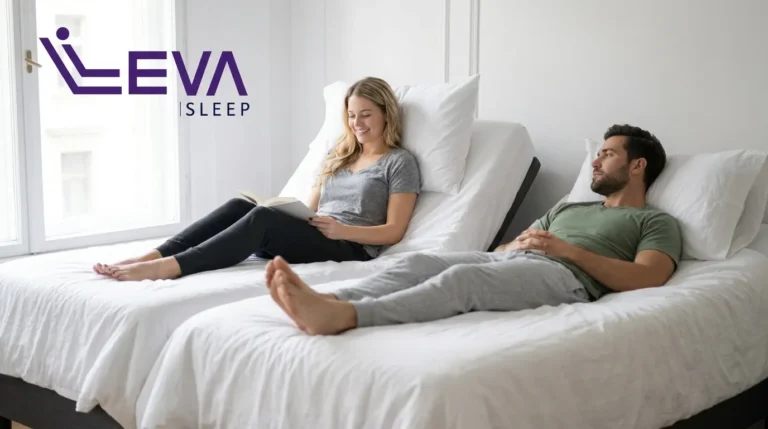
Both partners can use different elevation settings when they share a split adjustable base. Split king and split queen configurations use two independent bases placed side by side, each with its own motor, remote, and preset memory. One partner can elevate their head to a snoring-reduction angle while the other sleeps flat or chooses a different position.
Leva Sleep offers both split king and split queen configurations with independent app control per side, which suits couples with different sleep needs.
What mattress type works best with an adjustable base for snoring relief?
Memory foam, latex, and hybrid mattresses with individually wrapped pocket coils work well with adjustable bases. Traditional innerspring mattresses with interconnected coils do not work and can damage the base motor. For snoring relief, a medium-firm mattress in the 5–7 out of 10 firmness range helps maintain neutral spinal alignment during head elevation. This support prevents hip sinkage that can twist the spine and increase neck pressure.
Leva Sleep’s U.S.-made all-foam and hybrid pocket-coil mattresses are designed specifically for use with adjustable bases.
When should a snoring couple see a doctor instead of relying on an adjustable bed?
A snoring couple should see a physician when snoring comes with gasping, choking, or observed breathing pauses during sleep. A visit also makes sense when the snorer has excessive daytime sleepiness, morning headaches, or trouble concentrating, or when snoring persists in all sleep positions and does not improve with head elevation.
These signs may point to obstructive sleep apnea, which requires formal diagnosis through a sleep study and may call for CPAP therapy or other medical treatment. An adjustable base can support medical care but does not replace it.
Conclusion: Putting Your Anti-Snore Adjustable Bed Plan Together
The most effective adjustable bed for loud snoring in couples combines a clinically supported head elevation range of 10°–30°, a split configuration that gives each partner independent control, a compatible medium-firm mattress, and whisper-quiet motors that avoid new disruptions. Automatic snore detection often delivers the most consistent results because it responds to snoring events without manual presets. You can evaluate each of these criteria separately before you buy.
Leva Sleep’s split king and split queen systems address the key criteria for snoring reduction, and the 2026 automatic anti-snore mode adds an advantage over preset-only competitors. Eight years of adjustable bed specialization, more than 25,000 customers, U.S.-made mattresses, and pricing 30–50% below comparable premium brands position Leva Sleep as a strong option for snoring couples who want to keep sharing a bed.
You can start with one manageable change. Identify the elevation angle that reduces snoring without causing neck discomfort, confirm that your mattress is compatible, and decide whether a split configuration will improve your partner’s comfort. These three steps narrow your choices quickly and make the final purchase decision easier.