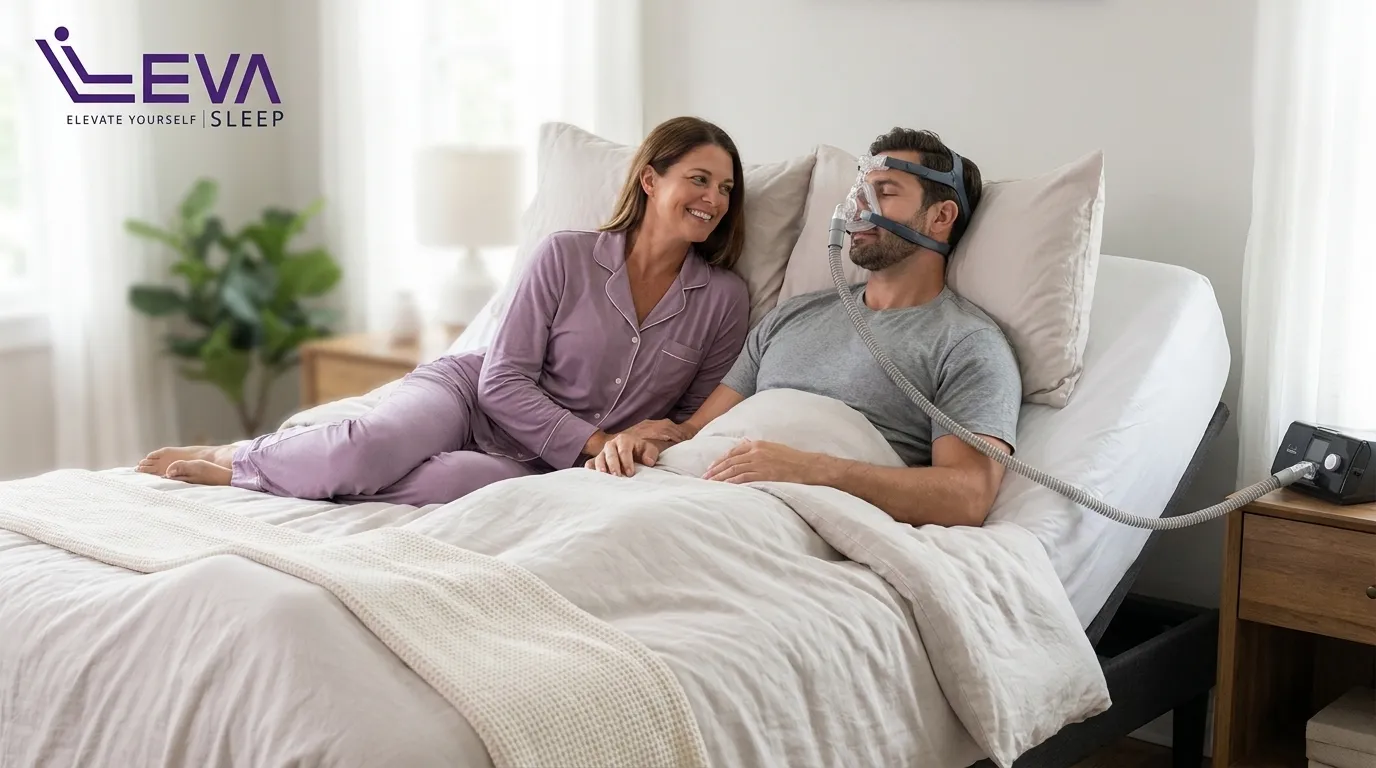
Written by: Matthew Timmins, Founder and Managing Director, Leva Sleep
Key Takeaways for Sleep Apnea and Adjustable Bases
- Head-of-bed elevation between 7.5 and 30 degrees can reduce the apnea-hypopnea index by up to 32% in mild to moderate OSA cases.
- Automated anti-snore presets with acoustic detection provide real-time micro-adjustments that maintain airway support without waking either partner.
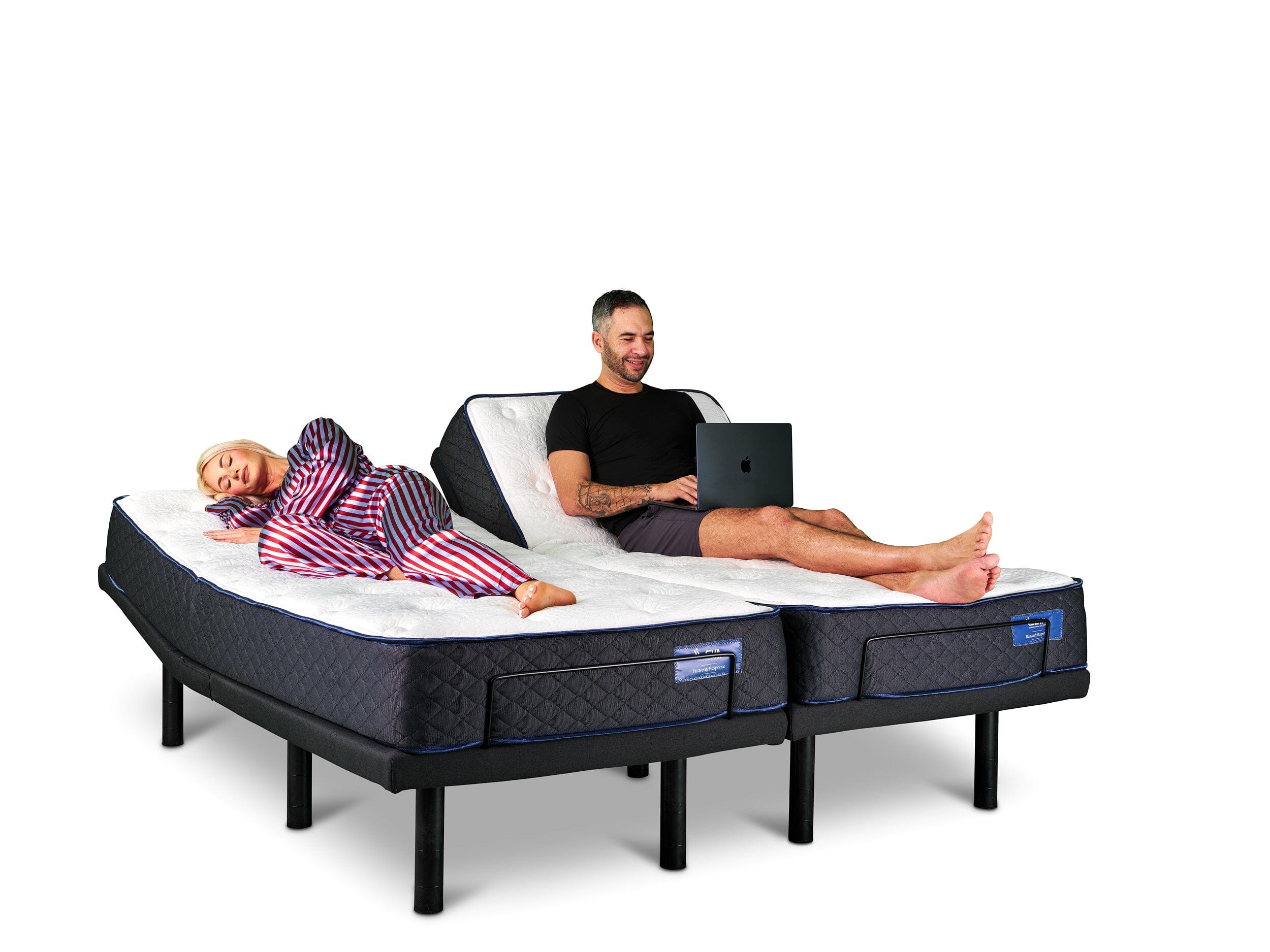
- Split King and Split Queen adjustable bases deliver independent head and foot control, so couples can address different sleep apnea and comfort needs without compromise.
- Adjustable bases support CPAP therapy by stabilizing mask position, easing hose management, and often allowing lower pressure settings for greater comfort.
- Leva Sleep offers precision-engineered adjustable bed frames with anti-snore automation and split configurations. Explore the full lineup and find your ideal solution.
Clinically Effective Elevation Range for Sleep Apnea
A 2017 study of 52 patients with mild to moderate OSA found that a 7.5-degree head-of-bed elevation reduced the apnea-hypopnea index by approximately 32%. A 2022 study found that 30-degree head-of-bed elevation can reduce AHI and the percentage of apneas. CT imaging studies show that head elevation can increase upper airway volume.
The practical range for most sleepers sits between 7.5 and 30 degrees. A 10–15 degree elevation shifts the tongue forward to reduce light snoring, while a 20–30 degree incline provides significant gravitational assistance to keep the airway open, the sweet spot for moderate to heavy snorers. When you evaluate an adjustable base, confirm that the head section reaches a true 30-degree incline, not a shallow tilt that tops out below 20 degrees. Leva Sleep’s bases reach and hold these clinically relevant angles with whisper-quiet German motors, so the position stays consistent throughout the night without mechanical noise disrupting either partner.
Best Adjustable Bed Position for Sleep Apnea Relief
Using the elevation ranges established above, the most effective position combines head elevation with lower-body support. Head elevation between 10 and 30 degrees uses gravity to help prevent soft tissue collapse in the throat, the primary cause of snoring and OSA. Elevating the head of the bed by 30 degrees can help keep the airway open and potentially improve obstructive sleep apnea symptoms, though side sleeping remains the most effective positional strategy.
Combining a modest head elevation with a slight knee bend, often called the zero-gravity configuration, keeps the sleeper from sliding down the mattress. This stable posture preserves the incline throughout the night and maintains the airway benefit that elevation provides.
When selecting an adjustable base for sleep apnea positioning, prioritize features that let you reach and maintain the therapeutic 7.5–30 degree window described above. Specifically, look for:
- Head section articulation range of at least 0–60 degrees to cover the full 7.5–30 degree therapeutic window
- Independent foot articulation to enable a stable zero-gravity posture that prevents sliding
- One-touch presets that recall a specific angle without manual re-entry each night
- App-based control for silent adjustments after lights out
Anti-Snore Presets and Real-Time Snoring Response
One-touch zero-gravity and anti-snore presets on adjustable bases provide consistent, research-backed positioning without manual angle adjustments. Manual elevation requires the sleeper or their partner to notice snoring, wake up, and operate a remote. An automated anti-snore mode removes that friction by detecting snoring acoustically and making micro-adjustments to the head section before the disruption fully wakes either person.
When you compare anti-snore features across brands, ask whether the detection is acoustic or timer-based, and whether the adjustment uses a fixed preset or a variable micro-correction. Acoustic detection paired with small, targeted movements usually delivers smoother, less disruptive corrections.
Positional elevation and anti-snore automation address the mechanical cause of snoring, airway collapse, rather than masking symptoms. For couples on the edge of sleep divorce, this distinction matters. A base that responds to snoring in real time helps both partners stay in the same bed and sleep through the night.
See how Leva Sleep’s acoustic anti-snore detection performs in person at the La Jolla showroom.
Split King and Split Queen Bases for Couples with Sleep Apnea
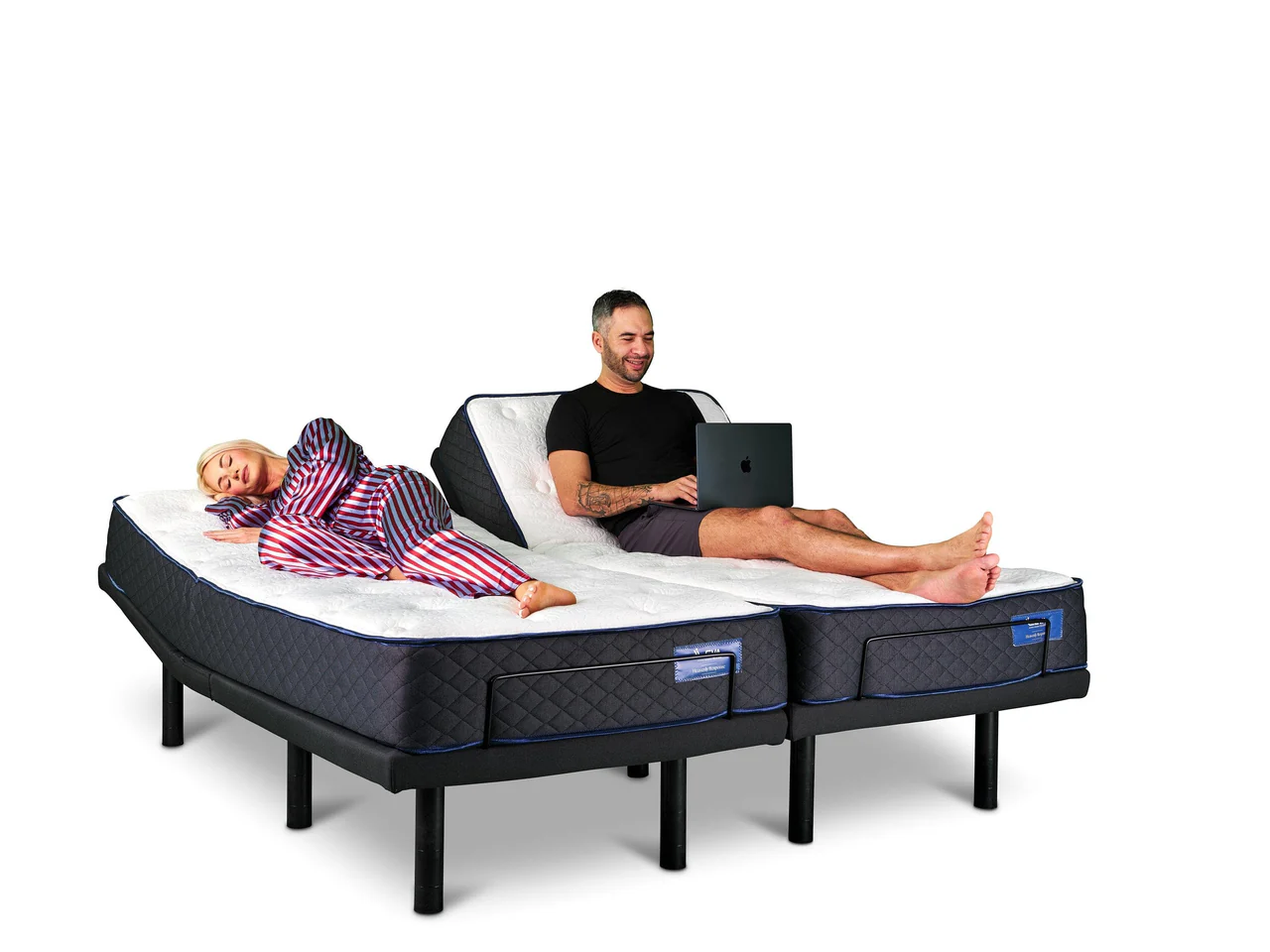
A split king adjustable bed uses two Twin XL mattresses and two independent adjustable bases placed side by side, with an overall footprint matching a standard king (76″ × 80″), so each sleeper can adjust head and foot elevation independently. Split-king designs also reduce motion transfer, preventing mechanical vibrations from one side’s adjustment from disturbing the other sleeper.
For couples where one partner has OSA or positional snoring and the other does not, independent control becomes the single most important feature. Common scenarios include:
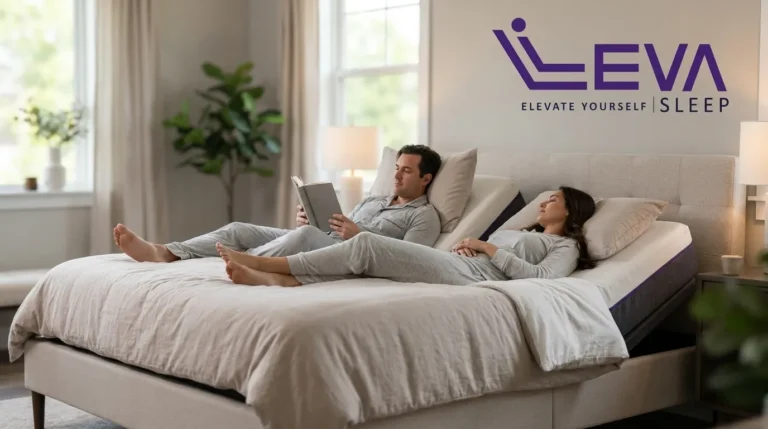
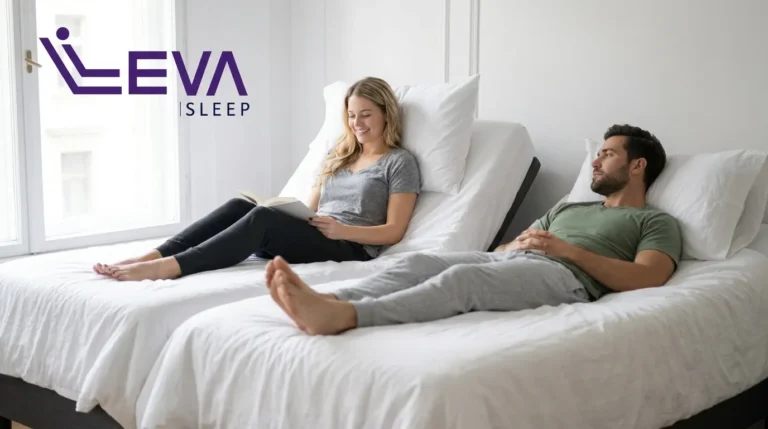
- Partner A elevates to 20–30 degrees for airway support while Partner B sleeps flat, with no negotiation required
- Partner A uses a CPAP machine at an elevated angle while Partner B adjusts foot elevation for leg comfort independently
- Both partners use the anti-snore preset on their respective sides, with each side responding only to its own sleeper’s acoustics
- One partner activates zero-gravity for acid reflux relief while the other uses a flat position preferred for shoulder comfort
Leva Sleep offers both Split King and the less common Split Queen configuration, a useful option for couples in smaller rooms who still require fully independent zones.
Adjustable Bases That Work Smoothly with CPAP
CPAP machines are fully compatible with adjustable bed frames, and elevating the upper body often makes the mask more tolerable and the hose easier to manage, which can improve how consistently users apply CPAP therapy. An adjustable base reduces the CPAP machine’s workload by keeping the airway more open initially, potentially allowing patients to use lower, more comfortable pressure settings, though users must keep their prescribed settings and consult their provider before making any changes.
Adjustable bases improve CPAP mask seal and comfort by maintaining a stable elevated position that prevents mask shifting, unlike pillows that slip during the night. When you evaluate an adjustable base for CPAP use, assess these practical factors:
- Head elevation range of at least 0–60 degrees to cover the full therapeutic window while maintaining mask seal
- Built-in or compatible CPAP hose management to prevent kinking during elevation changes
- A paired mattress in the medium-firm range (5–7 on a 1–10 scale) that flexes with the base without causing the head to sink and pull on mask straps
- Motion isolation sufficient to prevent a partner’s position change from breaking the CPAP seal
For diagnosed sleep apnea, a CPAP remains the recommended treatment, and an adjustable base serves as a complementary tool, not a substitute. Leva Sleep’s mattresses, available in all-foam and hybrid pocket-coil constructions, are designed specifically to flex with adjustable bases, maintaining consistent head height and mask seal throughout the night.
Zero Gravity Position for Airway Support and Back Comfort
Independent foot articulation paired with head elevation creates a stable zero-gravity position, head elevated with 10–20 degrees of knee bend, that prevents sliding and keeps airways open. The knee bend component plays a functional role. Without it, the sleeper gradually slides toward the foot of the bed, which reduces the effective head elevation angle and weakens the airway benefit by morning.
Zero-gravity positioning also distributes body weight more evenly across the mattress surface, which reduces pressure on the lumbar spine and hips. For OSA patients who also experience back pain, a common combination, this dual benefit makes zero-gravity the most practical preset on a full-featured adjustable base. Leva Sleep’s bases include a one-touch zero-gravity preset accessible through both the wireless remote and the Leva Sleep app, so you can recall the position silently without fumbling with manual angle controls after lights out.
When Adjustable Bases Are Not Enough for Sleep Apnea
An adjustable bed does not cure obstructive sleep apnea and serves as a highly effective supplemental treatment rather than a replacement for prescribed therapy. A 2025 meta-analysis by Gao et al. of 19 RCTs with 1,231 participants found no significant difference between CPAP and positional therapy for reducing AHI. Patients with moderate to severe OSA, or those whose AHI does not respond meaningfully to positional change, require evaluation by a sleep medicine physician before they rely on positional therapy alone.
Adjustable bases deliver the most measurable benefit for:
- Mild to moderate OSA with a supine-predominant pattern, where AHI is significantly higher when lying flat on the back
- Primary snoring without a formal OSA diagnosis, where elevation reduces airway vibration without requiring CPAP
- CPAP users seeking improved mask comfort, hose management, and lower effective pressure settings
- Couples where one partner’s snoring disrupts shared sleep and sleep divorce is the alternative
Any individual with suspected or diagnosed OSA should consult a sleep specialist before using positional therapy as a primary intervention. Leva Sleep’s role is to provide a precise, feature-complete adjustable base once a positioning strategy has been established, not to replace medical diagnosis or treatment.
Adjustable Base Comparison: Key Features for Sleep Apnea
| Feature | Leva Sleep (2026 Models) | Standard Retail Adjustable Base | Basic Online Adjustable Base |
|---|---|---|---|
| Head Elevation Range | 0–60°, reaching the clinically relevant 20–30° therapeutic window | Typically 0–45°; upper range varies by model | Often limited to 0–40°; angle accuracy unverified |
| Anti-Snore Automation | Acoustic detection with real-time micro-adjustments via app | Fixed anti-snore preset (no real-time detection) | Manual elevation only, no anti-snore preset |
| Split Configuration | Split King and Split Queen with fully independent zones; motion isolation under 40 dB motor noise | Split King available; Split Queen rare | Single-zone only in most models |
| CPAP Compatibility Notes | Paired medium-firm mattresses designed to flex without head sinkage; hose management compatible; smooth independent head elevation for stable mask seal | Compatible with CPAP; mattress pairing expertise varies | Compatible with CPAP; no specialist mattress pairing |
Data points for standard and basic categories reflect general market characteristics described across background research sources. Individual models vary, so evaluate each base against the criteria above before purchasing.
Frequently Asked Questions
Is it safe to sleep elevated every night on an adjustable base?
For most adults, nightly use of a head-elevated position between 10 and 30 degrees is well tolerated and carries no documented risks for healthy sleepers. The exception is individuals with lower limb edema or venous insufficiency, for whom sustained elevation may be contraindicated. Anyone with a diagnosed cardiovascular or circulatory condition should consult their physician before adopting a nightly elevated sleep position. Leva Sleep’s adjustable bases allow precise angle control, so sleepers can start at a modest 10–15 degrees and increase gradually based on comfort and symptom response.
Will a doctor recommend an adjustable bed for sleep apnea?
Sleep medicine physicians and ENT specialists frequently recommend positional therapy, including head-of-bed elevation, as a first-line or adjunct intervention for mild to moderate positional OSA, where AHI is substantially higher in the supine position than in side or elevated positions. For moderate to severe OSA, CPAP remains the primary treatment, and an adjustable base is recommended as a complementary tool to improve CPAP comfort and consistency. Patients should bring their polysomnography results to their provider and ask specifically whether their OSA is supine-predominant, because this pattern determines how much benefit positional elevation is likely to deliver.
How quiet are the motors on Leva Sleep adjustable bases?
Leva Sleep’s bases use whisper-quiet German motors engineered to operate below 40 dB, roughly equivalent to a quiet library. This matters for couples because nighttime position adjustments, including automated anti-snore micro-corrections, occur without waking the non-adjusting partner. Basic adjustable bases from general retailers frequently use motors that exceed this threshold, which produces audible mechanical noise that can itself become a sleep disruption. When you evaluate any adjustable base, ask the retailer for the motor’s decibel rating and request a live demonstration at the showroom.
What warranty and delivery experience should I expect from Leva Sleep?
Leva Sleep provides white-glove delivery for a fee, which includes in-room setup, leg height adjustment, a full product tutorial, and removal of the old bed through donation or recycling. This service creates a clear difference from bed-in-a-box brands that leave assembly to the customer. Warranty terms vary by model and component, and Leva Sleep’s direct-to-consumer model means warranty service is handled without a retail intermediary, which typically results in faster resolution. Prospective buyers should confirm specific warranty durations for the base motor, frame, and mattress at the time of purchase.
Can a split king adjustable base prevent sleep divorce caused by snoring?
A split king adjustable base directly addresses the two most common drivers of sleep divorce, one partner’s snoring disrupting the other and incompatible comfort preferences. Independent head elevation allows the snoring partner to maintain a 20–30 degree incline for airway support while the non-snoring partner sleeps flat. The 2026 anti-snore mode on Leva Sleep bases adds acoustic detection that makes micro-adjustments automatically, which reduces the frequency and intensity of snoring events before they wake either partner. Couples who have already moved to separate rooms frequently find that a split configuration with automated anti-snore functionality allows them to return to sharing a bed without either partner sacrificing sleep quality.
Conclusion: Turning Clinical Evidence into Nightly Comfort
The clinical evidence for head-of-bed elevation in mild to moderate OSA remains consistent across multiple study designs. Angles between 7.5 and 30 degrees produce meaningful reductions in AHI and improvements in oxygen saturation. For couples, a split king or split queen adjustable base turns that evidence into a practical, nightly solution. One partner elevates for airway support, the other adjusts independently, and automated anti-snore detection handles the rest without either person waking to operate a remote.
CPAP users gain a stable, mask-friendly incline that improves both comfort and therapy consistency. Positional therapy does not replace CPAP or physician-directed treatment for moderate to severe OSA, but for the large population of mild OSA sufferers and primary snorers, a precision adjustable base offers an accessible, non-invasive intervention.
Leva Sleep’s 2026 adjustable base lineup, featuring acoustic anti-snore detection, pillow-tilt motors, whisper-quiet German motors, and Split King and Split Queen configurations, delivers these capabilities at 30–50% below the price of comparable luxury competitors, with white-glove delivery and setup available for a fee. With over 25,000 customers served and eight years of adjustable base specialization, Leva Sleep focuses on helping couples stay in the same bed and breathe more easily while they sleep.
Start your journey to better breathing and shared sleep with Leva Sleep’s adjustable bases.