Written by: Matthew Timmins, Founder and Managing Director, Leva Sleep
Key Takeaways
- Raising the head of an adjustable bed to 30–45° can reduce apnea events by helping keep airways open, according to published research.
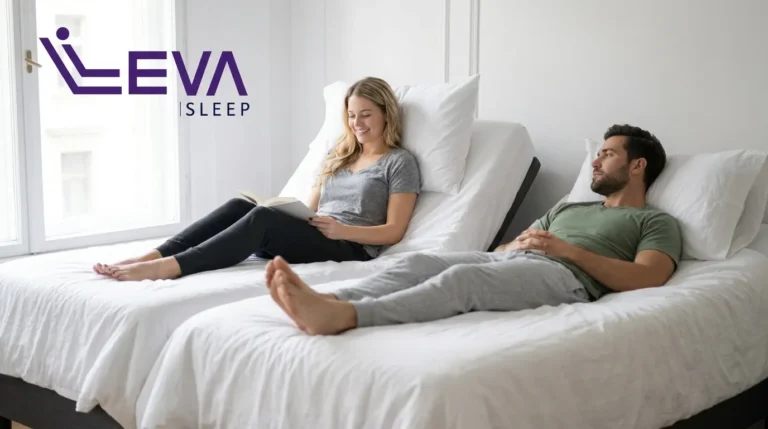
- Split adjustable bases let each partner choose their own elevation angle without disturbing the other sleeper.
- Supine (flat on the back) sleeping is the position most associated with worsened apnea events, and elevation helps counteract airway collapse.
- Stacked pillows are an unreliable workaround; true torso elevation from an adjustable base provides more consistent, anatomically aligned positioning.
- Discover personalized sleep apnea relief solutions at Leva Sleep and experience the difference today.
1. How adjustable beds support sleep apnea relief
Raising the head of an adjustable bed may help keep the airway open and reduce snoring and obstructive sleep apnea symptoms, based on Sleep Foundation analysis of published research. Gravity pulls soft palate tissue toward the throat when you lie flat. Elevation changes that angle and reduces this effect.
Iannella et al. (2022) used Drug-Induced Sleep Endoscopy in 45 patients and found that 30° head elevation can reduce airway collapse. This reduction can translate into fewer apnea events, although results vary with individual anatomy and apnea severity.
To bring this type of therapeutic elevation into your bedroom, your adjustable base needs specific capabilities.
Criteria to evaluate before purchasing:
- Head elevation range reaches at least 30° (not just a slight incline)
- Motor operates quietly enough not to wake a partner during adjustment
- Remote or app allows one-touch preset recall at bedtime
- Base accommodates your mattress type without voiding warranties
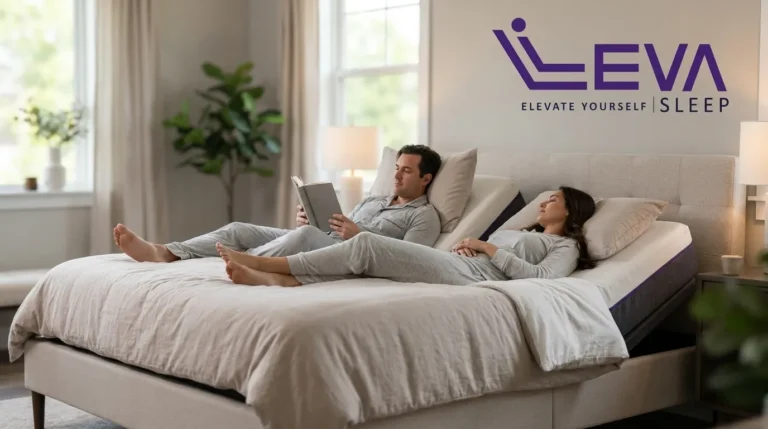
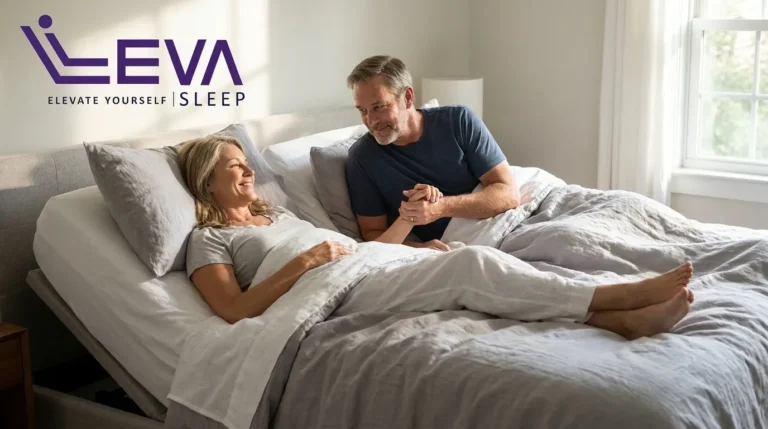
Scenario: Mark, 58, has mild OSA. His partner Lisa sleeps flat. A split base lets Mark elevate to 35° while Lisa stays level. They both sleep comfortably without nightly negotiation.
2. Sleep positions that worsen or relieve sleep apnea
Supine (flat on the back) is the position most associated with worsened apnea events. Gravity pulls the tongue and soft palate directly onto the airway. Elevating the head in an anti-snore position keeps airways open and helps prevent the tongue from collapsing back into the throat.
The elevation itself, not simply owning an adjustable base, creates the therapeutic benefit. A flat adjustable base set to zero elevation offers no advantage over a traditional bed for apnea management. The base must actually be raised to deliver benefit.
Positions ranked from most to least problematic for airway collapse:
- Flat supine — highest risk of airway obstruction
- Flat side-lying — moderate risk; lateral position helps but does not open the airway mechanically
- Elevated supine (30–45°) — reduced collapse per the endoscopy study cited above
- Elevated side-lying — generally considered the most favorable combination
Scenario: David, 62, rolls onto his back during the night and snores loudly. His partner sets a 35° head-elevation preset on his side of their split base before bed. The elevation remains active even when he rolls supine.
3. Why the “pillow trick” falls short for sleep apnea
The “pillow trick” refers to stacking standard pillows to approximate head-of-bed elevation. This approach costs little but comes with major drawbacks. Pillows compress, shift, and create neck flexion rather than true torso elevation. Neck flexion can narrow the airway instead of opening it.
True positional therapy inclines the entire upper body from the hips, not just the head and neck. An adjustable base achieves this effect. Stacked pillows do not.
Use this checklist to see whether your current pillow setup is adequate:
- Does your chin tuck toward your chest when elevated? (Sign of neck flexion, which is counterproductive)
- Do pillows shift during the night, returning you to flat?
- Does your partner’s pillow arrangement conflict with yours?
- Is your lower back unsupported, causing morning pain?
If any answer is yes, a motorized adjustable base provides more consistent, anatomically aligned elevation than pillows alone.
Scenario: Sandra, 47, tried three stacked pillows for two weeks. She woke with neck stiffness and her AHI remained unchanged at her follow-up. Her sleep physician recommended true torso elevation instead.
4. Split adjustable beds that support both partners
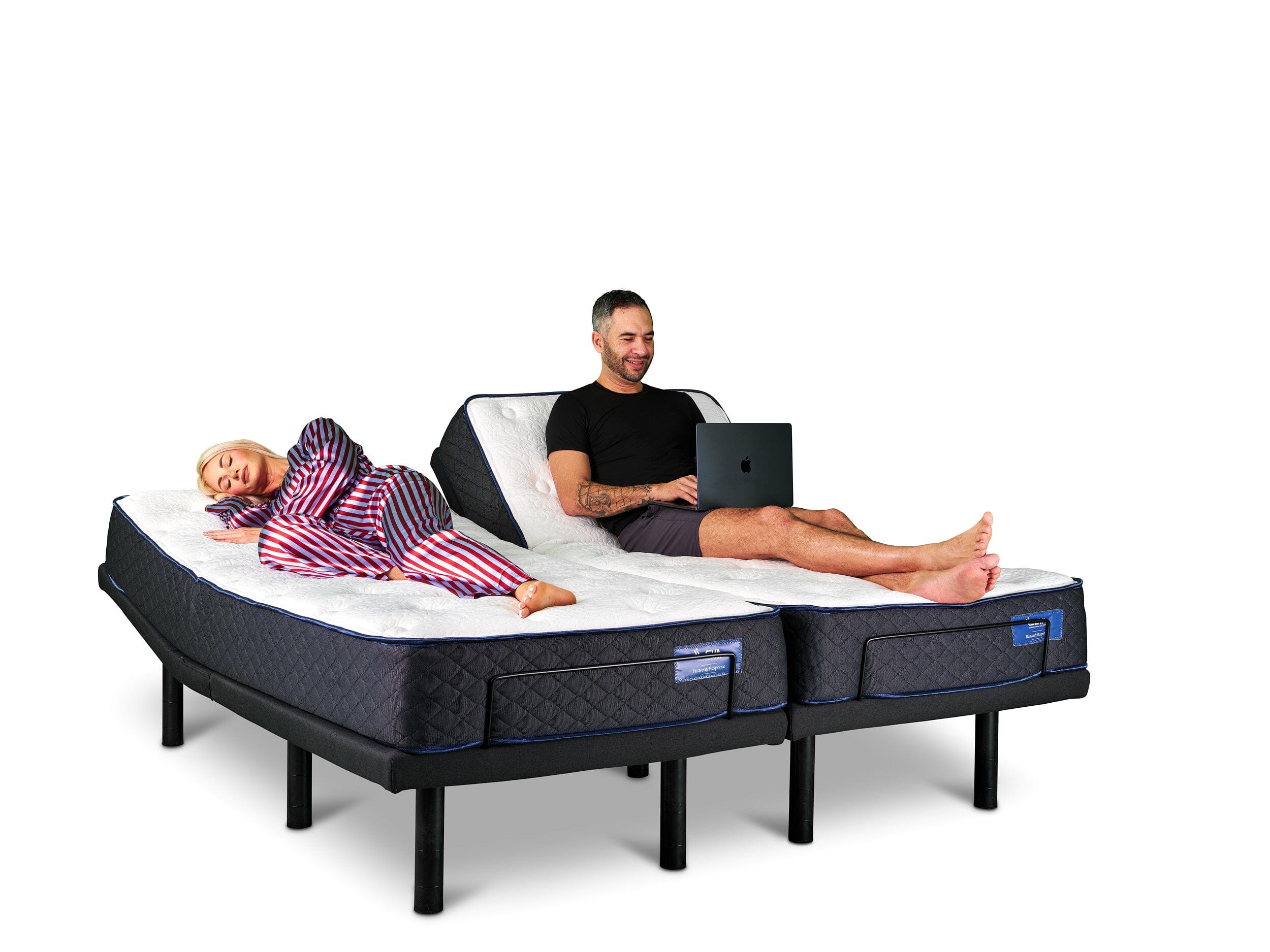
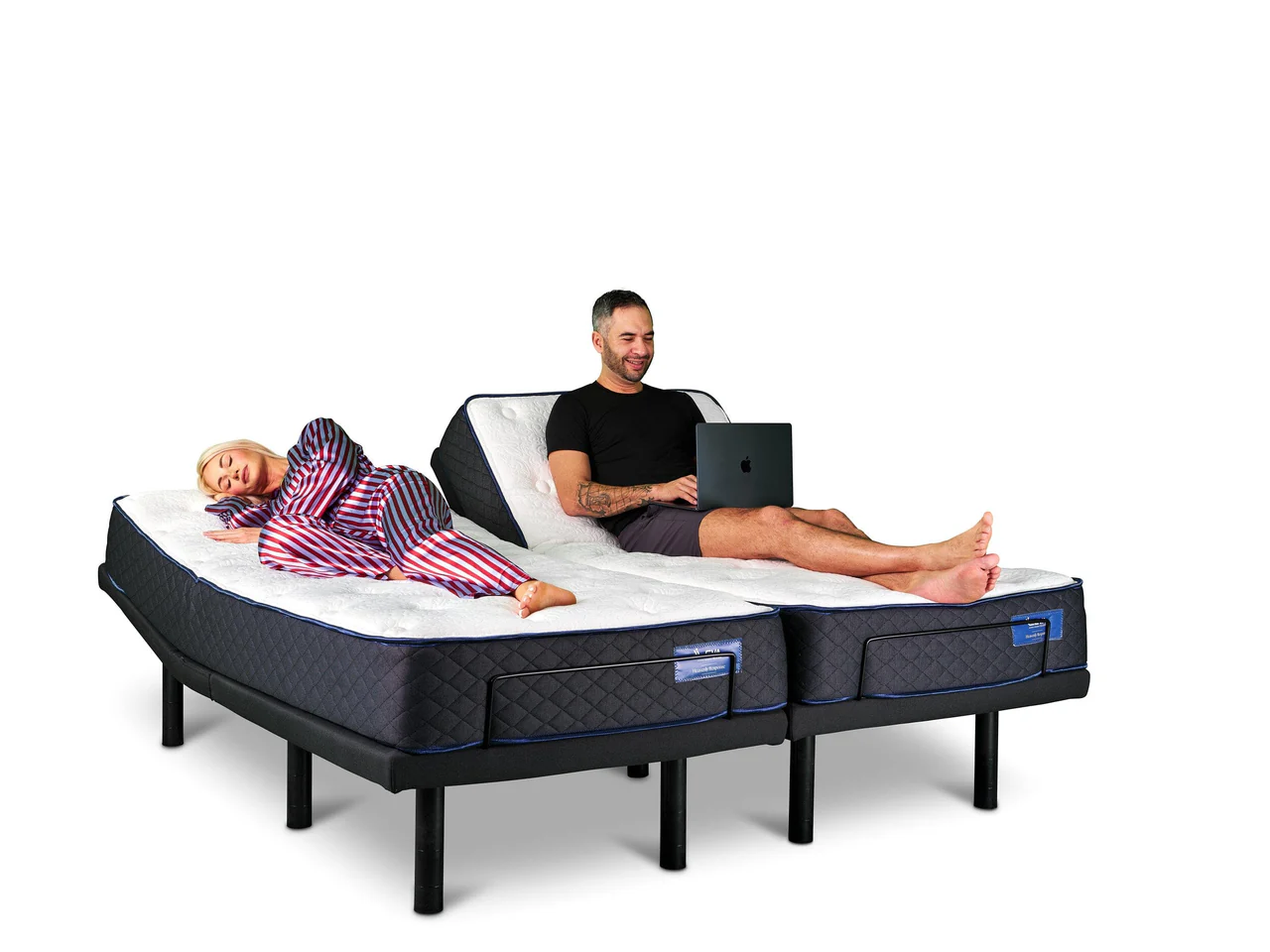
A split king adjustable base consists of two Twin XL bases placed side by side, enabling each partner to independently select their own head-elevation position. This configuration offers strong flexibility for couples where one or both partners manage sleep apnea.
Leva Sleep also offers a Split Queen, a rarer configuration built to customer specifications, for couples who want independent control in a smaller footprint. Most general retailers carry only Split King.
Key features to look for in a split base for apnea relief:
- Full independent head and foot articulation on each side
- Whisper-quiet motors that do not wake the other partner during adjustment
- Anti-snore automation: some bases include sensors that detect snoring and automatically elevate the head to expand the airway
- App-based presets so each partner saves their therapeutic elevation
- Compatible deep-pocket sheets with extra elastic to prevent slippage at elevation
Scenario: Tom and Rachel share a Split King. Tom elevates to 40° for apnea management. Rachel stays flat. Neither disturbs the other. Their fitted sheets, designed specifically for adjustable bases, stay anchored through the night.
5. Noise, sheets, and setup for apnea-focused adjustable bases
Motor noise affects real-world comfort more than many buyers expect. A base that wakes the non-apnea partner during a 2 a.m. position adjustment undercuts the value of independent control. Check motor decibel ratings or request an in-showroom demonstration before buying.
Sheet slippage is the second most common complaint. Standard fitted sheets are not designed for bases that flex to 30–45°. Purpose-built sheets with deep pockets and reinforced elastic bands function as essential accessories, not optional upgrades.
Setup complexity also matters for couples. A base that requires self-assembly or arrives without calibration support adds friction to an already significant purchase. White-glove delivery, where technicians set leg height, run a product tutorial, and confirm elevation presets, removes that friction.
Use this setup checklist before your base arrives:
- Confirm leg height options match your bed frame or platform
- Order split-base-compatible sheets before delivery day
- Download the control app and create individual profiles for each partner
- Identify your target elevation angle in advance (30–45° for apnea relief)
- Verify CPAP hose routing if one partner uses a machine alongside elevation
Scenario: James and Carol received white-glove delivery. The technician set leg height to match their existing frame, demonstrated the anti-snore preset, and confirmed both partners’ elevation angles before leaving. They avoided assembly stress and sheet-popping surprises.
Feature Comparison: Adjustable Base Specifications
| Feature | Leva Sleep | Competitor A (Sealy Ease) | Competitor B (Leesa) |
|---|---|---|---|
| Head elevation range | Up to 45° (therapeutic anti-snore range) | Up to 57° | Not specified in degrees; head articulation included |
| Automatic anti-snore response | Check manufacturer specifications for anti-snore features and automation options | Not listed in published specs | Not listed in published specs |
| Split availability | Split King and Split Queen (custom-built) | Split King (two 37.5″ × 79.5″ pieces) | King and Cal King ship as two pieces; sync or independent operation |
| Delivery experience | In-house white-glove: bedroom setup, height calibration, tutorial, old-bed removal | Retailer-dependent; varies by location | Direct ship, self-setup, zero-clearance installation option |
Note: Competitor names are used for specification comparison only. All Leva specs reflect published product features. Competitor specs are drawn from publicly available product pages cited inline.
Frequently Asked Questions
Can an adjustable bed replace a CPAP machine for sleep apnea?
No. An adjustable bed does not replace prescribed CPAP therapy or other clinically recommended treatments. Head elevation at 30–45° can reduce the frequency and severity of apnea events for some individuals with mild obstructive sleep apnea, but it does not correct the underlying anatomical or physiological causes of the condition. Anyone diagnosed with sleep apnea should follow their physician’s treatment plan. An adjustable base may serve as a complementary comfort measure alongside CPAP, not instead of it.
Is a split adjustable base compatible with CPAP use?
Yes, in most cases. Elevating the head of the bed while using a CPAP machine is a common combination. The elevation can improve airway geometry, which may allow some patients to use lower pressure settings, although any pressure changes must be directed by a physician. Practical considerations include routing the CPAP hose so it does not restrict movement when the base adjusts and ensuring the mask seal is maintained at the elevated angle. A white-glove setup service can help configure the base height and position to accommodate CPAP equipment comfortably.
What elevation angle is most effective for sleep apnea relief?
Clinical research points to 30–45° as the therapeutic range for reducing airway collapse. Iannella et al. (2022) specifically studied 30° elevation using Drug-Induced Sleep Endoscopy and recorded a reduction in AHI from 23.8 to 17.7 events per hour in their 45-patient cohort. Individual anatomy, body weight, and apnea severity all influence the optimal angle for any given person. Starting at 30° and adjusting upward in small increments, while monitoring comfort and symptoms, is a practical approach. Consult your sleep physician before making changes to your therapeutic positioning.
Will my partner be disturbed if I adjust my side of a split base during the night?
A well-engineered split base minimizes partner disturbance through two mechanisms: independent articulation, where each side moves separately, and whisper-quiet motors that operate below disruptive noise thresholds. Motion isolation between the two sides prevents vibration transfer. The key evaluation criteria are motor noise level and the quality of the motion-isolation barrier between the two halves. Requesting an in-showroom demonstration at operating speed, rather than relying on spec sheets alone, is the most reliable way to assess real-world noise before purchasing.
Do I need special sheets for an adjustable bed used at therapeutic elevation angles?
Yes. Standard fitted sheets are not designed to accommodate the flexion points created when a base elevates to 30–45°. At those angles, conventional sheets pull free from the corners, bunch under the mattress, and create discomfort. Sheets purpose-built for adjustable bases feature deeper pockets, reinforced elastic bands that wrap the full perimeter, and stretch fabric that moves with the base without loosening. Purchasing compatible bedding at the same time as the base, rather than after the first night of sheet-popping, is strongly recommended. Leva Sleep designs its bedding accessories specifically for this purpose.