Written by: Matthew Timmins, Founder and Managing Director, Leva Sleep
Key Takeaways
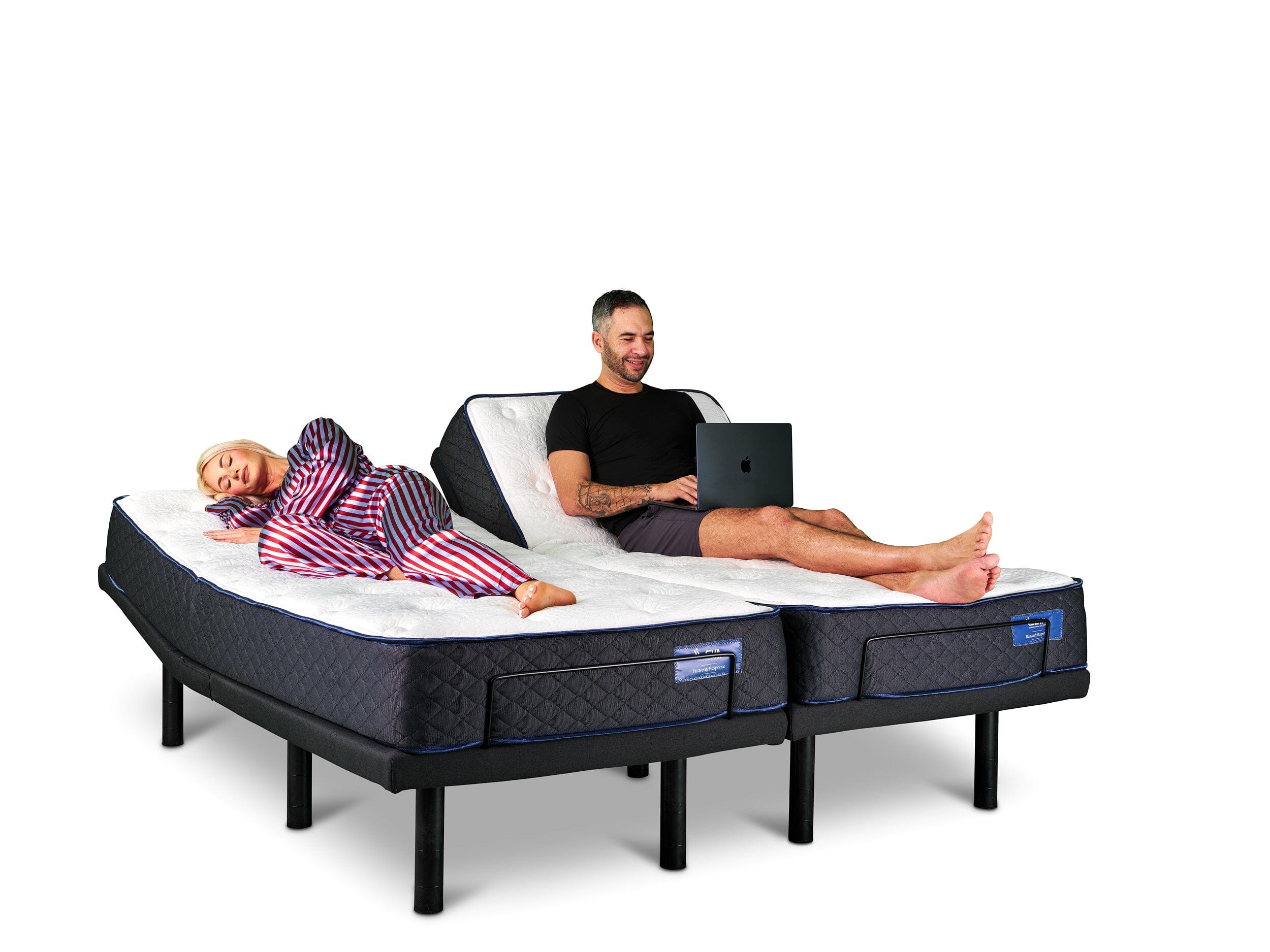
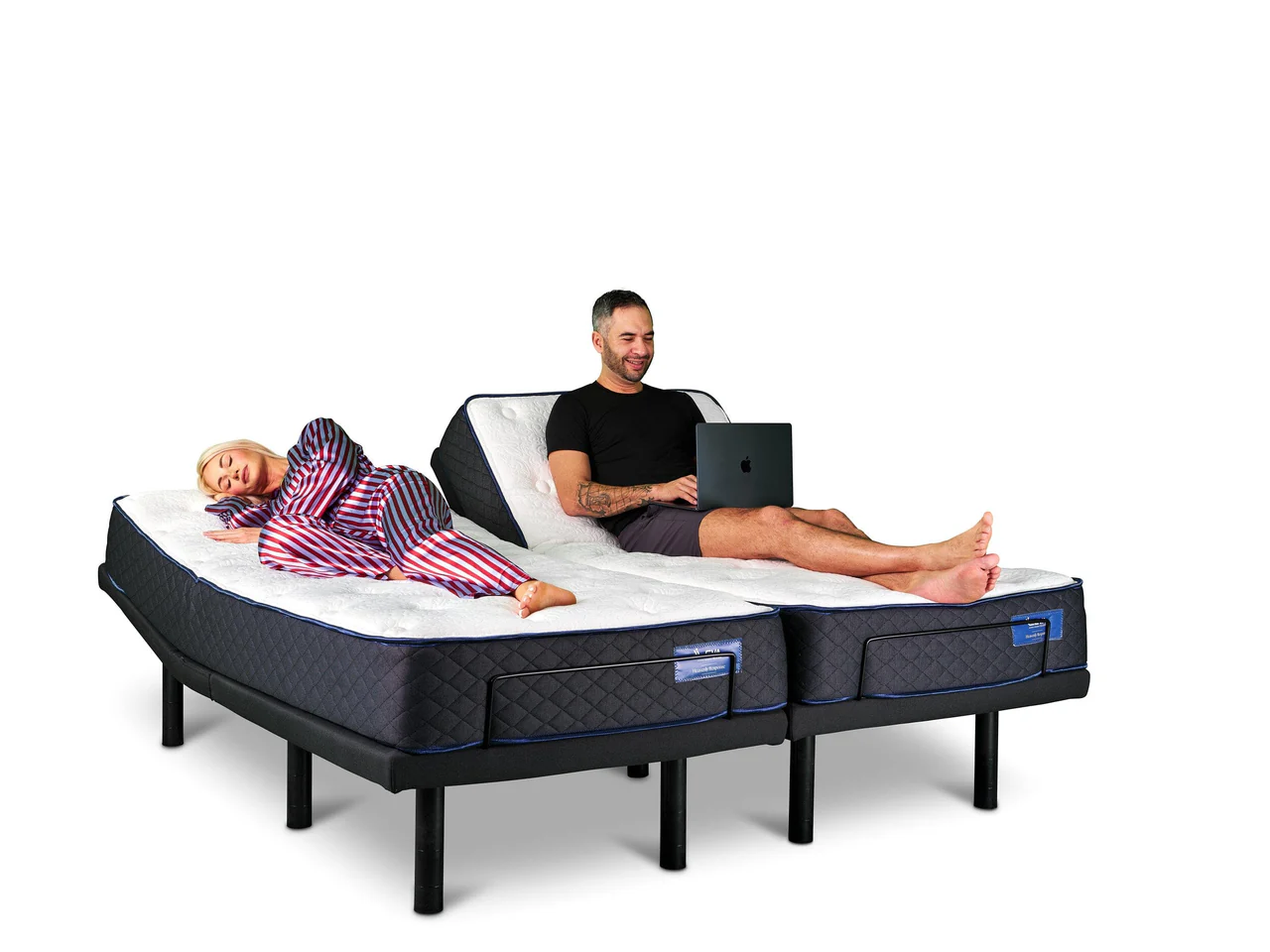
- Split adjustable bases give each partner independent control over positioning, lumbar support, and elevation. This setup reduces back pain and helps couples stay in the same room.
- Zero-gravity positioning with dedicated lumbar support relieves lower-back pressure by distributing weight evenly and relaxing the sciatic nerve.
- Whisper-quiet German motors in the 30–40 dB range keep nighttime adjustments from waking a sleeping partner.
- Memory foam, Talalay latex, and pocket-coil hybrid mattresses maintain spinal alignment and flex safely on split bases.
- Leva Sleep delivers premium split adjustable bases with independent positioning, quiet motors, and white-glove service at 30–50% less than many luxury competitors. Explore the collection online or visit the La Jolla showroom.
1. Independent Lumbar and Zero-Gravity Positioning for Back-Pain Relief
Orthopedic physical therapist Karena Wu, P.T., D.P.T., recommends the zero-gravity position, a 120-degree angle between thighs and torso, for people with lower-back pain because it takes pressure off the pelvis and backbone. This position raises the head to approximately 20–30 degrees and the knees to a similar height, which distributes body weight evenly and reduces pressure at the lower back and hips. For sciatica, elevating the knees 15–30 degrees relaxes the hamstrings, reduces posterior pelvic tilt, and decreases tugging on the sciatic nerve. Higher-end adjustable bases add a dedicated lumbar support section that raises a pad in the center to maintain the natural lumbar curve during articulation.
To verify whether a base delivers these clinical benefits in real use, follow these evaluation steps:
- Lie in the zero-gravity preset for at least ten minutes and notice whether lower-back pressure decreases in a clear, sustained way.
- Ask the retailer whether the base includes a dedicated lumbar motor that operates separately from the head and foot motors.
- Test incremental knee elevation from 15 to 30 degrees and identify the angle that best relieves your specific pain pattern.
- Confirm that each side of a split base adjusts independently so your partner’s position changes do not affect your side.
Users should start at a gentle elevation and increase the angle gradually over several nights so the body can adapt and avoid discomfort. An adjustable base functions as a comfort tool. Persistent, severe, or new back pain with numbness or tingling radiating down a leg requires evaluation by a doctor or physical therapist.
2. Noise Levels and Motor Quality for Undisturbed Sleep
The quietest adjustable bases operate at 30–40 decibels, roughly the volume of a whisper. This level is similar to gentle rainfall or a refrigerator hum and should not disturb most sleepers. Any active adjustment mechanism must operate quietly, or the adjustment itself becomes a sleep disturbance for couples sharing a bed. Motor quality therefore acts as a functional requirement for couples, not a luxury upgrade.
Use these steps to evaluate motor noise before purchasing:
- Request a live demonstration of the base moving through its full range of motion, from flat to zero-gravity and back, while you stand or sit quietly nearby.
- Ask the retailer for the motor’s decibel rating and confirm it operates in the 30–40 dB range.
- Inquire whether the motors are German-engineered, since precision-manufactured motors usually produce smoother, quieter operation than commodity options.
- Test the base in a quiet showroom space rather than a noisy retail floor so you can judge the operational sound accurately.
- Ask whether the motor speed is adjustable, because slower articulation often produces less noise during nighttime position changes.
Leva Sleep’s split adjustable bases use whisper-quiet German motors that keep nighttime adjustments below the threshold that typically wakes a sleeping partner. Many bases operate in the 35–40 dB range, and that range offers a practical benchmark to use with any retailer during a showroom visit.
3. Mattress Compatibility and Zoned Support
A supportive, responsive mattress is required for any adjustable-base position to maintain spinal alignment, because a sagging mattress can misalign the spine even when the base is adjusted correctly. For split king or split queen systems, each side articulates independently, so each mattress must flex without structural damage during repeated use. Even the best base cannot protect your back if the mattress fails to support it.
Use this guidance on compatible mattress types:
- Memory foam (8–14 inches): The most common pairing with split adjustable bases; bends smoothly with articulation and returns to its original shape without permanent deformation.
- Latex (Talalay): Open-cell flexibility makes Talalay latex generally compatible, while Dunlop latex is stiffer and may articulate less smoothly.
- Hybrid with pocketed coils: Works when labeled adjustable-friendly, because individually wrapped coils move independently; traditional Bonnell or connected-coil innersprings are not recommended, since repeated articulation damages the structure.
When testing compatibility, elevate the base to its maximum head and foot positions. Check that the mattress surface stays smooth and supportive without bunching or gapping at the articulation points. Ask the retailer whether the mattress warranty remains valid when used on an adjustable base. Split king configurations allow two sleepers to use separate Twin XL mattresses of different firmness levels on each side, which enables customization without affecting the partner.
4. Anti-Snore and Medical Positioning Features
Seventy-five percent of people with snoring partners report that it impacts their sleep quality, with partners losing at least one hour of sleep per night. Among adults aged 40–59, 55% report that their partner snores. This group also represents the demographic most likely to evaluate adjustable bases. Head elevation functions as a clinically recognized positional intervention. Mainstream medical advice supports head elevation for reflux and snoring, leg elevation for circulation, and partial recline for back pain and post-surgical comfort.
Use these steps to evaluate anti-snore and medical positioning features:
- Test the anti-snore preset in the showroom and confirm the head elevation angle feels comfortable for a full night of sleep, not just a brief recline.
- Ask whether the base includes automatic snore detection that triggers micro-adjustments without manual input from either partner.
- Verify that medical presets such as zero-gravity, anti-snore, and flat are accessible through both a remote and a smartphone app so you can adjust positions in the dark without disturbing your partner.
- Confirm that the anti-snore feature operates on each side independently so the snoring partner’s head elevation does not alter the other side.
Leva Sleep’s anti-snore mode, scheduled for launch in spring 2026, detects snoring and makes micro-adjustments to the head of the bed automatically. Improving sleep position can produce meaningful improvement for many patients with snoring. This feature offers a practical first intervention before more invasive treatments.
5. Split King Versus Split Queen Sizing Decisions
A Split King uses two Twin XL bases and mattresses placed side by side, totaling 76 inches wide, which matches a standard King footprint. A Split Queen uses two narrower bases totaling 60 inches wide, matching a standard Queen footprint. Each side articulates independently in both configurations, so each mattress must flex without structural damage. Room size and personal space needs guide this decision.
Follow these steps when choosing between Split King and Split Queen:
- Measure the bedroom’s usable floor space, including clearance for nightstands and walking paths, before committing to either size.
- Lie on both configurations in the showroom and decide whether the sleeping surface width per person feels adequate for your body type and sleep position.
- Confirm that the retailer stocks Split Queen options, because most generalist retailers carry only Split King. Leva Sleep is one of the few specialists offering Split Queen built to customer specifications.
- Ask whether the gap between the two mattresses in a split configuration can be minimized with a mattress connector or bridge pad.
6. Total System Cost Including Delivery and Accessories
Total system cost includes more than the adjustable base price. Accessories such as compatible deep-pocket fitted sheets with extra elastic, duvet clips, mattress protectors, and remote pockets are necessary for a functional split system and are rarely included in base pricing at generalist retailers. White-glove delivery, which covers in-room setup, leg-height adjustment, product tutorials, and old-bed removal, removes the assembly burden that usually comes with large-item deliveries.
Use these steps to evaluate total system cost:
- Request an itemized quote that includes the base, compatible mattress, all necessary accessories, and delivery and setup fees.
- Compare that total against competitor quotes using the same line-item structure, not base price alone.
- Ask whether the retailer designs accessories specifically for adjustable bases or sells generic bedding that may not stay in place during articulation.
- Confirm the warranty terms for both the base and the mattress when used together, because some warranties are voided by incompatible pairings.
Leva Sleep’s vertically integrated model, which covers design, assembly, and delivery in-house, removes middlemen and delivers premium engineering at 30–50% less than many comparable luxury competitors. White-glove setup is available as part of the service package.
Frequently Asked Questions
Are adjustable beds covered by health insurance for back pain?
Standard health insurance plans in the United States usually do not cover adjustable bed bases, because they are classified as comfort or lifestyle products rather than durable medical equipment. In limited cases, a physician-prescribed hospital-style bed may qualify for Medicare or Medicaid coverage, but consumer adjustable bases with features such as zero-gravity positioning and massage do not meet those criteria. Flexible spending accounts (FSAs) or health savings accounts (HSAs) may cover part of the cost if a physician documents medical necessity. Consult your plan administrator and tax advisor for guidance specific to your situation.
How loud are adjustable bed motors during nighttime adjustments?
Motor noise varies significantly by manufacturer and engineering quality. The industry benchmark for couples is below 45 decibels. Bases using precision-engineered German motors often operate in the 35–40 dB range, which is unlikely to wake a sleeping partner. Lower-cost motors can exceed 50 dB and may produce a noticeable whirring or clanking sound. Always request a live motor demonstration in a quiet environment before purchasing and ask the retailer for the specific decibel rating.
Which mattress types work best with a split adjustable base?
Memory foam, Talalay latex, and hybrid mattresses with individually pocketed coils work best with split adjustable bases. These constructions flex with articulation while maintaining support. Traditional innerspring mattresses with Bonnell or connected coils are not recommended, because repeated articulation can damage the coil structure and often voids the warranty. Leva Sleep designs and curates mattresses, both all-foam and hybrid pocket-coil, specifically to pair with its adjustable bases.
Does Leva Sleep offer Split Queen adjustable bases?
Yes. Leva Sleep is one of the few specialists in the United States that offers Split Queen adjustable bases built to customer specifications. Most generalist mattress retailers stock only Split King configurations, which leaves couples in smaller bedrooms without an independent-positioning option. Leva’s Split Queen delivers the same independent head, foot, and lumbar control as the Split King in a 60-inch-wide footprint, which makes it suitable for rooms where a King-size configuration is not practical.
When will the Leva Sleep anti-snore mode be available?
Leva Sleep’s anti-snore mode is scheduled to launch in spring 2026. The feature detects snoring through the base’s integrated sensors and makes automatic micro-adjustments to the head elevation of the snoring partner’s side without manual input from either sleeper. Because the system operates independently on each side of a split base, the adjustment affects only the snoring partner’s position and does not alter the other partner’s preset. Customers purchasing a Leva base before the launch date should confirm with the Leva Sleep team whether their specific model will support the anti-snore feature through a firmware update.
Conclusion
Selecting the right adjustable bed frame for couples with back pain requires attention to six connected criteria: independent lumbar and zero-gravity positioning, motor noise levels, mattress compatibility, anti-snore and medical presets, split sizing, and total system cost. No single factor works in isolation. Map your current pain patterns and your partner’s primary sleep disruptions, then use those findings to rank which criteria matter most for your household. Leva Sleep offers 15–20 adjustable base models, Split King and Split Queen configurations, whisper-quiet German motors, curated mattress pairings, and in-house white-glove delivery at prices often 30–50% lower than many comparable luxury competitors. Start your search at the La Jolla showroom or browse Leva Sleep’s full collection online.