
Written by: Matthew Timmins, Founder and Managing Director, Leva Sleep
Key Takeaways
- Traditional flat beds keep your spine, hips, and knees under constant load, which can worsen chronic back and joint pain.
- Basic add-on adjustable bases raise the head and feet but usually lack lumbar support, quiet motors, and true partner-by-partner control.
- Integrated adjustable sleep systems add full lumbar support, split-base personalization, zero-gravity presets, and quiet operation that support specific spinal conditions and different sleep styles.
- White-glove delivery, matched mattress-base design, and durable components make integrated systems the strongest long-term choice for couples managing chronic pain.
- Experience the difference with Leva Sleep. Shop online or visit the La Jolla showroom to find a pain-relieving sleep system that fits your needs.
Seven Criteria That Define a Pain-Relieving Adjustable Bed
Back and joint pain relief depends on more than a soft or firm label. The seven criteria below guide this comparison and highlight what most affects spinal alignment, joint pressure, partner comfort, and daily usability.
- Comfort and pressure relief: How well the system reduces pressure on the lumbar spine, hips, and knees in real sleep positions.
- Adjustability and personalization: The range of head, foot, and lumbar positions and whether each partner can control their own side.
- Noise and motion transfer: How loud the motors are and how much movement travels across the bed.
- Mattress compatibility and bedroom integration: Whether the mattress flexes safely, sheets stay on, and the bed looks like furniture instead of medical gear.
- Delivery and setup: How much effort installation requires and whether professional help is included.
- Long-term value: How well motors and materials hold up over five to ten years relative to the price.
- Zero-gravity mechanics: How leg and head elevation change spinal loading and circulation during sleep.
Comfort and Pressure Relief Across Bed Types
Traditional flat beds:
- Maintain a fixed horizontal plane that cannot redistribute pressure away from the lumbar spine, hips, or knees regardless of mattress material.
- This fixed position forces side sleepers to bear concentrated hip and shoulder loading, while back sleepers sustain lumbar extension that narrows the spinal canal, which is particularly problematic for spinal stenosis.
- Because no elevation angle is possible, conditions that benefit from leg or head elevation, such as acid reflux, post-surgical swelling, and mild sleep apnea, remain unaddressed.
Basic add-on adjustable bases:
- Provide head and foot elevation but typically lack a dedicated lumbar support segment, so muscles must bridge the gap under the lower back all night.
- Elevating the knees relaxes the hamstrings and may ease sciatic symptoms from disc bulges or herniated discs; the zero-gravity section below explains the full mechanics.
- Pressure relief improves compared with flat beds, yet remains partial without lumbar zoning that supports the natural curve of the spine.
Integrated adjustable systems:
- Offer independent head and foot adjustments plus lumbar segments that fill gaps under the lower back, which lets muscles fully relax during deep sleep.
- Targeted lumbar support combined with knee elevation addresses the full pressure chain in a single preset position; the zero-gravity section details the specific muscle mechanics.
- For spinal stenosis, a semi-Fowler position with slight forward flexion opens spaces between vertebrae, while flat sleeping forces extension and narrows the spinal canal.
Adjustability and Personalization for One or Two Sleepers
A single adjustable base supports one sleep profile. When two people share that base, one fixed profile often turns into a nightly compromise that feels similar to a flat mattress.
Split configurations solve this by dividing the base so each side runs on its own motors and controls. Each partner can fine-tune angles without affecting the other side.
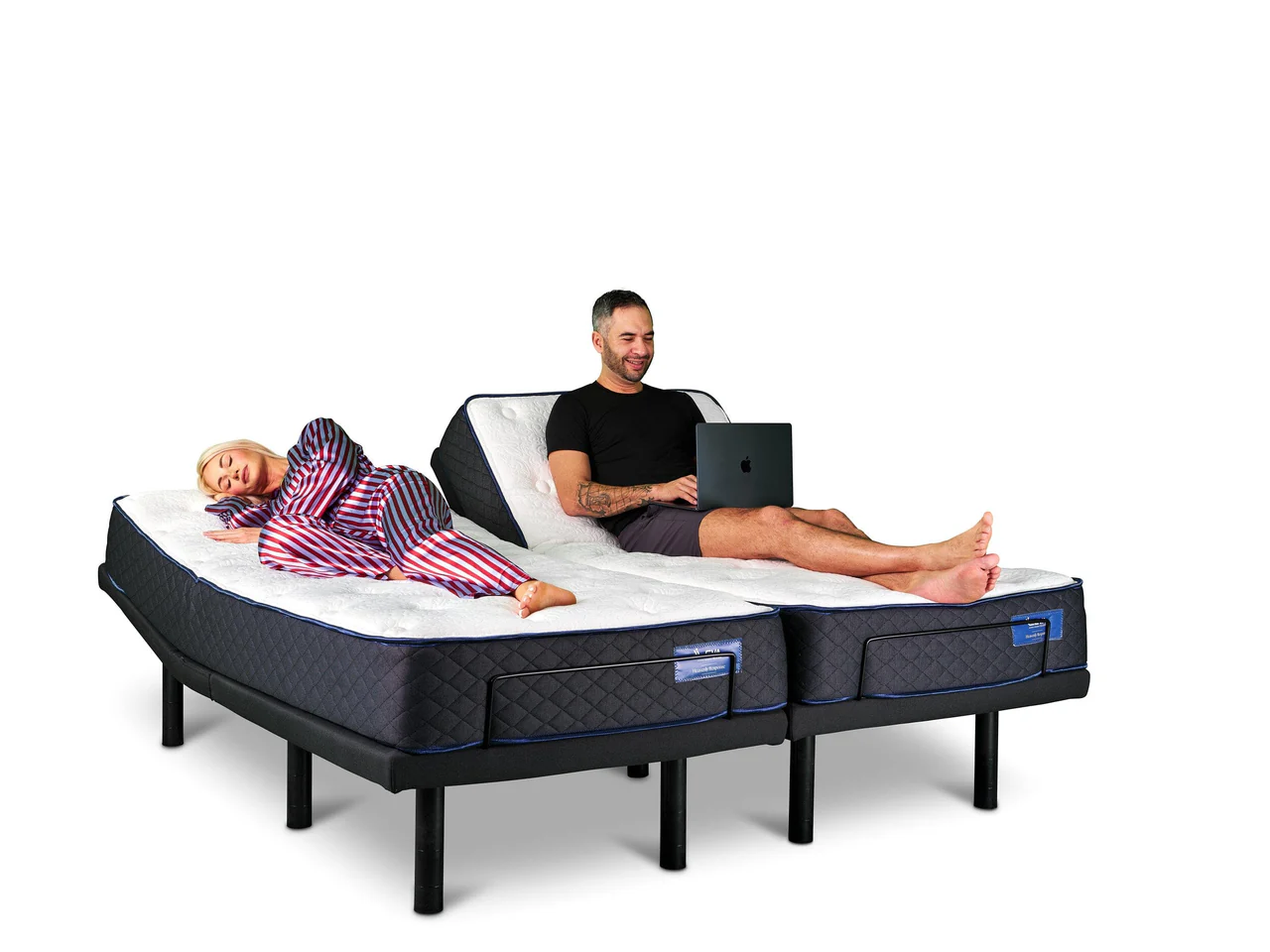
Raising the legs and upper body slightly with an adjustable base reduces nerve compression and supports a more neutral spine for both back and side sleepers. When one partner needs knee elevation for L4-L5 relief and the other prefers a flatter angle for shoulder comfort, a split base with independent controls becomes the only setup that truly works for both.
Basic split add-on bases exist but often limit independent control to head elevation. Integrated systems extend that independence to foot elevation, lumbar support, massage zones, and in advanced models, temperature control, with each side managed through its own app profile.
Noise and Motion Transfer During Nighttime Adjustments
Independent control only helps when adjustments do not wake your partner. Motor noise often becomes a hidden barrier that spec sheets gloss over.
Basic add-on bases frequently use motors chosen for low cost instead of quiet operation. Audible movement during position changes can wake a sleeping partner and discourage mid-night adjustments.
Those micro-adjustments provide real comfort only when the motor operates quietly. Integrated systems built around whisper-quiet motors let you change positions at night without creating a noticeable noise event. Strong motion isolation between the two sides of a split base further limits how much one partner’s movement reaches the other.
Mattress Fit, Sheets, and Bedroom Style
Mattress construction determines whether it can flex safely on an adjustable base. Innerspring mattresses with rigid border wires resist bending and can crack or separate when used repeatedly on a moving frame.
Pairing an adjustable base with a compatible memory foam, latex, or hybrid mattress lets you fine-tune spinal alignment and reduce pressure on the hips and lower back. Basic add-on bases sold separately from the mattress place the burden of compatibility checks on the buyer.
Sheet slippage often becomes a daily annoyance. Standard fitted sheets are cut for flat profiles, so significant head or foot elevation pulls corners loose. Integrated systems that include deep-pocket sheets with reinforced elastic keep bedding in place through frequent adjustments.
Visual design also affects long-term satisfaction. Many basic add-on bases expose metal frames and motors, which can make the bedroom feel clinical. Integrated systems hide the mechanics inside an upholstered, furniture-quality frame that blends with a designed space.
Delivery, Setup, and Long-Term Value for Couples
A split king adjustable system includes two bases, two mattresses, a shared headboard, and accessories. Self-assembly often takes several hours and involves moving heavy pieces through doorways and pairing electronics correctly.
White-glove delivery, where trained professionals bring the system to the bedroom, assemble every component, set leg height, connect app controls, and remove the old bed, removes that burden. This one-time service cost protects a multi-year investment and ensures everything works from the first night.
Long-term value depends on motor life, warranty strength, and whether the mattress and base were engineered to work together. A mattress and base from different brands may perform well alone yet wear out faster together if the base’s flex pattern does not match the mattress’s foam density or coil design.
How Zero-Gravity Positioning and Lumbar Support Relieve Pain
Zero-gravity positioning and knee elevation reduce shearing forces on the spine by placing the body in a neutral posture with the legs above heart level. In this position, the lumbar spine is no longer pulled into extension by the weight of the legs, and the intervertebral discs experience less compressive load than on a flat surface.
A knee-elevated or zero-gravity-style position often helps sciatica because it eases pressure on the lumbar spine and supports better circulation. Improved circulation during sleep delivers oxygen and nutrients to inflamed joint tissue, which matters for arthritis and post-surgical recovery when repair happens overnight.
Lumbar support segments in integrated bases fill the natural curve of the lower back. This support prevents the erector spinae muscles from holding a low-level contraction all night just to stabilize the arch. When those muscles release, deep sleep quality improves and morning stiffness usually decreases.
Real-World Scenarios and the Features That Matter Most
L4-L5 disc issues: An adjustable base can relieve sciatica symptoms by allowing independent elevation of the head and feet, which reduces pressure on the lower back and sciatic nerve while enabling a zero-gravity-style position. A basic add-on base offers partial benefit, while an integrated system with lumbar zoning addresses the full pressure profile of this diagnosis.
Arthritis hip pain: Many people with osteoarthritis find that subtle, periodic movements prevent joints from locking overnight. A flat bed offers no variation, while an integrated system can run gentle micro-adjustments that help maintain hip and knee mobility through the night.
Post-surgery recovery: Elevating the surgical limb or torso reduces swelling and venous pooling. An integrated system with independent foot elevation lets you dial in the exact angle you need without disturbing your partner’s side.
Snoring and mild sleep apnea: Head elevation opens the airway by shifting soft tissue away from the back of the throat. An adjustable base provides the customizable positioning discussed earlier, which helps many sleepers fall asleep faster and stay asleep longer. Advanced integrated systems add anti-snore detection that raises the head automatically when snoring starts, so the snoring partner does not need to wake up and adjust the bed.
Decision Matrix: Matching Your Needs to the Right System
Use the checklist below to connect your main priorities with the most suitable category.
- Single sleeper, mild back discomfort, limited budget: A basic add-on base with knee elevation offers clear improvement over a flat bed at a lower price.
- Couple with identical sleep preferences, moderate back pain: You can move up to a single integrated base with lumbar support and a zero-gravity preset, which addresses shared pain needs without requiring a split configuration.
- Couple with differing pain profiles or sleep preferences: A split integrated system with independent controls on each side becomes the only option that supports both partners without compromise.
- Diagnosed spinal condition (L4-L5, stenosis, sciatica) or post-surgical recovery: An integrated system with lumbar zoning and precise angle control is the appropriate category. A flat bed or basic base cannot match the mechanical benefit.
- Snoring or mild sleep apnea affecting the partner: An integrated system with anti-snore positioning or detection directly addresses this issue without adding a separate medical device.
- Noise-sensitive sleeper or light sleeper partner: Whisper-quiet motors in integrated systems are a non-negotiable feature. Verify motor specifications before choosing any basic add-on base.
- Bedroom aesthetics are a priority: Integrated systems designed as furniture-quality products are the only category that meets this requirement along with mechanical performance.
Frequently Asked Questions
Do doctors recommend adjustable beds for back pain?
Physical therapists and orthopedic specialists often recommend elevated sleeping positions for lumbar disc issues, spinal stenosis, sciatica, and osteoarthritis. Elevating the knees reduces compressive load on the lumbar spine and relaxes the hip flexors, while slight head elevation supports the airway and reduces acid reflux that can interrupt sleep.
The ideal angle and configuration depend on the diagnosis. A patient with spinal stenosis usually benefits from slight forward flexion, while a patient with a herniated disc may respond better to a neutral zero-gravity preset. People with diagnosed conditions should review angle ranges with a physical therapist or orthopedic specialist.
Can an adjustable bed replace a CPAP machine for sleep apnea?
An adjustable bed cannot replace a CPAP machine for moderate to severe obstructive sleep apnea. CPAP therapy delivers continuous positive airway pressure that holds the airway open regardless of position.
Head elevation on an adjustable base reduces the gravitational collapse of soft tissue into the airway and can meaningfully reduce snoring and mild apnea events. It does not create the pressure needed to treat moderate or severe apnea. Anyone with a formal sleep apnea diagnosis should discuss positional therapy as a complement to, not a substitute for, prescribed treatment.
Will fitted sheets stay on an adjustable bed when it is elevated?
Standard fitted sheets are cut for flat mattresses and often pop off corners when the head or foot rises. Purpose-built sheets with deep pockets, usually 18 to 22 inches, and reinforced elastic that wraps the full perimeter stay in place through repeated articulation.
Some integrated sleep systems include proprietary bedding designed for the full flex range of their bases, which removes this issue entirely. When buying sheets separately, match pocket depth to mattress thickness and confirm that the elastic is rated for adjustable base use.
How do I know if my mattress is compatible with an adjustable base?
Mattress compatibility depends on internal construction. All-foam and latex mattresses flex easily across the full range of motion. Hybrid mattresses with individually wrapped pocket coils are usually compatible because each coil moves on its own.
Traditional innerspring mattresses with rigid border wires or interconnected coils resist articulation and can suffer structural damage when bent repeatedly. Before pairing any mattress with an adjustable base, confirm with the manufacturer that it is rated for adjustable use. The safest route is buying a matched mattress and base from a specialist who has already tested their compatibility.
What is the difference between a Split Queen and a Split King adjustable bed?
A Split King uses two Twin XL mattresses on two independent bases inside a king frame, for a total size of 76 inches wide by 80 inches long. A Split Queen divides a queen footprint, 60 inches wide by 80 inches long, into two independently adjustable sides, each 30 inches wide.
Split Queen is less common and rarely offered by standard retailers, so it suits couples who want independent adjustability in a room that cannot fit a king. Because each side of a Split Queen is narrower than a Twin XL, mattress selection usually requires a specialist who builds to custom dimensions.
Conclusion: Why Integrated Systems Often Win for Pain and Partners
Across all seven criteria, a clear pattern emerges. Traditional flat beds miss the mechanical requirements for pain relief and couple compatibility. Basic add-on adjustable bases improve comfort with head and knee elevation but fall short on lumbar zoning, quiet motors, mattress integration, and precise split control.
Integrated adjustable sleep systems, where the base, mattress, bedding, and technology work as one design, meet every criterion at the same time. They fit couples managing chronic pain, different sleep profiles, or conditions that call for positional therapy.
Leva Sleep builds integrated adjustable systems that deliver these benefits without the price premium of legacy luxury brands. With more than 25,000 customers over eight years, 15 to 20 adjustable base models compared with the three to five at general retailers, Split Queen and Split King options with independent app control, whisper-quiet German motors, lumbar support, anti-snore detection, and in-house white-glove delivery and setup, Leva Sleep focuses on couples who want to sleep better together.
Mattresses are made in America and priced 30 to 50 percent below comparable luxury competitors by removing retail middlemen.