Written by: Matthew Timmins, Founder and Managing Director, Leva Sleep
Key Takeaways for Couples with Back Pain
- Flat mattresses provide consistent medium-firm support but cannot adapt to individual sleep positions or changing health needs.
- Basic adjustable bases add zero-gravity and incline options for spinal relief, yet non-split units force both partners to share the same elevation settings.
- Integrated split adjustable systems deliver fully independent head, lumbar, and leg positioning per partner, eliminating cross-frame vibration and enabling personalized therapeutic angles.
- Premium split systems with whisper-quiet motors and app-controlled presets minimize noise and motion disruption while offering long-term adaptability as health needs evolve.
- Leva Sleep’s integrated split systems combine furniture-quality design, white-glove delivery, and advanced features to help couples overcome back pain and partner disturbances, so you can shop Leva Sleep today.
How Each Option Supports Comfort and Spinal Alignment
Medium-firm mattresses are often linked to improved comfort, spinal alignment, and reduced back pain. That research creates a shared starting point for all three categories.
Flat medium-firm mattresses provide a fixed neutral surface. Neutral reflects an average body type, not your specific spine or pain pattern. Zoned support mattresses may help maintain spinal alignment by providing varying stiffness across body regions, preventing sinking of the hips and shoulders for those with mechanical back pain. The surface still stays static even as you change positions during the night.
Basic adjustable bases add head and foot elevation to any compatible mattress. Elevating the head 15–30 degrees restores natural lumbar spinal alignment and reduces lower back strain compared to a flat sleeping surface. The zero-gravity position, where head and knees rise together, goes further. Dr. Harish Chafle states that zero-gravity positioning reduces spinal pressure by mimicking astronauts’ neutral body posture, with weight distributed more evenly to lessen strain on the spine and joints. A non-split base moves both sides at once, so one partner’s therapeutic angle becomes the other partner’s position too.
Integrated split adjustable systems pair independent bases with compatible mattresses, typically memory foam or pocketed-coil hybrids. Each partner selects their own elevation and lumbar preset. Research indicates that adjustable lumbar support can help reduce pain for individuals with chronic low back pain, and split systems make that lumbar control available on each side independently.
- Flat mattress: Consistent medium-firm support, no positional adjustment, and both partners share identical surface conditions.
- Basic adjustable base: Adds zero-gravity and incline options, and spinal relief is meaningful but applied to both sides equally on a non-split unit.
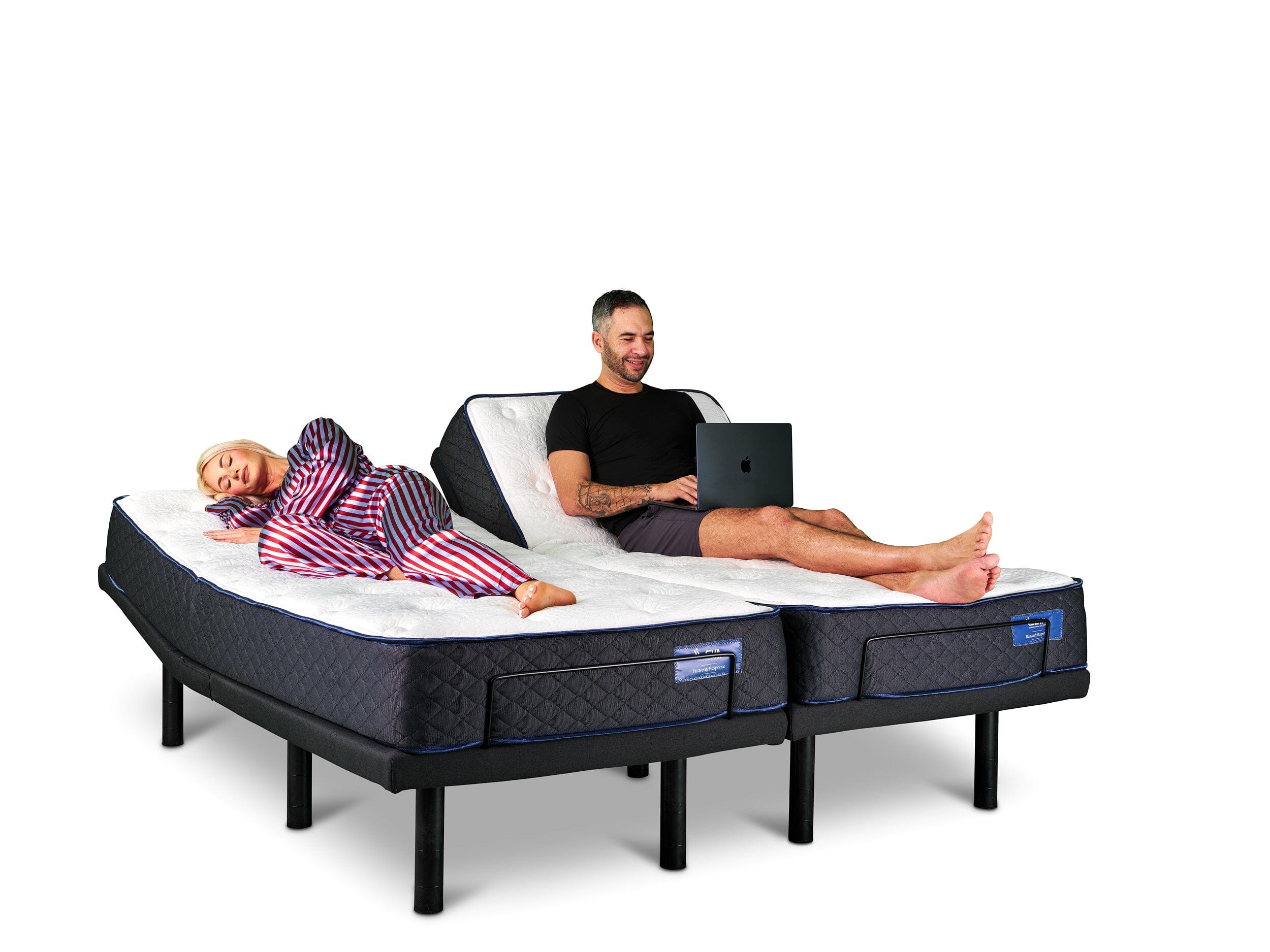
- Integrated split system: Independent head, lumbar, and leg positioning per partner, so each sleeper can access zero-gravity or custom inclines without affecting the other side.
Independent Adjustability for Different Pain Profiles
A non-split adjustable base operates as a single unit, so any head or foot elevation affects both partners. When one partner elevates the head to reduce snoring, the other partner’s head rises too. Queen-size adjustable bases move as a single unit and are appropriate for couples with similar comfort preferences, while Split King configurations are recommended when partners have differing back pain profiles or sleep positions.
Integrated split systems in Split King or Split Queen formats resolve this shared-control problem. Split-king adjustable base configurations consist of two twin XL units placed side by side, enabling each partner to independently control head and foot angles. App-controlled presets let each sleeper save therapeutic positions and return to them quietly. Mild to moderate positional snoring can be meaningfully reduced by 10–20 degrees of head elevation through automated adjustable bases, making app-controlled presets useful for snoring-related disruption.
- Flat mattress: No adjustability, and both partners share one fixed surface.
- Basic adjustable base (non-split): Adjustable, but changes apply to both sides at the same time.
- Integrated split system: Fully independent head, lumbar, and leg control per partner through app or remote.
Motion Isolation and Partner Disturbance
A 2020 actigraphy study from Monash University in 55 couples found that about one out of three wake-ups are caused by one’s partner. For people with chronic back pain who already sleep lightly, that extra disruption can feel overwhelming.
Mattress material drives most of the isolation difference. NapLab testing found that memory foam produces lower motion transfer compared to pocketed coils, which makes it better at isolation. A flat memory foam mattress therefore isolates motion well but offers no positional adjustment.
Many couples report frequent partner disturbances from motion, and rates vary by mattress type. Basic adjustable bases paired with memory foam or pocketed-coil hybrids inherit the isolation properties of the mattress. A non-split base still transmits mechanical vibration from motor adjustments across the shared frame.
Integrated split systems use two physically separate bases to remove cross-frame mechanical transmission. Each base operates independently, so a midnight adjustment on one side produces no vibration on the other. The mattress material still governs passive isolation between the two surfaces at the center seam, which is why pairing split bases with memory foam or individually pocketed coil mattresses is standard practice.
- Flat mattress: Isolation depends entirely on mattress material, with memory foam performing best, and there is no mechanical vibration source.
- Basic adjustable base (non-split): Inherits mattress isolation properties, and motor adjustments can transmit vibration across a shared frame.
- Integrated split system: Physically separate bases eliminate cross-frame motor vibration, and mattress material governs residual passive isolation at the center seam.
Noise Levels from Flat Beds to Premium Split Systems
Flat mattresses produce no mechanical noise. The only sound-related variable is mattress material aging. The Better Sleep Council reports that consumers replace mattresses due to deterioration such as sagging, discomfort, or squeakiness, all of which can introduce noise over time.
Basic adjustable bases vary widely in motor noise. Budget models with lighter-duty actuators are audibly louder during adjustment cycles. Quiet motor operation in quality adjustable bases minimizes disruption to a sleeping partner, supporting better motion isolation in shared sleeping environments compared to noisier budget models. Mid-range and premium bases increasingly use brushless DC motors that operate at very low noise levels.
Integrated split systems from specialist manufacturers, including Leva Sleep’s whisper-quiet German motor configurations, are engineered to keep audible output during adjustments as low as possible. Because each base adjusts independently, only the partner making an adjustment hears any motor activity, and premium motors reduce that sound to a level comparable to ambient room noise.
- Flat mattress: No motor noise, though aging materials may develop squeaks over time.
- Basic adjustable base: Noise varies significantly by motor quality, and budget models can be disruptive during adjustments.
- Integrated split system: Premium brushless motors minimize noise, and independent operation means only the adjusting partner is exposed to any motor sound.
Durability and Lifespan of Each Sleep Solution
A well-made adjustable base typically lasts 8 to 15 years of regular use. Budget models with lighter-duty actuators often show motor fatigue at the 4 to 6 year mark.
Memory foam mattresses typically last 7–10 years under normal use. Adjustable-base-compatible mattresses, including memory foam and pocketed-coil hybrids, are engineered for repeated flex cycles. Traditional innerspring mattresses with interconnected coil grids are broadly incompatible with adjustable bases because the rigid coil structure is engineered for stability rather than articulation.
For integrated split systems, durability depends on frame construction, motor grade, and mattress compatibility. A well-built adjustable bed base equipped with brushless DC motors, heavy-gauge steel frames, reinforced legs, and center supports can maintain structural integrity under substantial weight capacities. Manufacturers typically offer 2–10 year warranties on motors and 10–25 years on frames, and longer motor warranties often signal higher build quality.
- Flat mattress: Typical lifespan of 7–10 years, with no motor components to fail, and longevity depends on foundation quality.
- Basic adjustable base: Typically lasts 8–15 years, and motor longevity varies depending on build quality and usage.
- Integrated split system: Premium-grade frames and brushless motors support extended use, and warranty terms provide the clearest durability signal to evaluate.
Bedroom Design, Setup, and Service Experience
Flat mattresses on platform or slatted foundations integrate easily into almost any bedroom design. The trade-off is that the sleep surface stays fixed, and delivery is usually a drop-ship or bed-in-a-box experience that leaves assembly and setup to you.
Basic adjustable bases from general mattress retailers are often sold as add-ons rather than primary products. The result is a functional but visually utilitarian frame that may not match bedroom furniture, and delivery rarely includes professional setup or guidance on integration.
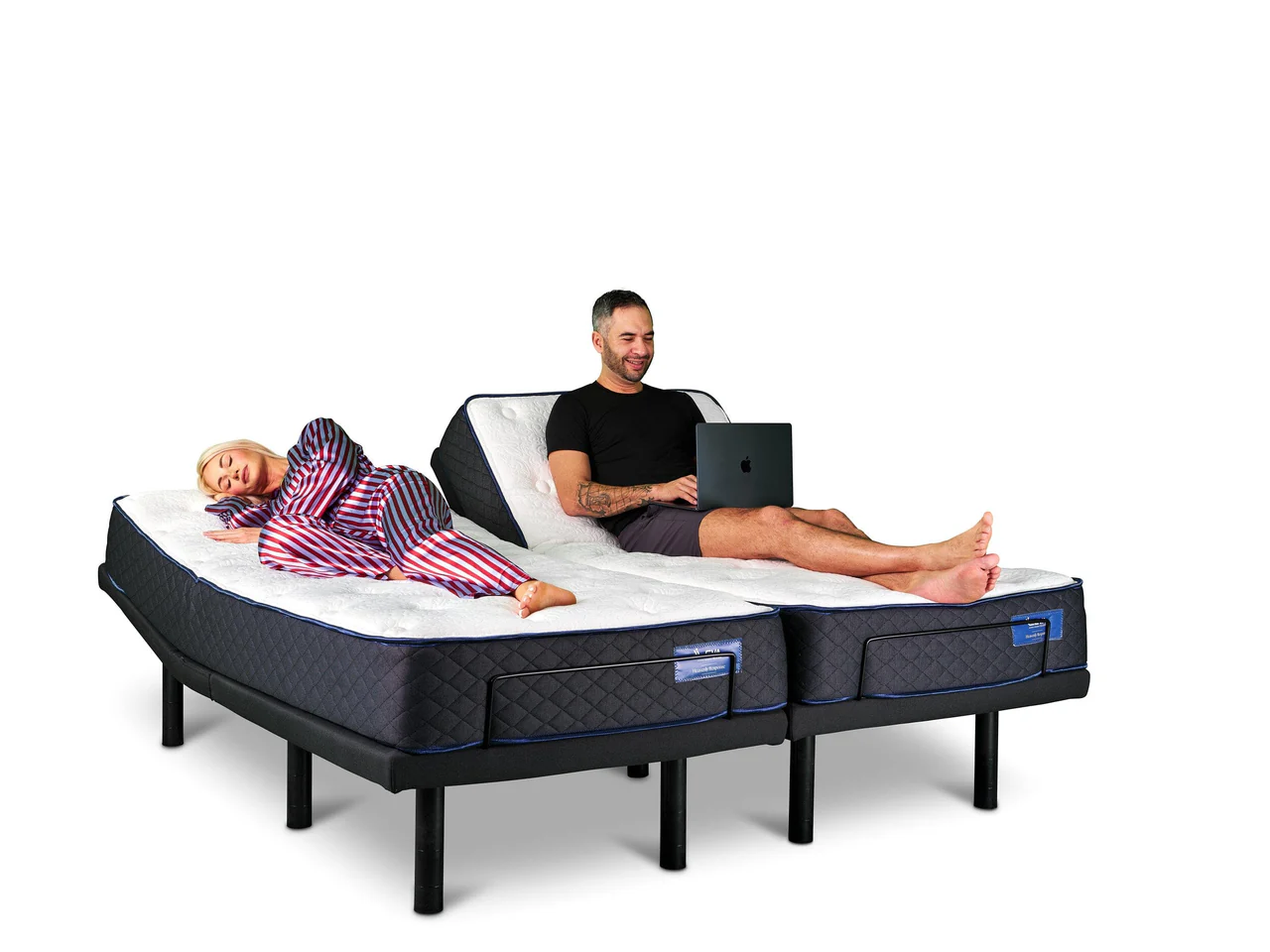
Integrated split systems from specialist manufacturers are designed as furniture-quality pieces. Leva Sleep controls the entire experience, from in-house design and local assembly to white-glove delivery that includes bedroom setup, leg-height adjustment, product tutorials, and removal of the old bed. That end-to-end ownership removes compatibility guesswork and avoids the clinical look associated with add-on adjustable bases.
- Flat mattress: Aesthetically neutral, delivery is typically self-managed, and there is no setup complexity.
- Basic adjustable base: Functional appearance, often sold as an afterthought, and delivery and setup support vary widely.
- Integrated split system: Furniture-quality design with specialist white-glove delivery and setup, plus accessories engineered specifically for adjustable use.
Clarifying Your Pain Triggers and Partner Needs
Clear insight into your pain triggers and partner needs makes the right configuration easier to spot. Consider whether your pain worsens when flat and improves with elevation, whether your partner’s movement or snoring wakes you, and whether you and your partner have meaningfully different firmness or temperature preferences. When you answer these questions clearly, the scenario section below maps more directly to your situation.
Explore Leva Sleep’s split systems designed for couples with different pain triggers.
Real-World Couple Scenarios and Matching Technology
Scenario 1: Chronic lower-back pain with sciatica. One partner experiences lumbar pain and radiating leg discomfort that worsens when lying flat. Given the zero-gravity benefits for spinal pressure discussed earlier, the most relevant features include per-side zero-gravity access, adjustable lumbar support, and the ability to change angles without waking the other partner.
Scenario 2: One partner snores, and the other has hip pain. These are two distinct therapeutic needs on one shared surface. The snoring partner benefits from head elevation, which can reduce positional snoring, while the hip-pain partner may need a softer pressure-relief surface or a different leg angle. A technology that allows each side to be configured independently in both elevation and firmness addresses both needs without forcing either partner to compromise.
Scenario 3: Post-surgery recovery. One partner requires medically recommended elevated positioning during recovery while the other maintains normal sleep habits. Dr. Harish Chafle notes that for lower back pain, sciatica, or post-surgery recovery, many orthopedicians recommend zero-gravity positioning because it reduces spinal pressure significantly versus flat lying. The key requirement is the ability to maintain a therapeutic position on one side indefinitely without imposing it on the other.
Practical Factors: Learning Curve, Maintenance, and Future Flexibility
Flat mattresses require no learning curve and minimal maintenance beyond rotation schedules. They offer no future adaptability, so if health needs change, you must replace the mattress entirely.
Basic adjustable bases introduce a remote or app interface, and most users adapt within a few nights. Maintenance focuses on protecting the motor from power surges. Adjustable base motors are sensitive to power surges, and using a surge protector is recommended to prevent control box failure. Because the feature set is fixed at purchase, future adaptability remains limited.
Integrated split systems have the steepest initial learning curve due to dual app profiles, preset configuration, and accessory integration. They also offer the greatest future flexibility. As health needs evolve, such as new diagnoses, post-surgery requirements, or changing firmness preferences, the system’s independent controls and software presets can be reconfigured without replacing hardware. Leva Sleep’s systems include anti-snore positioning, lumbar control, pillow tilt, and temperature integration, and each feature can be activated or adjusted as needs change.
Decision Matrix: Matching Pain, Space, and Budget
Specific patterns in pain, bedroom space, and budget point toward one of the three categories.
A flat mattress deserves serious consideration when both partners share similar firmness preferences and sleep positions, so neither person needs independent adjustment. This option works best when back pain is mild and positional elevation has not been recommended, because a flat surface cannot adapt to therapeutic angles. Budget-conscious couples can pair a flat memory foam mattress with a simple foundation to gain strong motion isolation at the lowest price point. Flat mattresses also integrate easily into any bedroom without the visual or spatial footprint of an adjustable base.
A basic adjustable base fits couples who share elevation needs but want more relief than a flat bed can provide. It works well when one or both partners have been advised to sleep elevated for acid reflux, mild snoring, or circulation issues, and both people feel comfortable at the same angles. This category suits households where the budget allows a base upgrade but not a full split system, and where bedroom space accommodates a Queen or King non-split configuration.
An integrated split adjustable system serves couples with more complex or divergent needs. It becomes the strongest fit when partners have meaningfully different back pain profiles, firmness preferences, or therapeutic positioning requirements. It also helps when partner motion or snoring causes measurable sleep disruption, or when one or both partners manage chronic lower back pain, sciatica, or post-surgery recovery. Couples who want to stay in the same bed without either person compromising their therapeutic position, and who value long-term adaptability and a premium service experience, gain the most from this category.
Compare Leva Sleep configurations in person or online to match your pain profile and budget.
Frequently Asked Questions
What is the practical difference between a split and non-split adjustable base for couples?
A non-split adjustable base moves as a single unit, so any elevation change affects both partners at the same time. This configuration works well when both partners share similar therapeutic needs, such as both benefiting from mild head elevation. A split configuration consists of two independent bases placed side by side, each with its own motor, controls, and presets. One partner can elevate to zero-gravity for sciatica relief while the other remains flat, with no mechanical connection between the two sides. For couples with different back pain profiles, snoring on one side only, or different firmness preferences, a split system is the only configuration that avoids forcing one partner to adopt the other’s therapeutic position.
How noisy are modern adjustable bases during adjustments?
Motor noise varies significantly by build quality. Budget models with lighter-duty actuators can produce audible whirring or grinding during adjustment cycles, which can wake a sleeping partner. Premium models, particularly those using brushless DC motors, operate at noise levels comparable to a quiet fan or ambient room sound. When evaluating a base, ask the manufacturer or retailer for the motor specification, and when possible, test the adjustment cycle in person. Leva Sleep’s systems use whisper-quiet German motors specifically selected to minimize audible disruption. In a split system, only the partner making an adjustment is exposed to any motor sound, which further reduces disruption risk.
What sleep positions do medical professionals recommend for back pain and sciatica?
Medical consensus generally supports positions that reduce lumbar disc pressure and maintain the natural spinal curve. Zero-gravity positioning, with the head elevated approximately 30–45 degrees and knees raised 15–25 degrees, is frequently recommended by orthopedic specialists for lower back pain and sciatica because it distributes body weight more evenly and decompresses lumbar discs. Slight leg elevation alone can relieve lower back strain for back sleepers. Side sleepers with hip pain often benefit from a slightly softer surface with targeted lumbar support. Any positional recommendation should be confirmed with the treating physician or physiotherapist, because individual anatomy, diagnosis, and surgical history affect what is appropriate.
Will an integrated split system work with my existing bedroom furniture?
Most integrated split systems are designed to function as standalone bed frames, replacing the existing foundation or platform bed. Compatibility with existing headboards depends on the base’s headboard bracket system. Most premium bases include universal brackets that accommodate standard headboard attachment points. The visual footprint of a Split King is identical to a standard King bed, and a Split Queen matches a standard Queen footprint. Leva Sleep designs its systems to integrate into modern bedroom aesthetics rather than appear clinical, and white-glove delivery includes setup within the existing bedroom configuration. Confirming headboard compatibility and leg height options before purchase is advisable.
What temperature regulation options are available in integrated split systems?
Temperature regulation in integrated split systems typically relies on two mechanisms. The first is compatible heating and cooling pads placed on each side independently. The second is temperature-regulating mattress materials such as phase-change fabric covers or open-cell foam. Because split systems allow each side to be configured independently, one partner can use an active cooling pad while the other uses a heating pad, a setup that is not possible on a shared flat mattress or non-split base. Leva Sleep’s systems are compatible with heating and cooling pad integration, and the company designs bedding accessories, including fitted sheets with deep pockets and extra elastic, specifically for adjustable bases so the temperature layer stays in place through elevation changes.
Choosing the Configuration That Protects Both Health and Relationship
The core trade-off across these three categories stays straightforward. Flat mattresses offer simplicity, proven motion isolation with the right material, and no mechanical complexity, but they cannot adapt to changing health needs or solve the problem of two people requiring different therapeutic positions on one surface. Basic adjustable bases add meaningful spinal relief through zero-gravity and incline positioning, yet non-split units impose one partner’s angle on the other, and motor quality determines whether adjustments help or disrupt sleep. Integrated split adjustable systems are the only category that delivers independent head, lumbar, and leg positioning on a single sleep surface, removes cross-frame motor vibration, and adapts to evolving health needs through software presets and modular accessories.
For couples where both partners have chronic back pain, differing therapeutic needs, or where partner motion and snoring are measurable sources of sleep disruption, the split system category addresses all three problems at once. The investment is higher, yet the alternative of ongoing pain, fragmented sleep, and gradual erosion of shared sleep carries its own long-term cost.
Leva Sleep has spent over eight years and more than 25,000 customer relationships refining integrated split adjustable systems specifically for couples navigating these challenges. With 15–20 adjustable models, specialist expertise, American-made mattresses, and white-glove delivery, the company offers a level of configuration depth and service that general mattress retailers do not provide.
Schedule a visit to Leva Sleep’s La Jolla showroom or start configuring your split system online.