
Written by: Matthew Timmins, Founder and Managing Director, Leva Sleep
Key Takeaways
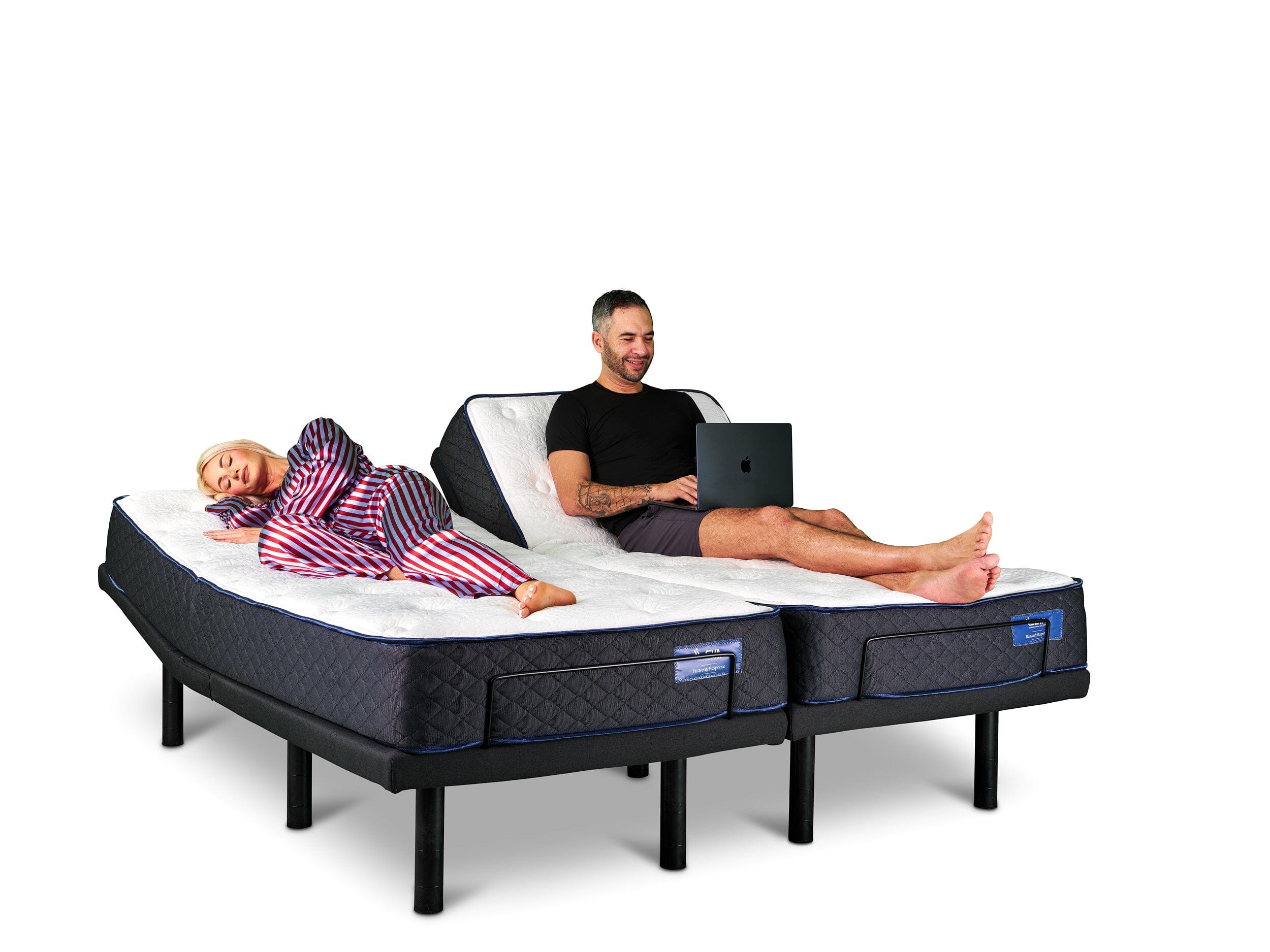
- Traditional flat beds and basic adjustable bases force couples to compromise on temperature, firmness, and motion transfer. Integrated split adjustable systems handle these variables independently on each side.
- Only split adjustable systems combine independent per-side elevation, firmness, temperature control, and AI anti-snore automation in a single app-controlled platform.
- Whisper-quiet motors, isolated split zones, and purpose-built mattresses reduce noise and motion transfer so one partner’s movements or schedule rarely disturb the other.
- Split-king (38-inch sides) and split-queen (30-inch sides) configurations let couples keep their current bed width while gaining full personalization.
- Experience independent sleep technology with Leva Sleep by visiting the La Jolla showroom or shopping online.
Comfort and Support: How Each System Really Feels
Comfort and support depend on four main variables: spinal alignment across different body weights, pressure relief at hips and shoulders, edge support, and partner disturbance. The table below shows how each technology category performs on these points so you can see where split adjustable systems pull ahead.
| Criteria | Flat Bed | Basic Base / Gadget | Split Adjustable System |
|---|---|---|---|
| Spinal alignment | Fixed, one position for both | Single-zone elevation only | Per-side head, lumbar, and foot control |
| Pressure relief | Depends on mattress only | Topper adds some relief | Elevation redistributes pressure dynamically |
| Edge support | Varies by mattress | Unchanged from base mattress | Reinforced perimeter on purpose-built mattresses |
| Partner disturbance | High | Moderate | Low with isolated split zones |
A flat bed delivers only what the mattress provides. A basic adjustable base adds head and foot elevation but usually moves both sides together, so one partner’s change affects the other. Piecemeal gadgets such as mattress toppers soften the surface but do not change posture or alignment.
An integrated split adjustable system pairs an articulating base with a purpose-built mattress, either all-foam or hybrid pocket coil. Each partner chooses their own elevation and surface feel, which supports their body independently while still sharing one bed frame.
Adjustability and Personalization: Features That Actually Matter
Modern adjustability in 2026 goes far beyond raising the head of the bed. A serious system should offer independent per-side head elevation, independent per-side foot elevation, lumbar support control, pillow tilt, app-based preset saving, and automated micro-adjustment when snoring is detected.
Traditional flat beds offer no adjustability at all. Basic adjustable bases usually move both sides together and rely on a single remote. Standalone gadgets handle only one variable, such as cooling, white noise, or position alerts, and they do not integrate with the bed.
Integrated split adjustable systems add Bluetooth app control, per-side preset positions, vibrating wake alarms that avoid disturbing a partner, and AI anti-snore modes that detect snoring and raise the head of the snoring partner automatically. When you compare systems, confirm that the app stores multiple named presets, that you can adjust positions quietly from a phone without turning on lights, and that anti-snore automation works independently on each side.
Noise and Motion Isolation: Keeping One Partner Asleep
Motor noise and motion transfer are the mechanical issues most likely to wake a sleeping partner. During evaluation, request a live demonstration at low speed, which is the speed most people use at night, and listen for motor hum, gear chatter, or frame vibration.
Basic adjustable bases sold as add-ons often use single-zone motors that move the entire platform. Any adjustment one partner makes travels across the surface. Split bases use whisper-quiet motors on each split zone, so one side can move without sending vibration across the center gap.
Mattress design also affects motion isolation. Pocket coil hybrids and all-foam models built for adjustable bases flex with the frame while limiting side-to-side movement. A standard innerspring mattress on a split base still sends motion across the gap. Confirm that the mattress and base were engineered to work together before you buy.
Temperature Regulation Technologies for Couples
Temperature mismatch ranks among the most common reasons couples think about separate beds. Each technology category handles temperature control in a different way.
A flat bed offers no active temperature control beyond the mattress cover and bedding. A single-zone cooling pad sold as a standalone device cools the entire surface, which helps a hot sleeper but can overcool a cold sleeper sharing the same bed. A basic adjustable base does not manage temperature unless you add a separate pad.
These single-zone solutions expose a core limitation: they cannot support two different temperature preferences at the same time. An integrated split adjustable system solves this by pairing the base with a per-side heating and cooling pad. One partner can choose a warm surface while the other prefers a cooler feel.
When you review this feature, confirm that temperature zones are fully independent, that the system reaches the chosen temperature within a clear time window, and that controls live inside the same app used for position adjustments instead of requiring a separate device.
Firmness Differences and Spinal Alignment Between Partners
Partners often differ in body weight, sleep position, or joint sensitivity, which leads to different firmness needs. A flat bed with one firmness level forces at least one partner to sleep on a surface that feels too firm or too soft.
A split king or split queen uses two separate mattresses on a split base. Each side can be a different model, such as an all-foam mattress for pressure relief on one side and a hybrid pocket coil for firmer support on the other. When fitted correctly, the center looks continuous. Leva Sleep offers deep-pocket fitted sheets for split adjustable beds to keep both mattresses secure.
When you compare firmness options, start by identifying each partner’s primary sleep position, body weight range, and any joint or spinal conditions. Side sleepers usually benefit from softer surfaces that cushion the shoulder and hip. Back sleepers often need medium-firm support to maintain the lumbar curve. A specialist retailer with 15–20 adjustable base models and several mattress constructions can match these variables more precisely than a general furniture store with only a few options.
Snoring and Apnea: Positioning-Based Solutions
Head elevation is a proven positional strategy that can reduce airway obstruction during sleep. Raising the head often lowers the frequency and intensity of snoring. For people with diagnosed obstructive sleep apnea, positional therapy usually works alongside other treatments. Always consult a sleep medicine physician before changing a prescribed apnea plan.
A flat bed cannot maintain steady head elevation without stacked pillows, which compress and shift overnight. A basic adjustable base can raise the head but usually moves both sides together, which disturbs the non-snoring partner. A standalone anti-snore wearable detects snoring and prompts movement but does not control the bed itself.
An AI anti-snore mode works at the base level. Sensors detect snoring vibration and raise the head of the snoring partner’s side by small increments until snoring eases, often without waking either partner. When you evaluate this feature, ask the retailer to show the sensitivity threshold, the maximum elevation the automation will apply, and whether the system records snoring events in the app.
Motion Isolation for Couples with Different Schedules
Different bedtimes or wake times often cause one partner to wake the other on a shared flat mattress. The key variables are motion transfer across the mattress, base noise during adjustment, and access to a silent alarm that wakes only one person.
Flat beds send motion directly across the surface. Foam mattresses reduce motion transfer but rarely remove it completely. A split adjustable system with a center gap between two independent mattresses physically interrupts motion. An app-controlled vibrating alarm wakes one partner through gentle vibration on their side only, which lets the other partner keep sleeping.
Split-King Versus Split-Queen: Choosing Your Width
A split king uses two twin XL mattresses, each 38 inches wide and 80 inches long, on two twin XL bases. The total width is 76 inches, which matches a standard king footprint and fits most king-size frames and layouts.
A split queen uses two 30-inch-wide mattresses (each 30 inches wide, 80 inches long) on two matching bases. The total width is 60 inches, which matches a standard queen footprint. Split queen options are less common in the market. Leva Sleep is one of the few retailers that builds them to customer specifications. A split queen suits bedrooms that cannot fit a king but still need independent per-side control.
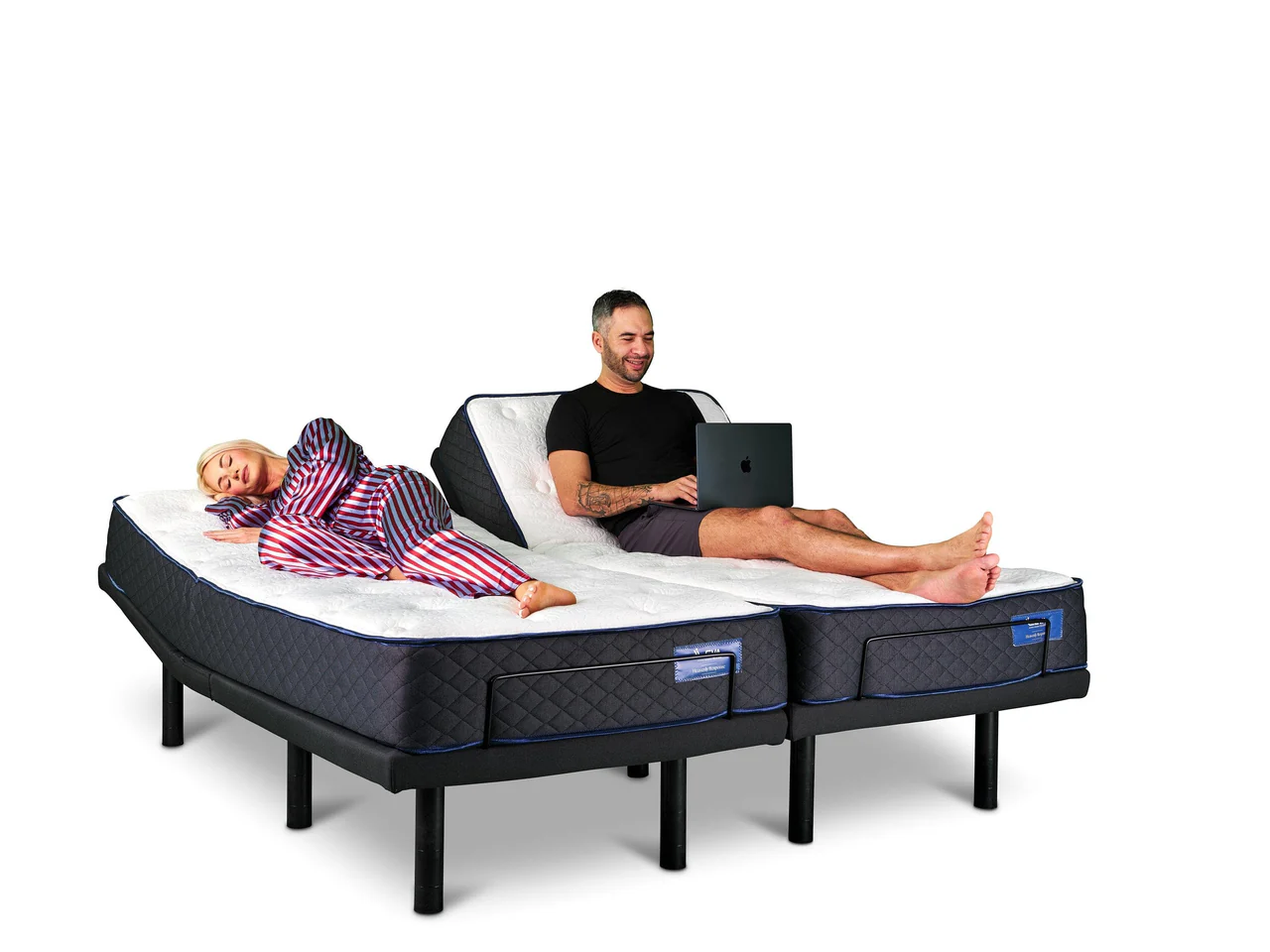
The main trade-off is per-side sleeping width: 38 inches per partner in a split king versus 30 inches in a split queen. Couples who currently share a queen and feel the width is adequate are strong candidates for a split queen upgrade. Couples who share a king today, or have a larger-framed partner, should focus on the split king.
Delivery and Setup: What to Expect on Day One
An adjustable sleep system includes more pieces than a standard mattress purchase. Typical components include a split base, two mattresses, a power supply, app pairing, optional temperature pad installation, and bedding fitting. Delivery and setup strongly influence whether the system works correctly from the first night.
Bed-in-a-box brands ship components to your door and leave assembly to you. Standard retail delivery usually brings items into the room but often stops short of full configuration, leg-height adjustment, app pairing, or old-bed removal. Leva Sleep’s white-glove delivery service, available for a fee, includes bedroom delivery, full assembly, leg-height adjustment, a product walkthrough, and removal of the existing bed through donation or recycling. For a system with several integrated components, professional setup lowers the risk of misconfiguration that could limit performance.
Guided Decision Framework and Checklist for Couples
This checklist helps you match your main sleep conflict to the right technology category. Identify your primary issue, follow the related guidance, then choose systems that meet those specific requirements.
Primary conflict: Temperature mismatch. If temperature is your main issue, evaluate systems with independent per-side heating and cooling pads that live inside the base app. Confirm full zone independence and app consolidation, since separate controls reduce ease of use.
Primary conflict: Firmness difference. If partners need different firmness levels, evaluate split configurations that allow different mattress models on each side. This works best with a retailer that carries enough mattress variety to match both partners’ body types and sleep positions.
Primary conflict: Snoring or mild apnea. If snoring is the main concern, evaluate bases with automated anti-snore head elevation. Confirm that automation works per-side and avoids disturbing the non-snoring partner. Anyone with diagnosed apnea should consult a physician before changing treatment.
Primary conflict: Motion transfer. If motion wakes one or both partners, evaluate split bases with physically separated zones and purpose-built mattresses. Test motor noise at low adjustment speed in person so you know how it sounds at night.
Primary conflict: Divergent schedules. If schedules differ, evaluate bases with per-side vibrating alarms and quiet app-controlled adjustments. Confirm that the base motor remains inaudible against typical bedroom background noise.
Couples with more than one active conflict, which is very common, should focus on an integrated split adjustable system that addresses all five variables. This approach avoids stacking separate gadgets that solve only one problem each while adding extra cords, separate apps, and clashing controls.
Apply this framework with Leva Sleep specialists in La Jolla, or start your evaluation online today.
Frequently Asked Questions
Does a split adjustable base leave a gap in the middle of the bed?
A split king or split queen base places two independent platforms side by side within one bed frame. The mattresses sit directly on the platforms, and when both sides lie flat, the surface looks continuous. A small gap exists between the two mattresses at the center, but purpose-built fitted sheets with deep pockets, such as those from Leva Sleep, help keep both sides secure. The gap becomes more noticeable only when one or both sides elevate significantly, which usually happens during sleep rather than shared activities.
How loud are the motors on a split adjustable base?
Motor noise varies widely across brands and price tiers. Entry-level and older adjustable bases often use motors that create audible hum or mechanical chatter during movement. Premium systems use precision-engineered motors, and Leva Sleep specifies whisper-quiet German motors, which operate below the normal noise level of a typical bedroom. For evaluation guidance, see the “Noise and Motion Isolation” section above.
Can a split adjustable base help with sleep apnea without a CPAP machine?
Head elevation on an adjustable base is a positional strategy that can reduce airway obstruction for some people who snore or have mild positional sleep apnea. It does not replace prescribed CPAP therapy for individuals with diagnosed moderate or severe obstructive sleep apnea. Anyone with a diagnosed condition should consult their sleep medicine physician before changing treatment. For couples where one partner snores without a formal diagnosis, an adjustable base with automated anti-snore head elevation, such as Leva Sleep's 2026 AI anti-snore mode, offers a non-invasive positional option that works quietly in the background.
What mattress types work best with a split adjustable base?
Not every mattress suits an adjustable base. The mattress must flex repeatedly at the head and foot without damaging internal components. All-foam mattresses and hybrid pocket coil mattresses with individually wrapped coils usually pair best with adjustable bases. Traditional bonnell or offset coil innerspring mattresses are generally poor matches because their interconnected coils resist flexing and can wear out quickly under repeated articulation. Leva Sleep designs both its all-foam and hybrid models to match the flex radius and articulation range of its adjustable bases.
Is a split queen available, and who should consider it?
A split queen configuration uses two 30-inch-wide independent bases and mattresses for a total width of 60 inches. This format is less common than a split king. Leva Sleep builds split queens to customer specifications, which makes this configuration available to more couples. A split queen suits couples who currently share a queen and feel the width is sufficient but want independent control of elevation, firmness, or temperature. It also fits bedrooms that cannot accommodate a king footprint. The 30-inch per-side width is narrower than the 38 inches in a split king, so couples with larger-framed partners or very active sleepers should consider whether the extra width of a split king is preferable.
Conclusion
The evaluation criteria above show that only an integrated split adjustable system addresses all five common couple sleep conflicts within one app-controlled platform. Traditional flat beds offer no adjustability, and basic adjustable bases or standalone gadgets handle only one variable at a time while leaving others unresolved.
A split king or split queen system with independent per-side elevation, firmness, temperature, and automated anti-snore capability lets couples avoid compromise without moving to separate beds. When you compare options, test motor noise in person, confirm that the mattress and base were engineered as a matched system, verify fully independent temperature zones, and check whether the retailer’s delivery service matches the setup needs described in the “Delivery and Setup” section.
A specialist retailer with deep adjustable base expertise and a curated mattress lineup can usually match both partners’ needs more precisely than a general retailer that treats the base as a simple add-on.
Transform your sleep with Leva Sleep by visiting the La Jolla showroom or shopping online today.