Written by: Matthew Timmins, Founder and Managing Director, Leva Sleep
Key Takeaways for Couples
- Consumer sleep trackers provide useful long-term data but cannot fix snoring, spinal misalignment, or partner disturbance.
- Trackers reliably measure total sleep time and timing but struggle with precise sleep-stage classification and partner-interference scenarios.
- Subscription costs add up quickly, and many premium wearables require ongoing fees that raise long-term ownership costs for couples.
- Split adjustable bases address root causes with independent per-side adjustments, lumbar support, and anti-snore automation without recurring subscriptions.
- Leva Sleep’s split adjustable bases deliver subscription-free monitoring and automated corrections, so explore Leva Sleep’s adjustable base options.
1. Best Sleep Tracker Without Subscription
The most important long-term ownership factor is whether full functionality requires a recurring fee. Several strong options sit in the subscription-free tier. The Withings Sleep Analyzer is priced at approximately $130 with zero subscription fees, and sleep stage tracking, heart rate, breathing disturbance index, and Health Mate app features are included permanently. The Beautyrest Sleeptracker Monitor costs $149–$150 and includes independent two-sleeper tracking via separate sensor strips, heart rate, HRV, and sleep stages.
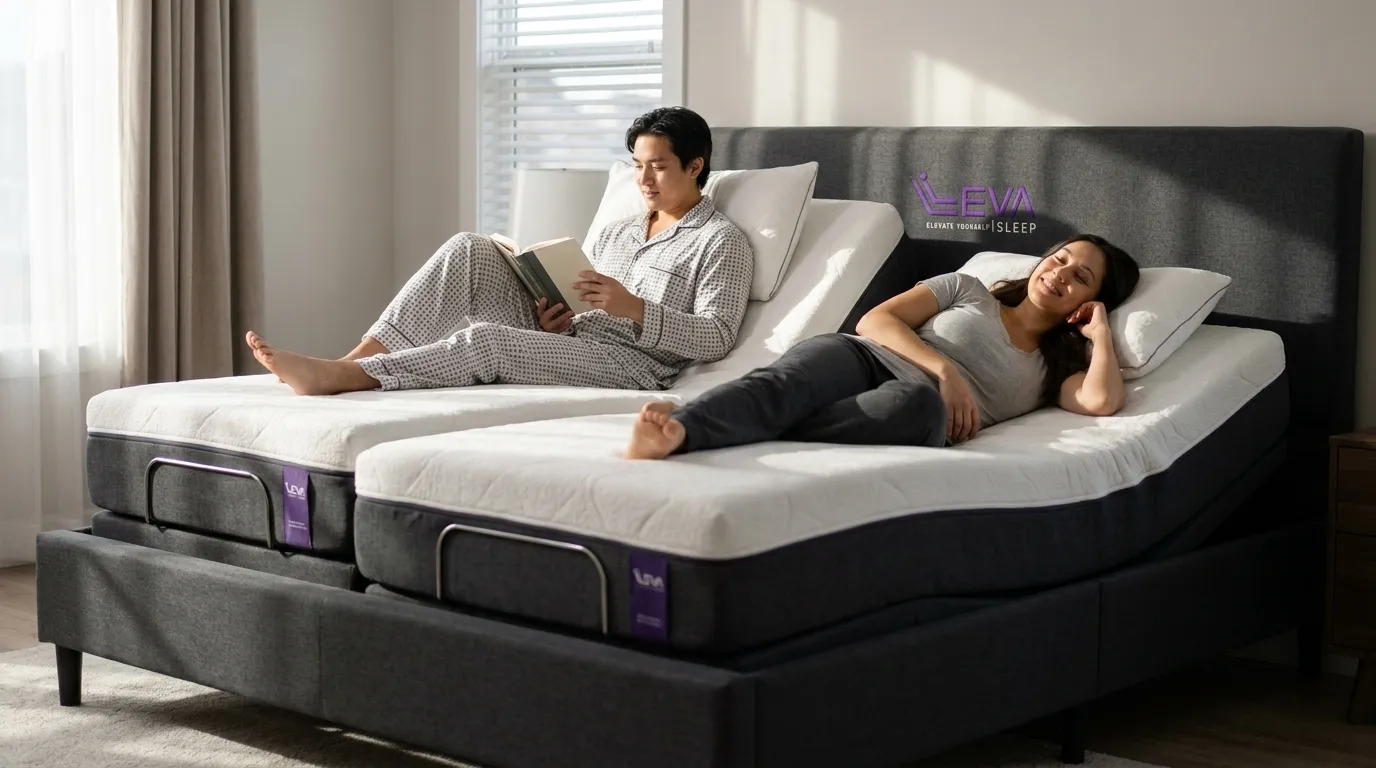
Couples who want passive, subscription-free monitoring built into their sleep system can use Leva Sleep’s adjustable bases with integrated tracking. The system removes the friction of nightly wear, charging, and monthly fees, so data becomes a natural byproduct of sleep instead of another task.
2. Best Non-Wearable Sleep Tracker for Shared Beds
Non-wearable trackers such as radar sensors, under-mattress pads, and ballistocardiographic strips remove the compliance burden of worn devices. The global non-wearable sleep tracker market was valued at USD 1.8 billion in 2025 and is projected to reach USD 5.4 billion by 2035. The appeal is clear: no charging, no skin contact, and no risk of forgetting to wear the device.
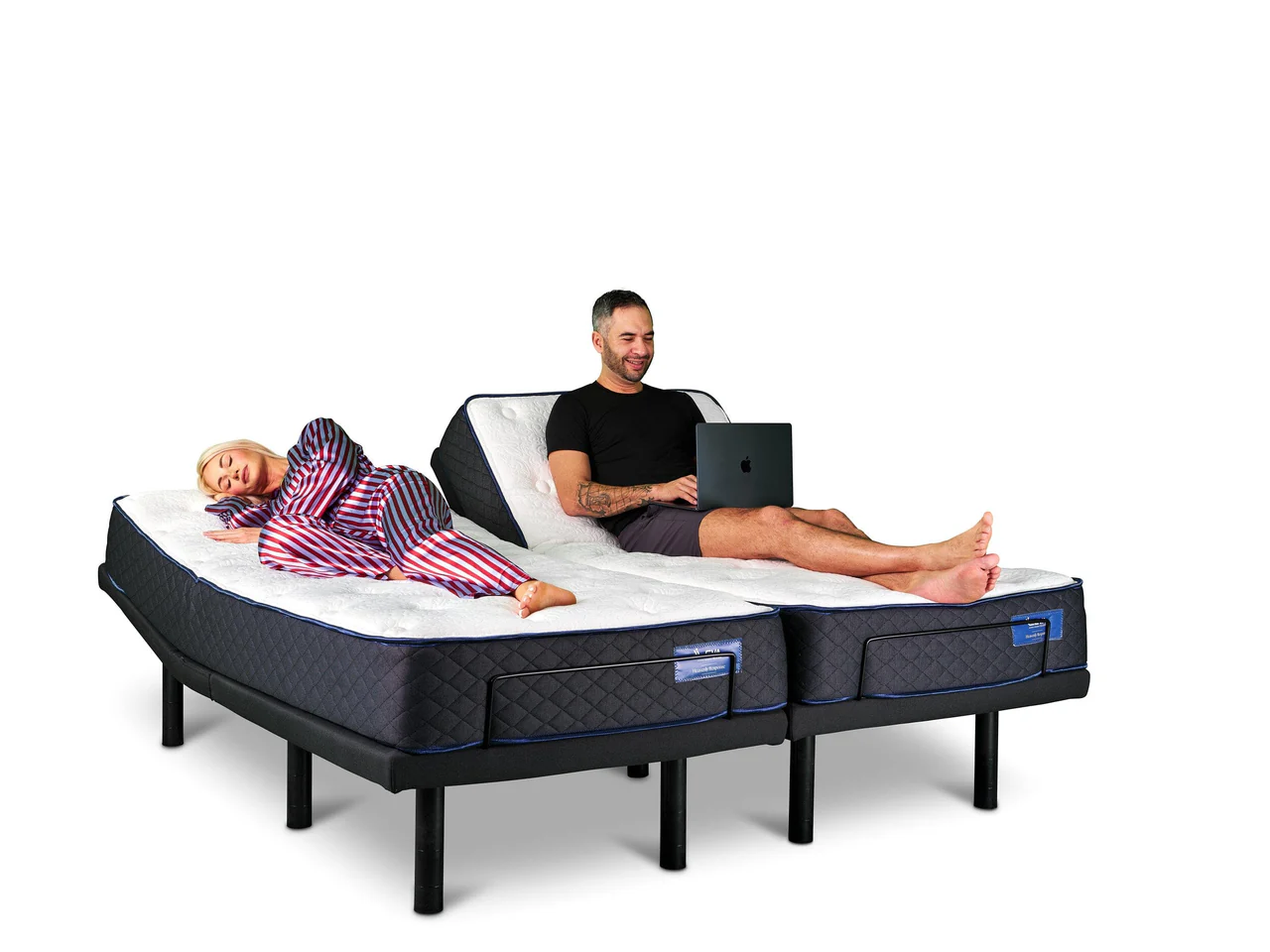
The shared-bed limitation creates a real challenge for couples. All contactless sleep sensors struggle with two people in the same bed unless specifically designed for dual-zone sensing, because partner movement creates false signals that confuse radar-based devices like the Google Nest Hub and under-mattress sensors like the Withings Sleep Analyzer. A prospective study found the Withings Sleep Analyzer achieved good overall sleep-wake accuracy but lower accuracy for four-class sleep stage classification.
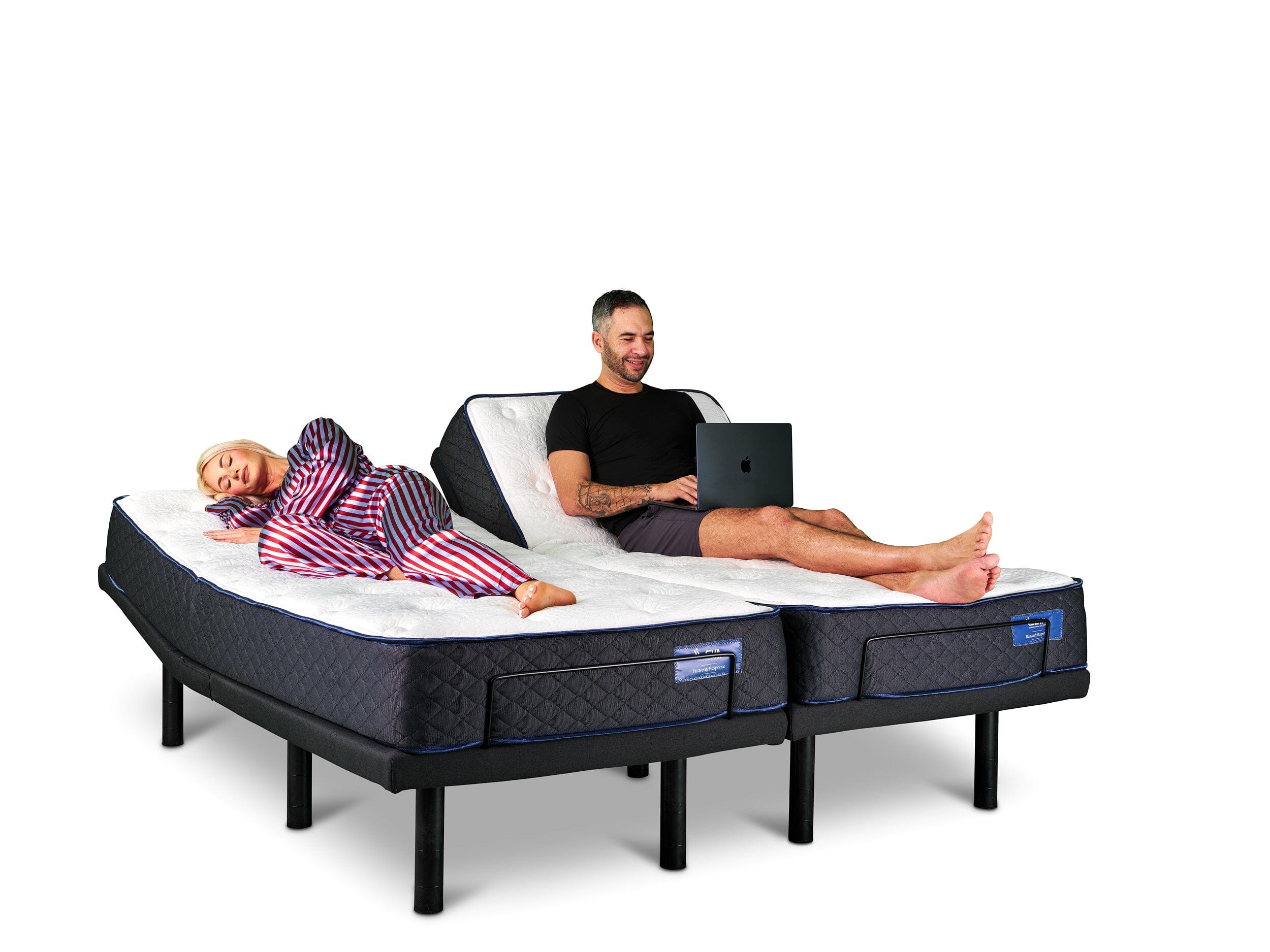
Leva Sleep’s split-base architecture addresses this shared-bed problem directly. Each side of the bed operates independently, so passive monitoring on one side is not contaminated by the other partner’s movement. That structural separation creates a dual-zone advantage that standalone nearables cannot match.
3. Accuracy for Total Sleep Time vs. Sleep Stages
Accuracy varies by metric, and couples need to know which numbers they can trust. Total sleep time is the metric consumer trackers measure most reliably. Home-based comparison studies have shown that wearables estimate total sleep time with reasonable accuracy versus portable polysomnography.
Sleep stage accuracy tells a different story. A 2025 comparison study found that consumer wearables are less accurate at estimating REM sleep percentage versus EEG-based polysomnography staging, with agreement rates dropping for multi-state classification. The practical takeaway is clear: consumer sleep trackers are reasonably good at measuring total sleep time and reasonably poor at measuring detailed sleep stages. Single-night REM or deep-sleep estimates carry a confidence interval too wide for precise decisions, while multi-week trends in total sleep time and sleep timing remain dependable.
Couples evaluating trackers should weight total sleep time and sleep timing data heavily and treat nightly stage breakdowns as directional, not definitive. This prioritization matters because multi-week trends in total sleep time reveal actionable patterns such as consistently fragmented sleep, shortened duration, or elevated wake-after-sleep-onset. Once you identify a stable pattern, the next step is to choose a physical intervention that addresses the underlying cause rather than chasing nightly stage percentages.
To see how a bed system can respond to these patterns, see how Leva Sleep’s adjustable bases address these accuracy limitations.
4. Heart-Rate Variability and Oxygen Tracking Reliability
Heart-rate variability is the most actionable biometric most consumer trackers provide, and accuracy depends heavily on sensor placement. A 2025 study at Ohio State University and the Air Force Research Lab evaluated multiple consumer wearables across 536 nights against a Polar H10 ECG chest strap and found the Oura Ring 4 achieved a Concordance Correlation Coefficient of 0.99 and MAPE of 5.96% for nocturnal HRV. The Whoop 4.0 achieved a CCC of 0.94 and MAPE of approximately 8% for nocturnal HRV in the same study.
While HRV tracking in premium wearables now approaches clinical-grade accuracy, oxygen measurement requires more caution. SpO2 readings often help screen for breathing disruptions during sleep, which matter for couples dealing with snoring or suspected apnea. A 2026 systematic review by Klier et al. found that PPG sensors in most consumer wearables show reduced accuracy for heart rate detection across different skin tones and in individuals with tattoos. Couples relying on oxygen-tracking features should factor in this limitation, especially when using SpO2 data as an informal apnea screen.
5. Interpreting Movement and Wake-After-Sleep-Onset Data
Movement data and wake-after-sleep-onset scores help couples connect tracker reports to physical discomfort. A 2026 rapid review in CHEST covering 29 studies found that consumer sleep trackers showed moderate accuracy for total sleep time and time in bed but lower precision for sleep efficiency, wake after sleep onset, and stage classification. Even with that limitation, elevated wake-after-sleep-onset scores tracked consistently over two or more weeks still represent a meaningful signal.
High WASO combined with frequent position changes points toward two correctable physical causes. Spinal misalignment can create discomfort that triggers repeated repositioning. Airway restriction from a flat sleep position can produce micro-arousals that fragment sleep. Both issues map directly to adjustable base interventions, with lumbar support reducing pressure-driven repositioning and head elevation helping maintain airway patency. Leva Sleep’s lumbar control and pillow tilt features address both variables independently on each side of the bed.
6. Couple Compatibility and Partner Disturbance
Couples need trackers that handle shared beds and tools that reduce partner disturbance. Wearables are more robust to partner interference than nearables because they sense the wearer’s own physiology. Wrist-worn and ring sleep devices sense the wearer’s own motion, making them relatively robust to a partner shifting in bed. However, wearable sleep trackers provide no couple’s view showing how partners’ sleep patterns interact, so each person’s data remains in a separate silo with no integration.
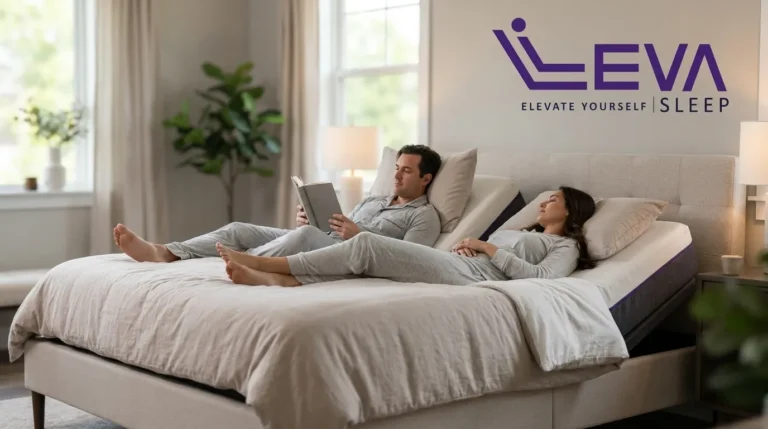
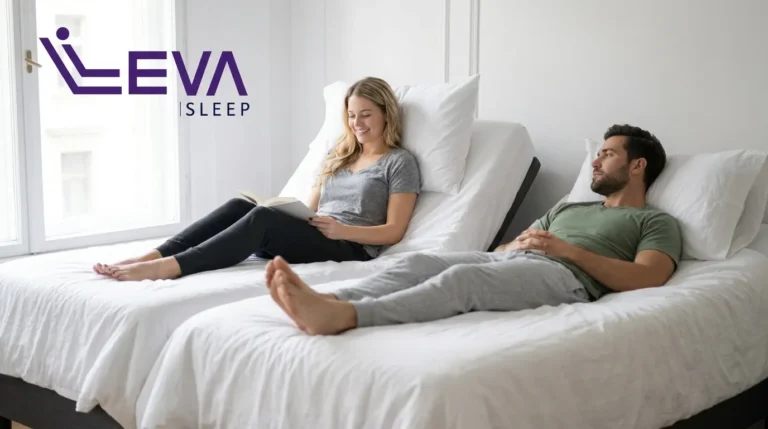
This technical advantage in measurement still leaves a deeper limitation. No tracker can prevent one partner’s snoring or movement from waking the other. When one partner’s restlessness wakes the other in a shared bed, wake-up events appear in both partners’ wearable datasets, and couples must manually correlate timestamps to infer causation. Leva Sleep’s split adjustable bases address this at the physical level. Independent per-side adjustment means one partner’s elevation, firmness, or massage setting does not affect the other, and the 2026 anti-snore automation responds to detected snoring with targeted head elevation on the snoring partner’s side only. To explore this couple-focused configuration, explore Leva Sleep’s split adjustable bases with independent per-side controls.
7. Mapping HRV and Oxygen Drops to Bed Adjustments
HRV and oxygen trends help couples decide when to seek care and when to adjust the bed. Multi-week HRV trends below a personal baseline, typically 10–20% below a 30-day rolling average indicating moderate fatigue and more than 20% below suggesting a rest-day need, combined with recurring SpO2 dips below 90%, warrant a physician consultation before any self-directed intervention. Trackers surface patterns, while clinicians diagnose causes.
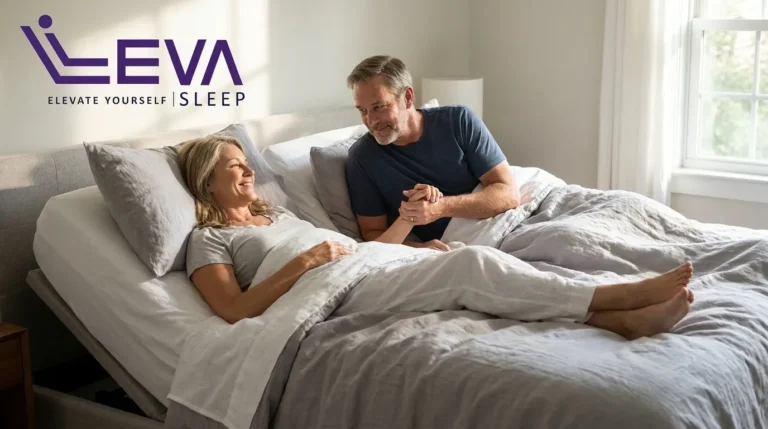
For patterns that fall short of clinical thresholds but still indicate poor recovery, adjustable base positioning offers a low-risk first step. Elevating the head 7–15 degrees reduces airway collapse associated with positional snoring and addresses breathing disruptions that cause SpO2 dips. Slight leg elevation reduces lower-limb pressure and improves venous return, which can ease nighttime restlessness. Lumbar support fills the natural curve of the lower back, reducing micro-arousals that fragmented sleepers attribute to discomfort and that appear in tracker data as elevated wake-after-sleep-onset. These adjustments require no prescription and carry no medication side effects.
8. Professional-Grade Monitoring and When to See a Doctor
Consumer sleep trackers are not equipped for medical diagnosis of conditions such as sleep apnea, periodic limb movement disorder, or narcolepsy, which require clinical evaluation including formal polysomnography. For post-surgical recovery, physician-directed elevation protocols, or confirmed sleep apnea management, a clinical referral remains the correct starting point.
Leva Sleep’s 2026 anti-snore automation fits between clinical diagnosis and nightly management. Once a physician has assessed a patient’s condition, the adjustable base becomes a compliance-friendly tool for maintaining therapeutic positioning. For mild cases, it can support airway positioning without the mask, hose, and noise of a CPAP device. For those who use CPAP, it serves as a complementary positioning aid. The system detects snoring acoustically and adjusts head elevation automatically, so couples do not need to intervene during the night.
9. Subscription Costs and Long-Term Ownership
Subscription costs can quietly turn an affordable tracker into a long-term expense. The Oura Ring 4 hardware costs $349 with the first year of membership included free, after which the membership is $5.99 per month. WHOOP 5.0 is available with One membership at $199 per year or Peak at $239 per year, for a four-year total of roughly $796–$956. The Eight Sleep Pod 4 Ultra hardware costs approximately $4,700–$5,249 and requires a subscription of $25 per month.
Leva Sleep’s adjustable bases function as a one-time purchase for couples. There is no subscription for anti-snore automation, lumbar control, app connectivity, or passive monitoring features. Over a three-to-five-year horizon, the absence of recurring fees creates a meaningful cost advantage versus subscription-dependent tracking ecosystems, especially for couples who would otherwise maintain two separate wearable memberships.
10. When a Split Adjustable Base Matters More Than Another Tracker
A split adjustable base becomes the primary investment when the problem is physical rather than informational. Couples who already know that one partner snores, that lower-back pain disrupts sleep, that differing firmness preferences cause compromise, or that partner movement triggers awakenings do not need more data. They need a corrective system that changes the sleep environment.
Trackers still play a role as long-term monitors. They confirm whether an intervention works, surface new patterns, and provide data for physician conversations. The most effective approach combines both tools by using a subscription-free, passive tracker to monitor trends while relying on a split adjustable base to address the physical causes those trends reveal. Leva Sleep’s systems support this workflow with independent per-side controls, quiet German motors, and 2026 anti-snore and lumbar automation that operate without requiring either partner to wear, charge, or manage a separate device.
Frequently Asked Questions
How accurate are consumer sleep trackers for sleep stages?
Consumer sleep trackers achieve roughly 86–89% agreement with polysomnography for the basic two-state classification of sleep versus wake. For multi-state classification that distinguishes light, deep, and REM sleep, agreement is moderate. Trackers infer sleep stages from peripheral signals such as heart rate, HRV, and movement rather than measuring brain activity directly via EEG. Single-night stage estimates carry too much measurement error for precise decisions, while multi-week trends in total sleep time and sleep timing are more reliable and represent the most actionable output from consumer devices.
Do sleep trackers work when two people share a bed?
Wearable devices such as rings and wristwatches are relatively robust to partner interference because they measure the wearer’s own physiology. Under-mattress and radar-based nearables are more susceptible to partner movement, which can register as false wake events or distort breathing pattern data. No consumer tracker provides a unified couple’s view that shows how both partners’ sleep patterns interact. For couples, the practical recommendation is to use individual wearables if passive monitoring is the goal and to recognize that no tracker can prevent the physical disturbances such as snoring, movement, or firmness mismatch that cause partner sleep disruption.
What is the best sleep tracker without a subscription in 2026?
Several strong options exist at the subscription-free tier. As discussed in Section 1, the Withings Sleep Analyzer and Beautyrest Sleeptracker Monitor are strong under-mattress choices for couples who want non-wearable sensing. Apple Watch Series 10 includes core sleep tracking and an FDA-cleared sleep apnea notification feature with no subscription required. Samsung Galaxy Ring also provides sleep tracking without a membership fee. For couples who prefer passive, subscription-free monitoring integrated into the bed instead of worn separately, Leva Sleep’s adjustable bases include built-in tracking as part of the system.
Can tracker data reduce snoring or improve spinal alignment?
Tracker data alone cannot reduce snoring or improve spinal alignment, because it only identifies that these problems exist. A wearable that flags elevated wake-after-sleep-onset, frequent micro-arousals, or suppressed HRV is describing a symptom, not correcting a cause. Snoring reduction requires physical intervention, and elevating the head of the bed 7–15 degrees reduces airway collapse associated with positional snoring. Spinal alignment improvement requires adjustable lumbar support and the ability to fine-tune head and foot elevation to create a neutral sleep posture. Leva Sleep’s adjustable bases provide both, with 2026 anti-snore automation that detects snoring and adjusts head elevation automatically, and lumbar control that can be set independently on each side of a split base.
Are non-wearable sleep trackers reliable for couples?
Non-wearable trackers offer genuine convenience with no charging, no nightly wear, and minimal compliance friction, but their reliability in shared beds is limited. Under-mattress sensors and radar devices struggle to differentiate between two occupants unless specifically designed for dual-zone sensing. As noted in Section 2, the Withings Sleep Analyzer shows good sleep-wake accuracy but lower accuracy for four-class sleep stage classification, a limitation shared by most under-mattress sensors. For couples, the most reliable non-wearable solution is one built into a split adjustable base with independent per-side sensing zones, which eliminates cross-contamination between partners through physical separation rather than complex algorithms.
Conclusion: Use Data to Guide Targeted Physical Changes
The most effective path to better sleep for couples in 2026 is not choosing between a tracker and an adjustable base but understanding what each provides. Trackers reveal patterns over time, and adjustable bases correct the physical conditions those patterns highlight. A subscription-free wearable or under-mattress sensor delivers the longitudinal data. A split adjustable base with independent per-side controls, anti-snore automation, and lumbar support delivers the correction.
Start with one or two changes. Identify the most disruptive pattern in your multi-week tracker data, match it to the corresponding physical intervention such as head elevation for snoring, lumbar support for lower-back pain, or independent firmness for partner compatibility, and then assess the result over the next two to four weeks. The data will confirm whether the adjustment worked and reveal the next priority.
Leva Sleep has helped more than 25,000 customers make this transition with split queen and king adjustable bases, specialized mattresses made in the United States, and white-glove delivery and setup from the La Jolla showroom. Visit Leva Sleep’s La Jolla showroom or shop online to get started.