Written by: Matthew Timmins, Founder and Managing Director, Leva Sleep
Key Takeaways
- Traditional flat beds provide no elevation or automation, so couples have no mechanical help for snoring or mild positional sleep apnea.
- Basic adjustable bases add motorized elevation but usually lack automated snore detection, independent split controls in non-King sizes, and quiet motors.
- Integrated smart adjustable systems add sensor-based snore detection, programmable micro-elevations, independent split zones, and whisper-quiet motors for health-focused couples.
- White-glove delivery, flexible mattresses, and compatible bedding support long-term durability and low-maintenance ownership of any adjustable system.
- Shop the complete range of integrated smart adjustable beds at Leva Sleep to match your apnea relief needs and your partner’s comfort preferences.
How These Bed Types Differ
Traditional flat beds are static platforms with no elevation capability. They remain the default purchase for most households but cannot follow medical recommendations that call for sleeping with the head raised.
Basic adjustable bases add motorized head and foot elevation to a flat frame. Most retail versions offer one or two elevation presets, a single remote, and limited app integration. Split configurations exist but appear inconsistently across brands and sizes.
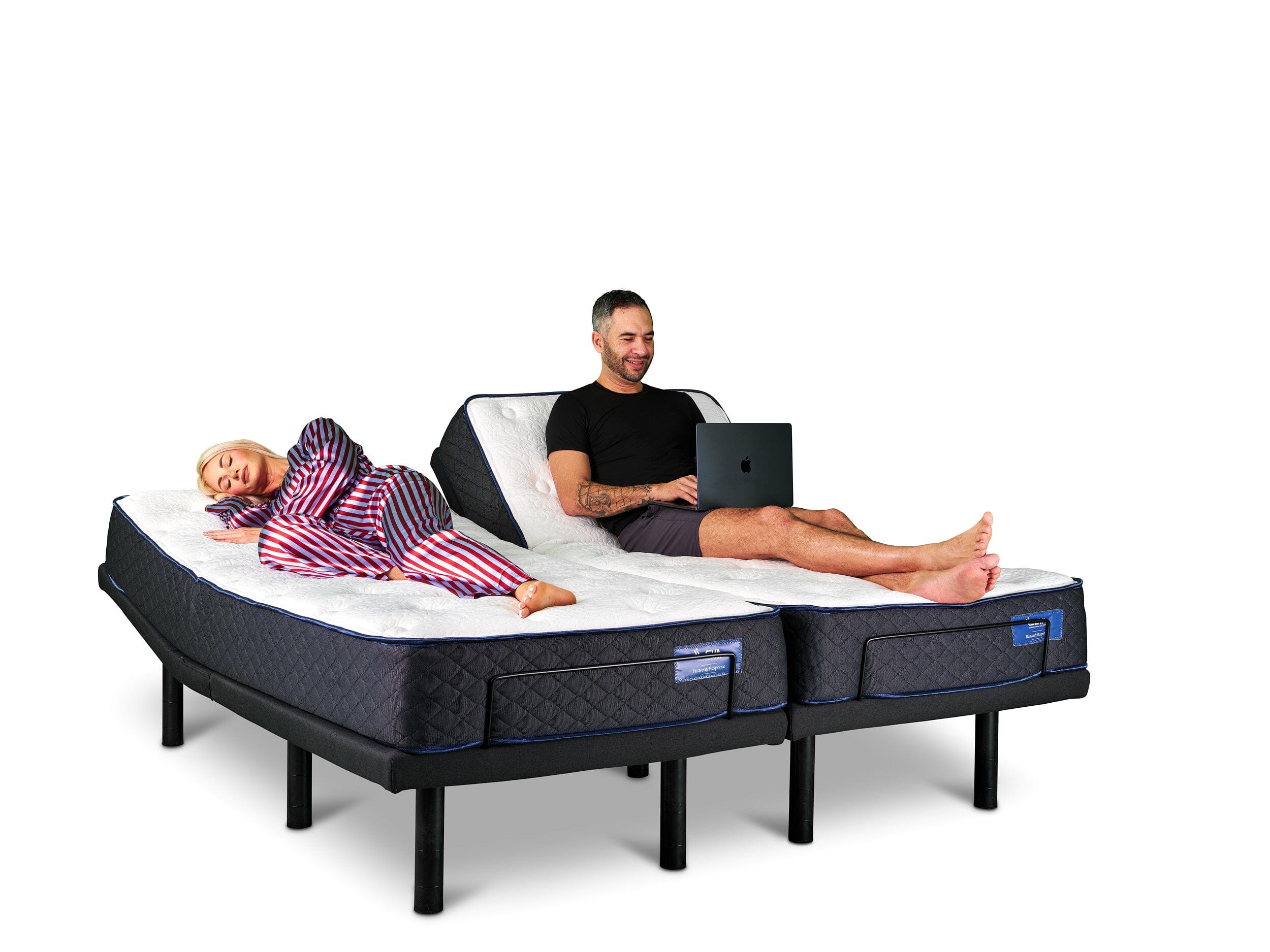
Integrated smart adjustable systems combine motorized elevation with sensors, app control, independent split zones, whisper-quiet motors, and accessories engineered for adjustable use. These systems function as complete sleep environments rather than simple upgraded frames.
Automation Features That Support Apnea Relief
| Criterion | Traditional Flat Bed | Basic Adjustable Base | Integrated Smart System |
|---|---|---|---|
| Snore detection | None | Rare, manual only | Sensor-based auto-detection available |
| Head elevation range | 0° | Typically 0–45°, manual preset | Programmable micro-increments, 10–15° anti-snore range |
| Real-time response | None | None | Automatic micro-adjustments during sleep |
| App control | None | Limited or absent | Full Bluetooth app with custom position memory |
Automation quality determines how well a bed supports positional apnea therapy. Ask vendors whether snore detection triggers a response automatically or requires manual activation. Confirm the degree range of the anti-snore elevation preset and whether the motor returns the bed to a flat position after the snoring event resolves. For mild positional sleep apnea, the ability to hold a stable 10–15° head elevation throughout the night separates basic bases from integrated smart systems.
Explore Leva Sleep’s sensor-based snore detection systems and programmable elevation options to match automation features to your apnea relief plan.
Couples’ Needs and Split Bed Configurations
Independent split controls matter most for couples with different elevation, firmness, or temperature needs. Evaluate each category on these points:
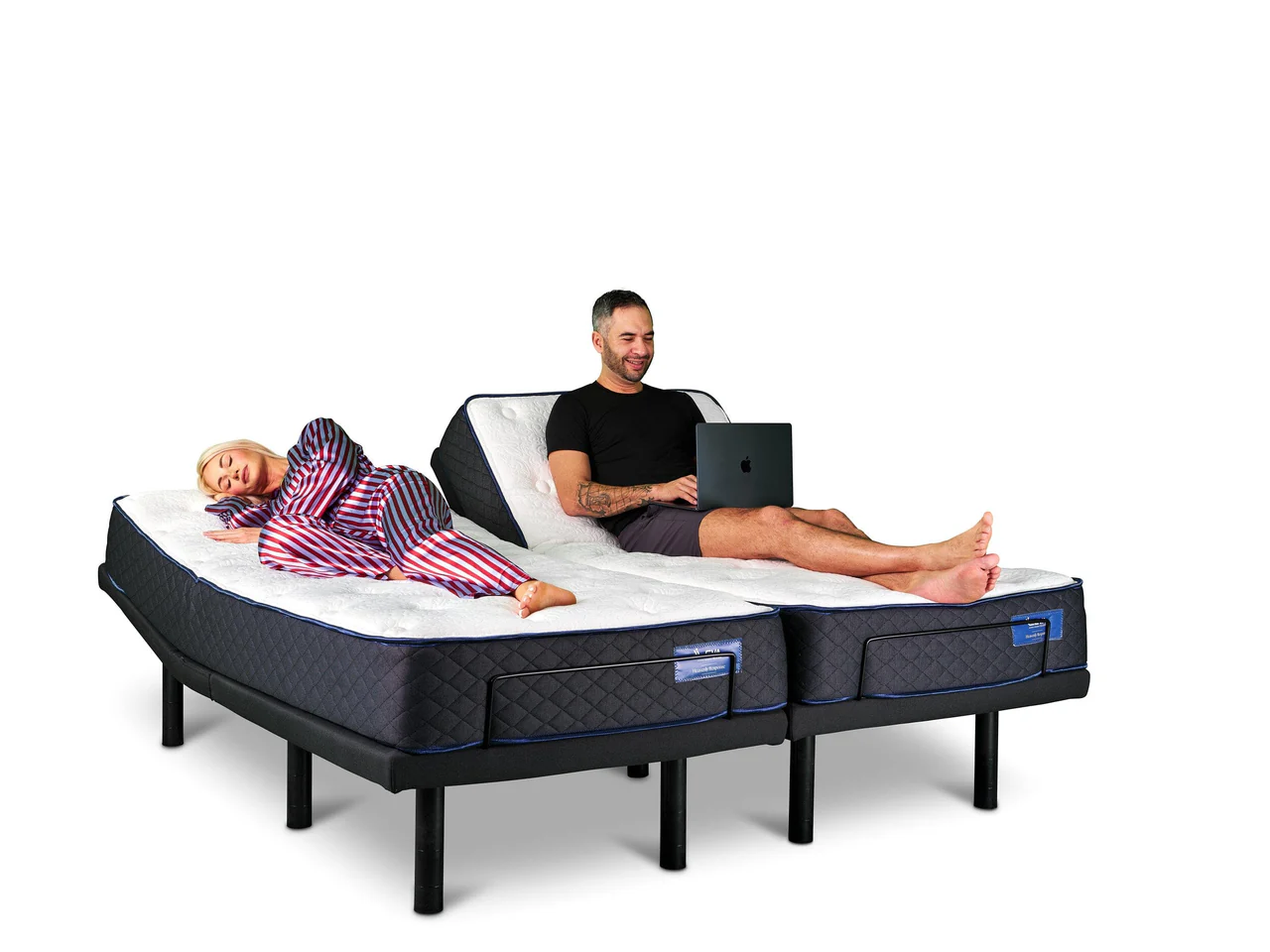
- Traditional flat beds: No split capability. One surface and one position for both partners.
- Basic adjustable bases: Split King appears in most major brands. Split Queen is rare, often unavailable, or built to non-standard dimensions.
- Integrated smart systems: Split King and Split Queen configurations with fully independent app-controlled elevation, massage, and temperature zones per side. Specialist retailers carry 15–20 adjustable models versus the 3–5 found at general mattress stores, which allows more precise size and configuration matching.
Check whether each side uses a completely independent motor and controller or whether one remote governs both sides with a split toggle. Also verify that the mattress sold with the base flexes at the split point without creating a gap or ridge at the center seam.
Compare Split Queen and Split King configurations at Leva Sleep to find an independent control setup that works for both partners.
Noise Levels and Partner Disturbance
Motor noise often becomes a complaint with basic adjustable bases. Request a live demonstration at the showroom or ask for a decibel specification from the manufacturer. Use these questions as a guide:
- Does the motor noise differ between head elevation and foot elevation cycles?
- Is the motor clearly audible from the opposite side of a split configuration?
- Does the base use German-engineered or equivalent precision motors, which usually run more quietly than commodity motors?
Integrated smart systems for health-focused couples usually specify whisper-quiet motors as a core engineering requirement, not an optional upgrade. Basic adjustable bases sold through general retailers vary widely in motor quality and rarely list decibel ratings in product descriptions.
Delivery Options and Setup Experience
Adjustable bases weigh more than standard frames and need precise assembly to work correctly. Delivery options differ in how much help you receive:
- Bed-in-a-box delivery: Shipped to the door or curb. The customer handles unpacking, assembly, and disposal of the old bed. No position calibration or product tutorial is included.
- Standard retailer delivery: Delivery to the room with basic assembly. Setup quality varies by crew. Old bed removal usually costs extra and may not be handled consistently.
- White-glove in-home service: Trained professionals deliver to the bedroom, assemble the complete system, adjust leg height, demonstrate app controls and position presets, and remove and donate or recycle the old bed. Specialist providers offer this service for a fee and prevent many common post-purchase complaints.
Mattress and Bedding That Work With Adjustable Bases
Mattress and bedding compatibility affects comfort and durability on an adjustable base. Innerspring mattresses with rigid border wire do not flex safely. All-foam and hybrid pocket-coil mattresses are the standard pairing.
Check these additional compatibility factors:
- Whether the manufacturer warrants the mattress for use on an adjustable base
- Whether fitted sheets have deep pockets and reinforced elastic to stay in place during elevation cycles
- Whether duvets include clips or anchoring systems to keep each side in place when split sides sit at different angles
- Whether the mattress is assembled domestically, which affects lead times and quality consistency
Specialist sleep systems include accessories engineered for adjustable use. General retailers often sell standard bedding alongside adjustable bases without confirming compatibility.
Long-Term Value and Ownership Costs
Total cost of ownership extends beyond the ticket price. Consider these factors when comparing options:
- Price positioning: Specialist direct-to-consumer brands that control manufacturing and remove retail markup can price 30–50% below comparable luxury competitors.
- Model selection: The broader model selection mentioned earlier allows precise matching to body type, sleep position, and budget, while limited options force compromise.
- Warranty and durability: Ask for motor warranty terms separately from frame warranty. Confirm whether the warranty covers commercial-grade use cycles, which matters for couples who adjust positions nightly.
- Replacement parts: Specialist brands with in-house assembly are more likely to stock replacement motors and controllers than general retailers that source from third-party manufacturers.
Real-World Situations and Matching Solutions
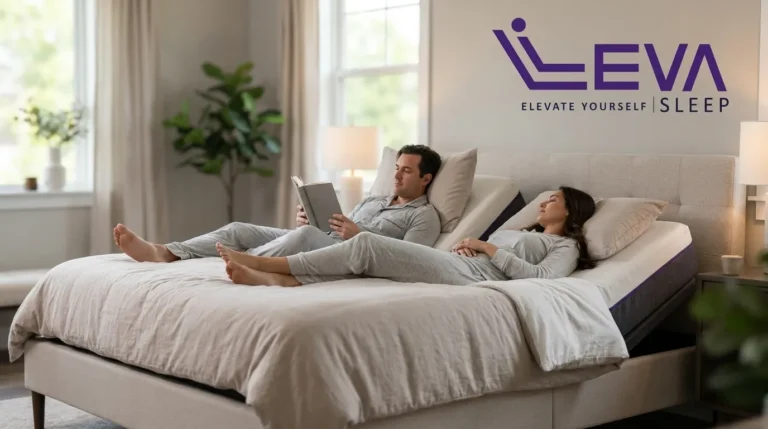
Snoring partner: One partner snores and the other wakes repeatedly. An integrated smart system with automated snore detection and independent head elevation addresses this without requiring the snoring partner to wake and adjust the bed. A basic adjustable base needs manual intervention. A flat bed offers no mechanical solution.
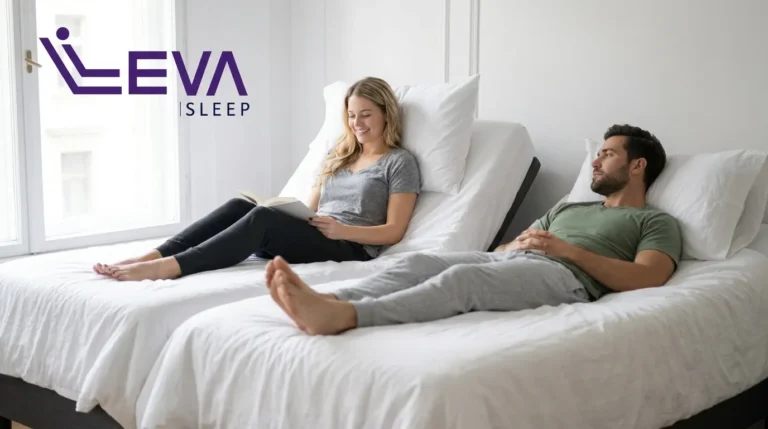
Differing firmness needs: One partner needs a firm surface for back support. The other needs pressure relief for hip pain. A Split Queen or Split King with independent mattress zones on each side solves this. A shared flat mattress forces a single-firmness compromise.
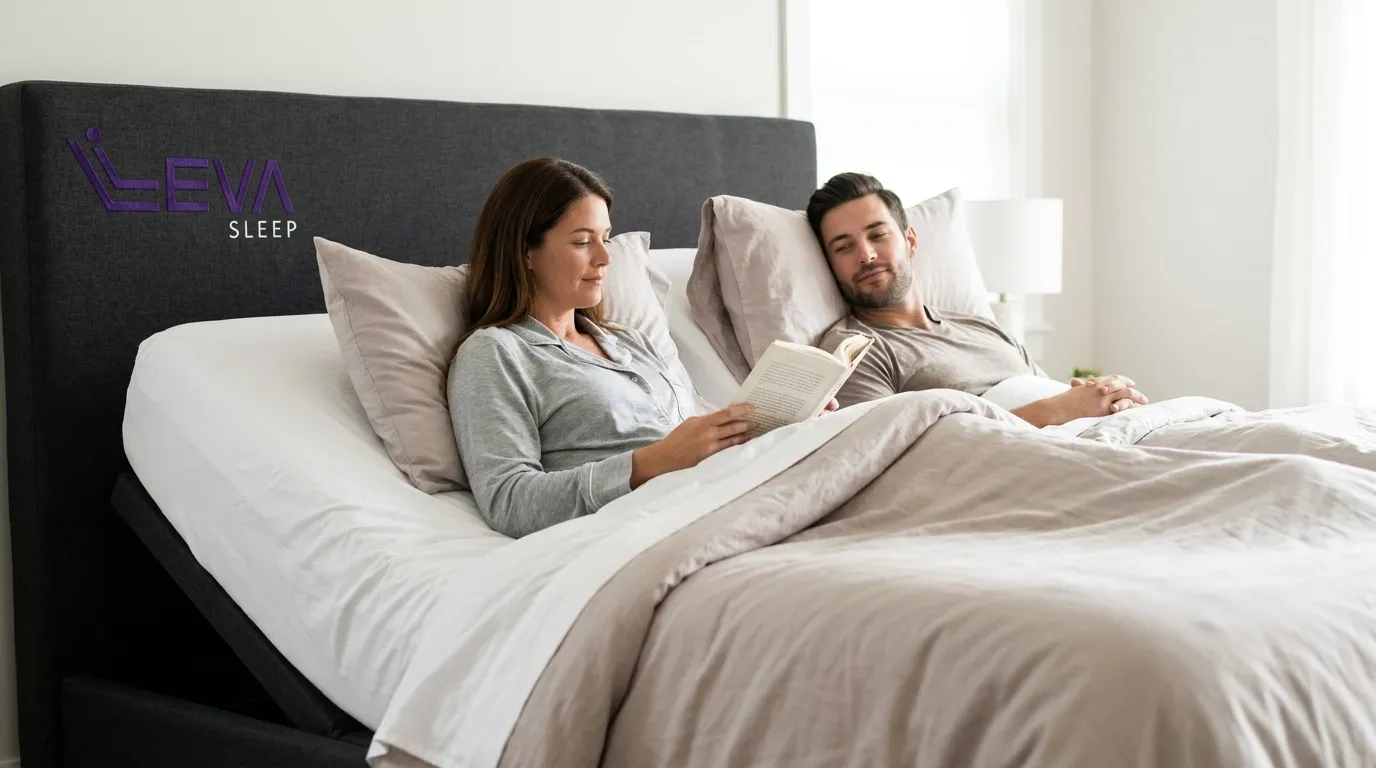
Doctor-recommended elevation: A physician recommends sleeping with the head elevated to manage mild obstructive sleep apnea or acid reflux. An integrated smart system holds the prescribed elevation angle reliably throughout the night, often in the 10–15° range discussed earlier. A flat bed cannot follow this recommendation.
Post-surgery recovery: One partner needs a specific head and leg elevation combination during recovery. The white-glove setup described earlier becomes essential here, ensuring prescribed angles are programmed correctly from day one. Bed-in-a-box delivery leaves this responsibility to the customer.
Non-Bed Options for Sleep Apnea Relief
Positional therapy for mild sleep apnea includes several non-bed approaches. Wedge pillows elevate the upper body with a fixed foam incline, typically 30–45°, without motorized adjustment. Side-sleeping positioning devices use body pillows or wearable aids to prevent back sleeping, which is associated with more apnea events.
CPAP machines remain the clinical standard for moderate to severe obstructive sleep apnea and work well with adjustable bases. Oral appliances that reposition the jaw are prescribed for mild to moderate cases. Lifestyle changes such as weight management and reduced alcohol intake can also reduce apnea severity. Adjustable bed elevation forms one part of a positional therapy plan and does not replace clinical diagnosis or prescribed treatment.
Decision Checklist: Match Your Needs to Features
Use this checklist as a short decision path. Start by identifying your primary sleep disruption, then match it to the right features and delivery support.
- If you or your partner snore or have diagnosed mild positional sleep apnea, prioritize automated snore detection and programmable head elevation.
- If you and your partner have different firmness or elevation preferences, require independent split controls and Split Queen or Split King availability.
- Once you define those core needs, consider implementation quality. If motor noise is a concern in your bedroom, request a decibel specification or live demonstration before purchasing.
- If a physician has recommended elevated sleeping, confirm that the base holds a stable programmed angle and that the mattress is warranted for adjustable use.
- If you want a complete system rather than a base-only purchase, verify that sheets, protectors, and accessories are designed for adjustable bases.
- If white-glove setup matters to you, confirm whether in-home professional setup is available and what the service includes.
- If you compare total cost over five years, factor in warranty terms, replacement part availability, and whether pricing reflects direct-to-consumer or retail markup.
Trade-Offs Between Bed Types and Next Steps
Traditional flat beds carry the lowest upfront cost but provide no mechanical solution for positional apnea, snoring, or differing partner needs. Basic adjustable bases add elevation at a mid-range price but often lack automated snore response, quiet motors, split configurations in non-King sizes, and integrated accessories. Integrated smart adjustable systems require a higher upfront investment and deliver the most complete solution for couples managing apnea symptoms, differing comfort needs, and long-term durability requirements, especially when purchased from a specialist with white-glove delivery and a curated mattress selection.
The right category depends on the severity of your sleep disruption, your configuration requirements, and how much of the total sleep environment you want a single provider to handle.
Schedule your white-glove consultation at Leva Sleep to experience a complete smart adjustable system in person.
Frequently Asked Questions
Can an adjustable bed replace a CPAP machine for sleep apnea?
An adjustable bed does not replace a CPAP machine, which remains the standard treatment for moderate to severe obstructive sleep apnea. For mild positional sleep apnea, where symptoms worsen when lying flat on the back, elevating the head of the bed can reduce airway obstruction by shifting soft tissue away from the throat. Adjustable beds with programmable head elevation hold this position consistently throughout the night without wedge pillows or manual repositioning. Anyone with a sleep apnea diagnosis should consult their physician before changing or stopping prescribed treatment. Adjustable beds and CPAP machines are fully compatible and often work best together.
What is the difference between a Split Queen and a Split King adjustable bed?
A Split King uses two Twin XL mattresses placed side by side on independent adjustable bases, which equals the width of a standard King. A Split Queen uses two narrower mattresses on independent bases to match the width of a standard Queen. Split Queen configurations are far less common than Split King and appear at only a few specialist retailers. For couples in smaller bedrooms or those who prefer a Queen footprint, a Split Queen provides independent elevation and firmness control without requiring King-size floor space. Both configurations let each partner set their own head elevation, foot elevation, massage intensity, and, on higher-end systems, temperature, without affecting the other side.
How do I evaluate whether a smart adjustable bed’s anti-snore feature fits my needs?
Start by confirming whether the anti-snore feature uses a sensor to detect snoring automatically or requires manual activation through an app. Automated detection that raises the head without waking either partner usually works better for couples. Next, ask what elevation angle the anti-snore preset uses and whether you can customize it. Confirm whether the base returns to a flat position after the snoring event ends or holds the elevated angle until you reset it. Finally, verify that the paired mattress flexes comfortably at the anti-snore elevation angle, since a rigid mattress creates pressure points at the bend. Visiting a showroom where staff can demonstrate the feature in person gives the most reliable evaluation before purchase.
What should I look for in bedding designed for an adjustable base?
Standard fitted sheets are built for flat mattresses and often pull off the corners when the head or foot of an adjustable base rises. Look for fitted sheets with deep pockets, typically 18 inches or more, and reinforced elastic that runs around the full perimeter of the sheet rather than only at the corners. For split configurations, confirm that the sheet is cut for the split size rather than a standard size adapted later. Duvets and comforters benefit from clip systems that anchor the duvet at the foot of the bed and prevent bunching when the foot section elevates. Mattress protectors should also be confirmed as compatible with adjustable bases, since rigid protectors can restrict the mattress’s ability to flex. Purchasing bedding from the same specialist that provides the base and mattress offers the most reliable way to ensure all components work together.
Is white-glove delivery worth the additional cost for an adjustable bed?
Adjustable bases rank among the most complex large items delivered to a home. They need precise leg height calibration, motor and remote pairing, app setup, and position programming before they work as intended. Standard or curbside delivery leaves all of this to the customer, and assembly errors can affect motor performance and warranty coverage. White-glove in-home service from a trained team covers delivery to the bedroom, full assembly, leg height adjustment, app and remote configuration, a product tutorial, and removal of the old bed. For couples purchasing a complete system that includes base, mattress, and accessories, the cost of white-glove setup usually represents a small fraction of the total investment and removes the most common sources of post-purchase dissatisfaction with adjustable beds.