
Written by: Matthew Timmins, Founder and Managing Director, Leva Sleep
Key Takeaways
- Sleep divorce often stems from incompatible sleep needs on a single surface. Smart adjustable split beds solve this by giving each partner independent control.
- Key evaluation factors include split configurations (King vs. Queen), independent controls, temperature regulation, lumbar support, and quiet motors.
- Anti-snore automation and app intelligence detect snoring in real time and make subtle head-elevation adjustments without waking either partner.
- Proper mattress-base-bedding integration and white-glove delivery prevent nightly disruptions and support long-term system performance.
- Leva Sleep offers Split King and Split Queen systems with full independent controls and integrated features. Shop Leva Sleep today to end sleep divorce and enjoy personalized rest.
Quick Preview: The 7 Factors Couples Must Evaluate
- Split King vs. Split Queen vs. Split Head configurations
- Independent controls for snoring and medical positioning
- Temperature regulation and lumbar support
- Whisper-quiet motor performance
- Anti-snore automation and app intelligence (2026 features)
- Mattress-base-bedding integration
- White-glove delivery and ongoing service
The following sections walk through each factor in detail, starting with the split configuration that fits your room and sleep needs.
1. Choosing Between Split King, Split Queen, and Split Head
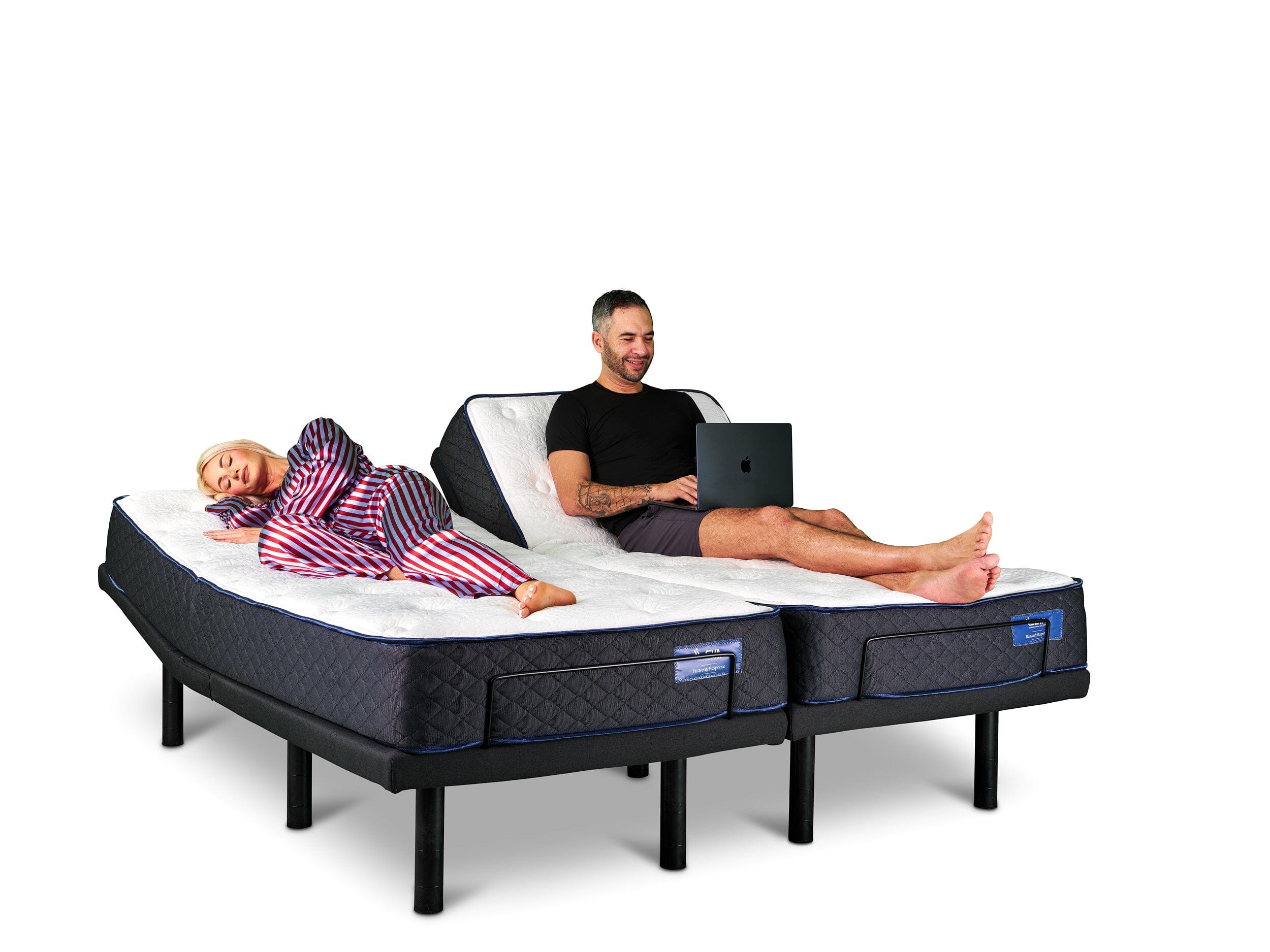
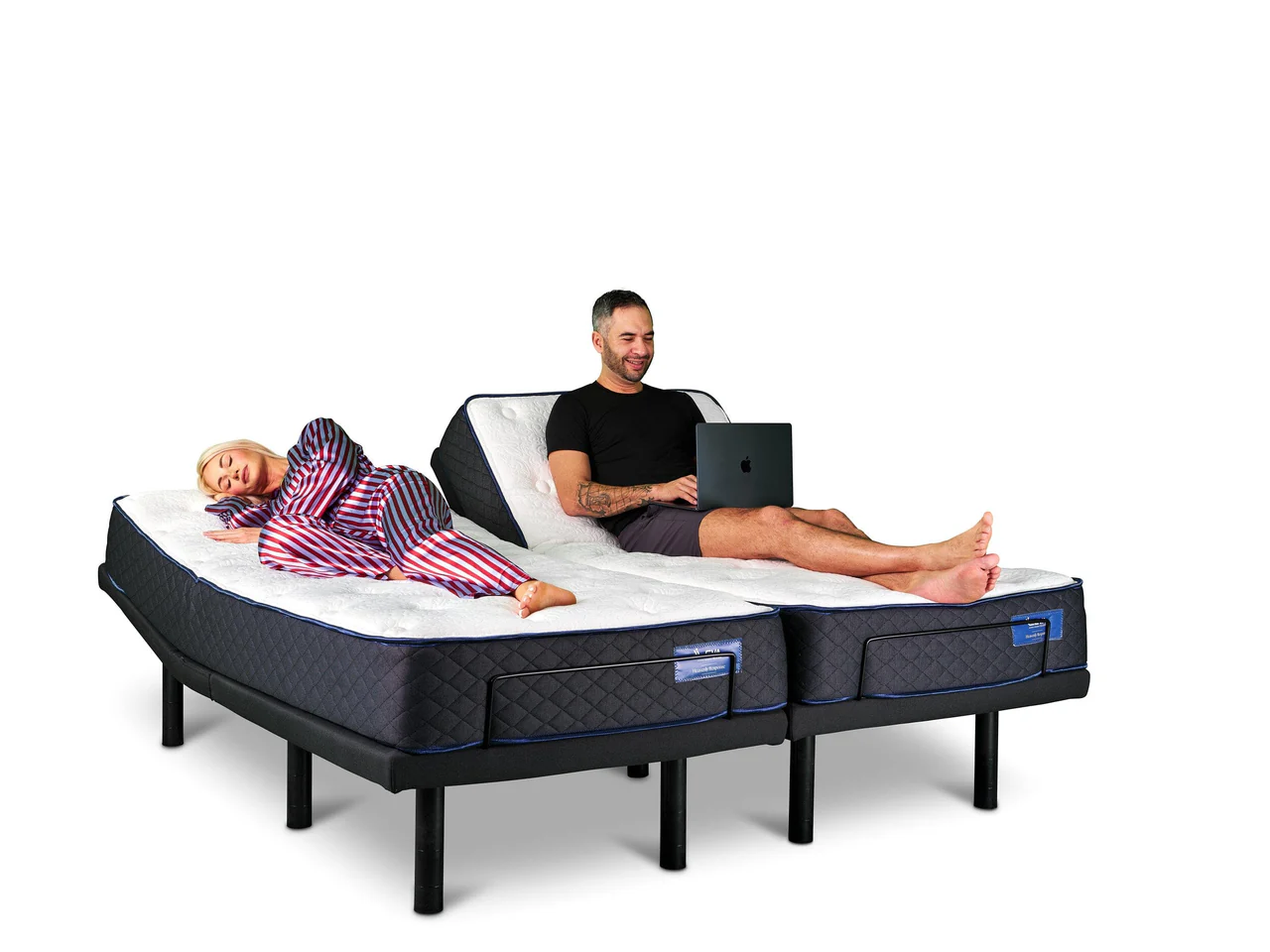
Configuration determines how much independent movement each partner actually gets. A Split King pairs two Twin XL bases inside a king-size frame. This format is the most common and the one most brands stock. A Split Queen pairs two narrower bases inside a queen-size frame. This configuration is rare in the market but critical for couples who want full independent adjustability in a smaller room. A Split Head base splits only the head section and leaves the foot section shared. That design limits independent leg elevation and becomes a real constraint for post-surgery or circulation needs.
When evaluating configurations, start by measuring the bedroom to see which footprint fits. A Split King requires the same floor space as a standard king. A Split Queen fits rooms where a king is impractical. Once you know what fits, confirm that the retailer actually stocks the configuration you need, not just lists it online. Then verify that the mattresses sold for each half are designed to flex with the base rather than resist it, since a rigid mattress will limit the base’s range of motion.
Leva Sleep offers both Split King and Split Queen formats, with the Split Queen built to customer specifications, a distinction that separates a specialist from a general retailer.
2. Independent Controls for Snoring and Medical Positioning
Independent controls form the functional core of any split system. Each partner should be able to raise or lower the head and foot sections, activate massage zones, and set saved positions without affecting the other side. For couples managing sleep apnea, acid reflux, or post-hip-surgery recovery, precise elevation on one side without disturbing the other partner becomes a medical necessity rather than a luxury feature.
When evaluating a system, ask the retailer to demonstrate independent operation so one partner raises their head section while the other remains flat. Verify that the remote or app controls are labeled clearly enough to use in the dark. For post-surgery use, confirm that the base supports zero-gravity positioning, meaning simultaneous head and foot elevation, on each side independently. Also confirm that the mattress does not restrict the range of motion the base is rated for.
Leva’s split bases give each partner full control of their own side through the Leva app, including saved custom positions and vibrating alarms that do not disturb the other sleeper.
3. Temperature Control and Targeted Lumbar Support
Mismatched temperature preferences cause many couples to report disrupted sleep. A system that addresses this needs more than breathable fabric. It needs active heating and cooling at the mattress or pad level, controllable per side. Evaluate whether the temperature layer is built into the mattress, added as a pad, or sold separately. Confirm that each side runs on an independent thermostat.
Lumbar support is just as specific. When testing lumbar controls, lie flat and increase the lumbar zone in small steps. The change should feel like targeted support under the lower back, not a general arch across the mattress. Leva Sleep integrates heating and cooling pads and lumbar controls into its higher-end bases, with each side operating independently through Leva’s mobile interface.
4. Whisper-Quiet Motor Performance for Light Sleepers
Motor noise often gets overlooked during adjustable bed evaluations. A base that sounds acceptable in a busy showroom during the day may feel disruptive at 2 a.m. when one partner adjusts their position while the other is asleep. Light sleepers are especially sensitive, since even a brief mechanical hum can trigger a full awakening.
Leva Sleep uses German-engineered motors across its lineup that are known for quiet performance. When evaluating any base, request a live demonstration at the slowest adjustment speed, which is the speed most likely used during the night. Listen from the non-adjusting side of the bed to judge how much sound the resting partner will hear.
5. Anti-Snore Automation and App-Based Intelligence
Anti-snore automation has matured significantly in recent years. The most capable systems use onboard sensors or paired wearables to detect snoring in real time. They then trigger a micro-adjustment, typically a head elevation of about 12 degrees, without waking the snorer or their partner.
When evaluating anti-snore automation, ask the retailer how detection is triggered, whether by microphone, motion sensor, or AI model. Clarify how many adjustments the system makes per night and whether you can adjust the sensitivity threshold. Leva Sleep’s anti-snore mode is designed to detect snoring and make subtle head-elevation adjustments using the Leva app, with the goal of reducing snoring without interrupting either partner’s sleep.
6. Matching Mattress, Base, and Bedding
A split adjustable base performs only as well as the mattress and bedding on top of it. Standard mattresses often resist the flex required for significant head or foot elevation. Standard fitted sheets tend to pop off at the corners as soon as the base articulates. These issues become nightly disruptions that erode the value of the entire system.
Evaluate mattress compatibility by confirming that the manufacturer explicitly rates the mattress for adjustable base use and specifies the maximum elevation angle. All-foam and hybrid pocket-coil constructions usually flex more readily than traditional innerspring designs. For bedding, start with fitted sheets that have deep pockets and reinforced elastic on all four sides so the corners stay put when the base moves. Add duvet clips to keep separation between the two halves when each side sits at a different angle, which prevents one partner’s duvet from sliding onto the other side. Finally, choose mattress protectors that flex with the base without restricting airflow, since rigid protectors can create pressure points or trap heat. Leva Sleep designs its full bedding suite, including sheets, duvets, protectors, and remote pockets, specifically for adjustable bases and treats bedding as a functional component rather than an afterthought.
Explore Leva’s complete bedding suite designed specifically for adjustable bases
7. White-Glove Delivery and Long-Term Service
A split adjustable base is heavy, mechanically complex, and needs precise setup to work correctly. Bed-in-a-box delivery, where components arrive in cartons and assembly falls to the customer, introduces real risk. Common issues include improperly seated motors, misaligned frames, and bedding that was never adjusted for the couple’s preferred leg height.
When evaluating a retailer’s delivery offering, ask whether trained technicians, not third-party contractors, handle the installation. Confirm whether old bed removal is included and whether real-time adjustments such as leg height are made on-site. Leva Sleep’s white-glove delivery service, available for a fee, covers all of these steps and includes a product tutorial before the team leaves.
Price-to-Value for Couples
Total cost of ownership for a split adjustable system includes the base, the mattresses for each half, compatible bedding, delivery, and any ongoing service or app subscription. Comparing a base price in isolation against a competitor’s base price does not help if one includes white-glove delivery and the other does not, or if one requires proprietary replacement parts at a premium.
Leva Sleep’s direct-to-consumer model and local assembly remove the retail markup that inflates prices at traditional mattress chains. This approach delivers systems at 30–50% below comparable luxury competitors. Over a 10-year ownership period, that differential compounds through lower initial cost, no middleman service fees, and mattresses made in the United States to standards the company controls directly.
With these seven factors and the price-to-value context in place, couples can now apply them in a simple sequence that narrows choices quickly.
How Couples Can Decide: A Simple Framework
Start with room size and configuration. If the bedroom accommodates a king, a Split King provides the widest range of compatible mattresses. If space is limited, confirm that the retailer actually stocks a Split Queen rather than listing it as a special order. Next, rank the medical and comfort priorities for each partner, such as snoring, lumbar pain, temperature, and post-surgery positioning. Verify that the base addresses each priority with a dedicated, independently controllable feature. Then evaluate the service model. White-glove delivery, local expertise, and a specialist’s product depth, such as Leva’s 15–20 adjustable models versus the 3–5 at a general retailer, reduce the risk of a costly mismatch.
Comparison Table: Split Configurations at a Glance
| Configuration | Motor Operation | Anti-Snore Automation | Service Model |
|---|---|---|---|
| Split King (two Twin XL bases) | Fully independent per side | Available on select models | White-glove delivery available on premium models |
| Split Queen (two narrower bases) | Fully independent per side, rare format, verify motor specs with retailer | Available on select models, confirm per-side detection capability with retailer | Built-to-specification by specialist retailers, white-glove delivery availability varies |
| Split Head (shared foot section) | Head sections independent, foot section shared, limits independent leg elevation | Available on select models, foot elevation for snoring not independently controllable | Widely available, standard delivery common at general retailers |
The configurations and features in this table address the mechanical requirements, but couples still need to know whether one bed can truly solve sleep divorce.
Sleep Divorce and Split Systems: How One Bed Can Help
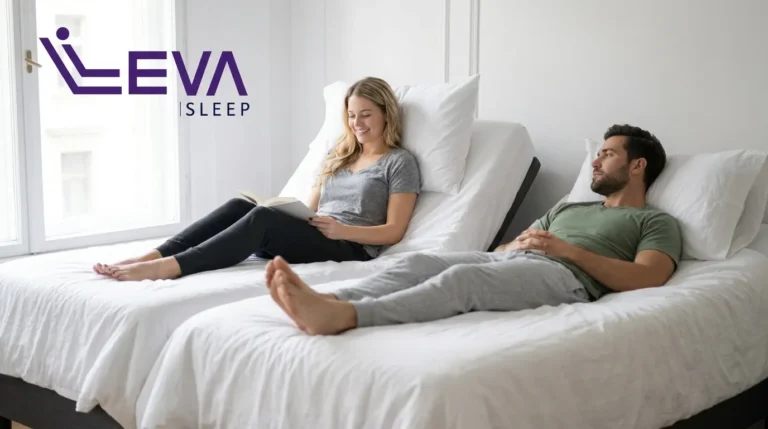
Sleep divorce usually comes from incompatibility between two different bodies and a single, undifferentiated sleep surface. A properly configured split adjustable system removes the mechanical source of that incompatibility. Each partner controls their own elevation, firmness pairing, temperature zone, and anti-snore response. The shared frame keeps the couple physically close. The independent controls remove the need for either partner to compromise their sleep quality to preserve that closeness.
Integration remains the caveat. A split base paired with incompatible mattresses, standard bedding, and drop-shipped delivery introduces new friction that can recreate the original problem. A vertically integrated system that includes base, mattress, bedding, and service from a retailer with enough depth to match every component to the couple’s needs offers a more reliable solution.
When Your Partner Snores: What Actually Works
Positional snoring, which occurs when the airway collapses as the head lies flat, often responds well to head elevation. Automated anti-snore systems detect the acoustic or motion signature of snoring and trigger a preset elevation before the disruption wakes the non-snoring partner. Key evaluation criteria include detection latency, or how quickly the system responds, adjustment smoothness, or whether motor noise itself causes an awakening, and reset behavior, or whether the base returns to the original position after snoring stops. Leva Sleep’s anti-snore mode is designed to address all three criteria and is accessible in the Leva app.
Beyond snoring, split adjustable beds also address another common shared-bed challenge. They allow one partner to follow medical recovery positioning without forcing both partners into the same posture.
Best Adjustable Bed After Hip Surgery: Shared-Bed Solutions
Post-hip-surgery recovery typically requires sleeping with the operated leg in a specific position, often slightly elevated and externally rotated, to reduce pressure on the joint and prevent dislocation. A split adjustable base lets the recovering partner maintain that position throughout the night without requiring the other partner to sleep in the same configuration.
When evaluating a base for post-surgery use, confirm that the foot section elevation range matches the angle recommended by the surgeon or physiotherapist. Check that the mattress does not create a pressure point at the hip when the foot section is raised and that the base operates quietly enough not to disturb the non-recovering partner during nighttime adjustments. Beyond the prescribed leg elevation, zero-gravity positioning can further reduce hip pressure by distributing weight more evenly across the mattress surface. This position is especially useful during the first 6–8 weeks post-surgery when prolonged flat sleeping can cause discomfort. Leva Sleep’s bases allow each partner to save their zero-gravity preset independently, so the recovering partner can return to that position with a single button press. White-glove setup also includes real-time adjustment to the patient’s prescribed position before the delivery team leaves.
Frequently Asked Questions
What is the difference between a Split King and a Split Queen adjustable bed?
A Split King consists of two Twin XL bases placed inside a king-size frame, giving each partner a 38-inch-wide independently adjustable surface. A Split Queen consists of two narrower bases inside a queen-size frame, with each partner receiving about 30 inches of independently adjustable width. The Split Queen is significantly rarer in the market, and most retailers do not stock it, but it is the correct choice for couples who want full independent adjustability in a room that cannot accommodate a king-size footprint. Most retailers require special orders for Split Queen configurations or push couples toward a Split King. Leva Sleep is one of the few U.S. specialists that builds Split Queens on demand, which helps avoid the typical 8–12 week lead time.
Does anti-snore automation actually work, or is it a marketing feature?
Anti-snore automation works specifically for positional snoring, which is snoring caused by airway collapse when the head is flat. Systems that detect snoring and automatically elevate the head can reduce or eliminate this type of snoring without waking the snorer or their partner. The technology is less effective for snoring caused by anatomical factors unrelated to sleep position, such as nasal obstruction or severe obstructive sleep apnea. Anti-snore systems also vary in detection speed and adjustment behavior. Some elevate the head immediately after detecting snoring, while others wait to confirm a pattern before adjusting. Ask whether the system lets you set a custom elevation angle, since some users need more or less than the default 12 degrees, and whether the base automatically returns to flat once snoring stops or holds the elevated position until you reset it. Leva Sleep’s anti-snore mode, launching in 2026, will make subtle head-elevation micro-adjustments through the Leva app.
Can a smart adjustable bed replace a CPAP machine for sleep apnea?
A smart adjustable bed is not a medical device and does not replace a CPAP machine prescribed for moderate to severe obstructive sleep apnea. Head elevation on an adjustable base can reduce positional snoring and may improve mild sleep apnea symptoms by helping keep the airway open. It does not deliver the continuous positive airway pressure that a CPAP provides. Couples where one partner uses a CPAP can still benefit from a split adjustable base because the CPAP user can elevate their head to a comfortable angle independently without affecting the other partner’s position. Always follow the guidance of a sleep physician for diagnosed sleep apnea.
Why does bedding matter for an adjustable bed?
Standard fitted sheets are sized and elasticized for flat mattresses. When an adjustable base elevates the head or foot section, the mattress surface geometry changes and standard sheets pull free at the corners, often multiple times per night. Leva Sleep designs its fitted sheets with deep pockets and reinforced elastic on all four sides specifically to accommodate the range of motion of an adjustable base. Duvet clips maintain separation between the two halves of a split configuration when each side sits at a different angle. Mattress protectors are engineered to flex without restricting airflow or creating pressure points. Treating bedding as a functional component of the sleep system, rather than a separate purchase, is one of the most practical steps couples can take to protect their investment.
What should couples ask during a white-glove delivery for an adjustable bed?
Ask whether the delivery team will adjust the leg height of the base to match your preferred bed height before they leave. Confirm that the team will walk through every app feature and saved position setting with both partners present. Clarify whether old bed removal, including the old mattress and frame, is included or available as an add-on. Ask whether the team is employed directly by the retailer or contracted through a third party, since directly employed technicians usually have deeper product knowledge. Finally, confirm the process for requesting a follow-up adjustment if a setting needs to be changed after the first night of use.
Conclusion: Two Practical Steps to End Sleep Divorce
Ending sleep divorce does not require sleeping apart. It requires a system engineered for two people that gives each partner independent control over elevation, temperature, lumbar support, and anti-snore response while preserving a shared bed. The seven factors in this guide, including configuration, independent controls, temperature and lumbar integration, motor noise, anti-snore automation, bedding compatibility, and white-glove service, create a complete evaluation framework for couples ready to move from compromise to genuine rest.
The two most productive next steps stay simple. Visit a specialist showroom where both partners can test a split configuration together, and request a full system demonstration that includes the app, the anti-snore feature, and the bedding. Visit Leva’s La Jolla showroom to test split configurations together, or start your search online