
Written by: Matthew Timmins, Founder and Managing Director, Leva Sleep
Key Takeaways for Couples
- Couples in 2026 most often struggle with snoring, temperature differences, and motion disruption, so accurate per-partner contactless tracking matters.
- Split adjustable-base ecosystems give the strongest dual-zone control for motion isolation, temperature, firmness, and anti-snore positioning compared with integrated mattresses or pod systems.
- Consumer sleep tracking still falls below clinical accuracy, yet trend data from bed-based sensors supports useful nightly adjustments for couples.
- Leva Sleep systems provide automatic per-side anti-snore adjustments, Split Queen options, and no mandatory subscriptions, which lowers five-year ownership costs.
- Explore Leva Sleep’s split adjustable systems and see how per-partner control solves the challenges outlined in this guide.
How This Guide Evaluates Couple-Focused Smart Beds
This guide compares smart bed options for couples using five clear criteria.
- Tracking accuracy and validation against clinical benchmarks
- Independent dual-zone control for motion isolation and separate adjustability
- Snoring and apnea positioning effectiveness
- Temperature and firmness personalization per partner
- Total cost of ownership over five years
Three Smart Bed Categories Competing in 2026
Three product categories compete for couple-focused smart bed buyers in 2026. Integrated smart mattresses with embedded sensors combine the mattress and tracking hardware into a single unit, with firmness or temperature adjustments built into the mattress layer itself. Subscription-based pod systems sit on top of an existing mattress and add active cooling, heating, and biometric tracking through a proprietary hub, usually tied to an ongoing software subscription for full feature access. Split adjustable-base ecosystems pair independent motorized bases, one per partner, with compatible mattresses and optional temperature accessories, delivering mechanical adjustability, anti-snore positioning, and app-controlled personalization without mandatory recurring fees.
Tracking Accuracy and Validation
A 2026 physician-reviewed guide confirms that all consumer sleep tracking devices fall below polysomnography accuracy, with sleep/wake detection sensitivity above 95% but sleep stage classification accuracy ranging from 50–86% depending on device and stage. A 2025 validation study of an under-mattress sensor found 83% overall sleep-wake accuracy, 95% sensitivity, and 37% specificity, with overestimation of total sleep time and underestimation of wake after sleep onset. A 2026 contactless-monitoring study reported 93% sensitivity for sleep detection and 73% specificity for wake detection from under-mattress sensors.
Terra’s analysis of 77,000+ filtered sleep episodes from November to December 2025 found that deep sleep detection remains the most variable metric across consumer devices, because all rely on heart rate, movement, and temperature rather than EEG. In 31 overlapping nights comparing Eight Sleep’s bed-based sensors to WHOOP, WHOOP reported longer total sleep time on 80.6% of nights with a median difference of 21.6 minutes, which matters when couples use per-partner data to make nightly adjustments. Under-mattress sensors perform well for total sleep time and night-to-night trends but show lower sleep stage accuracy than wearables or smart rings, so they suit device-averse users who want passive monitoring rather than clinical-grade staging.
Is Sleep Number Tracking Accurate Enough for Couples?
Sleep Number represents the integrated smart mattress category’s approach to per-partner tracking, so it serves as a useful test case for embedded sensors. Sleep Number’s Climate360 offers dual-sided biometric tracking embedded in the mattress, capturing heart rate and movement for each partner independently. Sleep Number Climate360 owners must perform monthly recalibration by setting both sides to firmness level 100 for at least 12 hours to reset the responsive air technology, which introduces a maintenance variable that affects tracking consistency. The Climate360 requires a certified technician for any relocation, limiting flexibility for couples who move or reconfigure their bedroom.
For couples comparing Sleep Number’s tracking to the broader category, the key benchmark is whether the per-partner data is accurate enough to guide nightly adjustments. Given the accuracy limitations discussed above, the practical question becomes whether trend data is reliable enough to justify the system’s total cost. Split adjustable-base ecosystems that pair with external tracking accessories let couples upgrade tracking hardware independently as sensor technology improves, without replacing the entire sleep system.
Independent Dual-Zone Control for Couples
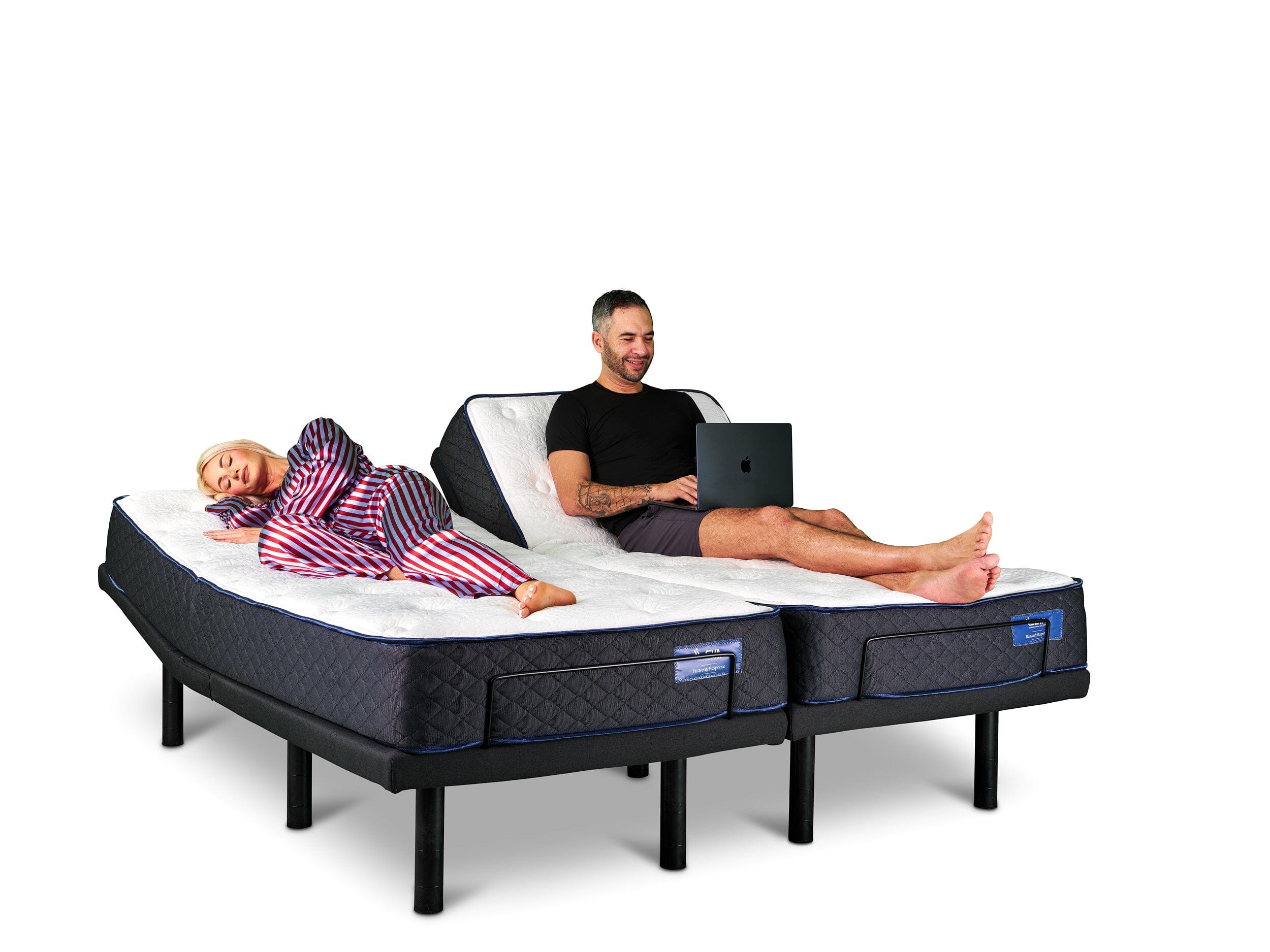
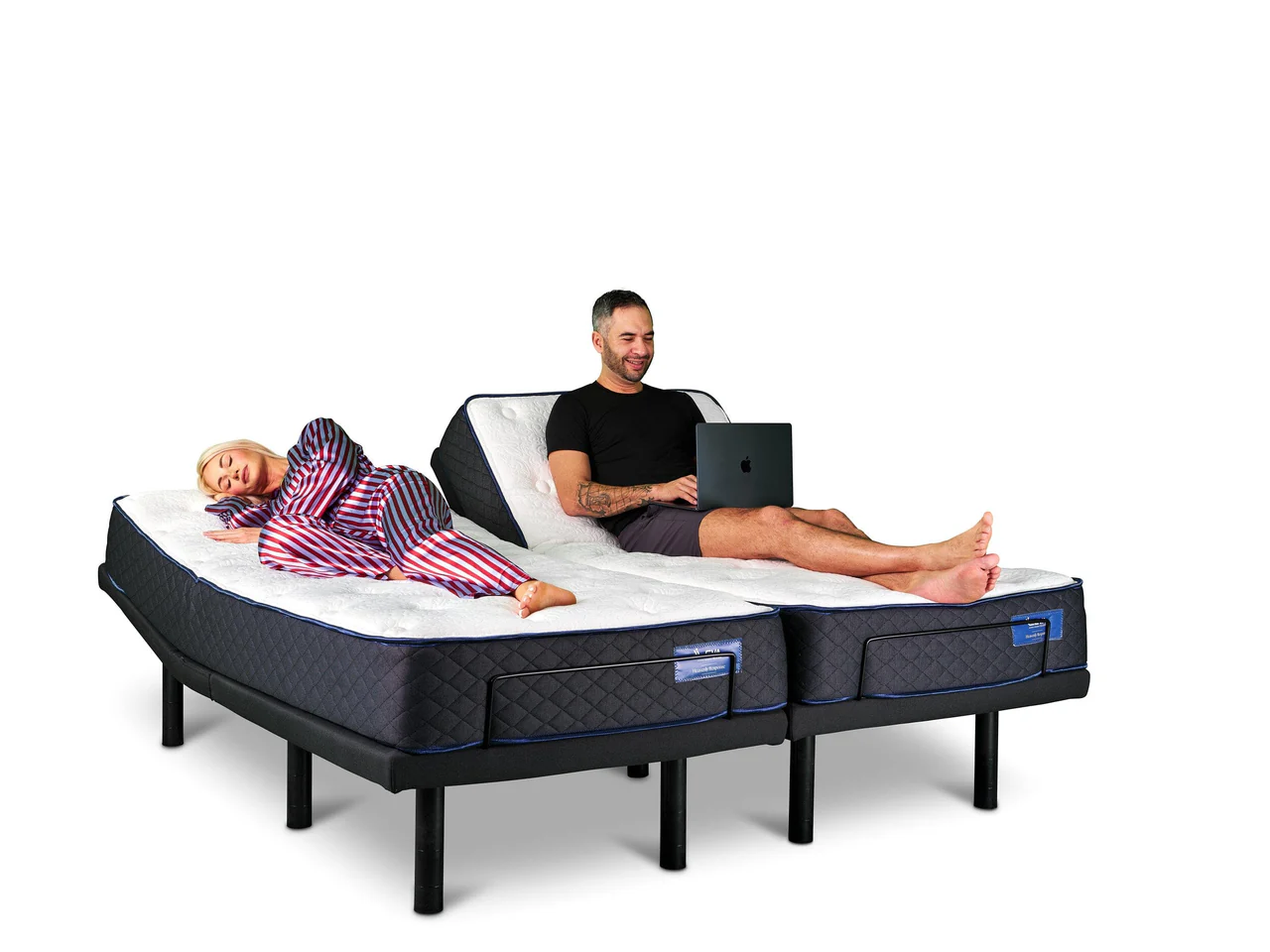
A standard single-unit adjustable base lifts the entire mattress in one piece, so both sleepers experience the same position change when the head or foot is raised. A split-king adjustable base consists of two independent twin XL bases placed side by side, allowing each partner full, separate control over both head and foot sections.
Split King setups consisting of two Twin XL mattresses enable couples with differing firmness preferences or sleep positions to each select their ideal mattress without compromise, helping partners remain in the same bed. Split-king configurations provide future flexibility because each side operates independently, so one partner’s adjustments can change over time without affecting the other. Leva Sleep extends this architecture to Split Queen configurations, a size largely unavailable from competing brands, giving couples in smaller rooms the same independent control without requiring a king-size footprint.
Best Smart Bed for Different Sleep Temperatures
Temperature strongly influences sleep quality for most couples. Integrated smart mattresses and pod systems address temperature through active heating and cooling embedded in the mattress surface or a topper layer. Split adjustable-base ecosystems address temperature through compatible heating and cooling pads layered onto each side independently, which preserves the ability to upgrade temperature hardware without replacing the base.
Split king configurations solve the problem of couples with mismatched sleep needs by enabling independent selection of firmness, materials, and temperature-regulating features on each side without forcing compromise on a single mattress. For couples where one partner sleeps hot and the other sleeps cold, a split adjustable ecosystem allows each side to run a different temperature profile at the same time. Integrated single-unit mattresses cannot match this behavior unless they use proprietary dual-zone hardware locked to that specific product line.
Snoring and Apnea Positioning for Partners
Many adjustable bed bases include anti-snore presets with a partner option that raises only one side of the bed for a snoring partner while keeping the other side flat. The Tempur-Ergo Smart Base features automatic snore response along with sleep coaching and smart alarm capabilities, representing the integrated smart mattress category’s approach. Sleep Number’s FlexFit 2 Smart Base includes Partner Snore technology that allows a user to raise their partner’s head with the press of a button when snoring occurs.
Split adjustable-base ecosystems address snoring through independent head elevation on the snoring partner’s side, without disturbing the other partner’s position. Leva Sleep’s anti-snore mode detects snoring and makes micro-adjustments to the head of the relevant side automatically, so the non-snoring partner does not need to wake up and press a button.
Anti-Snore Adjustable Beds That Actually Help
The distinction between automatic and manual anti-snore response matters for couples where snoring occurs most nights. AI models in 2026 smart beds such as the Tempur-Ergo Smart Base can automatically detect snoring via heart rate and blood oxygen tracking and dynamically adjust bed position, moving beyond manual presets. Technological advancements have made features like automatic anti-snore adjustments more accessible across smart bed categories.
Couples evaluating anti-snore claims can focus on three points. First, does the system detect snoring on each side independently. Second, does the adjustment affect only the snoring partner’s side. Third, does the system return to the original position after snoring stops. Split adjustable-base ecosystems with per-side motor control satisfy all three conditions mechanically, regardless of which tracking layer triggers the response.
Temperature and Firmness Personalization for Each Partner
Comfort and spinal support drive many couples to consider higher-priced mattresses. Integrated smart mattresses deliver firmness adjustment through air chambers or foam layer repositioning within a single unit, which limits how differently the two sides can be configured. Pod systems add temperature control but usually do not change firmness. Split adjustable-base ecosystems separate the firmness decision, handled by the mattress selected for each side, from the positional adjustment handled by the base, so couples gain the widest range of independent personalization.
Leva Sleep’s split bases pair with all-foam or hybrid pocket-coil mattresses selected independently per side, giving each partner control over firmness at the mattress level. Temperature is then layered on top through integrated heating and cooling pads that operate independently per side. Both the base position and temperature settings are controlled through the Leva Sleep app, which consolidates all per-partner adjustments, including sleep positions, vibrating alarms, and lumbar support, into a single interface.
Total Cost of Ownership Over Five Years
Smart beds generally last 10 years or more. Sleep Number beds carry a 10-year limited warranty, and because of air-chamber and electronic components, the Climate360 may experience air leaks or technical glitches over time, with proprietary replacement parts becoming expensive after the warranty period expires. Pod systems typically require active subscriptions for full feature access, which adds recurring annual costs that compound over a five-year horizon.
Split adjustable-base ecosystems from Leva Sleep carry no mandatory subscription. Components such as the base, mattress, and temperature pad can be replaced or upgraded independently, which avoids full-system replacement costs. Leva’s direct-to-consumer model delivers pricing 30–50% below comparable competitors by removing retail markup, and white-glove delivery and setup is available for a fee, covering installation, old bed removal, and product tutorials.
Real-World Scenarios for Couples
Four scenarios show how system characteristics map to real couple needs.
- Snoring disruption: A couple where one partner snores nightly benefits most from automatic per-side head elevation that does not require the other partner to wake up. Split adjustable bases with app-controlled anti-snore modes address this directly.
- Differing firmness: One partner needs pressure relief for hip pain, while the other prefers a firm surface. Split king configurations allow each partner to select a different mattress model or firmness level without compromise.
- Post-surgery recovery: A partner recovering from hip or knee surgery requires elevated leg positioning and lumbar support that changes week by week. A split base allows the recovering partner to adjust independently without disrupting the other side.
- Athletic recovery: A partner focused on sleep quality for performance recovery benefits from per-side temperature control and detailed sleep trend data, both available through split ecosystem accessories without a mandatory subscription.
Decision Checklist: Matching Priorities to System Types
This matrix links your primary priority to the system type most likely to meet it, and highlights that split adjustable-base ecosystems are the only category offering all six capabilities without mandatory subscriptions.
| Priority | Integrated Smart Mattress | Pod System | Split Adjustable-Base Ecosystem |
|---|---|---|---|
| Per-partner tracking without wearables | Available on select models | Available with subscription | Available via compatible accessories |
| Independent head/foot elevation per side | Limited to select configurations | Not available | Standard feature |
| Automatic anti-snore per side | Available on select models | Not available | Available on Leva Sleep systems |
| Independent temperature per side | Available on dual-zone models | Available with subscription | Available via compatible pads |
| No mandatory subscription | Varies by brand | Typically required | Yes — Leva Sleep |
| Split Queen availability | Rarely available | Not available | Available — Leva Sleep |
Frequently Asked Questions
Are bed-based sensors as accurate as wearables for tracking individual sleep stages?
Bed-based and under-mattress sensors perform well for detecting total sleep time and broad night-to-night trends, but show lower sleep stage accuracy than wrist wearables or smart rings. As noted in the tracking accuracy section, consumer devices cannot replicate clinical polysomnography. For couples, the practical value of bed-based tracking is passive, nightly trend monitoring without requiring either partner to wear a device. If precise sleep stage data is a priority, pairing a split adjustable base with a validated wearable on the relevant side gives the most complete picture.
Does Leva Sleep offer Split Queen adjustable beds?
Yes. Leva Sleep is one of the few providers offering Split Queen adjustable beds built to customer specifications. This configuration delivers the same independent per-side control as a Split King, including separate head and foot elevation, independent app control, anti-snore positioning, and compatible temperature accessories, in a smaller footprint suited to rooms that cannot accommodate a king-size bed. This makes Leva Sleep’s Split Queen a meaningful option for couples who want full dual-zone independence without upsizing their bedroom.
How loud are the motors on Leva Sleep adjustable bases?
Leva Sleep’s adjustable bases use whisper-quiet German motors designed specifically to avoid disrupting sleep during automatic adjustments. This reflects a deliberate engineering choice, because anti-snore and positional micro-adjustments that occur during the night only help if they do not wake the partner who is already sleeping. Motor noise is one of the most common complaints about basic adjustable bases sold as add-ons at general mattress retailers, so Leva Sleep positions motor quality as a core product specification rather than a secondary feature.
Do Leva Sleep systems require a subscription to access sleep tracking or app features?
No. Leva Sleep’s app-controlled features, including custom sleep positions, anti-snore mode, vibrating alarms, and independent side control, do not typically require a mandatory ongoing subscription. This contrasts with pod-based systems that gate full feature access behind annual fees. Over a five-year ownership period, the lack of a subscription can represent a meaningful cost difference, especially for couples who want full functionality from day one without recurring charges.
What mattress types work best with Leva Sleep’s split adjustable bases?
Leva Sleep’s split adjustable bases are compatible with all-foam mattresses and hybrid pocket-coil mattresses. Both types flex appropriately with head and foot elevation without damaging the mattress structure. Leva Sleep designs and curates its mattress lineup specifically for use with adjustable bases, and each mattress in the lineup can be selected independently per side in a split configuration, so one partner can choose an all-foam model for pressure relief while the other selects a hybrid for firmer support. Leva Sleep’s mattresses are made in the United States.
Conclusion: Why Split Adjustable Ecosystems Suit Most Couples
Across all five evaluation criteria, split adjustable-base ecosystems deliver the broadest range of independent per-partner control for couples. Tracking accuracy across consumer categories falls below polysomnography, yet split ecosystems allow tracking hardware to be upgraded independently as sensor technology improves. Independent dual-zone control comes from the structure of split bases rather than an optional add-on. Anti-snore positioning operates per side without waking the other partner. Temperature and firmness are personalized through independent mattress selection and compatible accessories. Five-year ownership costs also stay lower without mandatory subscriptions or proprietary replacement parts.
Leva Sleep’s split adjustable systems, available in both Split King and Split Queen, provide this full capability set at 30–50% below comparable competitors, backed by eight years of adjustable bed specialization, 25,000+ customers, and white-glove delivery and setup. Couples in Southern California can visit the La Jolla showroom for a hands-on evaluation with 15–20 adjustable models available for direct comparison.
Compare Leva Sleep’s split adjustable systems in person or configure your setup online.