Written by: Matthew Timmins, Founder and Managing Director, Leva Sleep
Key Takeaways
- Snoring and back pain often disrupt couples’ sleep at the same time, so independent, responsive bed features protect both partners’ comfort.
- Automatic snore-detection systems that elevate the head without manual input provide more consistent relief for nighttime airway issues.
- Zoned lumbar support and independent motorized lumbar pads help maintain spinal alignment and reduce back pain for each sleeper.
- Split adjustable bases with true independent controls, quiet motors, and strong motion isolation let each partner customize their side without disturbance.
- Leva Sleep’s integrated adjustable systems combine these features at 30–50% below many luxury competitors, with white-glove delivery and setup included. Shop online or visit the La Jolla showroom today.
1. Snore-Detection Response That Works While You Sleep
Elevating the head during sleep is a clinically recognized approach to reducing positional snoring. Raising the head shifts soft tissue away from the airway and reduces the vibration that produces snoring sound. The practical question is whether a system does this automatically or requires manual input.
Automatic snore response uses a microphone or sensor to detect snoring and trigger a head-elevation adjustment without waking either partner. Manual anti-snore modes require the snorer or their partner to initiate the adjustment via remote or app. For couples where snoring begins after the snorer is already asleep, automatic detection usually provides more reliable relief.
When evaluating a system, ask whether the base detects snoring independently or requires a connected wearable. Confirm how many degrees the head section elevates and whether the non-snoring partner’s side can remain unchanged. A couple where one partner snores heavily after midnight needs a system that responds without either person waking to press a button.
Automatic snore response addresses airway issues, but back pain requires a different mechanical solution that maintains spinal alignment regardless of head elevation.
2. Zoned Lumbar Support for Consistent Spinal Alignment
The most important factor in preventing sleep-related back pain is spinal alignment, with most bed-related pain issues stemming from the midsection sinking below the rest of the body at night. Zoned support systems address this by placing firmer foam or thicker coils beneath the torso and hips, with softer materials elsewhere for cushioning.
Zoned coil systems can be especially helpful for people with lower back or hip pain. Lumbar support keeps the spine in a neutral position that reduces lower-back strain. Some adjustable bases add a motorized lumbar pad that raises independently of the head and foot sections. This pad provides targeted mid-back reinforcement regardless of overall bed position.
When evaluating a mattress-and-base combination, ask whether the mattress uses zoned construction with reinforced support beneath the hips and torso. Confirm that the base includes an independent lumbar motor and that lumbar height can be adjusted without changing head or foot elevation.
Once spinal support is addressed, couples need a way to tailor those benefits to each partner’s unique sleep position and schedule.
3. Independent Controls for Each Partner’s Side
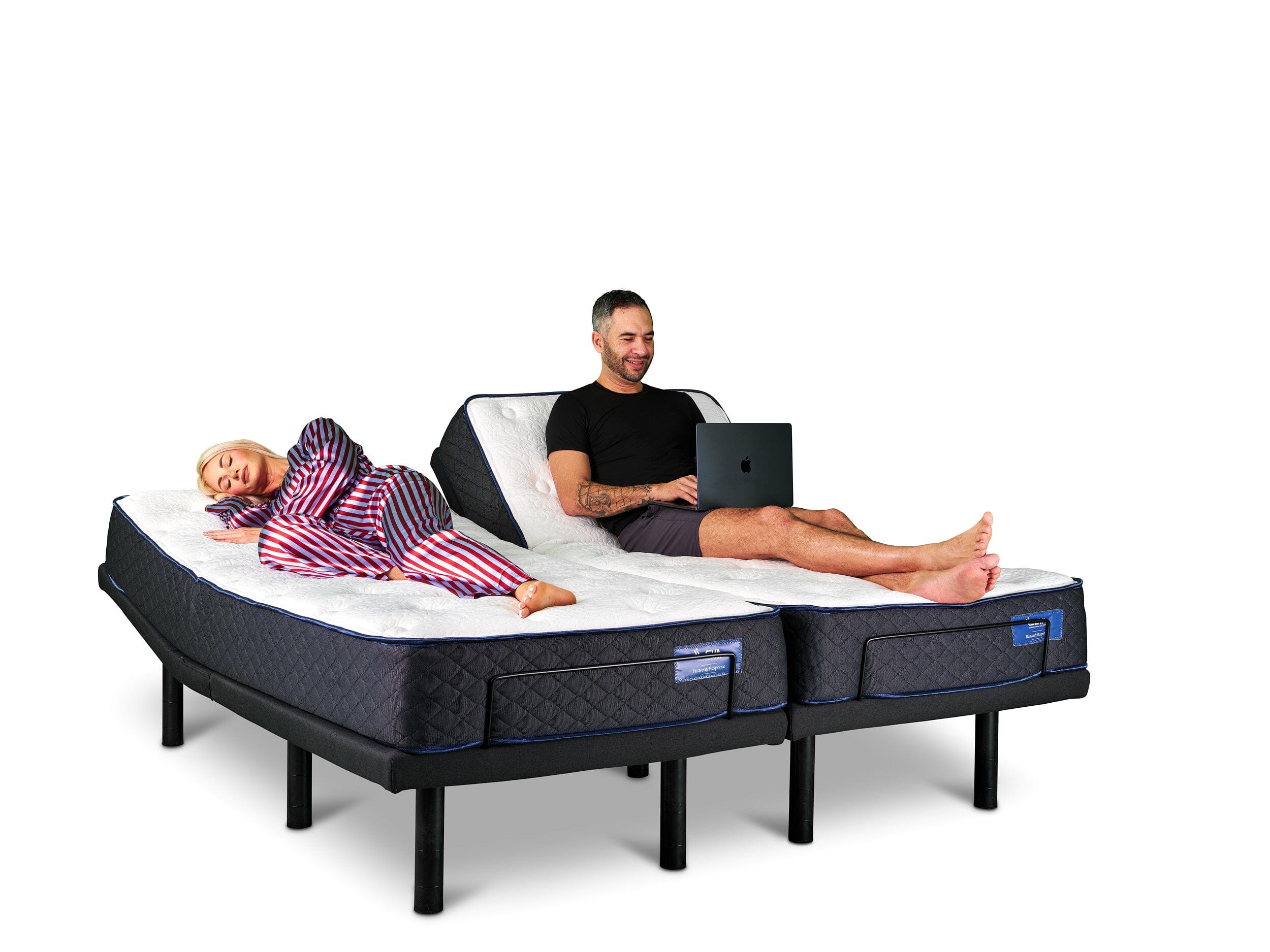
A split adjustable base only delivers its full benefit when each side truly operates on its own. Each partner should adjust their side without affecting the other. That means different head angles, different foot elevations, different lumbar heights, and different massage settings running at the same time.
Split king adjustable beds are ideal for couples with differing sleep schedules, sleep positions, mattress firmness preferences, or health needs because each partner can select a different mattress type and adjust their side independently. For couples where one partner needs head elevation for snoring while the other needs foot elevation for circulation or back pain, this independence becomes essential.
Start by verifying that the system offers a true split configuration, not a shared base with separate mattresses that move together. Once you confirm the base itself is split, check that app control is available for both sides independently so each partner can adjust without sharing a single remote. Look for a sync mode that allows both sides to move together when desired, and confirm Split Queen availability if your bedroom needs a smaller footprint than a standard king.
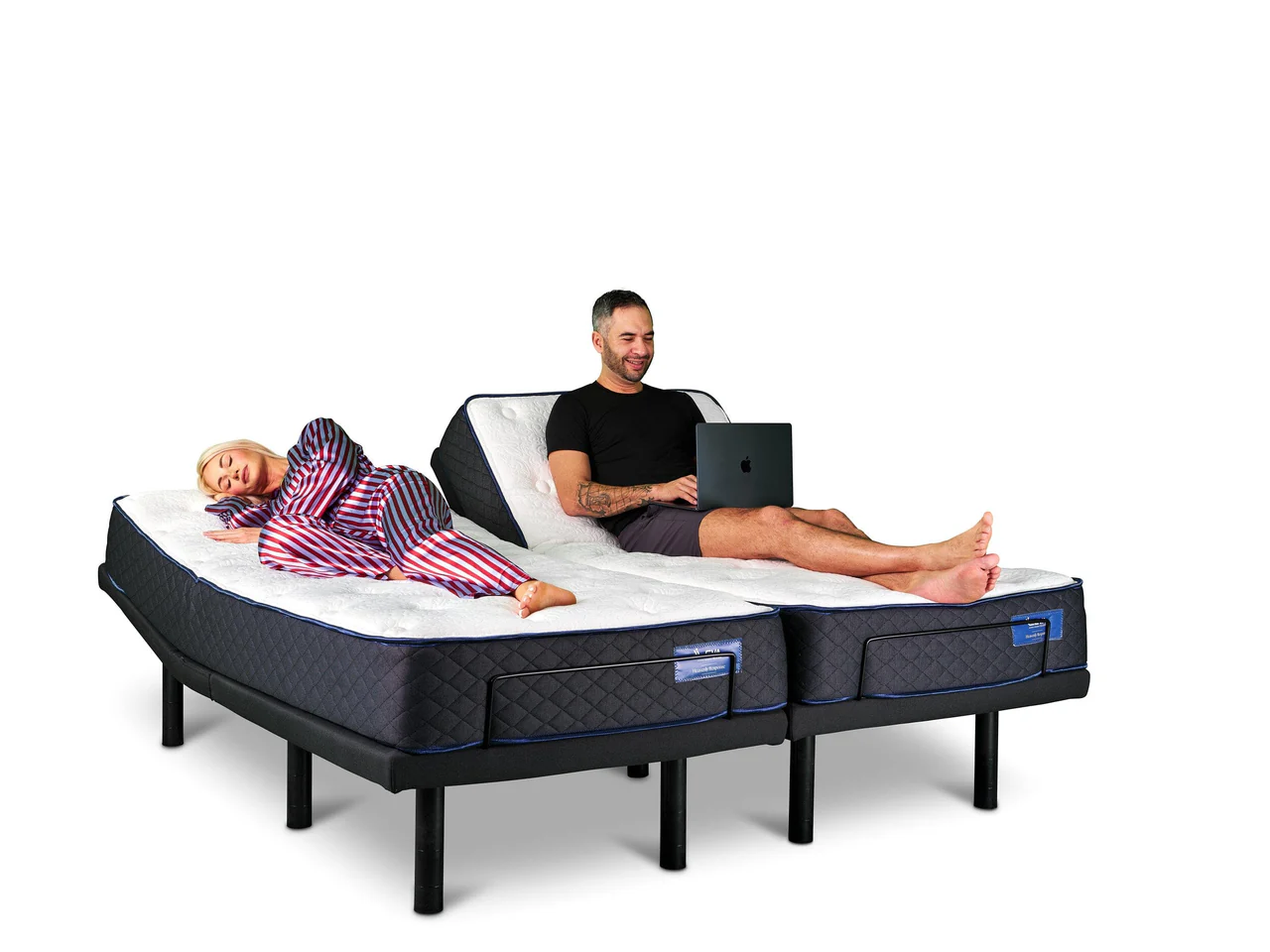
See how independent controls feel in person by visiting Leva Sleep’s La Jolla showroom, where you can test both sides of a split base at the same time.
Independent controls reduce disruption from position changes, and motion isolation further protects each partner from feeling every shift.
4. Motion Isolation That Protects Light Sleepers
Even with independent elevation controls, a mattress that transfers motion will transmit every shift and adjustment across the bed. Motion isolation describes the mattress’s ability to absorb movement at the point of origin instead of sending it to the other side.
Memory foam and latex mattresses are the most compatible with split king adjustable bases because of their flexibility. Both materials also rank among the strongest for motion isolation. When evaluating a mattress, ask whether it uses individually wrapped pocket coils, which isolate motion better than interconnected springs, or all-foam construction. Avoid traditional innerspring mattresses with interconnected coils, which transfer motion readily and may be damaged by repeated articulation.
Even with excellent motion control, couples still need a shared bed that feels comfortable at different temperatures for each partner.
5. Temperature Regulation for Two Different Sleepers
Temperature mismatch ranks among the most common secondary complaints for couples sharing a bed. One partner sleeping hot while the other sleeps cold creates a nightly compromise on a single shared surface. Dual-zone temperature regulation solves this by allowing each side to be cooled or warmed independently.
When evaluating a system, look for active temperature control that circulates air or uses a heating and cooling pad. Passive temperature-neutral foam simply avoids trapping heat but does not adjust temperature. Confirm that each side’s temperature is controlled independently via app or remote. Also confirm that the system operates quietly enough not to disrupt sleep.
Comfortable temperature and stable support set the stage, but the sound of the base itself can still make or break real-world use.
6. Quiet Motor Operation During Nighttime Adjustments
Motor noise is one of the most common frustrations with traditional adjustable bases. A base that grinds or clicks during position changes undermines automatic snore response. If the adjustment wakes the non-snoring partner, the original problem simply changes form.
When evaluating a base, ask specifically about motor decibel ratings. German-engineered motors are widely recognized in the industry for very quiet operation. Request a live demonstration at a showroom, or look for verified customer reviews that describe noise during nighttime adjustments. A base that operates silently at 2 a.m. feels very different from one that seems quiet during a brief daytime demo.
Experience whisper-quiet motor operation firsthand at Leva Sleep’s La Jolla showroom, or explore the full system online to review detailed specifications.
Once you know the system will run quietly, consider how it arrives in your home and how easily you can start using every feature.
7. Delivery and Setup Experience That Starts You Off Right
A split adjustable base is a complex, heavy system. The delivery experience directly affects whether the system is assembled correctly, whether the old bed is removed, and whether both partners understand how to use every feature on the first night.
White-glove delivery, where trained professionals bring the system to the bedroom, assemble it, adjust leg heights, connect the app, and walk both partners through the controls, removes the frustration and risk of self-assembly. Ask whether old-bed removal is included, since disposing of a split king yourself often requires a truck and multiple trips. Confirm that the delivery team adjusts the base height to match your existing furniture, because even a small mismatch makes reaching lamps or nightstands awkward every night. Finally, verify that a product tutorial is part of the service so both partners feel confident using features like anti-snore mode and lumbar adjustment. For a system this integrated, setup quality is part of the product.
With delivery and setup handled, the final step is understanding how all these features work together over years of nightly use and how that compares to the total price.
8. Long-Term Value and Price for an Integrated System
Leva Sleep offers an integrated adjustable sleep system that addresses all eight criteria described in this guide. Its Split King and Split Queen adjustable bases feature independent controls for each side, quiet German motors, a motorized lumbar support pad, a pillow tilt motor for head and neck positioning, and an anti-snore mode that detects snoring and makes automatic micro-adjustments to the head section without waking either partner. Each side is controlled independently via the Leva Sleep app, with custom sleep position presets, vibrating alarms, and sync mode available.
Leva’s mattresses are all-foam or hybrid pocket coil and are designed specifically to flex with adjustable bases. The company offers a selection of adjustable base models, and its direct-to-consumer pricing model with local assembly reduces distribution costs. This structure delivers the feature set described above at roughly half the cost of many comparable luxury brands. White-glove delivery includes bedroom setup, leg-height adjustment, old-bed removal, and a full product tutorial.
When evaluating price, calculate the total cost of the system, including base, mattress, bedding accessories, and delivery, against the feature set delivered. A lower sticker price on a base without lumbar motors, automatic snore detection, or quiet operation does not represent a comparable product. To see how these eight criteria work together in practice, consider how Leva Sleep’s integrated system performs on each dimension.
Side-by-Side Comparison Table
Use this table as a worksheet when comparing systems. The “Your Notes” column lets you record specific answers from sales representatives or product specifications. The Leva Sleep column shows how one integrated system addresses each criterion. The “Other Systems” column lists questions you can ask competitors to ensure a fair, apples-to-apples comparison.
| Evaluation Criteria | Your Notes | Leva Sleep | Other Systems |
|---|---|---|---|
| 1. Snore-Detection Response | Automatic anti-snore mode, app-controlled micro-adjustments | Verify: automatic vs. manual, elevation degree, sensor type | |
| 2. Zoned Lumbar Support | Independent motorized lumbar pad, zoned mattresses | Verify: motorized lumbar available, mattress zoning specs | |
| 3. Independent Controls | Full split configuration, app + remote, Split Queen available | Verify: true split base or shared base, app independence per side | |
| 4. Motion Isolation | All-foam or hybrid pocket coil, designed for adjustable articulation | Verify: coil type, foam layer, compatibility with articulation | |
| 5. Temperature Regulation | Dual-zone heating and cooling pad, independent per side | Verify: active vs. passive, dual-zone availability, noise level | |
| 6. Noise Levels | Whisper-quiet German motors | Verify: motor origin, decibel rating, nighttime adjustment noise | |
| 7. Delivery and Setup | In-house white-glove, old-bed removal, tutorial included | Verify: white-glove available, who assembles, old-bed removal | |
| 8. Long-Term Value and Price | Direct-to-consumer model, pricing below many luxury competitors | Verify: total system cost including base, mattress, delivery |
Frequently Asked Questions
Can a bed automatically adjust when someone snores?
Advanced adjustable bases can include sensors that detect snoring sounds and automatically elevate the head section to a position that may reduce airway obstruction. Leva Sleep’s anti-snore mode does this through the base itself, making micro-adjustments without requiring either partner to wake up or interact with a remote. The key distinction to check when shopping is whether the detection is built into the base or requires a separate wearable device.
What is the difference between a Split King and a Split Queen adjustable base?
A Split King uses two Twin XL mattresses side by side to form a standard king footprint, with two fully independent adjustable bases beneath them. A Split Queen uses two narrower mattresses to form a queen footprint, a configuration less commonly available but important for couples who want independent controls in a smaller bedroom. Leva Sleep offers both configurations, including the Split Queen, which most general retailers do not carry.
Does elevating the head of the bed actually help with back pain?
Head and foot elevation can reduce pressure on the lumbar spine by shifting weight distribution and allowing the lower back to decompress. The more targeted solution for back pain is a mattress with zoned lumbar support, which provides firmer resistance beneath the hips and torso, combined with an adjustable base that includes an independent lumbar motor. This combination maintains spinal alignment across different sleeping positions rather than relying on elevation alone.
How do I know if a mattress will work with an adjustable base?
Memory foam and hybrid pocket coil mattresses are the most compatible with adjustable bases because they flex without damage during articulation. Traditional innerspring mattresses with interconnected coils are generally not compatible and may be structurally compromised by repeated bending. When evaluating a system, confirm that the mattress is explicitly rated for use with an adjustable base, and ask whether the manufacturer warranties the mattress when used with articulation.
Is white-glove delivery worth the cost for an adjustable bed system?
For a split adjustable base, professional setup is strongly advisable. These systems involve heavy components, precise leg-height calibration, app pairing, and accessory integration that are difficult to execute correctly without experience. Errors in setup, such as misaligned bases, incorrect leg heights, or unpaired remotes, affect nightly comfort from the first use. White-glove delivery that includes a product tutorial also ensures both partners know how to use every feature, including anti-snore mode and lumbar adjustment, from night one.
Conclusion
The eight criteria above, including snore detection, zoned lumbar support, independent controls, motion isolation, temperature regulation, noise levels, delivery quality, and long-term value, form a complete evaluation framework for couples managing both snoring and back pain. Before visiting a showroom or requesting a demo, note how frequently snoring disrupts sleep and which specific areas of the back cause discomfort. Those two data points immediately narrow the features that matter most for your household.
Leva Sleep offers an integrated adjustable sleep system that addresses all eight criteria outlined above, with the pricing advantage mentioned earlier and white-glove delivery included. Use this framework to evaluate any system, then compare your findings against Leva Sleep’s solution, available online or at the La Jolla showroom.