
Written by: Matthew Timmins, Founder and Managing Director, Leva Sleep
Key Takeaways
- Split king adjustable beds let each partner independently control head and foot elevation, firmness, and temperature to match different sleep needs.
- Independent Twin XL mattresses eliminate most motion transfer and allow each sleeper to choose firmness based on weight and sleep position.
- Head elevation on adjustable bases can reduce snoring, ease acid reflux, and relieve back or sciatic pain without forcing the same position on both partners.
- Quiet, high-quality motors, connector straps, and height-matched mattresses minimize noise, gaps, and other common drawbacks of split configurations.
- Leva Sleep offers premium split king systems with app-based anti-snore technology and white-glove delivery, so you can shop online or visit the La Jolla showroom today.
How Split King Beds Help Couples Sleep Better Together
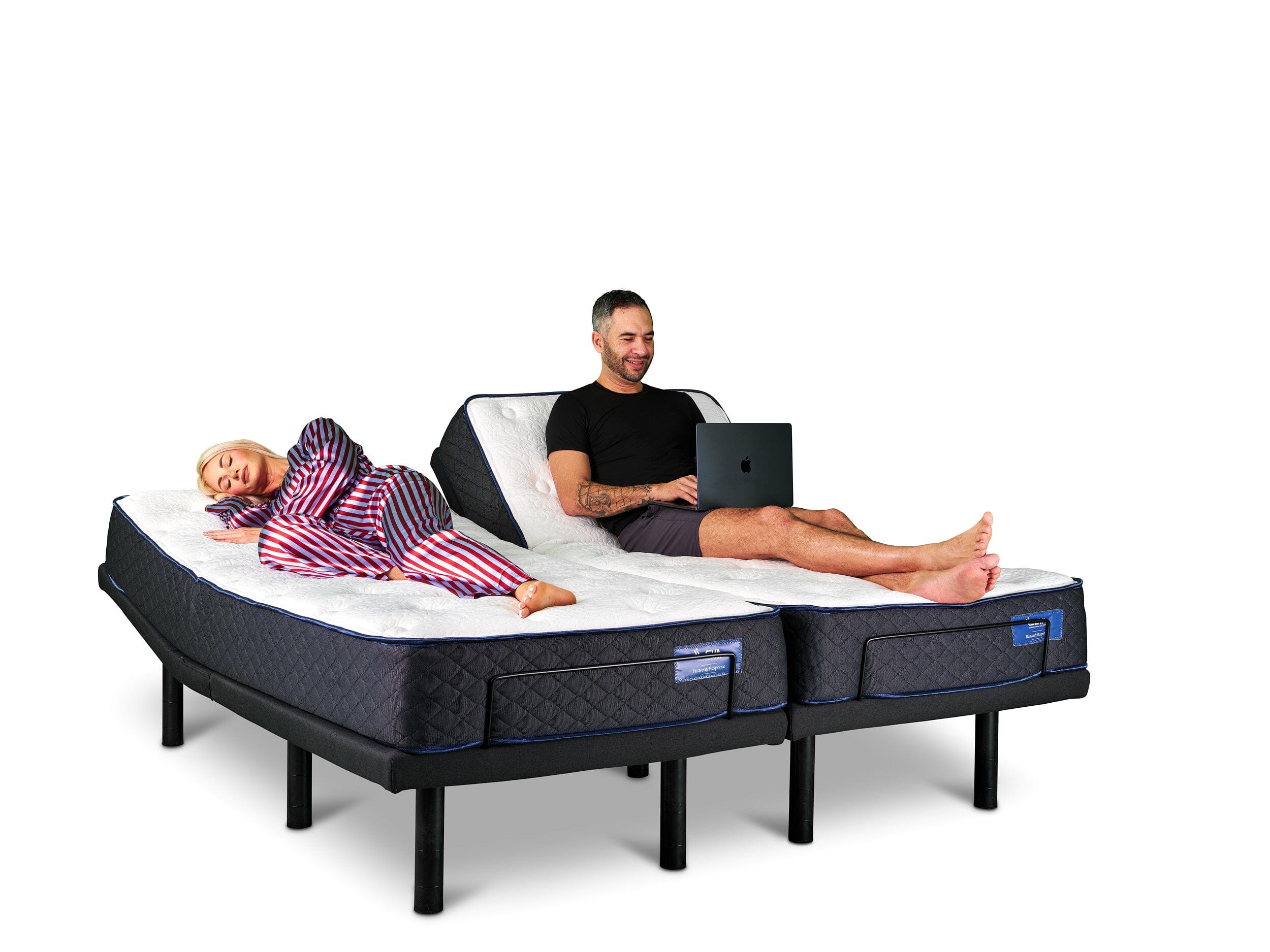
Split king configurations give couples with different sleep needs more control than a unified mattress. Each partner can independently raise or lower the head and foot sections without affecting the other sleeper, and each can select a different mattress firmness suited to their body type and sleep position. Independent control over elevation and firmness allows both partners to sleep comfortably instead of compromising on a single setting.
Firmness needs vary significantly by sleep position and body weight. Side sleepers generally need softer surfaces rated 4–6 on a 1–10 firmness scale to cushion shoulders and hips, back sleepers often prefer medium firmness (5–7) for spinal support, and stomach sleepers usually require firmer mattresses (6–8) to prevent lower back sag. When partners sleep in different positions, a single unified mattress rarely satisfies both at the same time.
Weight differences add another layer of complexity. Heavier sleepers typically require firmer mattress support, while lighter sleepers may find that same firmness level uncomfortably hard. Split configurations let each partner choose a mattress that supports their frame instead of meeting in the middle on a compromise that works for neither.
Medical conditions often make independent adjustment even more valuable. Elevating the head a few degrees can open airways and reduce snoring for sleep apnea sufferers, while raising the head 6 to 8 inches uses gravity to keep stomach acid down and alleviate GERD symptoms. The zero-gravity preset position elevates both the head and feet slightly above the heart, which reduces pressure on the lower spine and joints. One partner can use these positions while the other remains flat.
Targeted elevation also helps with specific pain and circulation issues. For partners dealing with sciatica, slightly elevating the knees on an adjustable base relieves tension on the lower back and sciatic nerve that occurs when sleeping flat. Raising the feet uses gravity to support blood flow back toward the heart, which can help reduce leg swelling and edema. This setting can benefit partners with circulation issues, those who stand for long periods, or pregnant women.
Drawbacks of Split King Beds and How to Manage Them
Split king systems introduce a few practical considerations that buyers should review before purchasing. The most commonly cited issue is the gap between the two Twin XL mattresses. This gap stays manageable with the right setup. Adjustable bases equipped with connector straps or non-skid surfaces keep the two Twin XL halves securely aligned, which prevents gaps or separation during independent movement. Mattress height matching also matters. Mattress heights on each side should be kept within 2–3 inches of each other to avoid creating a noticeable slope in the middle.
Bedding needs a small adjustment as well. Two separate Twin XL fitted sheets are required because each mattress moves independently, and a single king fitted sheet cannot accommodate that motion. Leva Sleep addresses this by designing fitted sheets with deep pockets and extra elastic, duvets with clips to maintain separation when bed positions differ, and accessories built specifically for adjustable bases.
Motor noise can become a problem with lower-quality systems. Basic adjustable bases often produce mechanical noise during position changes that disrupts a sleeping partner. Leva Sleep's systems use very quiet German-made motors engineered to minimize this disruption, which creates a clear difference from commodity adjustable bases sold as afterthoughts at general mattress retailers.
Room size and wall clearance also deserve attention. Buyers should verify base weight capacity, including mattress and both sleepers, and ensure adequate wall clearance for movement. A split king requires the same floor space as a standard king, so room dimensions usually are not a barrier. Headboard clearance for elevation still needs confirmation.
Cost sits higher than a standard mattress purchase. Many buyers, however, compare split king adjustable systems to the long-term costs of sleep disruption, such as reduced productivity, health consequences, or the relationship strain of separate sleeping arrangements, and conclude that the investment makes sense.
Explore Leva Sleep's split king systems and financing options at the La Jolla showroom or online.
Mattress Choices for Couples with Different Weights
Mattress selection for adjustable bases follows different criteria than selection for flat frames. Flexibility is the primary requirement. Mattresses for adjustable bases must flex without internal damage. Memory foam and latex usually provide the most flexibility, most modern pocketed-coil hybrids also perform well, and traditional innerspring mattresses with interconnected coils should be avoided because of their rigidity.
Thickness affects performance as much as material. Mattresses 10–12 inches thick provide a strong balance between flexibility for base movement and adequate support. Mattresses outside this range can compromise the adjustable base's functionality by either flexing too much and lacking support or resisting movement and straining the frame.
For couples with different weights, the split configuration lets each partner select a mattress suited to their individual body. A heavier partner can choose a firmer hybrid with reinforced support layers. A lighter partner can select a softer all-foam option. Both mattresses share the same base footprint while performing independently for each sleeper.
The table below summarizes how split king configurations compare to traditional unified mattresses for firmness, motion isolation, and elevation control.
| Configuration | Independent Firmness | Motion Isolation | Elevation Control |
|---|---|---|---|
| Flat unified mattress | None, shared surface | Varies by material, no structural separation | None |
| Split king (two Twin XL mattresses, dual adjustable bases) | Full independence, each partner selects own firmness | Complete motion isolation between separate mattresses | Independent head and foot elevation per side |
Leva Sleep offers both all-foam and hybrid pocket-coil mattresses manufactured in the United States, each engineered to flex with adjustable bases. The curated lineup includes California-made brands such as Airloom alongside regional manufacturers, all selected for compatibility with Leva's proprietary adjustable bases.
Reducing Partner Disturbance with the Right Mattress and Base
Partner disturbance usually comes from three main sources: movement transfer, snoring, and temperature conflict. Each source benefits from a different solution within an integrated sleep system.
Motion isolation starts with the structure of the bed. Split king systems on dual adjustable bases deliver complete motion isolation between separate mattresses. A partner shifting positions or adjusting elevation does not transfer movement to the other side.
Snoring responds well to head elevation. Elevating the head section 30–40 degrees on an adjustable base can significantly reduce snoring by keeping airways open. In 2026, app-based anti-snore technology extends this benefit. Leva Sleep's anti-snore mode detects snoring and makes automatic micro-adjustments to the head of the bed without requiring the sleeper to wake. The same quiet motor technology mentioned earlier helps these adjustments occur without creating new noise that would disturb a partner.
Temperature conflict improves with independent climate control. Split king systems allow individualized temperature control options such as different cooling protectors or heated pads, which reduces partner disturbance from thermal preferences. Leva Sleep's systems integrate heating and cooling pads that operate independently on each side.
When evaluating systems, buyers benefit from moving through the decision in a clear sequence. Start with practical constraints, then address medical needs, then personalize comfort, and finally review service and support.
Begin with the room itself. Room dimensions should allow wall clearance for full head elevation and floor space for the king footprint. Once the bed fits the space, consider health-related needs. Health conditions such as sleep apnea, acid reflux, post-surgery recovery, or circulation issues call for a physician's guidance on elevation angles. Adjustable positioning can support medical recommendations but does not replace clinical treatment.
After room fit and medical guidance are clear, focus on personalization. Weight difference between partners should guide mattress firmness on each side based on individual body weight and sleep position, not a shared compromise. For light sleepers, noise sensitivity becomes critical. Motor specifications should confirm that quiet operation is a standard feature, not an optional upgrade.
Finally, review service and product depth. Delivery and setup work best through white-glove installation, because adjustable base systems with dual motors, app integration, and accessory components perform reliably when professionals assemble them. Model selection depth also matters. A specialist retailer offering 15–20 adjustable models provides far more fit options than a general retailer carrying only a few.
Frequently Asked Questions
Do split king beds feel disconnected when sleeping together?
The gap between two Twin XL mattresses stays minimal when connector straps and non-skid surfaces align the bases. Selecting mattresses of matching height, as noted earlier, further reduces any perceptible transition. Most couples report that the gap is not noticeable during normal sleep.
How loud are adjustable base motors during position changes?
Motor noise varies significantly by product tier. Entry-level bases from general retailers often use louder motors that can disrupt a sleeping partner. Premium systems, including those offered by Leva Sleep, use very quiet German motors engineered for minimal acoustic output. When evaluating a base, ask about decibel ratings or request a live demonstration before purchasing.
Can adjustable bases help with sleep apnea?
Elevating the head of an adjustable base can help open airways and reduce positional snoring and mild sleep apnea symptoms. This does not replace a CPAP machine or other clinically prescribed treatment. Individuals with diagnosed sleep apnea should consult their physician before modifying their sleep positioning and should not discontinue prescribed therapy without medical guidance.
What mattress types are compatible with adjustable bases?
Memory foam, latex, and modern pocketed-coil hybrid mattresses are all compatible with adjustable bases. Traditional innerspring mattresses with interconnected coils are not suitable because they cannot flex without structural damage. Mattresses in the 10–12 inch thickness range usually perform best on adjustable frames, balancing flexibility with adequate support.
Is a split king the only option for couples with different needs?
Leva Sleep also offers Split Queen adjustable beds for couples who need independent control in a more space-conscious configuration. Split Queen systems provide the same independent elevation, firmness, and temperature benefits as split king configurations but fit smaller room dimensions. This remains a relatively rare product category, and Leva Sleep is one of the few providers offering it built to customer specifications.
Conclusion: Choosing a Split King System That Fits Your Life
A split king adjustable bed system serves as a practical solution for couples whose differing health conditions, body types, and comfort preferences make a unified flat mattress inadequate. Independent elevation addresses snoring, acid reflux, back pain, and circulation. Independent firmness addresses weight differences and sleep position preferences. Independent temperature control addresses thermal conflict. Quiet motors and strong motion isolation address the mechanical disturbances that basic adjustable bases often introduce.
Clear decision criteria simplify the process. Match the system to the specific conditions present, verify mattress compatibility with the base, confirm motor quality, and arrange professional setup so every component functions correctly from the first night. For any medically relevant positioning decisions, consult a physician before finalizing a configuration.
Leva Sleep has spent more than eight years and 25,000 customers building expertise specifically in this category as its core product. With 15–20 adjustable models, U.S.-made mattresses, app-based anti-snore technology, and in-house white-glove delivery, the integrated system aims to eliminate the compromises that drive couples toward separate beds.