
Written by: Matthew Timmins, Founder and Managing Director, Leva Sleep
Key Takeaways
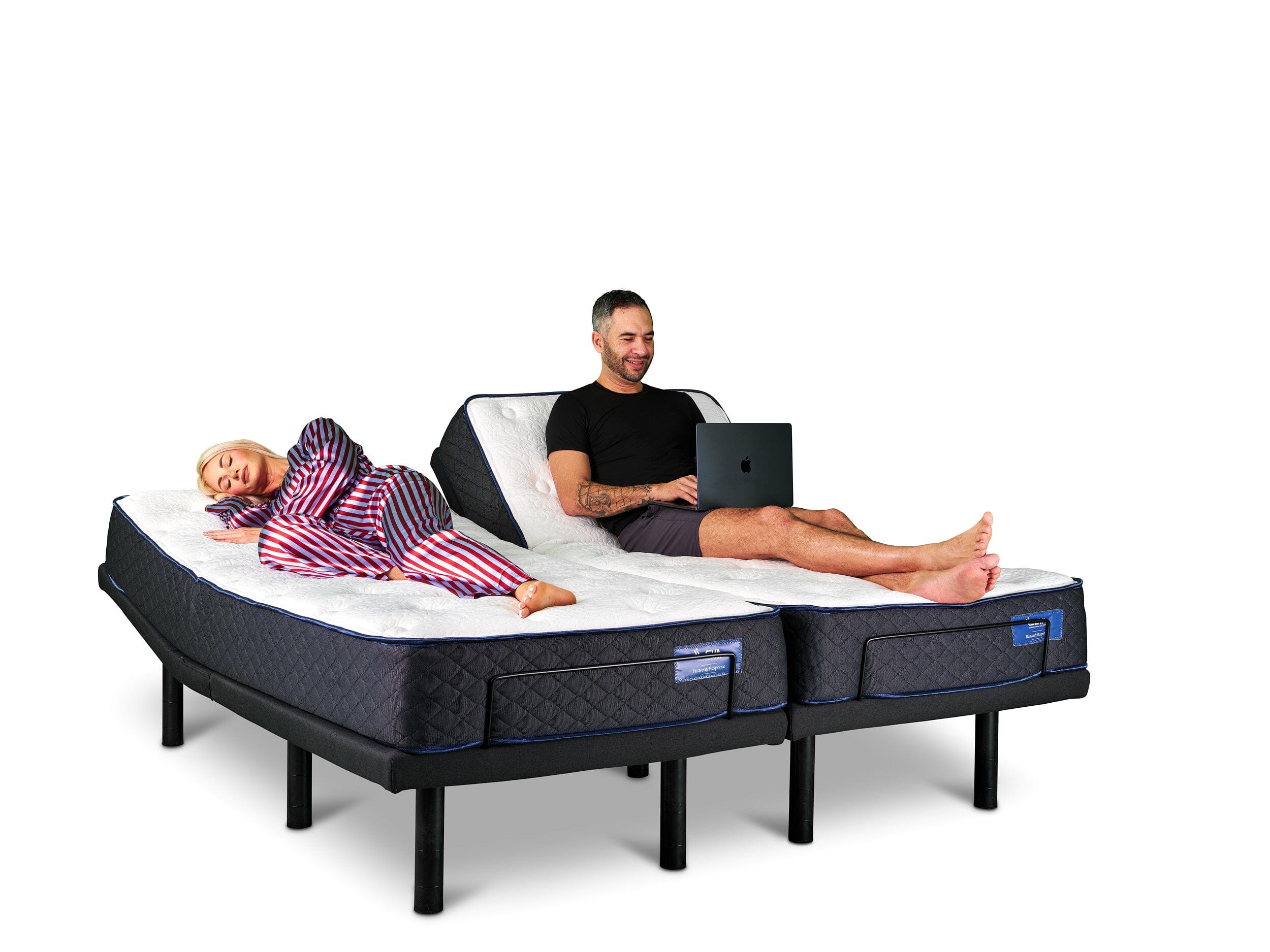
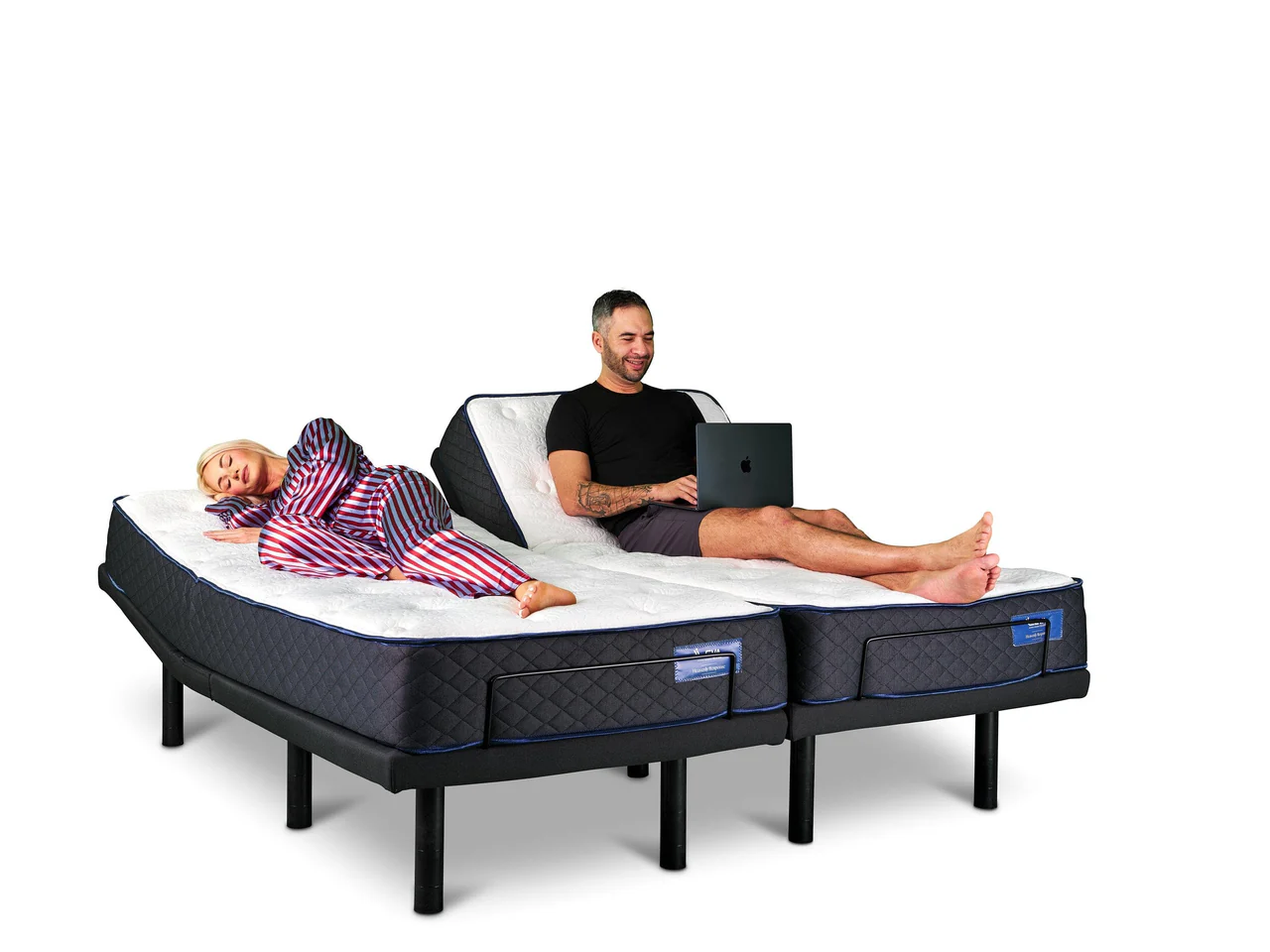
- Split king adjustable bases let each partner independently raise the head 15–20° and feet 10–15°. These angles relieve hip, shoulder, and lower-back pressure while preserving spinal alignment.
- Zero Gravity positioning elevates the legs above heart level, decompresses the spine, and reduces pressure on the shoulders and hips for side sleepers.
- Medium-firm (6–7/10) memory-foam or hybrid mattresses flex cleanly on adjustable bases without gapping. This pairing delivers targeted contouring at pressure points.
- Independent app control, whisper-quiet motors, lumbar support, and pillow-tilt features keep one partner’s adjustments from disturbing the other.
- Leva Sleep offers fully independent split-king systems with white-glove delivery and setup. Shop online or visit the La Jolla showroom today to find your ideal configuration.
1. Elevation Relief for Side Sleepers with Joint Pain
Approximately 75–85% of adults experience significant back pain at some point in their lifetime, according to the American Association of Neurological Surgeons. A flat mattress holds the spine in a fixed plane regardless of body shape, sleep position, or joint condition. An adjustable base introduces angles that match the body instead of forcing the body to match the bed.
The Zero Gravity position elevates the legs above heart level, decompresses the spine, and allows muscles to fully relax for repair during sleep. For side sleepers, slightly raising the head section reduces crushing pressure on the bottom shoulder, while foot elevation creates a cradle that prevents the top leg from sliding forward and twisting the lower spine.
Many people spend much of the night on their side, so shoulder and hip pressure become the most common overnight complaints. When evaluating an adjustable base for joint pain, start with the mechanical foundation. Head elevation of at least 0–60° and foot elevation of at least 0–45° give you the full spectrum from gentle relief to Zero Gravity positioning.
Beyond basic articulation, look for targeted support features. A lumbar support insert or dedicated lumbar motor decompresses the lower back independently of head and foot angles. A pillow-tilt motor aligns the cervical spine without raising your entire upper body. Finally, confirm whisper-quiet motor operation so nighttime adjustments do not wake either partner.
2. Head and Foot Angles by Joint Complaint
Many side sleepers find comfort with gentle angles between 10° and 20° of elevation on each end; for lower-back pain, starting with the head raised 15–20° and the feet raised 10–15° is a practical baseline. The table below converts that guidance into a quick reference by primary complaint.
| Primary Joint Complaint | Recommended Head Elevation | Recommended Foot Elevation |
|---|---|---|
| Lower back / lumbar | 15–20° | 10–15° |
| Hips / SI joint | 10–15° | 15–20° |
| Shoulders (side sleepers) | 15–20° | 10–15° |
| Sciatica / hamstring tension | 10–15° | 15–30° |
These ranges serve as starting points rather than rigid rules. Individual anatomy, mattress thickness, and base geometry all influence the final feel. Use these angles as a baseline on the first night, then adjust by 2–3° increments until pressure dissipates.
Ready to find your ideal angle in real time? Test these positions in person at Leva Sleep’s La Jolla showroom or configure your split-king system online.
3. Split King Benefits for Couples with Different Needs
Split king mattresses are a strong option for couples with different needs and comfort preferences, because each twin-XL half operates as a fully independent sleep surface. When one partner needs the head raised 18° for shoulder relief and the other needs the feet raised 20° for hip pain, a single-base king forces one person to accept a suboptimal angle. A split configuration removes that compromise.
Split king setups allow partners sharing a bed to each select independent head and foot angles. This structure also supports independent firmness when each side carries a different mattress model. Couples can place two different twin-XL mattresses from brands like Helix on a split-king base, allowing each partner to select a distinct firmness level tailored to their sleep position and body type.
Dual-zone support technology appears more often in luxury mattresses because couples strongly value independent control. When one partner adjusts their base angle at 2 a.m., the other side remains completely undisturbed. That separation matters for light sleepers managing chronic pain who already wake frequently.
4. Mattress Firmness and Contouring for Adjustable Bases
Not every mattress flexes cleanly with an adjustable base. Innerspring models with rigid border wires resist articulation and can gap at the head or foot bend points. That resistance reduces the pressure-relief benefit of elevation. When evaluating a mattress for a split-king adjustable system, apply these criteria.
Firmness: A medium-firm feel rated approximately 6–7 out of 10 is a practical starting point for adjustable-base pairings. This range balances contouring at pressure points with enough support to prevent excessive sinkage during elevation.
Construction: Memory foam mattresses conform seamlessly to base angles without gapping or sliding, delivering targeted pressure relief at the hips, shoulders, and lower back. Hybrid models with individually wrapped pocket coils also articulate well when the coil gauge is not overly rigid. Avoid bonnell or offset coil systems.
Chronic pain context: Nearly 21% of American adults experience chronic pain according to the CDC. For this group, pairing a flexible mattress with an adjustable base unlocks the therapeutic angles described earlier without the mattress fighting against the base’s articulation.
Leva Sleep carries 15–20 adjustable base models alongside a curated mattress lineup, including American-made options from Airloom and hybrid models from Helix, all pre-vetted for adjustable-base compatibility. Compare mattress and base pairings side by side online or in the La Jolla showroom to see how each combination feels.
5. App Controls, Motor Noise, and Hardware Checklist
Use this checklist when evaluating any split-king adjustable base system.
- Independent app control per side: Each partner should be able to save and recall custom positions without accessing the other side’s settings.
- Preset positions: Zero Gravity and Anti-Snore presets reduce manual adjustment during the night.
- Motor noise level: Audible motor noise during automatic adjustments can wake sleepers and undermine the benefit of real-time pressure-relief interventions, so confirm whisper-quiet operation before purchasing.
- Lumbar support motor: A dedicated lumbar insert that inflates or extends independently of head and foot articulation provides targeted lower-back decompression.
- Pillow-tilt motor: This feature allows the top 6–8 inches of the head section to tilt separately, supporting cervical alignment without raising the entire upper body.
- Anti-snore detection: Systems that detect snoring and make micro-adjustments to head elevation address airway obstruction passively, without waking either partner.
- Vibrating alarm: A gentle haptic vibration wakes one sleeper without sound, preserving the other partner’s sleep.
- Bluetooth reliability: Test connection stability from both sides of the bed before finalizing a purchase.
- Weight capacity per side: Confirm each twin-XL base supports the sleeper’s weight with a comfortable safety margin.
6. Delivery, Setup, and Bedding Details
- Room-of-choice delivery: Confirm the base and mattress are carried to the bedroom, not left at the door.
- Professional assembly: Split-king systems involve two bases, two mattresses, a connector bar, and app pairing. Professional setup prevents configuration errors.
- Leg-height adjustment on-site: Bed height affects ease of entry and exit, which matters significantly for hip and knee pain. A trained technician should adjust this during setup.
- Old-bed removal: Confirm whether the delivery service removes and disposes of or donates the existing mattress and frame.
- Product tutorial: A hands-on walkthrough of app features, preset positions, and lumbar controls helps both partners use the system correctly from night one.
- Bedding compatibility: Standard fitted sheets often slip on articulating bases. Deep-pocket sheets with reinforced elastic or clips designed for adjustable beds stay in place.
Split King Adjustable System Comparison
| System | Independent Controls | Elevation Range | Lumbar / Pillow-Tilt | White-Glove Delivery |
|---|---|---|---|---|
| Typical big-box retailer adjustable base | Single-side only on entry models | Head 0–45°, Foot 0–30° (varies by model) | Not standard | Threshold or room-of-choice only |
| Bed-in-a-box brand (e.g., Saatva, Purple) | Available on split configurations | Head 0–60°, Foot 0–45° (varies by model) | Select models only | White-glove available, third-party logistics |
| Sleep Number Climate360 | Yes, per-side firmness and elevation | Head and foot articulation (range not published) | Not standard | In-home setup included |
| General mattress retailer split-king package | Varies, often 3–5 base models available | Varies by base SKU | Rarely included | Third-party, setup not always included |
| Leva Sleep Split King System | Yes, fully independent per side, app-controlled | Head 0–60°, Foot 0–45° across multiple models | Lumbar motor and pillow-tilt motor available | In-house white-glove: bedroom delivery, assembly, leg-height adjustment, tutorial, old-bed removal |
Frequently Asked Questions
What are the drawbacks of a split king mattress?
The primary drawback is the center gap between the two twin-XL mattresses. Without a gap filler or connector, the seam can be felt when sleeping near the middle of the bed. Standard fitted sheets also struggle with the split configuration and tend to pop off during elevation.
Both issues have straightforward solutions. A split-king gap filler pad bridges the seam, and deep-pocket sheets with reinforced elastic or purpose-built adjustable-bed bedding keep sheets in place. A secondary consideration is cost, because two independent bases and two mattresses represent a higher upfront investment than a single king setup. For couples with mismatched pain profiles or firmness needs, the alternative of disrupted sleep or separate rooms carries its own long-term cost.
What mattress do orthopedic doctors recommend for joint pain?
Orthopedic and sleep medicine professionals generally recommend a medium-firm mattress, roughly a 6–7 on a 10-point firmness scale, as a starting point for joint pain. A surface that feels too soft allows the hips to sink excessively and can misalign the spine. A surface that feels too firm creates pressure points at the shoulder and hip.
Material choice also matters. Memory foam and hybrid pocket-coil constructions contour to the body’s curves, distributing weight across a larger surface area and reducing concentrated pressure at joints. When paired with an adjustable base, the mattress material needs to flex without gapping at articulation points, which rules out most rigid innerspring designs. The ideal pairing is a medium-firm all-foam or hybrid mattress on an adjustable base that allows independent head and foot elevation.
Can you still cuddle with a split king?
Couples can still cuddle comfortably on a split king. A split king shares the same overall footprint as a standard king, 76 inches wide by 80 inches long, so no physical barrier separates partners. The center gap between the two twin-XL mattresses is typically less than an inch and feels minimal when lying side by side.
When both bases are set to the same flat position, the bed functions like a standard king. The independent elevation only activates when one or both partners choose to adjust their side. Many couples set their bases flat for the first part of the night and activate their preferred joint-relief angles once they are ready to sleep. A gap filler pad further minimizes any sensation at the seam for couples who sleep close together.
How much should a quality split-king adjustable system cost in 2026?
A quality split-king adjustable system in 2026, which includes two independent bases plus two compatible twin-XL mattresses, typically ranges from approximately $3,000 to $10,000 or more. Final price depends on motor technology, feature set, mattress construction, and delivery model. Entry-level split-king packages from general retailers often sit at the lower end but may lack lumbar motors, pillow-tilt hardware, or app control.
Premium systems with whisper-quiet motors, anti-snore detection, lumbar support, and white-glove delivery occupy the upper range. Leva Sleep’s vertically integrated model, which involves designing and assembling systems locally while bypassing traditional retail markups, positions its split-king systems at 30–50% below comparable luxury competitors. White-glove delivery and setup is available for an additional fee and includes bedroom placement, assembly, leg-height calibration, and a product tutorial.
Conclusion
A flat mattress cannot adapt to two different bodies with two different joint-pain profiles. A split-king adjustable base with independent elevation resolves that limitation by letting each partner dial in the exact head and foot angles their hips, shoulders, or lower back require without disturbing the other side.
You can test the concept tonight by raising the head of your current bed with a folded pillow to approximate 15°. Notice whether lower-back tension decreases by morning. Then evaluate a purpose-built system with lumbar support, whisper-quiet motors, and app-controlled presets that hold that position reliably every night.
Leva Sleep has spent more than eight years and 25,000 customers refining this type of solution, with 15–20 adjustable base models, American-made mattress options, and in-house white-glove delivery that handles every detail from assembly to old-bed removal. Visit the La Jolla showroom or shop online with Leva Sleep to build your split-king system.