
Written by: Matthew Timmins, Founder and Managing Director, Leva Sleep
Key Takeaways for Joint Pain Sufferers
- Split-queen adjustable systems let couples with different joint-pain needs control head, foot, and lumbar positions without disturbing each other.
- Leva Sleep, Saatva Upper-Flex, and ESHINE differ in lumbar motors, noise levels, and per-side firmness options. Testing zero-gravity positioning reveals real pressure relief.
- Independent app or remote control, quiet German motors, and anti-snore automation strongly influence nightly comfort and partner compatibility.
- White-glove delivery and setup help buyers with hip, knee, or post-surgical limitations, while split-queen sheets and gap fillers improve daily usability.
- Couples who want premium independent adjustability at 30–50% below many luxury competitors can explore Leva Sleep’s split-queen solutions.
How Split-Queen Systems Relieve Joint Pain
Effective pressure relief on an adjustable base depends on mattress construction and the base’s ability to keep your spine neutral. Zero-gravity positioning, where the head and legs elevate together, spreads body weight across the surface instead of loading it into hips, lumbar spine, and shoulders. This position reduces joint pressure by easing the gravitational load that a flat mattress creates.
- Leva Sleep: Pairs its split-queen base with all-foam or hybrid pocket-coil mattresses built for flex-point articulation. Lumbar control and pillow-tilt motors fine-tune lower-back and head support separately from main head and foot elevation. This level of control helps sleepers with hip or shoulder arthritis who need precise support instead of a single fixed angle.
- Saatva Upper-Flex: Uses a zoned innerspring mattress with a flex zone in the upper third to allow head elevation. The lower portion stays flat, which limits how much the base can change pressure across hips and lumbar areas. Shoppers should test whether this flex zone actually eases their pressure points when the head is raised.
- ESHINE: Commonly pairs with memory foam mattresses and offers head and foot elevation. Lumbar-specific adjustment depends on the model. Buyers should confirm whether a dedicated lumbar motor exists or if the system relies only on head and foot elevation for lower-back support.
During in-person testing, use the zero-gravity position and notice changes at the sacrum, outer hips, and shoulder blades. If you cannot visit a showroom, choose a trial period long enough to track pain levels for at least two weeks.
Partner Compatibility and Independent Positioning
Couples with different pain profiles need true split-queen independence so each side can move without shaking the other. Each partner may require a different head angle, leg height, or lumbar setting, and shared motion quickly becomes a problem when needs diverge.
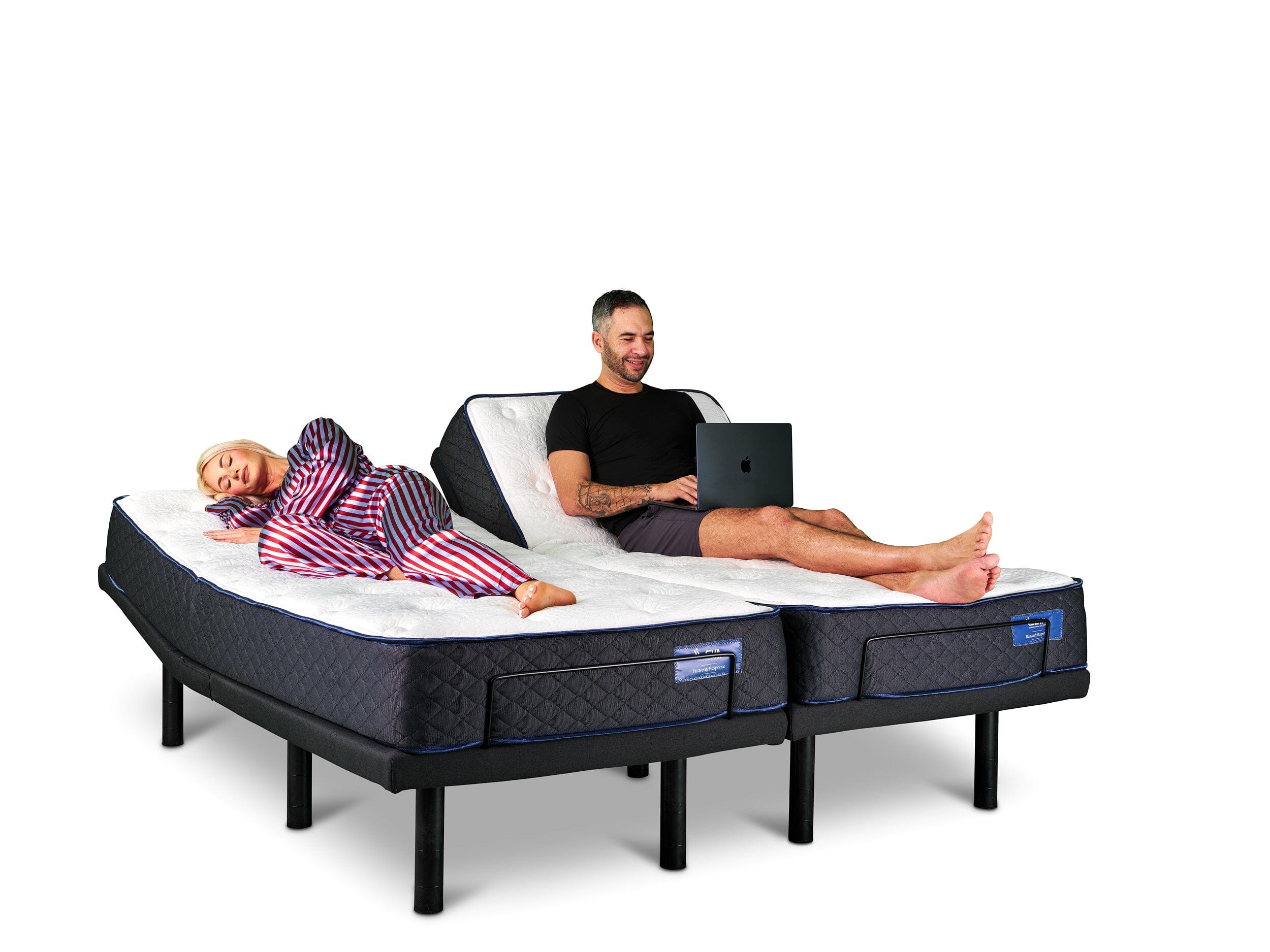
- Leva Sleep: Each half of the split-queen base runs on its own motor system with independent Bluetooth app control. Partners can set and save custom positions, including separate lumbar and pillow-tilt settings. Motion isolation comes from both structure and mechanics because the bases are separate units inside a queen frame.
- Saatva Upper-Flex: Uses a single mattress with a flex zone rather than a true split base. Head elevation changes the upper portion of one shared mattress, so both partners move together unless a specific split configuration is chosen. Buyers should confirm that their chosen SKU provides fully independent base control on each side.
- ESHINE: Offers split-queen setups with independent remote controls. Motion isolation depends on how the system manages the gap between mattress halves. Buyers should ask whether a gap filler or connector is included to keep the halves from drifting apart.
Technology and Features That Affect Nightly Comfort
Motor noise affects light sleepers who adjust positions during the night. Shoppers should ask for motor specifications and noise ratings, since quieter motors reduce disruption during movement. Some models also detect snoring through vibration or audio input and then raise the head slightly to open the airway without waking the snoring partner.
Apps may include vibrating alarms, custom position presets, and real-time micro-adjustments, and these capabilities vary across brands. Saatva’s adjustable bases provide wireless remote control and programmable positions but less app-based customization. ESHINE bases usually include wireless remotes and USB charging ports as standard features, while advanced options such as anti-snore mode or dedicated lumbar motors vary by SKU and appear in the detailed comparison checklist below.
When comparing technology, ask each brand directly about dedicated lumbar motors, whether anti-snore features are sensor-driven or manual, and the decibel rating or motor specification for nighttime adjustments.
Real-World Setup and Daily Use Scenarios
These scenarios show how specific features translate into everyday comfort, especially when joint pain or medical recovery shapes your sleep needs.
Scenario 1 – Chronic hip pain, single firmness preference: A sleeper with chronic hip bursitis needs precise lumbar and leg elevation to reduce joint compression overnight. The most important criteria are a dedicated lumbar motor, accurate zero-gravity presets, and a mattress that avoids pressure ridges at flex points. Leva’s lumbar control and purpose-built mattresses address all three needs. Saatva’s Upper-Flex supports head elevation but offers less detailed lumbar control. ESHINE’s performance depends on the motor configuration of the specific model.
Scenario 2 – Different firmness needs plus shoulder arthritis: One partner needs a plush surface for shoulder relief, while the other needs firm support for lower-back stability. As outlined in the partner compatibility section, per-side firmness selection removes this compromise. Leva’s split-queen supports different mattress constructions on each half, which becomes the key differentiator here. Saatva’s single-mattress Upper-Flex does not allow per-side firmness changes. ESHINE’s split configuration can support different mattresses per side when ordered correctly.
Scenario 3 – Post-surgery recovery: A partner recovering from hip or knee replacement needs frequent position changes, elevated leg support, and quiet motors to avoid jarring the joint. White-glove delivery and professional setup also matter because the recovering partner cannot help with assembly. Leva’s in-house white-glove service includes bedroom setup, leg-height adjustment, and a product tutorial, which strongly benefits this situation.
If these scenarios resemble your household, consider visiting Leva’s La Jolla showroom or exploring split-queen configurations and white-glove options online.
Long-Term Reliability and Overall Value
- Leva Sleep: Designs and assembles systems locally and sells directly to consumers at prices about 30–50% below many comparable luxury competitors. Vertical integration keeps quality control consistent from manufacturing through delivery. Warranty and service support come directly from Leva instead of third-party retailers.
- Saatva: Offers an established brand with white-glove delivery included in the price. Total cost of ownership usually runs higher than Leva’s for similar feature sets. Saatva’s retail infrastructure supports broad service coverage but adds margin to the final price.
- ESHINE: Typically sits at a lower entry price. Public long-term reliability data is more limited than Saatva’s. Buyers should review warranty length, motor replacement policies, and whether customer service operates domestically or routes overseas.
Day-to-Day Practical Details
Split-queen systems need split-queen fitted sheets with deep pockets and strong elastic so bedding stays in place when the base moves. Standard queen sheets usually slip once the head or foot rises. Leva designs bedding accessories specifically for adjustable bases, including sheets, duvet clips, and mattress protectors. Buyers choosing Saatva or ESHINE should source compatible bedding separately and confirm pocket depth before purchase.
Delivery logistics affect safety for people with joint pain. A system that arrives unassembled and requires the buyer to handle setup creates immediate physical risk for anyone with hip, knee, or back limitations, which makes professional delivery a health decision rather than a luxury. Leva’s white-glove service removes this burden, while Saatva includes white-glove delivery in its standard pricing. ESHINE’s delivery terms vary by retailer and may or may not include professional setup.
Health needs often change over time, including post-surgery recovery, progressive arthritis, or new medical guidance. The ability to reprogram positions without buying new hardware becomes a long-term advantage. App-controlled systems with saveable presets, such as Leva’s, adapt to evolving needs while keeping the same base and mattress.
Decision Checklist for Your Split-Queen Choice
Space constraints (queen footprint required): All three brands offer split-queen configurations. Confirm that the exact SKU uses a true split base instead of a single base with a flex-zone mattress.
Noise sensitivity: Leva’s German motor specification clearly highlights quiet operation. Buyers who prioritize silent nighttime adjustments should request motor specifications from Saatva and ESHINE before purchase.
White-glove delivery preference: Leva and Saatva both provide professional setup. ESHINE’s delivery and assembly options depend on the retailer.
Advanced joint-pain features (lumbar motor, anti-snore): Leva’s 2026 lineup includes anti-snore technology and German motors as standard. Buyers should confirm availability of these features on specific Saatva and ESHINE models.
Budget: ESHINE usually offers the lowest starting price. Leva delivers luxury-level features at 30–50% below many comparable competitors. Saatva’s pricing reflects its retail network and included white-glove service.
Conclusion: Matching Your Bed to Health and Relationship Needs
The most effective split-queen adjustable mattress for joint pain relief aligns its features with each partner’s pain profile and relationship priorities. Saatva’s Upper-Flex fits buyers who want an established brand, included white-glove delivery, and a single-mattress flex-zone design. ESHINE works for budget-conscious buyers who are willing to research model-specific features closely. Leva Sleep fits couples who need very detailed independent control, including dedicated lumbar motors, pillow tilt, anti-snore technology, per-side firmness selection, and professional setup, at the premium-feature-to-price ratio described earlier.
The split-queen layout itself offers the most space-efficient path to independent adjustability for couples. The choice among these three systems depends on how much control each partner wants over their own sleep environment and how much delivery and setup support feels appropriate.
Ready to compare configurations in person or online? Visit Leva Sleep’s La Jolla showroom or shop their split-queen lineup on the web.
Frequently Asked Questions
What firmness level works best on a split-queen adjustable base for joint pain?
Medium to medium-firm mattresses usually work best for joint pain on adjustable bases. A mattress that feels too soft may fail to support the lumbar area when the base lies flat, while an overly firm surface can create pressure points at hips and shoulders when you lie without elevation. The ideal firmness depends on body weight, sleep position, and which joints hurt most. Side sleepers with hip or shoulder pain often benefit from a slightly softer surface that lets the shoulder sink without twisting the spine. Back sleepers with lumbar pain often prefer a medium-firm surface combined with gentle head and leg elevation. A split-queen system lets each partner choose a different firmness level, which removes the need for a single compromise.
Does a split-queen adjustable bed create a gap between the two mattresses?
A true split-queen uses two separate mattress halves, so a small gap appears at the center. This gap becomes more noticeable when one or both sides elevate. Most manufacturers offer a gap filler, which is a narrow foam or fabric insert that bridges the center seam when both sides lie flat. When evaluating a split-queen system, ask whether a gap filler comes included or is sold as an accessory. Couples who sleep near the center should test this detail before purchase.
Can a split-queen adjustable base reduce snoring without waking the snoring partner?
Raising the head of the bed between seven and fifteen degrees can reduce airway obstruction that contributes to snoring by shifting soft tissue away from the airway. A manual preset can achieve this, but it requires the snoring partner to adjust their position before sleep. Leva Sleep’s 2026 anti-snore mode automates the process by detecting snoring through sensors and then raising the head gradually without waking the sleeper. This feature matters for couples who lose sleep because of repeated snoring episodes. Buyers should confirm whether their chosen model includes sensor-driven anti-snore technology or only a manual preset.
Is white-glove delivery necessary for a split-queen adjustable bed?
People with joint pain, hip or knee limitations, or recent surgery gain real safety benefits from professional delivery and setup. Split-queen adjustable systems are heavy, and each base half can weigh more than 100 pounds. They also require careful assembly, leg-height calibration, and app pairing. A white-glove service that handles bedroom delivery, assembly, leg adjustments, and a product walkthrough removes this physical strain. Buyers without physical limitations can assemble some systems themselves, but the complexity of split-queen configurations with independent motors and app connectivity makes professional setup the lower-risk choice for most households.
How does a split-queen differ from a split-king for couples with joint pain?
A split-king uses two twin XL mattresses on two independent bases to create a king-sized footprint with full independence. A split-queen uses two narrower halves on two independent bases within a standard queen footprint. For joint pain management, both configurations provide independent head, foot, and lumbar adjustment on each side. The main difference involves space. A split-king needs a room that comfortably fits a king bed with walking clearance. A split-queen fits any room that already holds a standard queen. Couples in smaller bedrooms, or those who prefer the closeness of a queen, get similar joint-pain benefits from a split-queen, with the trade-off of slightly less width per person.