Written by: Matthew Timmins, Founder and Managing Director, Leva Sleep
Key Takeaways
- The most effective zero gravity sleep position for snoring raises both the head and legs to about 30 degrees. This elevation uses gravity to keep the airway more open and reduce snoring.
- Adjustable bases with independent split controls let each partner choose their own incline. This setup improves sleep quality for couples without disturbing the other side.
- Effective configuration includes a 30°/30° preset, supportive low-profile pillows, and gentle lumbar support to maintain comfort and spinal alignment.
- Track snoring reduction and sleep changes over 7–14 days. Persistent snoring may signal conditions such as obstructive sleep apnea (OSA) that require medical evaluation.
- Experience these configurations in person or online with Leva Sleep by visiting the La Jolla showroom or shopping on the website.
How Zero Gravity Positioning Reduces Snoring for Couples
Snoring starts as a mechanical issue. As throat muscles relax during sleep, soft tissue can partially block the airway and vibrate, which creates snoring sounds. Elevating the upper body uses gravity to limit soft tissue collapse, helps the tongue and jaw move slightly forward, and widens the airway so air flows more smoothly. A flat mattress cannot create the same effect.
For couples, snoring affects more than noise levels. One partner’s disrupted breathing often wakes the other repeatedly, which builds sleep debt for both people. Anti-snore presets on adjustable beds slightly raise the head, ease airway pressure, and help move the tongue forward.
Snoring can also indicate obstructive sleep apnea, a condition that needs medical diagnosis. Positional elevation may reduce snoring symptoms, yet it does not replace a physician’s evaluation when apnea is suspected. Consult a healthcare provider before relying only on positional therapy for suspected OSA.
Now that the mechanical benefits are clear, you can explore how Leva Sleep supports this approach. Explore adjustable bases and zero gravity setups at the La Jolla showroom or online.
Health and Equipment Checks Before You Adjust Your Bed
Review key health considerations before configuring any zero gravity position. People with certain medical conditions should obtain medical clearance before using elevated zero-gravity positioning. Pregnant individuals, especially in later stages, and seniors with limited mobility should seek guidance from a healthcare provider before changing sleep positions.
Confirm equipment compatibility as well. Make sure your mattress is rated for use with an adjustable base. All-foam and hybrid pocket-coil mattresses usually flex safely, while traditional innerspring models with rigid border wires often do not. Verify that your base supports independent split operation if both partners need different settings.
Step 1 – Confirm the Zero-Gravity Angles That Open Airways
The zero-gravity preset raises both the head and feet, with the knees slightly above the heart, which creates a neutral cradle that reduces spinal pressure while keeping the airway more open. A practical configuration for snoring relief uses head elevation of 20–30 degrees along with leg elevation.
The table below shows target angles for each body zone and explains how each setting supports snoring reduction and comfort.
| Zone | Target Angle | Primary Outcome |
|---|---|---|
| Head / Upper Body | ~30° | Widens the airway, encourages sinus drainage, and reduces mouth breathing |
| Legs / Knees | ~30° | Offloads the lumbar spine, reduces lower-back pressure, and supports neutral pelvic tilt |
| Head elevation | to 30° (or the 7.5–30° range) | Clinically associated with snoring reduction |
Diagram suggestion: A side-profile illustration showing a figure reclined with the head section raised to 30° and the leg section raised to 30°, with the knees at or slightly above heart level and a straight line indicating spinal neutrality.
Step 2 – Program a Reliable Anti-Snore Preset
Most modern adjustable bases include a one-touch Zero-G or anti-snore preset on the physical remote or in a companion app. To program or activate the position, start by locating the Zero-G or Anti-Snore button on the remote. Press and hold this button until the base moves to its stored position, which represents the factory default.
If that default does not match the 30°/30° target from Step 1, adjust it manually. Use the head-up and foot-up controls to reach the correct angles, then save the new position to a memory slot so you can recall it with one touch later. If your base uses app control instead of a physical remote, follow a similar sequence in software. Open the sleep app, go to Positions or Presets, adjust the head and foot elevation sliders to your target values, and save the setup under a clear label such as “Anti-Snore.”
The correct physical result looks like a gentle V-shape recline. The torso stays elevated, the lower back feels supported, the knees bend upward, and no single pressure point carries most of the body weight.
Step 3 – Adjust Zero Gravity for Side Sleepers and Couples
Side sleepers can still benefit from mild head elevation. The full 30° incline may create shoulder or hip pressure on one side, so a gentler 15–20 degree head elevation often works better. This angle reduces airway restriction while limiting lateral pressure on joints.
Support alignment with simple accessories. Place a contoured pillow between the knees to maintain hip alignment. Add a softer mattress layer or topper at the shoulder zone to prevent shoulder impingement.
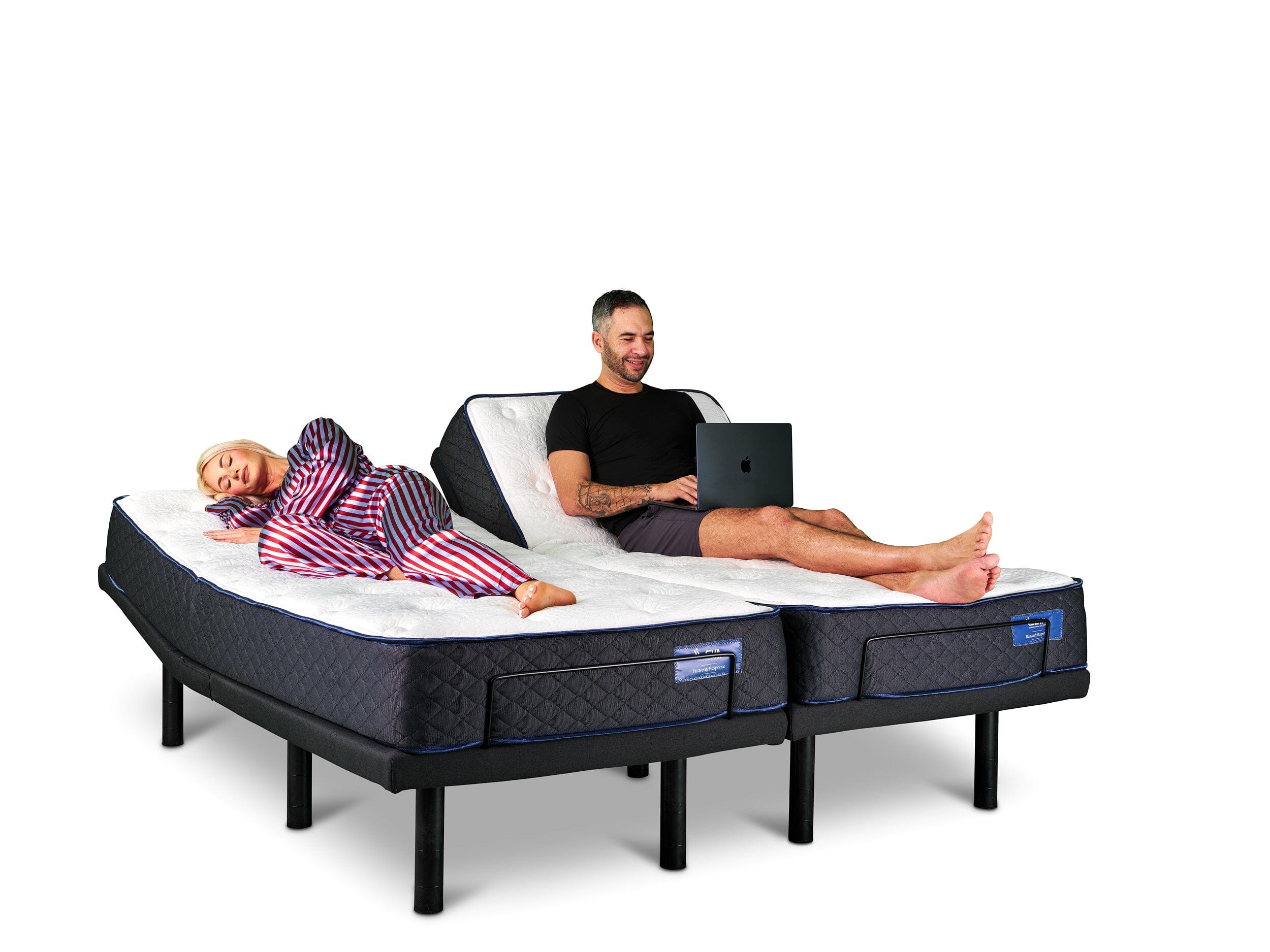
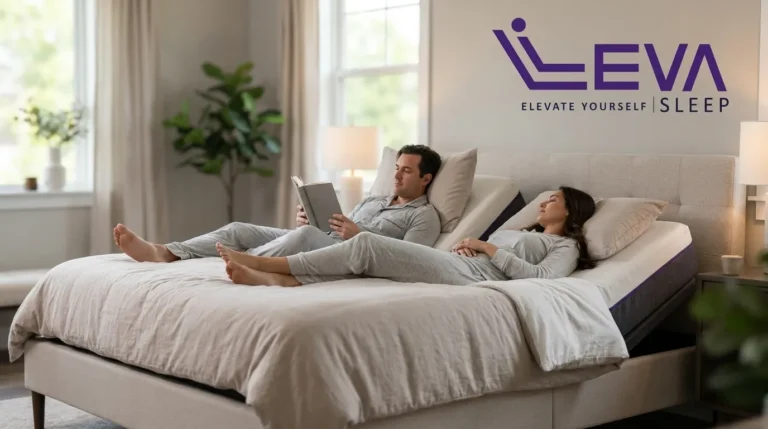
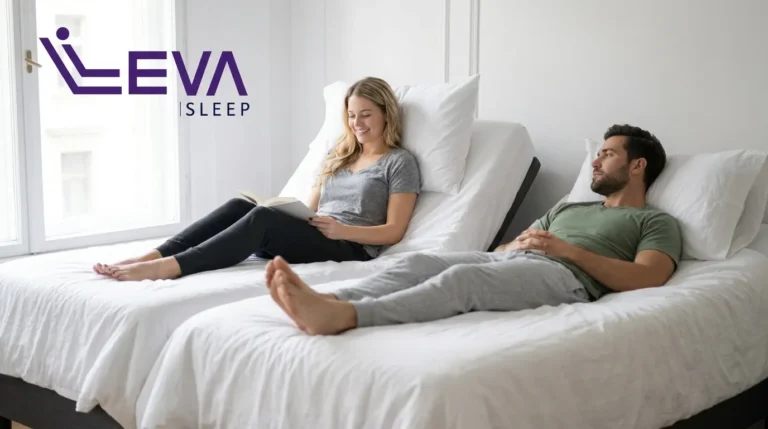
Couples often have different sleep styles. When one partner sleeps on their side and the other on their back, a split adjustable base lets each side hold a different incline independently. A split king configuration allows one partner to use slight head elevation for airway pressure reduction while the other uses the full zero-gravity position with elevated head and feet. Movement or position changes on one side do not disturb the other side of the bed.
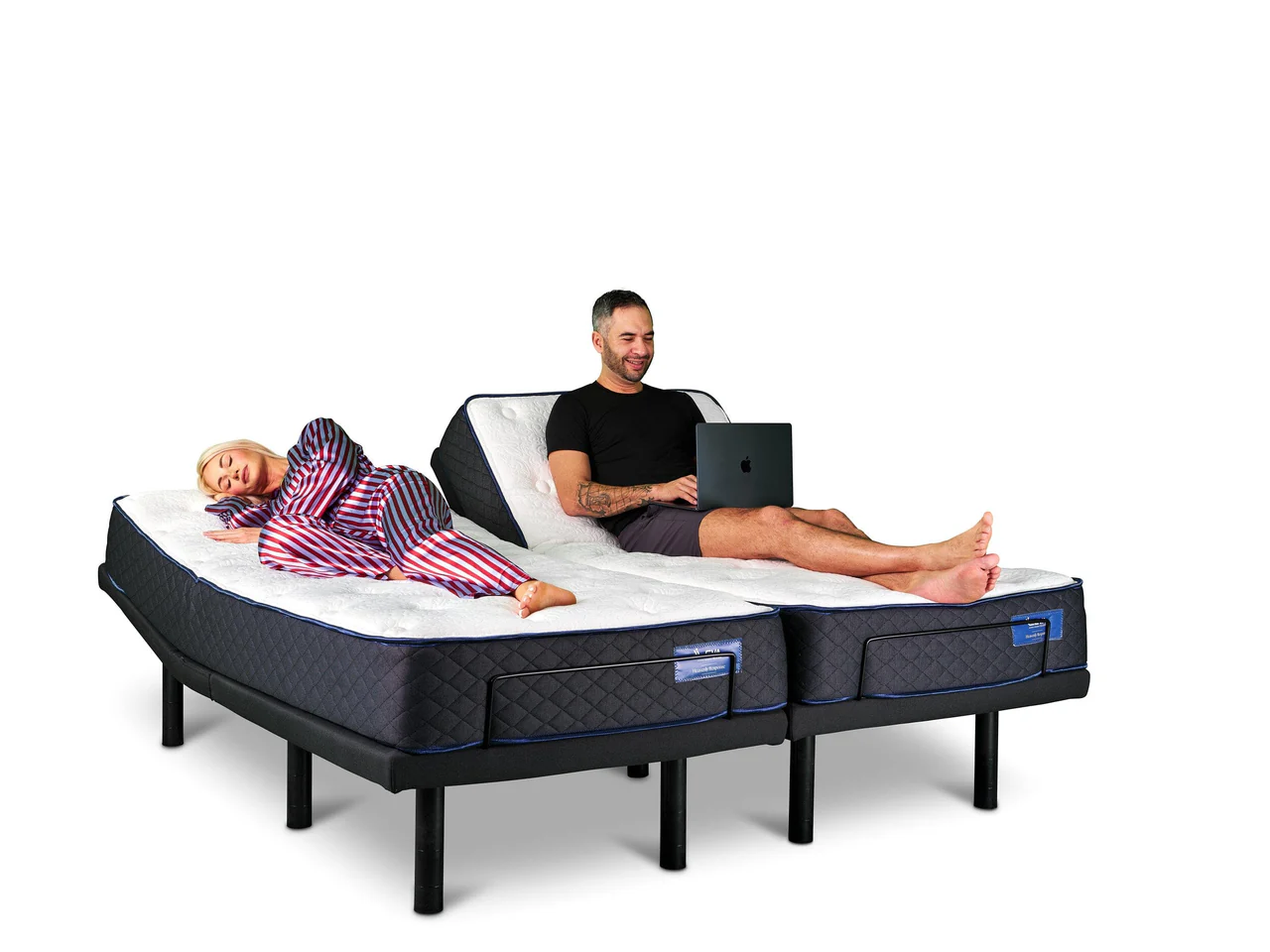
Diagram suggestion: A top-down and side-profile pair showing two independent base sections at different incline angles, with one side at 30° and the other at 15°.
To experience how split configurations feel in real life, you can visit Leva Sleep’s La Jolla showroom or compare split king options online.
Step 4 – Fine-Tune Pillows and Lumbar Support
Neck position can support or undo your elevation work. At 30° head elevation, a thick standard pillow often pushes the chin toward the chest and partially closes the airway. Choose a low-profile or cervical pillow that maintains a neutral neck curve. If the base includes a pillow tilt motor, apply a slight upward tilt that gently extends the neck instead of flexing it.
Lumbar support controls on higher-end adjustable bases add another layer of comfort. A small arch at the lower back prevents the spine from flattening against the mattress when the legs are raised. Start with a low lumbar setting and test comfort at three points during the night: right after lying down, after about two hours, and upon waking. If discomfort appears at any checkpoint, reduce lumbar intensity or change the head angle by one increment.
Step 5 – Set Up Independent Controls on a Split King
A split king zero gravity setup uses two twin XL bases placed side by side in a shared frame. Each base has its own motor system, remote, and app profile. To configure the system, pair each base with its app profile using the Bluetooth pairing steps in the app. Assign each remote to the correct base, then program each side’s Zero-G or anti-snore preset independently.
Confirm that adjusting one side does not move the other side. Quiet operation also matters for couples. Whisper-quiet motors work best, so review motor noise ratings before purchase because louder motors can undermine the benefit of independent nighttime adjustments.
Common Mistakes, Pro Tips, and When to Call a Professional
Common Mistakes
- Using a thick standard pillow at high incline angles, which flexes the neck forward and narrows the airway.
- Elevating only the head without raising the legs, which increases lower-back pressure and reduces comfort.
- Setting both sides of a split base to identical positions without considering each partner’s body type or sleep style.
- Skipping lumbar support adjustments, which often leads to morning lower-back stiffness.
Pro Tips
- Save two presets: one at 30°/30° for back sleeping and one at 15°/15° for side sleeping, then switch between them as needed.
- Use the app’s scheduled position feature to return the base to flat about 30 minutes before the alarm, which eases the transition to waking.
- Pair the adjustable base with fitted sheets designed for adjustable beds. Deep-pocket elastic sheets stay in place during position changes.
When to Stop and Seek Professional Help
- Snoring continues at full 30° elevation after a consistent 14-day trial, which may indicate OSA that needs clinical evaluation.
- New or worsening chest discomfort, shortness of breath, or limb numbness appears after starting elevated sleep.
- Morning headaches increase, which can signal carbon dioxide retention or positional vascular changes that require medical review.
How to Measure Whether Your Setup Works
Track your zero gravity snoring setup over a 7–14 day period using three simple checkpoints.
Days 1–7: The non-snoring partner logs the number of nighttime awakenings caused by snoring each morning. A reduction of 50 percent or more in reported awakenings by day 7 shows that the position is helping. The snoring partner also rates morning throat comfort on a 1–5 scale to spot dryness or soreness from mouth breathing.
Days 8–14: Both partners complete a brief sleep log that notes total perceived sleep duration and a morning energy rating. If the snoring partner uses a wearable sleep tracker, compare sleep-stage fragmentation data from the pre-adjustment baseline to this period. A meaningful improvement appears as fewer light-sleep interruptions and more deep-sleep time.
Day 14 Review: If partner-reported snoring frequency has decreased, morning comfort ratings remain stable, and both partners report better energy, the configuration is working. If snoring remains unchanged, increase head elevation by about 5 degrees, if the base allows and your doctor agrees, or consult a physician to rule out OSA.
To test these configurations on real adjustable bases, you can visit Leva Sleep in La Jolla or review models online.
Advanced Anti-Snoring Enhancements
Temperature control can quietly influence snoring. Sleeping too warm often increases nasal congestion, which raises airway resistance. Pairing a split adjustable base with an individual heating and cooling pad lets each partner maintain a personal sleep temperature. This setup reduces congestion-related snoring for one partner without affecting the other side.
AI-powered sleep tracking on select adjustable base platforms adds another layer of automation. These systems monitor movement and breathing patterns in real time and make small head-elevation changes during the night. The goal is to maintain helpful airway positioning without constant manual adjustments.
Frequently Asked Questions
Is it safe to sleep in the zero-gravity position every night?
Most healthy adults tolerate nightly zero-gravity sleep well. The position spreads body weight across a larger surface area, reduces pressure on the spine, and can support circulation. People with certain medical conditions should talk with a physician before using elevated sleep positions every night. Pregnant individuals should follow guidance from their healthcare provider.
Can I use a CPAP machine with an adjustable base in the zero-gravity position?
CPAP therapy works well with an adjustable base in the zero-gravity position. Head elevation can even improve CPAP effectiveness by lowering the pressure needed to keep the airway open, which some users find more comfortable. Make sure the CPAP hose has enough length for the elevated head position without tension, and route the hose to avoid kinking when the base moves. Ask your sleep medicine provider whether your prescribed CPAP pressure settings should be reviewed after you adopt a consistently elevated sleep position.
How long does it take to adapt to sleeping in the zero-gravity position?
Many people adapt to zero-gravity sleep over several nights. The first few nights may feel unfamiliar, especially for long-time flat sleepers, as the body adjusts to the incline and new pressure distribution across the back and legs. Start at a lower incline and increase elevation gradually to ease the transition. Morning stiffness that appears in the first few days usually fades as the body acclimates. If discomfort continues beyond a couple of weeks, reassess pillow height, lumbar support settings, and mattress compatibility.
Will a split king adjustable base affect intimacy or closeness for couples?
A split king uses two twin XL mattresses on independent bases inside one shared frame, so a small center seam exists. Many couples solve this with a mattress bridge or topper that spans the seam and creates a unified surface when both sides lie flat. Independent controls let each partner return to a flat position at the same time, and the shared frame keeps both partners in one bed. For couples focused on snoring-related sleep disruption, the ability to adjust each side independently usually improves relationship quality by reducing fatigue and frustration from repeated nighttime awakenings.
Conclusion: A Practical Zero Gravity System for Snoring Relief
The most effective zero gravity sleep position for snoring uses a precisely configured 30-degree head and leg elevation that keeps the airway more open throughout the night. The five-step process in this guide, which covers target angles, presets, side-sleep adaptations, pillow and lumbar tuning, and independent controls, gives couples a clear and repeatable framework.
Measuring results over 7–14 days with partner-reported snoring frequency, sleep logs, and morning comfort ratings provides objective feedback. Advanced tools such as AI tracking, temperature regulation, and dedicated anti-snore modes can extend these benefits beyond basic manual setup. For couples who want to stay in the same bed while addressing snoring, a split adjustable base with independent zero-gravity controls offers a direct and mechanical path to quieter nights.
Ready to put this system into practice? Explore Leva Sleep’s adjustable bases online or schedule a visit to the La Jolla showroom.