Written by: Matthew Timmins, Founder and Managing Director, Leva Sleep
Key Takeaways for Senior Adjustable Beds
- Adjustable beds can help seniors with pain relief, safer transfers, reduced snoring, and better sleep when managing chronic conditions.
- Doctors and sleep specialists endorse adjustable beds for seniors with back pain, respiratory issues, and circulation problems, but a physician should always be consulted first.
- NCOA guidance highlights compatible mattresses like Helix Midnight Luxe and Saatva that pair well with adjustable bases for spinal alignment and comfort.
- Medicare covers qualifying hospital beds as durable medical equipment but does not cover most consumer adjustable bases sold at retail.
- Leva Sleep offers premium split adjustable systems with whisper-quiet motors, compatible mattresses, and white-glove service. Shop Leva Sleep today to compare split systems and accessories.
How Doctors View Adjustable Beds for Seniors
Most physicians and sleep specialists endorse adjustable beds for seniors managing specific conditions. Dr. Jordan Burns, DC, MS, states that adjustable beds can be a great option for anyone looking to reduce back pain and improve overall sleep quality. Orthopedic physical therapist Karena Wu, P.T., D.P.T., confirms that adjustable beds help with chronic back and neck pain, respiratory issues including snoring and asthma, digestive issues such as gastric reflux, and circulatory problems. However, the NCOA advises seniors to always consult a doctor before investing, since positional elevation may ease some symptoms but not replace other treatments.
Top NCOA-Recommended Adjustable Beds and Mattresses
NCOA consulted sleep specialists including doctors, occupational therapists, and physical therapists, tested more than 130 mattress models, surveyed more than 2,000 older adults on sleep quality, and worked with older adult testers to evaluate products. Their guidance centers on mattresses rather than bases, but the models below are widely cited across senior sleep research and are compatible with adjustable bases. The table below highlights four models that excel in edge support, split compatibility, and quiet operation, which are three features seniors often prioritize when pairing a mattress with an adjustable base. Use it as a starting framework for your own assessment, not as a definitive ranking.
| Model | Key Senior Features | Firmness Options | Split-Base Compatible |
|---|---|---|---|
| Helix Midnight Luxe | Exceptional edge support, cooling features, pressure relief for side and back sleepers | Medium | Yes (pocketed coil hybrid) |
| Saatva Adjustable Base | Split king and split California king with independent side control | Multiple | Yes (split king/Cal king) |
| Sealy Ease Power Base | Height adjustability from 4 to 16 inches, intuitive remote, quiet motor | Varies by mattress pairing | Yes (twin XL split configuration) |
| Tempur-Pedic TEMPUR-Ergo Smart Base | Available in split king and split California king for independent adjustment | Multiple | Yes (split king/Cal king) |
Leva Sleep carries several of these partner brands, including Helix through 3Z Brands and Tempur-Pedic through its Legacy Luxury lineup, paired with its own proprietary adjustable bases. Explore Leva Sleep’s partner brand pairings at the La Jolla showroom or online.
Medicare Coverage Rules for Adjustable Beds in 2026
Medicare Part B covers 80% of the cost to buy or rent a qualifying hospital bed as durable medical equipment, and the patient is responsible for the remaining 20% and the Part B deductible. The 2026 Part B deductible is $283. Medigap Plan F or Plan G can cover the remaining 20% coinsurance and the deductible, which results in $0 out-of-pocket cost for many beneficiaries.
Eligibility requires meeting all of the following steps:
- A Medicare-enrolled physician must prescribe the bed and document a qualifying medical condition such as breathing problems, spinal cord injuries, or conditions requiring specific body positioning.
- A face-to-face physician visit and a Written Order Prior to Delivery (WOPD) are required as of the August 2024 CMS update.
- The bed must be obtained from a Medicare-approved supplier that accepts assignment, and purchases from non-enrolled suppliers result in no Medicare reimbursement.
A critical distinction matters here. Commercial adjustable bases purchased from stores are typically not considered durable medical equipment and are not covered by Medicare. Consumer adjustable beds lack the side rails, medical attachment frames, and DME durability ratings required under Medicare rules. For seniors who do not qualify for Medicare DME coverage, a premium commercial split system often delivers superior comfort, aesthetics, and technology at a fraction of the long-term cost of a clinical hospital bed. Explore Leva Sleep’s Split Queen and Split King configurations at the La Jolla showroom or online.
Honest Disadvantages of Adjustable Beds for Seniors
Adjustable beds carry real practical challenges that generic listicles rarely address. Seniors and their families should evaluate each one before purchasing.
- Weight and immobility: Adjustable bases for a Queen size are heavy, making them extremely difficult to move once set up. Because repositioning a 150 to 200 pound base can risk injury and floor damage, confirming that the delivery team handles initial placement and setup is essential. Leva Sleep’s white-glove service includes this support so you do not need to move the base yourself.
- Motor noise: Even “whisper quiet” motors produce an audible low hum during movement that may disturb a sleeping partner. Choosing German-engineered whisper-quiet motors reduces this hum, and a split base allows adjustments on one side without shifting the other, which further limits disturbance.
- Mattress incompatibility: Traditional innerspring mattresses with Bonnell or continuous coils are generally incompatible with adjustable bases, risking permanent damage and voiding the manufacturer’s warranty. Pairing the base with memory foam, latex, or pocketed-coil hybrids from the outset protects the mattress, preserves the warranty, and ensures smooth articulation.
- Cost realities: A mid-range adjustable base for a queen typically costs $1,100 to $1,500, and an incompatible existing mattress may require a compatible replacement. Purchasing a complete system from a specialist like Leva Sleep ensures every component works together and prevents paying twice for trial-and-error upgrades.
- Return policy restrictions: Adjustable bases typically carry stricter return policies than mattresses because of their weight and size. Reviewing return terms before purchase and choosing brands with clear, written policies reduces surprise costs if the system does not work out.
- Safety contraindications: Individuals with spinal fusion or osteoporosis should avoid adjustable beds, as improper positioning can worsen these conditions, and those with heart or respiratory issues should consult a doctor before use. A physician can confirm whether elevation and flexion are safe for your specific diagnosis.
Split vs. Single Bases for Senior Couples
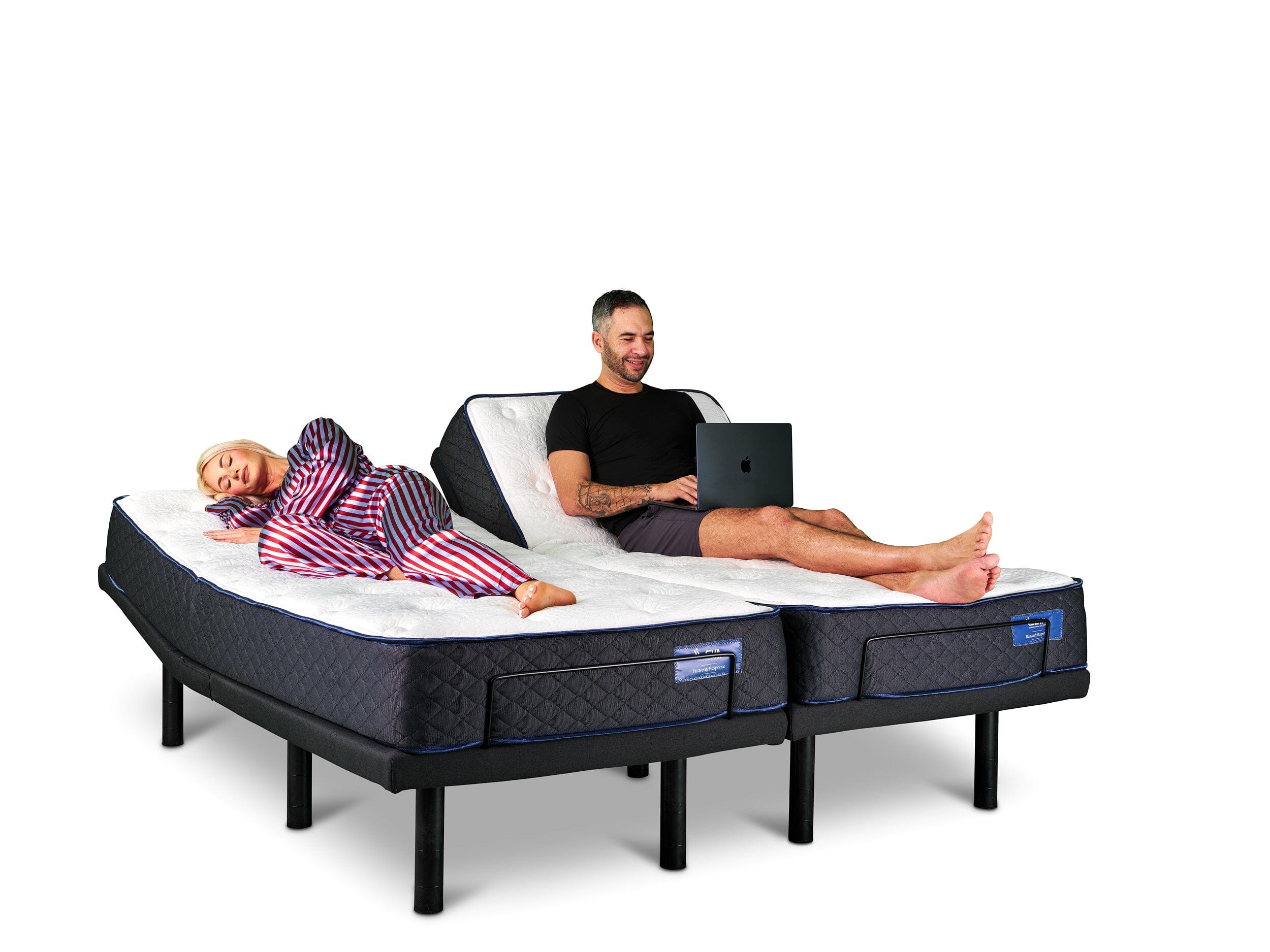
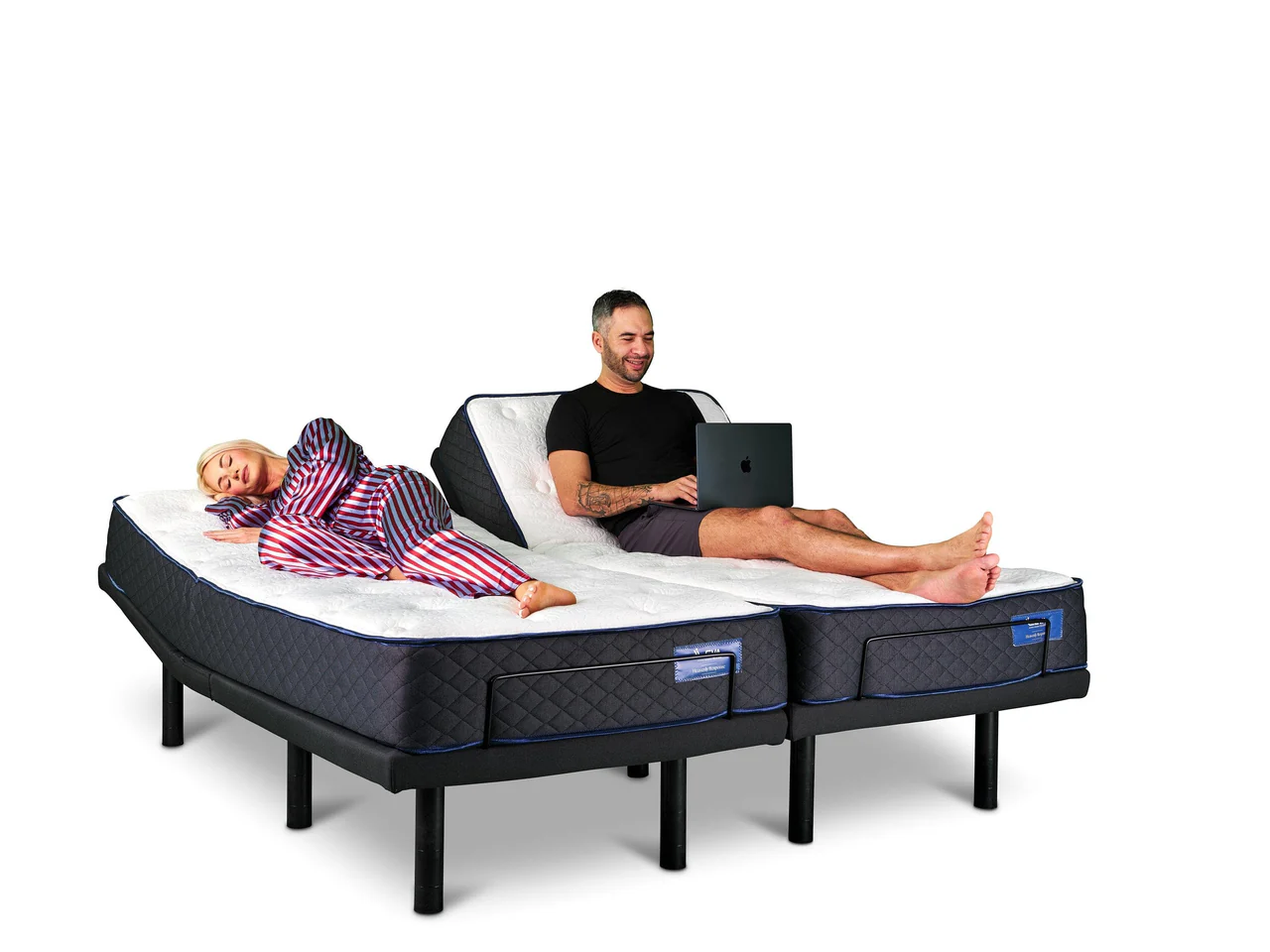
A Split King adjustable bed consists of two Twin XL mattresses and two independent adjustable bases placed side-by-side, which allows each sleeper to adjust their side’s head and foot elevation independently while maintaining a unified King-sized footprint of 76 inches by 80 inches. A single shared base forces both partners into the same position, which creates a significant compromise when one partner needs head elevation for acid reflux while the other prefers a flat surface.
Split bases address the most common senior couple conflicts:
- Differing firmness preferences, since one partner can use memory foam and the other a hybrid
- Snoring on one side without disturbing the other
- Leg elevation to reduce edema and improve circulation on one side independently
- Independent massage zones and temperature regulation
Leva Sleep is one of the few specialists offering a Split Queen configuration, which gives couples in smaller bedrooms fully independent controls without moving to a king-size footprint.
Mattress Firmness and Materials for Seniors on Adjustable Bases
Low-back pain is common among older adults and can contribute to sleep problems. NCOA recommends medium-to-medium-firm mattresses for back pain relief and spinal alignment in older adults. Board-certified spinal surgeon Dr. Gbolahan Okubadejo advises choosing a mattress that keeps the spine in a natural, straight line regardless of sleep position.
Material compatibility with adjustable bases narrows the field. Suitable options include:
- All-foam (memory foam or latex): most flexible and conforms fully to base articulation
- Pocketed-coil hybrids: compatible with adjustable bases when individual pocket coils are used rather than connected Bonnell coils
- Mattresses under 14 inches thick: mattresses thicker than 14 inches may fail to conform properly, which results in “bridging” where sections hover above the deck
Adjustable-Friendly Bedding Accessories That Stay Put
Standard bedding often fails on adjustable bases. As the base articulates, conventional fitted sheets can pop off and duvets can bunch. Seniors should look for:
- Fitted sheets with deep pockets and extra elastic designed specifically for adjustable bases
- Duvet clips that maintain separation when each partner’s side is at a different angle
- Mattress protectors engineered to flex without bunching
- Pillows sized for spinal alignment at elevated head positions
- Remote pockets or app-controlled bases to eliminate fumbling for controls at night
Leva Sleep designs its entire bedding accessory line specifically for adjustable bases, including sheets with reinforced elastic and duvet clips for split configurations, which eliminates one of the most common post-purchase frustrations.
With these base features, mattress choices, and accessories in mind, the next step is a quick checklist that confirms you have covered every critical decision point before you buy.
Senior Evaluation Checklist for Adjustable Bed Systems
Before purchasing an adjustable bed system, verify each of the following:
- Confirm that the base offers independent split controls for each partner.
- Check that the motor is rated as whisper-quiet and that the brand specifies motor origin and warranty length.
- Verify that the mattress is made from memory foam, latex, or a pocketed-coil hybrid, not Bonnell or continuous coils.
- Measure the mattress profile and confirm it is 14 inches or under.
- Confirm that the base offers adjustable leg height for safe entry and exit.
- Look for under-bed lighting to reduce nighttime fall risk.
- Ask your physician to clear adjustable positioning for any existing conditions such as osteoporosis, spinal fusion, or cardiac issues.
- Confirm that the retailer offers white-glove delivery, in-room setup, and old bed removal.
- Check that all bedding accessories, including sheets, protectors, and duvets, are designed for adjustable base use.
- Review the return and warranty terms for both the base and the mattress in writing.
Frequently Asked Questions
Will Medicare pay for an adjustable bed for a senior?
Medicare Part B covers qualifying hospital beds as durable medical equipment when a Medicare-enrolled physician prescribes one and documents a qualifying medical condition. After the 2026 Part B deductible of $283, Medicare pays 80% of the approved cost and the beneficiary pays 20%. However, consumer adjustable bases sold at retail stores, including premium models, do not qualify as DME under Medicare rules because they lack the side rails, medical attachment frames, and durability ratings required. Seniors who do not meet Medicare’s strict eligibility criteria often find that a commercial split adjustable system delivers better comfort, technology, and aesthetics than a covered hospital bed.
What are the biggest disadvantages of adjustable beds for seniors?
The most significant practical challenges include weight, mattress incompatibility, motor noise, stricter return policies, and upfront cost when a new compatible mattress is also required. Bases typically run 150 to 200 pounds and are difficult to reposition, traditional innerspring mattresses with connected coils can be permanently damaged, and motors create some noise during adjustment. Return policies are often tighter than for standard mattresses, and total system cost can rise when replacing an old mattress. Seniors with spinal fusion or osteoporosis should avoid adjustable beds entirely, and those with cardiac or respiratory conditions should consult a physician before use. Choosing a specialist retailer that bundles a compatible mattress, accessories, and white-glove setup removes most of these risks.
Are split king adjustable beds worth it for older couples?
For couples with differing sleep needs, such as different firmness preferences, one partner who snores, or different medical positioning requirements, a split king is almost always the better choice over a shared single base. Each partner controls their own side’s elevation, massage, and firmness independently, which means one partner can elevate their head for acid reflux or sleep apnea while the other sleeps flat. The center seam between the two Twin XL mattresses is the primary trade-off, but purpose-designed split king bedding minimizes its impact. A Split Queen offers the same independent control in a more space-conscious footprint.
What mattress firmness works best for seniors on an adjustable base?
Medium to medium-firm is the most widely recommended range for seniors, because it supports spinal alignment without creating excessive pressure on hips and shoulders. The material matters as much as firmness. Memory foam, latex, and pocketed-coil hybrids all articulate safely with an adjustable base, while traditional Bonnell or continuous-coil innersprings do not. Seniors with significant joint pain may benefit from a slightly softer surface with dedicated pressure-relief zones at the shoulders and hips, particularly when the base’s zero-gravity preset is used to reduce lumbar load.
Do adjustable beds reduce snoring for seniors?
Head-of-bed elevation has clinical support for reducing snoring and mild obstructive sleep apnea. A study of 52 sleep apnea patients found that a 7.5-degree head elevation reduced the Apnea-Hypopnea Index by approximately 32% and raised minimum oxygen saturation from 83.5% to 87%. Elevating the head opens the airway by shifting soft tissue away from the throat. On a split base, only the snoring partner’s side needs to be elevated, which leaves the other partner undisturbed. Leva Sleep’s upcoming anti-snore mode detects snoring and makes automatic micro-adjustments to the head position without requiring the sleeper to wake up.
Choosing Premium Split Adjustability with Leva Sleep
NCOA-aligned research, clinical evidence, and real-world senior testing all point to the same conclusion. Adjustable beds deliver meaningful benefits for older adults, and split configurations solve many comfort and compatibility issues for couples. Leva Sleep’s Split Queen and Split King systems combine whisper-quiet German motors, app-controlled independent sides, compatible mattresses made in America, and white-glove delivery, all tailored for senior and couple use cases that generic recommendations often overlook. With more than 25,000 customers served and 15 to 20 adjustable models available, Leva Sleep offers specialist depth that general mattress retailers rarely match.