Written by: Matthew Timmins, Founder and Managing Director, Leva Sleep
Key Takeaways for Snorers and Their Partners
- The Nitetronic Z6 claims a 67% snoring reduction but has no independent peer-reviewed RCT validation from 2024–2026.
- UnitedHealthcare’s April 2026 policy notes positional therapy may help short-term for side-sleep–responsive OSA but classifies many devices as unproven.
- Acoustic sensor pillows like the Z6 carry risks of false triggers, partner interference, and weaker long-term adherence than integrated bed-based solutions.
- Split adjustable bases deliver peer-reviewed head-elevation benefits without subscriptions, loose cables, or cross-sleeper disruptions.
- For couples seeking reliable, independently supported positional therapy, explore Leva Sleep’s split adjustable bases with peer-reviewed elevation benefits.
How the Nitetronic Z6 Pillow Tries to Reduce Snoring
The Nitetronic Z6 uses MEMS acoustic sensors to detect snoring sounds, then inflates internal micro-airbags to rotate the sleeper’s head. This rotation aims to reopen the airway through a small positional change. The device must stay plugged into a power outlet and pairs with a companion app that tracks sleep data. Premium app features sit behind a quarterly subscription. The pillow targets back sleepers whose snoring is gravity-driven, although Nitetronic clearly states that the Z6 is not indicated as a treatment for obstructive sleep apnea syndrome (OSAS) and advises OSAS patients to consult a doctor before use.
Clinical Marketing Claims Compared with Independent Evidence
Nitetronic’s Z6 product page calls the pillow clinically proven but does not name specific clinics. A separate how-it-works page mentions only University ENT Clinic Mannheim. It lists no peer-reviewed journal citations, publication years, sample sizes, or quantified success rates from 2024–2026. The reported 67% snoring reduction and 50% AHI reduction carry no peer-reviewed journal citation or publication date.
An independent trial of a sensor-based smart pillow, NCT06594627 sponsored by Indiana University, is recruiting but has not yet published results. A 2025 meta-analysis by Gao et al. of 19 RCTs (1,231 participants) evaluated sleep positional therapy and found benefits, although high heterogeneity limited certainty. UnitedHealthcare’s April 2026 Commercial Medical Policy states that positional therapy for OSA may work as a short-term method for people whose OSA improves when they sleep on their side. While clinical studies focus on controlled conditions, real-world user experiences highlight daily usability issues that affect whether people keep using these devices.
Real-World Complaints About Sensor-Based Anti-Snore Pillows
Independent evaluations reveal recurring practical problems with sensor-based anti-snore pillows. Acoustic detection systems can misread ambient noise or detect snoring only after it has already occurred. The Nitetronic Z6 may inflate its head-rotation airbags unintentionally when two snorers share a bed within about 4 inches of each other. A single abrupt positional change through an air bladder can startle the user and disturb normal sleep stages. Users frequently report false triggers from coughing, heavy breathing, traffic noise, or partner movement, along with adjustments that wake the snorer or their partner.
Who May Benefit from the Pillow and Who Needs a Doctor Visit
Pillow-based positional therapy works best when body position clearly drives snoring and a bed partner notices that snoring worsens after the sleeper rolls onto their back. Many habitual snorers snore only or mainly in the supine position.
Medical evaluation becomes urgent when snoring appears with any of the following:
- Gasping or choking at night, excessive daytime sleepiness, morning headaches, irritability, trouble concentrating, high blood pressure, or witnessed breathing pauses during sleep
- Snoring that continues even on the side, or no clear improvement after 2–4 weeks of pillow use
- A known diagnosis of obstructive sleep apnea syndrome
Effectiveness of Anti-Snore Pillows in Practice
Anti-snore pillows lack strong RCT evidence but can act as a low-cost starting point for positional therapy in confirmed positional snorers. One study of a 6-inch memory-foam pillow found reduced snoring and fewer awakenings compared with a laboratory pillow, yet no improvement in overall sleep apnea severity. European Respiratory Society guidance notes that head-positioning devices which stabilize the head without flexion or inclination show insufficient therapeutic effect and cannot be recommended for positional OSA therapy. Traditional pillow-based methods also show limited long-term continuation.
What Types of Pillows Doctors Tend to Favor for Snoring
Physicians do not endorse a single universal pillow, yet expert commentary often favors designs that maintain steady upper-body elevation or lateral positioning. Dustin Cotliar, MD, MPH, notes that wedge pillows often provide the most consistent benefit for snorers because they address gravitational airway collapse. Unlike standard pillows that lift only the head, wedge pillows raise the entire upper torso and create a stable incline that helps keep airways open without perfect positioning. Wedge pillows and adjustable bases outperform standard pillows for sustained head elevation. Manual anti-snore presets on adjustable bases also tend to deliver more reliable value than automatic detection systems, which struggle with false triggers and inconsistent timing.
Nitetronic Pillow vs. Adjustable Bed: Side-by-Side Comparison
The table below compares the Nitetronic Z6 with a split adjustable base system across six practical criteria. All figures come from cited sources. When a direct unit comparison is not possible, the explanation appears in the notes column.
| Criterion | Nitetronic Z6 | Split Adjustable Base (e.g., Leva Sleep) | Key Evidence |
|---|---|---|---|
| Snoring reduction claim | 67% average reduction (clinic study, no peer-reviewed RCT citation) | Head elevation of 7.5° reduces AHI by 31.8% on average in OSA patients (Souza et al., 2017) | Adjustable-base elevation data comes from a peer-reviewed journal, while the Nitetronic figure does not. |
| Couple compatibility | May trigger false airbag inflation when two snorers share a bed within 4 inches | Split configuration gives each partner independent controls with no cross-interference | Single-user design limits pillow utility for couples; split bases are built for two sleepers. |
| Noise and disruption | Single abrupt air-bladder inflation can startle the user and disrupt sleep architecture | Whisper-quiet motors and manual anti-snore presets reduce false-trigger disruptions | Automatic detection on any platform can misfire due to coughing, traffic noise, or partner movement. |
| Ongoing cost | Quarterly subscription required for premium app sleep data | No subscription required, with app control included | Total cost of ownership differs because the subscription model adds recurring expense. |
| OSA contraindication | Explicitly not indicated for OSAS; patients must consult a doctor | Head elevation functions as an adjunct positional strategy; medical consultation remains essential for diagnosed OSA | Neither option replaces a sleep study or CPAP for moderate-to-severe OSA. |
| Long-term adherence | Traditional pillow-based positional methods show limited continuation at 2 years | Integrated into the bed, with no separate device to remember or maintain | Pavlov RCT (ATS 2026) found that over two-thirds of positional therapy users maintained side-sleeping behavior after stopping active treatment. |
How Split Adjustable Bases Help Snoring Couples Sleep Together
Ravesloot et al. (2017) in Sleep and Breathing reported that head-of-bed elevation remains undervalued for position-dependent snoring and mild-to-moderate OSA, with consistent evidence that elevation reduces snoring intensity and frequency. A split adjustable base builds this elevation into the bed itself and removes the need for extra gadgets, cables, or subscriptions.
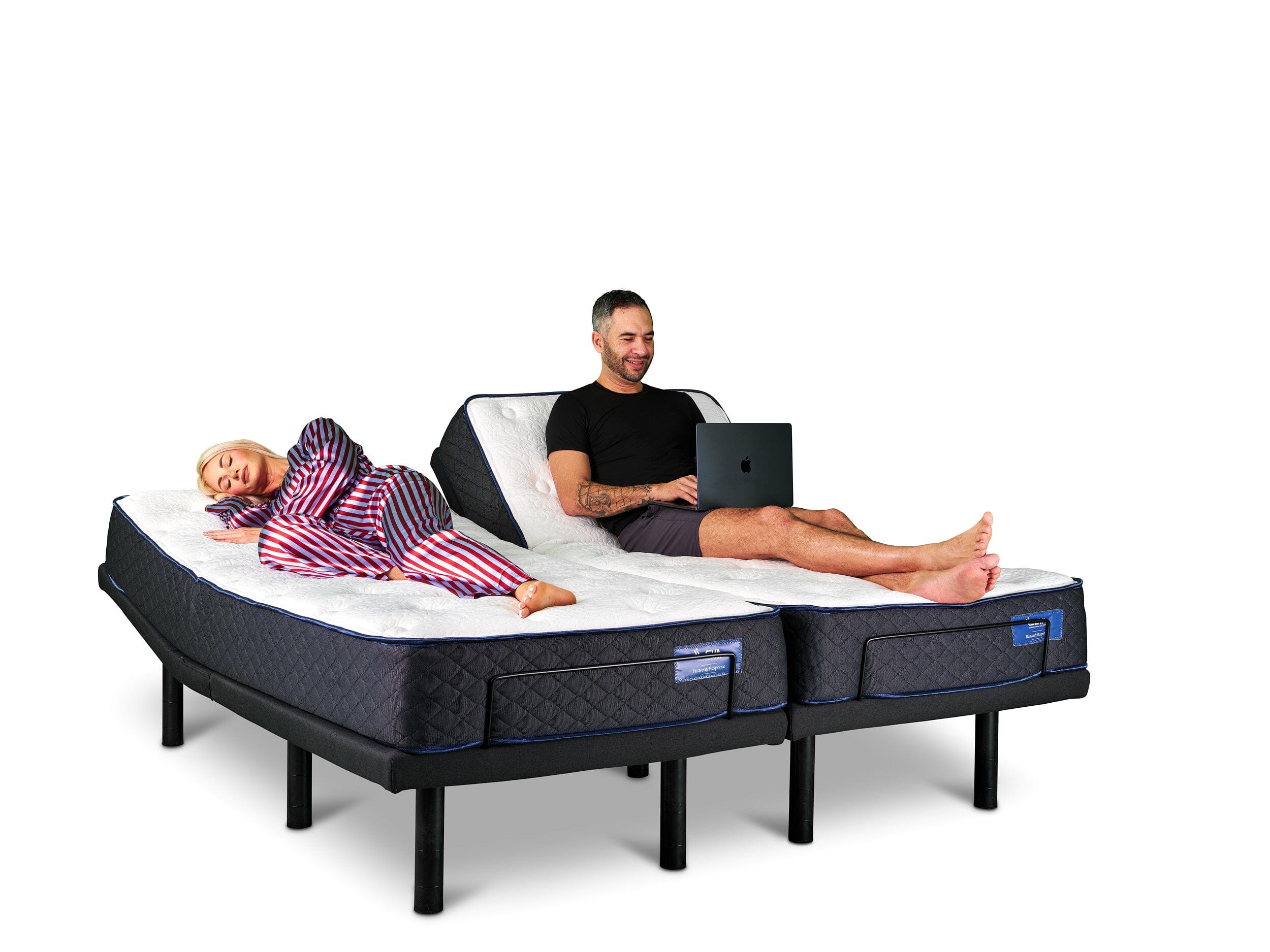
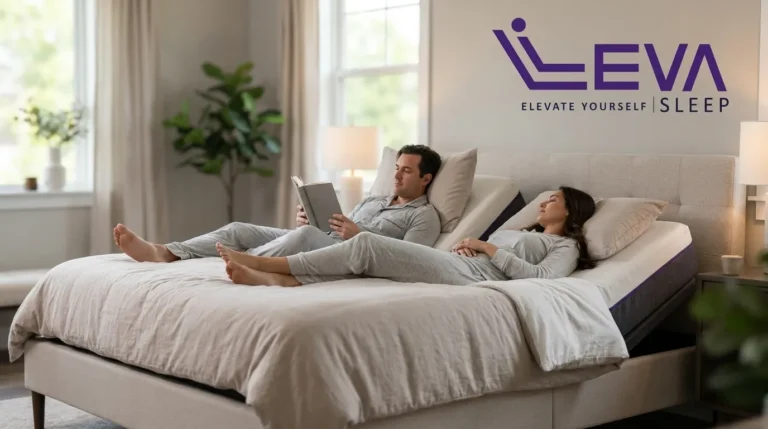
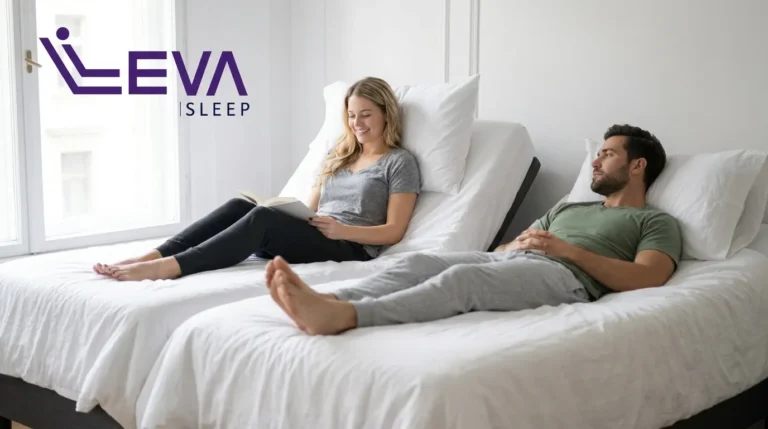
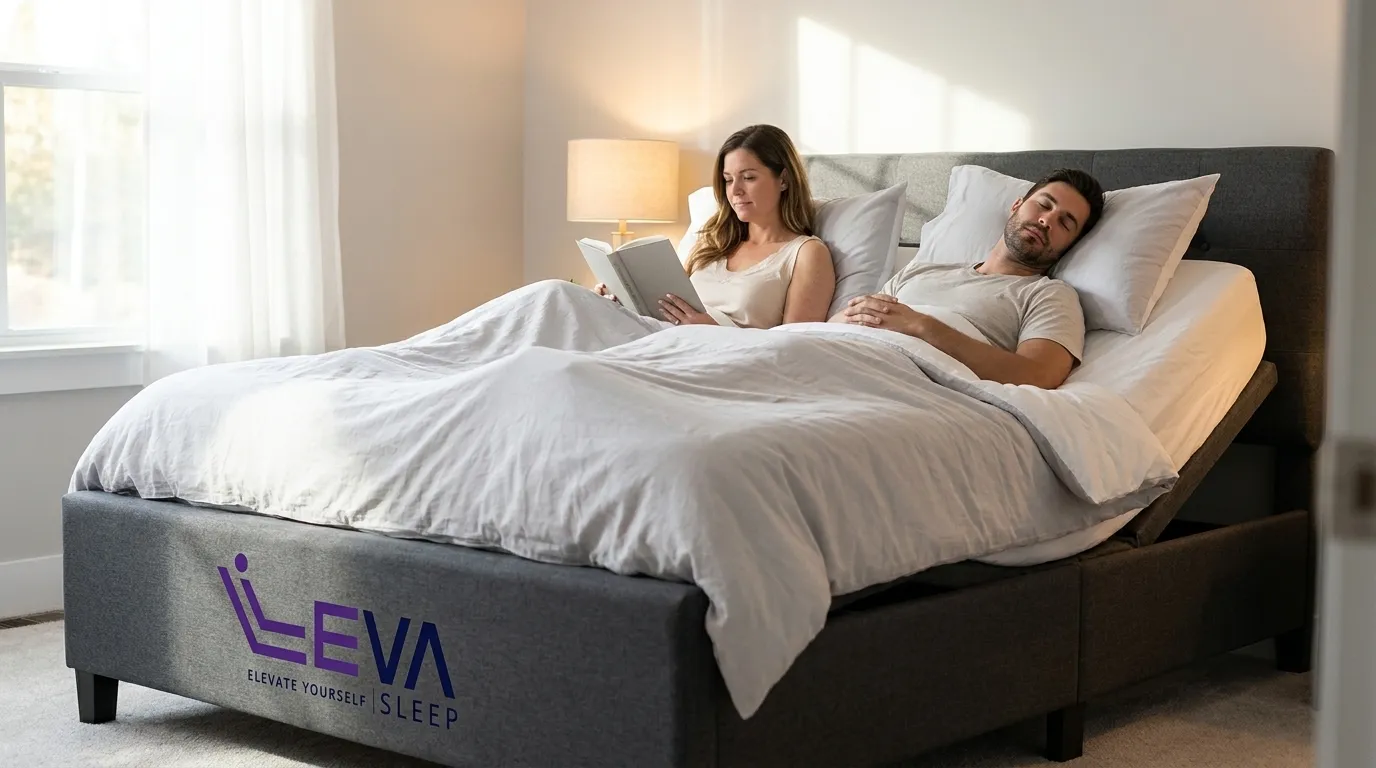
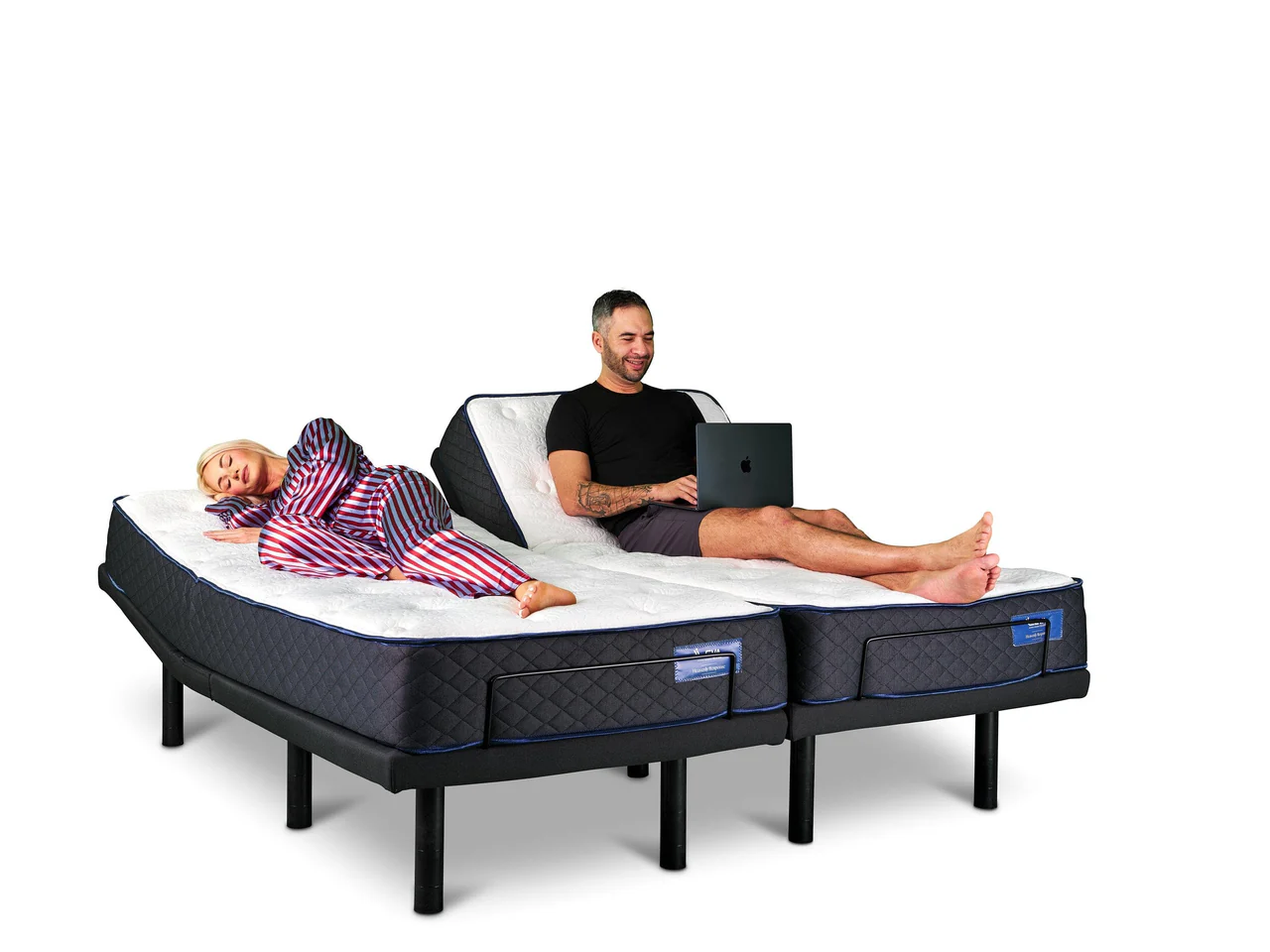
Leva Sleep’s split King and split Queen adjustable bases give each partner independent control over head and foot elevation, massage, and firmness. This independence lets one partner raise the head to reduce snoring while the other stays flat, without mechanical interference. Leva’s upcoming anti-snore mode will extend this capability by detecting snoring and making micro-adjustments to head elevation automatically. Because the system lives inside the sleep surface instead of on top of it, one partner’s movements do not trigger the other partner’s device.
Decision Checklist for Pillows, Wedges, and Split Bases
This checklist links common snoring scenarios to reasonable starting points. It supports research and does not replace medical advice. Consult a sleep medicine physician if you notice apnea symptoms.
- Snoring only on the back, no apnea symptoms: A positional pillow or manual head-elevation preset on an adjustable base may offer meaningful relief. Pillow-based therapy works best when a partner confirms that snoring worsens after rolling onto the back.
- Snoring in every position or paired with gasping, daytime fatigue, or breathing pauses: Seek professional sleep evaluation before buying any positional device.
- Two partners with different comfort needs or one partner disturbed by snoring: A single-user pillow cannot manage both sides independently. A split adjustable base handles both sleepers without separate devices.
- Prior CPAP non-adherence: Many OSA patients do not use CPAP enough to gain full benefit. Positional therapy through an adjustable base may serve as a physician-supervised adjunct for confirmed positional OSA.
- Desire to keep sharing the same bed long-term: As discussed earlier, pillow-based devices face adherence challenges beyond two years. A system built into the bed removes that compliance barrier.
Frequently Asked Questions
Does the Nitetronic pillow work for sleep apnea?
The manufacturer states that the Z6 is not indicated as a treatment for obstructive sleep apnea syndrome and advises patients with OSAS to consult a doctor before use. The clinical figures on Nitetronic’s marketing materials, including a 67% reduction in snoring episodes and a 50% reduction in AHI for posture-dependent snorers, come from clinic studies without peer-reviewed journal citations or 2024–2026 RCT confirmation. As noted earlier, UnitedHealthcare’s 2026 policy acknowledges short-term positional therapy benefits for side-sleep–responsive OSA but classifies many devices as unproven. Anyone with witnessed breathing pauses, excessive daytime sleepiness, or morning headaches should pursue a formal sleep study instead of relying on a pillow.
What are anti-snore pillow alternatives for couples?
Split adjustable bases offer the most practical alternative for couples because each partner can raise the head of their own side of the bed. This setup uses the same gravitational airway-opening principle as a wedge pillow by lifting the upper torso to reduce airway collapse. It also avoids buying separate devices for each sleeper and prevents cross-interference between partners. Wedge pillows provide a lower-cost option for solo sleepers but cannot support two people with different positioning needs. Vibrotactile positional trainers worn at the neck or chest show better long-term adherence than traditional pillow methods in clinical trials, yet they remain single-user wearables and do not solve comfort differences in a shared bed. Leva Sleep’s split King and split Queen adjustable bases focus on couples, with independent app-controlled settings for elevation, massage, and firmness on each side.
How does Leva Sleep’s anti-snore mode differ from pillow-based therapy?
Pillow-based anti-snore devices such as the Nitetronic Z6 work by rotating or repositioning the head on a single sleep surface. Each pillow serves only one user, requires its own powered hardware and cable, and often depends on acoustic sensors that can misfire due to ambient noise or partner movement. Leva Sleep’s anti-snore mode, scheduled for 2026, embeds snoring detection and micro-adjustment directly into the adjustable base, which forms the sleep surface itself. In split configurations, each partner’s side operates independently so one partner’s anti-snore adjustments do not disturb the other. The elevation mechanism also draws support from a broader body of peer-reviewed research on head-of-bed elevation for positional snoring than any single smart pillow currently offers. Leva’s system fits into a complete sleep environment that includes a paired mattress, specialized bedding, and white-glove setup rather than a standalone gadget added to an existing bed.
Conclusion: When a Split Adjustable Base Outperforms a Smart Pillow
The Nitetronic Z6 suits a narrow group of users: confirmed positional snorers who sleep alone and whose snoring is purely gravity-driven. Outside that group, evidence gaps become significant. No independent peer-reviewed RCT from 2024–2026 validates its main effectiveness claims, UnitedHealthcare’s 2026 policy treats much of the category as unproven, and the single-user acoustic detection design creates friction for couples. Head-of-bed elevation through a split adjustable base rests on a stronger body of peer-reviewed positional therapy research, removes the gadget layer, and serves both partners at once. For couples who have already tried pillows or basic positional devices without lasting relief, a split adjustable system offers a more complete next step and a better chance of keeping both partners in the same bed.