Written by: Matthew Timmins, Founder and Managing Director, Leva Sleep
Key Takeaways for Quieter Sleep
- Partner movement and motor noise are primary disruptors for light sleepers and couples sharing an adjustable bed.
- Brushless DC motors, independent split-side controls, and zero-clearance frames are the quietest technologies available in 2026.
- Physical mattress separation in Split Queen or Split King setups delivers stronger motion isolation than single-mattress designs.
- App-controlled presets, anti-snore automation, and white-glove delivery reduce nighttime disturbances and long-term frame noise.
- Leva Sleep’s whisper-quiet Split Queen and Split King systems combine these features for undisturbed rest, explore the collection online or schedule a La Jolla showroom visit.
1. Independent Motor Noise Levels for Light Sleepers
Motor type is the single most important noise variable in any adjustable base. Brushless DC motors usually operate around 45 decibels, roughly the volume of a whisper, and represent the quietest option currently available. Brushed DC motors can reach noise levels of about 65 decibels, which most people notice, while budget AC motors reach 50–60 dB and often wake a light sleeper during nighttime adjustments.
Request the manufacturer’s stated decibel rating and confirm whether it applies to each motor independently or to the system as a whole. In a split configuration, both motors may run at once if partners adjust at the same time, so per-motor noise matters. Leva Sleep’s German-engineered brushless DC motors are tuned for quiet operation, keeping nighttime adjustments below the level that disturbs most light sleepers.
The trade-off is cost, because brushless DC motors carry a higher unit price than AC alternatives. However, for couples where one partner is a light sleeper, that premium is often the most defensible investment in the entire purchase because motor noise is the factor most likely to cause nighttime disturbances.
2. Motion Isolation Between Split Sides for Fewer Disturbances
Even the quietest motor cannot prevent disturbances if partner movement transfers across the mattress. Motion isolation in a split adjustable system depends on physical separation between mattresses, not just mattress foam density. Bryte reports that split king mattresses deliver 74–82% better motion isolation than single kings because vibration cannot transfer between physically separate mattresses. Motion transferred laterally across a mattress decreases deep sleep, the most restorative phase of non-REM sleep, which compounds the disruption already caused by motor noise and partner movement.
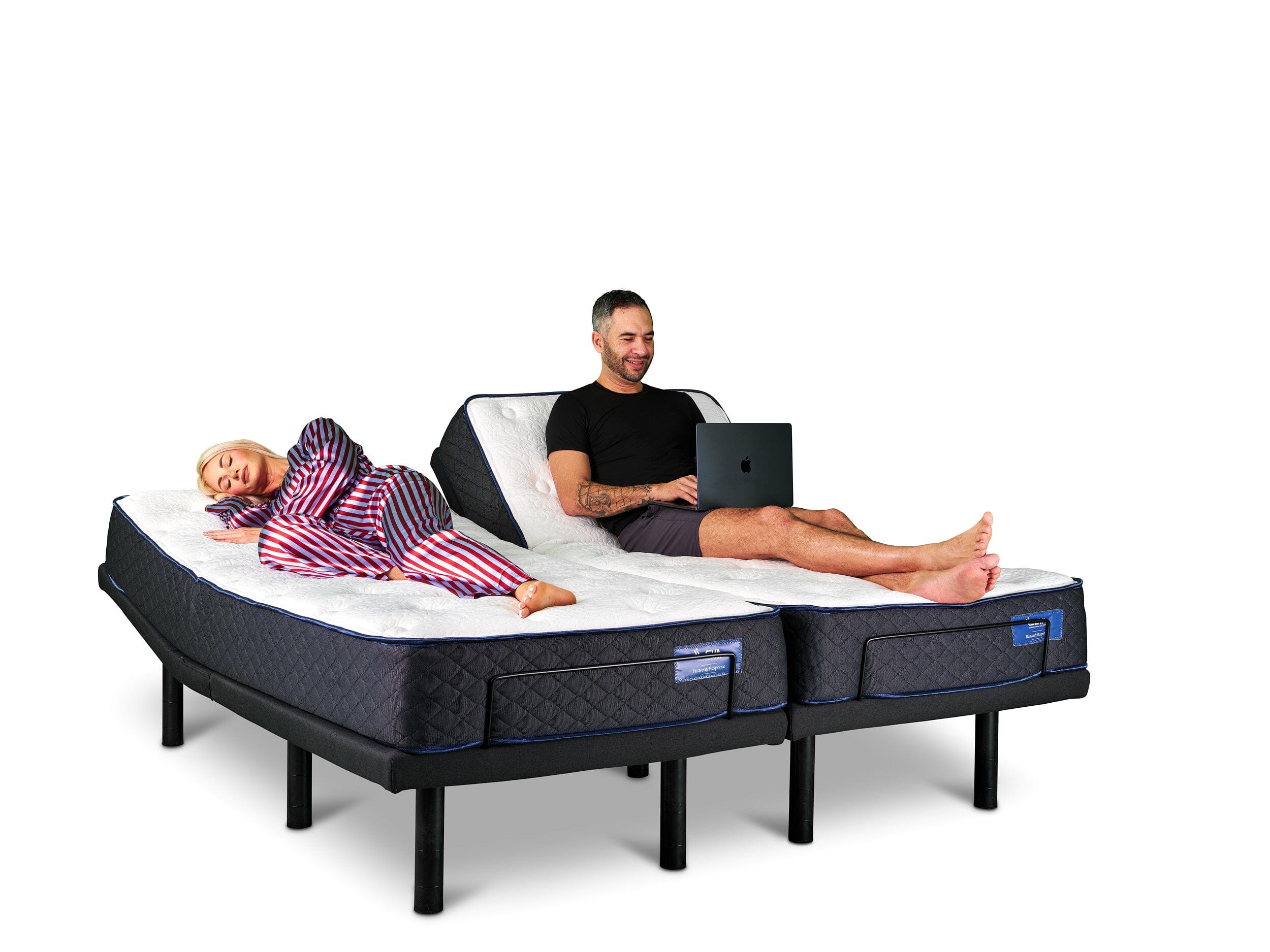
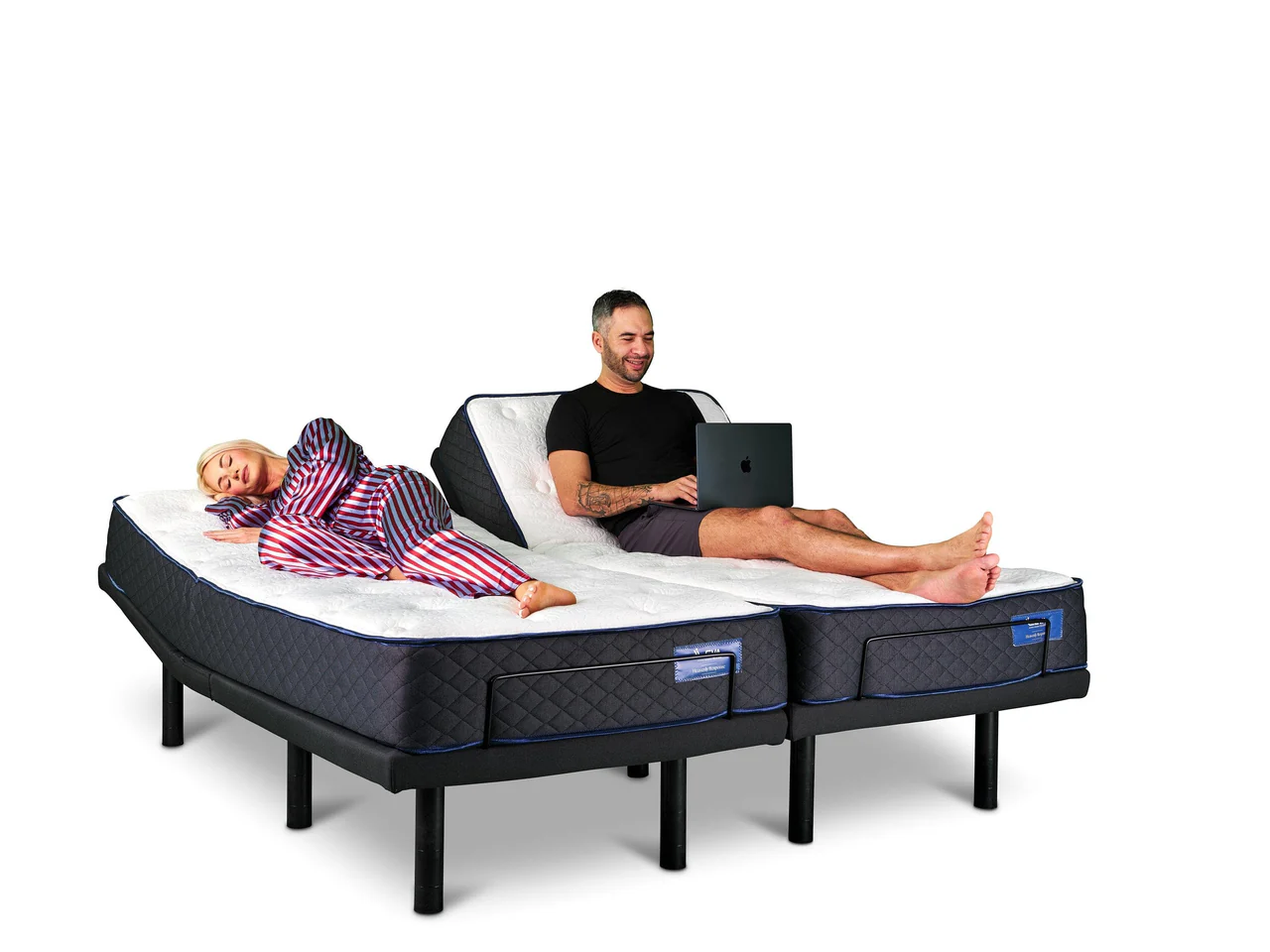
Test motion isolation before purchase by lying on one side of a split demo unit while a partner shifts position on the other. Any perceptible movement indicates incomplete isolation. A Split King uses two Twin XL mattresses, each 38″ × 80″, placed side by side. This layout enables strong motion isolation and independent firmness selection, which helps couples who disagree about mattress comfort.
The trade-off is the gap between mattresses. Some couples find the center seam disruptive to closeness. For these couples, a Split Queen configuration, two narrower independent bases in a queen footprint, addresses space constraints while preserving independent control and brings partners closer together than a Split King while maintaining motion isolation benefits.
3. Zero-Clearance Base Design and Stable Frames
Base design affects how much your body moves relative to the bed and how much noise the frame produces. A zero-clearance base, which articulates without requiring the mattress to slide forward, removes the mechanical slippage that creates creaking and frame noise during adjustment.
Check frame stability by confirming whether the base uses a retainer bar or anti-slip surface to hold the mattress during elevation. Run the base through a full head-and-foot cycle and listen for metallic creaking at the pivot joints. Light sleepers are as likely to be disturbed by noise from a creaky or shaky bed frame as by movement from a partner, so frame rigidity deserves equal scrutiny to motor noise. Proper assembly also matters, because undertightened pivot bolts and misaligned brackets often cause the creaking that develops after self-installation.
Leva Sleep’s bases are precision-fabricated with reinforced pivot points and zero-clearance articulation, which removes the frame rattle common in entry-level adjustable beds. White-glove setup includes height calibration at delivery, so the frame sits level and stable from the first night.
4. App-Controlled Presets and Quiet Automation
App control reduces noise because manual remote adjustments at night require waking up enough to locate and operate a handset. App-controlled presets let a sleeper trigger a saved position, such as anti-snore elevation, zero-gravity, or flat, with a single tap. Shorter adjustment time means less motor run time and less sound.
Confirm that each split side has fully independent preset storage, that Bluetooth connectivity remains stable without a hub, and that the app supports vibrating alarms as a silent alternative to audible alarms. Leva Sleep’s app provides independent preset control for each partner, including custom sleep positions and a vibrating alarm that wakes one partner without disturbing the other.
Leva Sleep’s spring 2026 anti-snore mode adds another automation layer. The system detects snoring and delivers micro head-of-bed adjustments automatically, without requiring either partner to wake. Sleep apnea and positional snoring can cause frequent disruptions that make manual intervention unrealistic. Automated micro-adjustment addresses that gap directly and helps couples stay asleep longer.
The trade-off is app dependency because Bluetooth-only systems lose remote functionality if a phone is not nearby. Confirm whether the base also ships with a physical backup remote for power-outage or connectivity issues.
5. Mattress Compatibility and Height Calibration for Quiet Articulation
An adjustable base performs only as well as the mattress paired with it. Mattresses with thick, rigid foam layers or innerspring systems with stiff, interconnected coils resist articulation, which strains the motor, increases noise, and shortens motor life. All-foam and hybrid pocket-coil mattresses with individually wrapped coils flex cleanly through head and foot elevation without binding.
Ask the manufacturer for the maximum mattress thickness and flex-radius specifications for their base when you confirm compatibility. Mattresses above 14 inches often restrict the full articulation range. Height calibration, which means adjusting the leg height of the base so the sleeping surface aligns with the room’s furniture, also affects frame stability. A base set too high on one side introduces lateral tilt that generates noise during adjustment.
Leva Sleep designs its all-foam and hybrid pocket-coil mattresses specifically to pair with its adjustable bases. White-glove delivery includes on-site height calibration so the system is level and fully functional before the delivery team leaves. Old-bed removal is included in the white-glove service, which removes the logistical burden that often delays setup.
6. Delivery, Setup, and Long-Term Noise Control
Improper setup is a primary cause of post-purchase noise in adjustable bases. Bases delivered unassembled and self-installed frequently have undertightened pivot bolts, misaligned leg brackets, or mattress retainer bars that were never engaged, which often generates creaking within weeks of use. Frame articulation design strongly influences how forces propagate through the support system, and that design only performs as intended when assembly is executed correctly.
Ask whether setup is performed by trained technicians or third-party couriers, whether height calibration is included, and whether the service covers old-bed removal when you review delivery options. A white-glove setup performed by brand-trained professionals eliminates the assembly variables mentioned in Section 3 and keeps the base quiet over time.
Leva Sleep’s in-house white-glove delivery team handles full assembly, mattress placement, height calibration, and a product tutorial in the bedroom. Old beds are removed and donated or recycled. Because Leva controls the delivery process internally rather than outsourcing to third-party logistics, setup quality remains consistent across every installation.
Side-by-Side Comparison Matrix for Shortlisting Bases
After evaluating a base against all six criteria, use the table below to document your findings and compare options side by side. This matrix captures the most critical specifications, including motor noise, motor type, split configuration, and warranty, in one place for quick review. Populate each row using the manufacturer’s published specifications and independent retailer listings. Leave the Leva Sleep row blank until you receive a direct quote, then complete it during your showroom visit or online consultation.
| Brand / Model | Stated Motor Noise (dB) | Motor Type | Split Configuration Options | Warranty Length |
|---|---|---|---|---|
| Brand A | Enter dB claim | AC / Brushed DC / Brushless DC | King only / Split King / Split Queen | Enter years |
| Brand B | Enter dB claim | AC / Brushed DC / Brushless DC | King only / Split King / Split Queen | Enter years |
| Leva Sleep | Request at showroom or online | German Brushless DC | Split Queen & Split King | Request at showroom or online |
Note: Manufacturer decibel claims are measured under controlled conditions. Request the test methodology alongside the figure, and when possible, listen to the motor in operation at a showroom before purchasing.
Frequently Asked Questions
How can I verify a manufacturer’s real-world noise level before buying?
The most reliable method is an in-person demonstration. Bring a free decibel meter app on your smartphone and measure the motor sound during a full head-elevation cycle in a quiet showroom. Manufacturer specifications are measured under controlled conditions and may not reflect bedroom acoustics. If an in-person visit is not possible, ask the retailer for video demonstrations recorded in a quiet room, and request the specific motor type. Brushless DC motors consistently perform in the 30–40 dB range, while AC motors typically reach 50–60 dB.
Does a Split Queen sacrifice features compared to a Split King?
A Split Queen provides the same independent control, motor technology, app connectivity, and preset functionality as a Split King. The difference is dimensional, because a Split Queen fits a queen-sized bed frame and suits smaller bedrooms or couples who prefer a more compact sleeping surface. Each side of a Leva Sleep Split Queen operates independently, so both partners retain full elevation, massage, and automation control without any feature reduction compared with the Split King configuration.
What should couples expect from anti-snore automation in 2026?
Anti-snore automation works by detecting snoring through a sensor and delivering a small, incremental elevation to the head of the bed, typically one to three degrees. That change often shifts the airway position and reduces or interrupts snoring without waking the snoring partner. Leva Sleep’s spring 2026 anti-snore mode uses this micro-adjustment approach and is designed to address positional snoring and mild sleep apnea symptoms. Couples dealing with diagnosed moderate-to-severe obstructive sleep apnea should consult a physician, because a CPAP or other medical intervention may be required alongside positional therapy.
Why does white-glove setup affect long-term noise performance?
Adjustable bases have multiple pivot points, leg brackets, and retainer components that must be correctly torqued and aligned during installation. Undertightened bolts and misaligned brackets are the most common sources of creaking that develops weeks after a self-assembled setup. White-glove installation by trained technicians removes these variables. Leva Sleep’s delivery team also performs height calibration on-site, ensuring the base sits level, which matters because an unlevel base introduces lateral stress on the frame during articulation and generates noise over time.
Which mattress types pair best with adjustable bases for motion isolation?
All-foam mattresses and hybrid mattresses with individually wrapped pocket coils provide the best combination of flexibility and motion isolation for adjustable bases. All-foam mattresses articulate cleanly through the full elevation range and absorb movement without transmitting it laterally. Hybrid pocket-coil mattresses add edge support and temperature regulation while maintaining the flexibility needed for adjustable base use. Traditional innerspring mattresses with interconnected coils resist articulation and transmit motion across the surface, which makes them a poor pairing for split adjustable systems.
Conclusion and Next Steps for Choosing a Quiet Base
The six criteria, independent motor noise levels, motion isolation between split sides, zero-clearance frame stability, app-controlled automation, mattress compatibility, and delivery quality, create a complete evaluation framework for couples and light sleepers assessing adjustable bases in 2026. Motor noise and split configuration sit at the top of the priority list. A base that operates above a whisper-quiet threshold or lacks true physical separation between sides will not solve the partner-disturbance problem, even if it offers many extra features.
Partner disturbance during sleep is common, yet modern adjustable bases can reduce it significantly. German-engineered brushless DC motors, physically separated split mattresses, and spring 2026 anti-snore automation represent the current ceiling of what adjustable base technology delivers for couples who want quiet nights.
Confirm motor type and decibel rating first, then verify split-configuration availability in your preferred bed size. If a showroom visit is possible, bring a decibel meter app and run the base through a full adjustment cycle before committing.